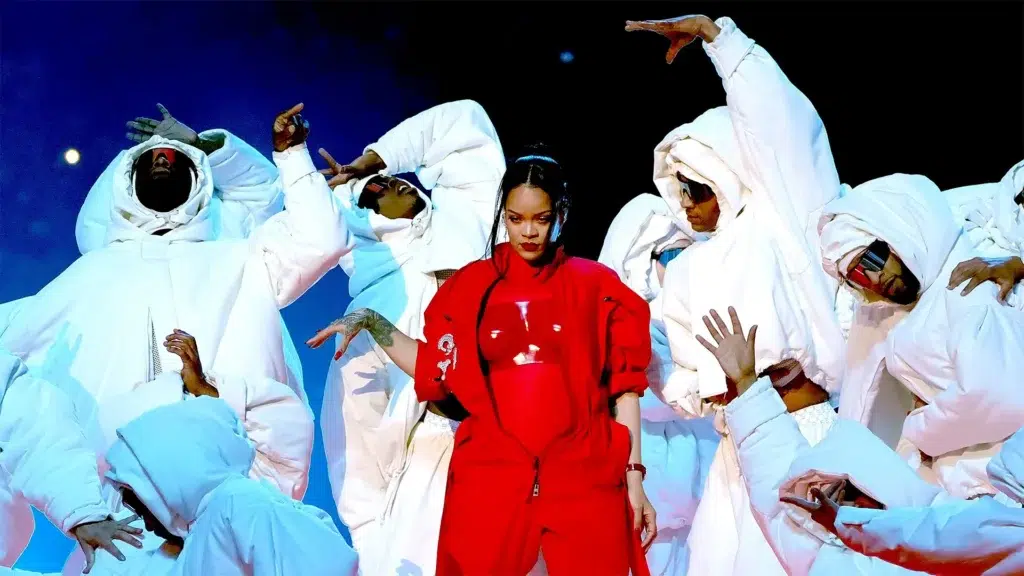
When Rihanna took the stage at Super Bowl LVII on February 12, 2023, she wasn’t just performing her first concert in five years. She was executing the most strategically brilliant luxury marketing moment in halftime show history. Dressed in custom Loewe and Alaïa, she revealed her second pregnancy to 113 million viewers while generating $11.3 million in media impact value for her Fenty Beauty brand and $4.2 million for Savage x Fenty.
The performance wasn’t supposed to be a pregnancy announcement. Rihanna’s custom red Loewe jumpsuit wouldn’t zip completely, forcing her to reveal what she’d planned to keep private. But that unplanned moment of vulnerability transformed a standard halftime show into a cultural phenomenon that dominated global conversation for weeks. Every outlet from Vogue to ESPN covered not just her music but her fashion choices, her makeup, her lingerie, and the brands she’d strategically chosen to wear.
This is the story of how one 13-minute performance generated over $15 million in combined brand value, made pregnancy announcements a legitimate luxury marketing strategy, and proved that Rihanna understands brand building better than almost anyone in entertainment.
The Super Bowl LVII performance and what Rihanna wore
Custom Loewe and Alaïa, not the brands people expected
Rihanna’s Super Bowl outfit wasn’t Balenciaga, wasn’t Gucci, wasn’t any of the obvious luxury suspects. She wore custom pieces from two brands experiencing creative renaissances: Loewe under creative director Jonathan Anderson and Alaïa under Pieter Mulier. The red jumpsuit that became iconic was Loewe. The black leather pieces she wore underneath were Alaïa. Both choices reflected sophisticated fashion knowledge that casual observers missed.
Loewe under Anderson had become fashion insiders’ favorite brand, winning LVMH Prize recognition and critical acclaim while remaining relatively unknown to mainstream audiences. Alaïa under Mulier was experiencing similar creative respect after years of uncertainty following founder Azzedine Alaïa’s 2017 death. Rihanna’s choices elevated both brands to global visibility they couldn’t have purchased at any price.
Strategic brand choices and their significance:
- Loewe custom red jumpsuit: Jonathan Anderson’s design showcased at world’s biggest stage, brand experiencing creative renaissance
- Alaïa black leather: Pieter Mulier’s vision for the heritage house worn underneath, signaling fashion insider knowledge
- Fenty Beauty makeup: Rihanna’s own brand receiving $11.3M media impact value from the performance
- Savage x Fenty lingerie: Her intimates brand generating $4.2M MIV as pregnancy reveal focused attention on body and clothing
- Multiple luxury touch points: Every outfit layer represented different brand creating compound marketing effect
The outfit choices also reflected Rihanna’s pregnancy practically. The Loewe jumpsuit’s looser fit accommodated her growing belly while maintaining the dramatic silhouette a Super Bowl performance demands. The Alaïa leather pieces underneath provided structure and support. These weren’t arbitrary fashion choices. They were calculated decisions balancing aesthetic impact with physical comfort for a pregnant performer executing a demanding show.
113 million viewers and the accidental pregnancy reveal
Super Bowl LVII drew 113 million viewers, making it the third-most-watched program in US television history. Rihanna’s halftime show became the second-most-watched in Super Bowl history, trailing only Katy Perry’s 2015 performance. That audience represented guaranteed global reach no advertising budget could replicate, which is why luxury brands compete intensely to dress halftime performers.
The pregnancy reveal wasn’t planned as central narrative. Rihanna later explained in interviews that her custom Loewe jumpsuit wouldn’t zip completely due to her growing belly, forcing her to perform with the outfit partially open. What she’d intended as subtle hint became impossible-to-miss announcement. Mainstream and fashion media immediately focused on her pregnancy, turning a music performance into a maternity fashion moment.
Performance scale and immediate impact:
- 113 million live viewers: Third-most-watched US television program in history
- Second-most-watched halftime: Only Katy Perry’s 2015 show reached more viewers historically
- Unplanned reveal: Jumpsuit wouldn’t zip forcing pregnancy announcement Rihanna hadn’t intended as focus
- Global conversation: Pregnancy dominated post-show coverage across entertainment, fashion, and mainstream news
- Multi-week news cycle: Performance generated sustained media coverage extending weeks beyond initial broadcast
The $11.3 million Fenty Beauty moment
How 13 minutes generated massive brand value
Launchmetrics, the leading brand performance measurement company, calculated that Rihanna’s Super Bowl performance generated $11.3 million in media impact value for Fenty Beauty. This metric measures the equivalent advertising cost of earned media coverage across print, digital, and social platforms. The $11.3 million figure represents genuine brand exposure that no paid campaign could achieve as efficiently.
The Fenty Beauty value came from sustained coverage discussing Rihanna’s makeup throughout the performance. Beauty editors analyzed her glowing skin, her bold lip color, her flawless complexion under harsh stadium lighting. Every article mentioning her makeup created impressions for Fenty Beauty without the brand spending anything beyond the products Rihanna wore. The Super Bowl transformed from football game into 13-minute Fenty Beauty commercial.
Fenty Beauty media impact breakdown:
- $11.3M total MIV: Launchmetrics calculation of equivalent advertising value from earned coverage
- Beauty editor coverage: Publications from Vogue to Allure analyzed her makeup choices in technical detail
- Product identification: Fans identified specific Fenty products creating direct purchase interest
- Pregnancy beauty angle: Glowing complexion attributed to both pregnancy and Fenty products
- Social media amplification: Millions of posts discussing and recreating her makeup looks
Fenty Beauty particularly benefited from pregnancy framing. Articles about “pregnancy glow” consistently mentioned Fenty products as contributing factors. The brand became associated with maternity beauty and looking good while pregnant, demographics Fenty hadn’t explicitly targeted before. The Super Bowl created new market positioning that Fenty Beauty marketing teams immediately exploited in subsequent campaigns.
Why owned brands benefit most from cultural moments
Rihanna’s strategic genius was wearing her own brands to the Super Bowl rather than accepting luxury partnerships that would have paid millions but generated less long-term value. Fenty Beauty and Savage x Fenty capturing $15.4 million combined MIV meant that value flowed directly to brands she owns rather than to external partners.
Compare this to typical Super Bowl halftime sponsorships where performers wear brands paying appearance fees. Those brands benefit from exposure but the performer receives one-time payment. Rihanna’s approach generated sustained brand value she’ll monetize for years through increased Fenty sales, not just immediate appearance fees. The financial sophistication demonstrates why she became youngest self-made female billionaire.
Owned brand advantages versus traditional endorsements:
- Permanent value capture: $15M+ MIV flows to brands Rihanna owns rather than external partners
- No endorsement fees: Wearing own brands means no external payments reducing net financial benefit
- Sustained sales impact: Media exposure drives Fenty product sales where Rihanna captures profits
- Brand equity building: Super Bowl association elevates Fenty Beauty’s positioning permanently
- Strategic flexibility: Owns the narrative and products rather than being limited by sponsor contracts
Savage x Fenty’s $4.2 million pregnancy lingerie moment
How maternity changed intimates marketing
Savage x Fenty, Rihanna’s lingerie brand, generated $4.2 million in media impact value from the Super Bowl performance according to Launchmetrics. This came from coverage discussing what Rihanna wore underneath her Loewe jumpsuit and how pregnancy affected her intimate apparel choices. The performance transformed maternity lingerie from afterthought category into aspirational fashion moment.
Traditional maternity lingerie marketing emphasizes comfort and function over style and aspiration. Rihanna’s Super Bowl appearance demonstrated that pregnant women could embody glamour, power, and desirability while accommodating physical changes. Savage x Fenty immediately became associated with pregnancy confidence and maintaining personal style through body changes.
Savage x Fenty maternity positioning impact:
- $4.2M media impact value: Launchmetrics measurement of equivalent advertising from earned coverage
- Maternity glamour: Performance positioned pregnancy as aspirational rather than limiting
- Body confidence: Rihanna’s visible pregnancy celebrated rather than concealed
- Product inference: Media assumed Savage x Fenty pieces underneath even without explicit confirmation
- Category expansion: Brand entered maternity conversation without launching specific maternity line
The pregnancy reveal particularly resonated because Rihanna was the first pregnant woman to headline a Super Bowl halftime show. Her visible belly, her confidence, her refusal to hide her pregnancy created cultural permission for other pregnant women to feel glamorous and visible. Savage x Fenty benefited from this positioning without needing to explicitly market maternity products.
$15 million combined brand value from one performance
Combining Fenty Beauty’s $11.3 million and Savage x Fenty’s $4.2 million creates $15.5 million in total media impact value from Rihanna’s 13-minute Super Bowl performance. This figure doesn’t include additional value for Loewe and Alaïa, which didn’t commission Launchmetrics measurement but certainly benefited from global exposure.
The $15 million combined value represents one of the most efficient marketing moments in luxury history. No traditional advertising campaign could reach 113 million viewers with the cultural authenticity and sustained media coverage Rihanna generated. The performance demonstrated that owned brands plus cultural moment plus strategic vulnerability creates exponentially more value than any paid partnership.
Total brand value calculation:
- $11.3M Fenty Beauty: Makeup and beauty coverage generating equivalent advertising value
- $4.2M Savage x Fenty: Lingerie and maternity coverage creating brand associations
- $15.5M combined total: Both Rihanna-owned brands capturing full value
- Loewe/Alaïa unmeasured: Additional value for fashion brands not quantified by Launchmetrics
- Sustained impact: Media coverage extending weeks beyond performance multiplying initial value
Why Loewe and Alaïa won without paying anything
The luxury brands that got billion-viewer exposure for free
Loewe and Alaïa didn’t pay Rihanna appearance fees or provide financial consideration for Super Bowl styling. She chose both brands based on aesthetic preferences and fashion credibility rather than commercial partnerships. Yet both brands received exposure worth millions through Rihanna’s organic selection and global media coverage analyzing her fashion choices.
Jonathan Anderson, Loewe’s creative director, gained validation that his creative vision resonated beyond fashion insiders. Pieter Mulier at Alaïa received similar confirmation that his work deserved global attention. Both designers likely saw immediate sales increases, website traffic surges, and brand awareness spikes following the performance without spending marketing budgets.
Fashion brand benefits without financial investment:
- Zero cost exposure: Neither brand paid Rihanna or Super Bowl for placement
- Creative validation: Rihanna’s organic choice signaled fashion credibility to industry and consumers
- Global awareness: Brands relatively unknown to mainstream audiences gained instant recognition
- Sales conversion: Immediate website traffic and product interest from 113M viewer exposure
- Editorial coverage: Fashion publications extensively covered Loewe and Alaïa choices
This organic brand selection carried more weight than paid partnerships. When celebrities wear brands because they genuinely love them rather than contractual obligation, audiences perceive the association as authentic endorsement. Rihanna’s fashion credibility meant her Loewe and Alaïa choices signaled genuine quality rather than purchased placement.
How pregnancy made fashion choices even more valuable
The pregnancy reveal amplified fashion coverage beyond typical halftime show analysis. Instead of just “what did she wear,” media discussed “how did she dress her pregnant body” and “what brands accommodate pregnancy while maintaining style.” This pregnancy angle created sustained fashion conversation that benefited Loewe and Alaïa through repeated mentions.
Maternity fashion historically lacks luxury brand attention. Most pregnant celebrities hide their bodies or wear generic maternity brands. Rihanna wearing cutting-edge Loewe and Alaïa while visibly pregnant positioned both brands as pregnancy-compatible without requiring maternity-specific lines. The Super Bowl essentially provided free maternity market research and positioning.
Pregnancy amplification factors:
- Extended coverage: Pregnancy angle sustained media conversation weeks beyond typical halftime cycles
- Maternity market entry: Brands entered pregnancy conversation without maternity collections
- Body inclusivity: Pregnant body visibility positioned brands as accommodating various forms
- Repeat mentions: Every pregnancy fashion article mentioned Loewe and Alaïa repeatedly
- Cultural milestone: First pregnant halftime performer created historic angle driving sustained interest
What the moment reveals about modern luxury marketing
Authenticity beats paid partnerships in cultural moments
Rihanna’s Super Bowl demonstrates that authentic brand choices generate more value than the largest endorsement deals. She could have accepted millions from any luxury conglomerate to wear their brands exclusively. Instead, she wore her own brands (Fenty Beauty, Savage x Fenty) plus fashion brands she genuinely admired (Loewe, Alaïa), creating authentic moment worth far more than any paid partnership.
Modern luxury consumers, especially younger ones, research extensively and detect inauthenticity immediately. They know when celebrities wear brands because contracts require it versus genuine preference. Rihanna’s organic brand mix felt credible because it reflected her established fashion taste and business interests rather than manufactured associations.
Authenticity advantages in cultural marketing:
- Consumer trust: Audiences believe organic choices more than obvious paid placements
- Sustained value: Authentic associations last beyond campaign cycles
- Editorial respect: Fashion media treats genuine style choices more seriously than sponsored content
- Social proof: Fans emulate authentic preferences more readily than contracted endorsements
- Long-term equity: Real relationships build permanent brand value not temporary awareness
Owned brands plus cultural platform equals exponential value
The financial brilliance of Rihanna’s approach was combining owned brands with the world’s biggest cultural platform. Most celebrities leverage platforms like the Super Bowl to secure endorsement deals. Rihanna leveraged the platform to build equity in brands she owns, multiplying the value infinitely beyond one-time appearance fees.
This strategy requires two rare conditions: owning valuable brands and having cultural influence commanding Super Bowl invitations. Few celebrities possess both. Those who do, like Beyoncé with Ivy Park or Jessica Alba with Honest Company, typically don’t receive Super Bowl halftime opportunities. Rihanna’s unique position let her execute the strategy perfectly.
Owned brand platform advantages:
- Permanent value capture: All $15M+ brand value flows to Rihanna’s equity not external partners
- No endorsement costs: Wearing own brands eliminates fees reducing net benefit
- Strategic control: Full authority over messaging and brand integration
- Compounding returns: Increased brand value generates ongoing profits through sales
- Billionaire math: Strategy contributed to youngest self-made female billionaire status
The Bottom Line
Rihanna’s Super Bowl LVII halftime performance on February 12, 2023 generated over $15 million in combined brand value for Fenty Beauty ($11.3M) and Savage x Fenty ($4.2M) while providing unmeasured millions more for Loewe and Alaïa. The 13-minute performance reached 113 million viewers and transformed an accidental pregnancy reveal into the most strategically brilliant luxury marketing moment in halftime show history.
The genius was combining owned brands with cultural platform and authentic fashion choices. Rihanna wore her own beauty and lingerie brands capturing full value, while choosing Loewe and Alaïa based on genuine fashion credibility rather than paid partnerships. The unplanned pregnancy reveal amplified coverage exponentially, creating sustained media conversation that drove value far beyond the performance itself.
Key success factors creating $15M+ brand moment:
- Owned brand strategy: Fenty Beauty and Savage x Fenty capturing full $15M+ value flowing to Rihanna’s equity
- Authentic fashion choices: Loewe and Alaïa worn for creative credibility not contracts generating organic coverage
- Accidental vulnerability: Unplanned pregnancy reveal created human moment amplifying media interest exponentially
- Cultural platform scale: 113 million viewers providing guaranteed global reach no advertising replicates
- Sustained coverage: Pregnancy angle driving weeks of media conversation multiplying initial performance value
For luxury brands studying cultural marketing, the lesson is clear: authentic partnerships with culturally influential figures who own complementary brands generate exponentially more value than traditional endorsements. Rihanna didn’t need appearance fees because she owns the brands benefiting from exposure. The $15 million in brand value flows directly to her net worth rather than external partners.
The performance also validated pregnancy as legitimate luxury marketing moment. Rihanna became the first pregnant woman to headline Super Bowl halftime, proving that maternity doesn’t limit cultural influence or marketing effectiveness. Her confidence and visibility gave permission for other pregnant women to feel glamorous, expanding both cultural representation and commercial opportunities for maternity-focused brands.
As brands continue chasing Super Bowl exposure, Rihanna’s 2023 performance stands as the blueprint for maximum value capture: own the brands, choose the platform, embrace vulnerability, and let authenticity multiply the impact beyond what any paid partnership could achieve.