In July 2021, Aadit Palicha and Kaivalya Vohra were 19-year-old Stanford University students who had dropped out of college during the COVID-19 lockdown to return to Mumbai. They had watched India go contactless, seen grocery delivery explode, and identified a gap that the existing players were not addressing: nobody was actually delivering fast.
Zomato took 45 minutes. BigBasket took a day. Grofers delivered the next morning. For a customer who had run out of something essential, none of these options solved the problem. Palicha and Vohra believed that if delivery could be cut to 10 minutes, it would create an entirely new consumer behaviour, not just a faster version of existing grocery delivery but something closer to what a refrigerator had replaced the weekly market run with.
They started as KiranaKart, a delivery-from-stores model. It did not work. Stores had variable inventory, inconsistent quality, and no ability to guarantee delivery timelines. The pivot came within months: build a network of dark stores, warehouses positioned inside residential neighbourhoods, stocked with only the fastest-moving products, with delivery riders stationed on-site rather than being dispatched from afar.
They renamed the company Zepto. The rest is one of the fastest corporate ascents in Indian startup history.
By October 2025, Zepto had raised $450 million in a Series H round led by CalPERS, the California pension fund managing $1.6 trillion in assets, at a $7 billion valuation. Total cumulative funding crossed $2.3 billion. FY2025 revenue hit ₹9,669 crore, up 129% year on year. The company confidentially filed its DRHP with SEBI on December 26, 2025, targeting an IPO in the July to September 2026 quarter with an issue size of approximately ₹11,000 to ₹11,682 crore.
The Dark Store Model: Why It Works
Quick commerce is not fast grocery delivery. It is a fundamentally different supply chain architecture, and understanding why requires understanding what a dark store actually is.
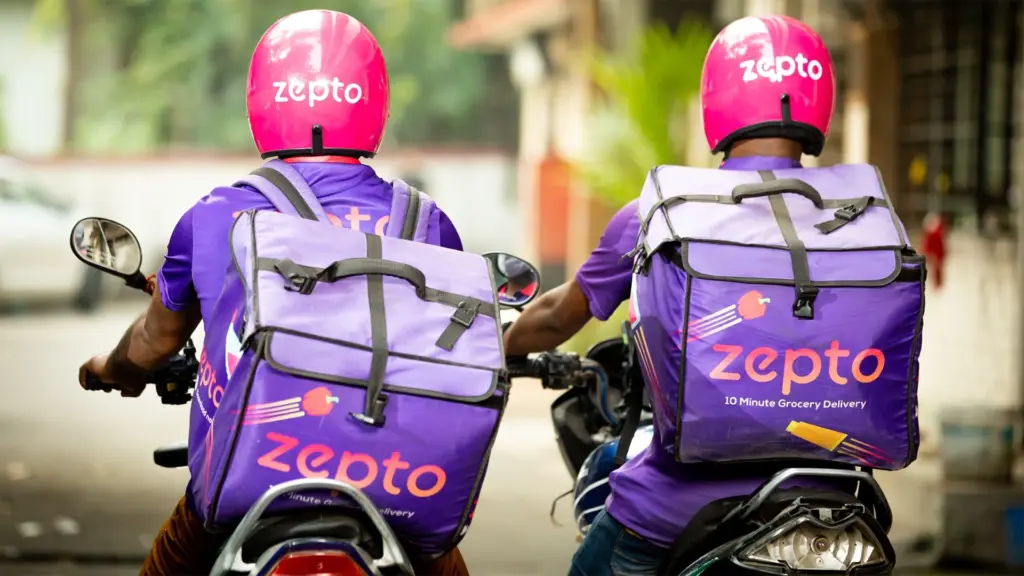
A dark store is a micro-warehouse positioned inside a dense urban neighbourhood, typically occupying 2,000 to 4,000 square feet, stocked with a curated selection of 2,000 to 5,000 SKUs covering the 95% of daily needs that account for 95% of grocery orders. It is called dark because it is closed to the public. There is no shop front, no customer browsing, no checkout queue. It exists entirely to fulfil orders from riders who pick items and dispatch in under three minutes from the time an order is placed.
Zepto’s version of this model adds a specific operational constraint: every dark store must be within a 2-kilometre radius of the customers it serves. This geography rule is what makes 10-minute delivery physically possible. A rider can cover 2 kilometres in under 4 minutes on a Mumbai or Bengaluru side road. Add 2 to 3 minutes for picking, and the 10-minute promise holds.
What the dark store model delivers that conventional delivery cannot:
- Delivery time certainty: A fixed geography constraint eliminates the variable of traffic distance that makes conventional delivery unpredictable.
- Inventory control: Zepto stocks its own inventory in each dark store, controlling quality, freshness, and availability in ways that delivery-from-partner-stores cannot guarantee.
- Picking efficiency: A picker in a 3,000 square foot warehouse with 3,000 SKUs can locate and pick an order in under 2 minutes. A picker in a full supermarket cannot.
- Rider utilisation: Riders stationed at the dark store complete more deliveries per hour than riders dispatched from a central hub, improving unit economics at scale.
- Data advantage: Every order from every dark store tells Zepto exactly what sells in that neighbourhood, enabling hyper-local inventory management that reduces waste and improves in-stock rates.
Zepto operated more than 900 dark stores across 70 plus cities by late 2025, up from approximately 250 stores across 10 cities in early 2024. The company targets more than 2,000 orders per dark store per day, and at that throughput level, individual stores begin approaching profitability even as the overall business continues to invest in expansion.
The Funding Sprint: From Zero to $7 Billion
Zepto’s funding trajectory is among the most compressed in Indian startup history. It went from seed to $7 billion in under five years, a pace that reflects both the quality of the business and the intensity of investor interest in India’s quick commerce market.
The early rounds were small and fast. Y Combinator backed Zepto in its seed stage. Nexus Venture Partners led the Series A. By the Series D in 2022, Zepto had achieved unicorn status at a $1.4 billion valuation. The acceleration happened in 2024, when Zepto raised $665 million in June at a $3.6 billion valuation and a further $340 million in August at a $5 billion valuation, totalling over $1 billion in fresh capital in a three-month window.
Zepto’s funding journey from launch to Series H:
- 2021 Seed (Y Combinator): Initial capital to launch the quick commerce platform with the first dark stores in Mumbai.
- Series D (2022): Unicorn status at $1.4 billion valuation, validating the dark store model at early scale.
- Series F, June 2024 ($665 million): Raised at a $3.6 billion valuation; largest single round at the time and a 2.5x valuation step-up in under a year.
- Series G, August 2024 ($340 million): Led by General Catalyst at a $5 billion valuation; brought total 2024 raises to over $1 billion.
- Domestic pre-IPO round, November 2024: ₹400 crore raised from Motilal Oswal Private Wealth and Indian family offices, diversifying the investor base toward domestic capital.
- Series H, October 2025 ($450 million): Led by CalPERS at a $7 billion valuation, a 40% step-up from the prior year, with CalPERS making a rare direct investment in an Indian startup.
The domestic round in November 2024 was strategically significant beyond its size. SEBI’s norms require Indian companies going public to have meaningful domestic shareholding. Zepto, which had been incorporated in Singapore, had to redomicile to India and build domestic investor participation before filing its IPO papers. The family office round, followed by the CalPERS round, built the capital structure that made the December 2025 DRHP filing possible.
The Aadit Palicha Factor
Zepto’s speed of execution is partly explained by the product and operations team. It is also partly explained by Aadit Palicha.
Palicha has been consistently present as the company’s public voice, its strategic communicator with investors, and its operational driver simultaneously. At 19 years old when he co-founded Zepto and 23 at the time of the Series H, he has managed nine funding rounds, a corporate redomiciliation from Singapore to India, a DRHP filing, a 129% revenue growth year, and significant competitive pressure from Blinkit and Swiggy Instamart, all within four years of operations.
His public framing of Zepto’s mission has been consistent: Zepto is not trying to be a cheaper grocery store. It is trying to be the most reliable last-mile consumer infrastructure in India’s urban markets, with groceries as the entry product and a much broader category expansion as the medium-term ambition.
The Revenue Engine: More Than Just Groceries
Zepto’s revenue model in FY2025 was built on three primary streams: gross merchandise value from product sales, platform fees and delivery charges from customers, and advertising revenue from brands paying for visibility and placement within the Zepto app.
The advertising revenue line is the most strategically important for the long-term business case. Zepto crossed ₹1,000 crore in annualised advertising revenue in 2025, leveraging a proprietary ad platform called Jarvis. At a 30% quick commerce market share, Zepto has the kind of purchase-intent data that makes its advertising inventory genuinely valuable to FMCG brands. A consumer who searches for “oats” on Zepto at 7 am on a weekday is demonstrably in a buying mindset. That context makes Zepto’s ad inventory meaningfully more effective than display advertising elsewhere.
FY2025 performance in numbers:
- Revenue from operations: ₹9,669 crore, up 129% year on year from ₹4,224 crore in FY24.
- Net loss: ₹3,367 crore in FY25, widened from ₹1,215 crore in FY24.
- Daily order volume: Over 20 lakh orders per day as of October 2025.
- Annualised advertising revenue: Over ₹1,000 crore through the Jarvis platform.
- Zepto Cafe run rate: Over $110 million annually and growing, with over 1 lakh orders per day.
- Dark store throughput: Over 2,000 orders per dark store per day on average.
The widening losses need context. Zepto was simultaneously expanding its dark store network from 250 to 900 plus stores, entering new cities, building Zepto Cafe as a food delivery vertical, and funding the customer acquisition spending required to build usage habits in new markets. Each new dark store costs capital to set up and several months to reach the order volumes where unit economics turn positive.
Zepto Cafe: The Food Delivery Vertical
In 2024, Zepto launched Zepto Cafe, a food delivery service operating out of its dark store network. Rather than building a separate kitchen infrastructure, Zepto integrated food preparation capability into existing dark stores, using the same picker and rider network to deliver freshly prepared food alongside grocery orders.
Zepto Cafe crossed 1 lakh orders per day and a $110 million annualised run rate before Zepto was forced to pause operations in 44 cities due to operational staffing challenges. The company has since relaunched in multiple cities.
The Cafe vertical matters because it addresses a structural weakness in the quick commerce model. Grocery orders are frequent but low-margin. Food orders are higher-margin and habit-forming. A customer who uses Zepto for both groceries and food is a stickier customer than one who uses Zepto for groceries and Swiggy or Zomato for food. Zepto Cafe compresses that split and increases the share of a customer’s daily spend that flows through a single platform.
What Zepto Cafe adds to the business model:
- Higher average order value: Food orders carry a higher average ticket than grocery orders, improving revenue per delivery.
- Improved rider utilisation: A rider who delivers both a grocery bag and a food order in the same run has a lower cost per delivery than one handling each separately.
- Competitive moat against Swiggy and Zomato: A customer who gets food from Zepto has one fewer reason to open a competitor’s app, protecting grocery market share in both directions.
- Platform stickiness: Combined grocery and food on a single app builds daily habit at a depth that grocery alone cannot sustain.
The Competition: Blinkit, Instamart, and What Follows
India’s quick commerce sector in 2025 is a three-player race between Zepto, Blinkit (owned by Eternal, formerly Zomato), and Swiggy Instamart.
Blinkit is the clear market leader. Following the Zomato acquisition in 2022, Blinkit has benefited from Eternal’s balance sheet, its food delivery customer base, and a consistent investment in dark store expansion. In Q1 2025, Blinkit’s gross order value surpassed Zomato’s food delivery GOV for the first time, signalling that quick commerce had overtaken the parent company’s original business in scale.
Swiggy Instamart went public alongside Swiggy in November 2024, giving it public market capital access. Swiggy has been deploying this capital into Instamart’s dark store expansion and advertising.
Zepto sits in third position by market share estimates, holding approximately 30% of the quick commerce market. Its advantage over the other two is structural independence: unlike Blinkit, which must share platform economics with Eternal’s food delivery business, and Instamart, which sits within Swiggy’s broader platform, Zepto is a pure-play quick commerce company whose every rupee of investor capital and management attention is focused on this single category.
How Zepto differentiates in a three-way quick commerce competition:
- Pure-play focus: Every dollar of Zepto’s $2.3 billion in funding has gone into quick commerce. Neither Blinkit nor Instamart has that undivided capital and leadership focus.
- Dark store profitability discipline: Palicha has publicly committed to turning individual dark stores profitable before expanding aggressively, a discipline that both competitors have been slower to implement.
- Jarvis advertising platform: A proprietary ad tech stack designed specifically for quick commerce purchase intent gives Zepto a monetisation advantage over competitors using generic ad platforms.
- Domestic investor base: The family office and domestic institutional participation ahead of the IPO gives Zepto regulatory and governance advantages heading into the public markets.
- CalPERS institutional signal: A direct investment from the largest US public pension fund is a credibility signal that neither Blinkit nor Instamart has in its private funding history.
The Competitive Threat From Big Tech and Legacy Players
Zepto, Blinkit, and Instamart are not the only players in the quick commerce race. Flipkart Minutes and Amazon Now have both entered the 10-minute delivery space, backed by the logistics infrastructure and customer bases of India’s two largest e-commerce platforms.
Flipkart and Amazon have structural advantages in electronics, apparel, and high-ticket categories that pure grocery platforms have not penetrated effectively. The question for quick commerce is whether the category expands from groceries into discretionary products, and whether the dark store model scales into categories with lower order frequency but higher margins.
Zepto’s response has been visible on its app: it has added electronics, fashion, and decor alongside groceries, signalling an ambition to expand the category scope of quick commerce. Palicha acknowledged in 2025 that the app had become cluttered with these additions and committed to simplifying the interface in subsequent months, a clear signal that the category expansion strategy is still being calibrated.
The IPO: What the Filing Means
On December 26, 2025, Zepto filed its DRHP with SEBI via the confidential route. The filing came roughly four and a half years after the company was founded, making it one of the fastest paths from founding to public listing in Indian startup history.
The proposed IPO is expected to raise approximately ₹11,000 to ₹11,682 crore through a combination of a primary fresh issue and a limited offer for sale by early investors. Lead managers include Morgan Stanley, Goldman Sachs, Axis Capital, HSBC, JM Financial, IIFL Capital, and Motilal Oswal. The listing is targeted for the July to September 2026 quarter, subject to SEBI approval and market conditions.
Zepto received SEBI’s in-principle approval for the $1.3 billion IPO by early 2026. As of March 2026, the company was reviewing its valuation in response to investor feedback, with reports suggesting an IPO valuation of approximately $5.6 to $5.95 billion, a 15 to 20% discount to the $7 billion private round valuation. This is standard for quick commerce listings, where public market investors apply a discount to the growth-adjusted private valuations that late-stage venture rounds typically command.
What the IPO represents strategically for Zepto:
- Permanent capital for dark store expansion: Fresh issue proceeds will fund the target of 700 plus dark stores and entry into new tier 2 cities.
- Exit path for early investors: Y Combinator, Nexus, and other early-stage backers have held positions since 2021. The IPO provides a structured liquidity event.
- Public market valuation benchmark: Listing establishes a reference price that supports future fundraises, ESOP liquidity, and potential acquisitions.
- Governance upgrade: Public company status adds quarterly disclosures, independent board requirements, and analyst coverage that strengthens institutional credibility.
- Competitive signalling: As a listed company, Zepto would have a balance sheet standing comparable to Eternal and Swiggy in a market where capitalisation determines how aggressively a platform can subsidise growth.
The Profitability Question
The central question following Zepto into its IPO is whether a business that grew revenue 129% while widening losses 177% in FY2025 can credibly claim a path to profitability that public market investors will fund.
The bull case is that quick commerce unit economics are well-understood, that individual dark stores achieve contribution margin positivity at 2,000 plus orders per day, and that Zepto’s trajectory replicates the Blinkit model, which moved from heavy losses to positive GOV contribution as it scaled past 400 dark stores. Zepto operates 900 plus stores and should, on this logic, be approaching the structural inflection point.
The bear case is that Zepto’s loss per order has not improved at the rate that the bull case requires, that the competitive intensity from Blinkit, Instamart, Flipkart Minutes, and Amazon Now will require sustained customer acquisition spending that prevents margin improvement, and that the category expansion into electronics and fashion creates inventory risk without the same frequency advantage that groceries provide.
Palicha’s answer has been consistent: Zepto targets EBITDA break-even within 12 to 15 months from any given point in its operating timeline. The IPO will provide the public disclosure that allows investors to verify whether the trajectory toward that target is on track.
The Bottom Line
Zepto’s story is one of the most compressed value creation stories in Indian business history. From two 19-year-old Stanford dropouts with a delivery idea in July 2021 to a $7 billion company with 900 plus dark stores, 20 lakh daily orders, and a filed DRHP in under five years is a genuinely remarkable operational achievement.
The dark store model worked because it solved a real consumer problem with a specific and repeatable infrastructure solution. The 10-minute promise was not a marketing slogan. It was an operational architecture built around geography, inventory curation, and rider positioning that produced a delivery experience Indian consumers had never had before.
Whether the business can sustain the growth trajectory while closing the profitability gap is the defining question for the public market chapter. The quick commerce market itself is not in doubt. Morgan Stanley projects it will reach $42 billion in India by 2030. The question is which two or three platforms capture the majority of that market, and whether Zepto’s pure-play focus gives it the operational intensity advantage over better-capitalised but more complex competitors.
What built Zepto into India’s fastest-growing consumer internet company:
- The right thesis at the right time: The dark store model addressed a genuine consumer frustration with grocery delivery timelines that every incumbent had accepted as unavoidable.
- Operational architecture before marketing: Zepto spent its first capital on dark stores and rider networks rather than advertising, building a product that earned retention before spending on acquisition.
- Speed as a competitive moat: The 10-minute promise requires a specific infrastructure investment that cannot be replicated by adding riders to an existing delivery network.
- Advertising revenue as the margin lever: Crossing ₹1,000 crore in annualised advertising revenue through Jarvis creates a high-margin revenue line that improves unit economics independent of delivery margins.
- Domestic redomiciliation and IPO preparation: Returning to India and building domestic investor participation was as much a strategic preparation as an operational one, enabling the December 2025 DRHP filing.
- CalPERS validation: A direct lead investment from a $1.6 trillion pension fund in October 2025 provided a credibility signal that reset the market’s perception of Zepto from fast-growing startup to institutional-grade investment.
The Zepto IPO, expected in the July to September 2026 window, will be India’s first pure-play quick commerce listing and one of the youngest venture-backed companies to list on Dalal Street. How public market investors price the loss trajectory against the growth rate will determine whether Zepto’s next chapter is as rapid as its first four years.