On the evening of February 23, 2000, Jennifer Lopez arrived at the 42nd Annual Grammy Awards in a barely-there sliver of emerald green chiffon by Versace, patterned with palm fronds and held together with little more than tape.
What followed was not just a fashion moment. It was a technology event.
The image generated the most popular search query Google had ever seen at that point. The problem was that Google could only return pages of text and blue links. People did not want to read about the dress. They wanted to see it. One month later, Google Image Search was born. Former Google CEO Eric Schmidt confirmed this directly in a 2015 Project Syndicate essay, writing that the dress search volume made it clear users needed a way to find images, not just text.
A single red carpet look changed the architecture of the internet.
The Dress That Started Everything
Four celebrities, one design, one defining moment
The green jungle print dress was not even new when Lopez wore it to the Grammys. Donatella Versace had designed it for the Spring/Summer 2000 collection, shown on the Milan runway in October 1999 where model Amber Valletta wore it as the penultimate look. Donatella herself had worn a sleeveless version to the Met Gala in December 1999. Spice Girl Geri Halliwell wore it to the NRJ Music Awards in January 2000, just one month before the Grammys. Sandra Bullock had worn a different colourway at the VH-1 Vogue Fashion Awards in December 1999.
Four celebrities. Three months. Zero cultural impact until Lopez walked into the Staples Center.
The difference was not the dress. It was the person, the platform, and the moment she chose to wear it in.
Why the same dress hit differently on Lopez than on everyone else:
- Platform scale: The Grammy Awards draws tens of millions of television viewers globally; the NRJ Music Awards and Met Gala did not carry the same mass audience
- Timing of the reveal: The plunging neckline and dramatic split became even more visible as Lopez moved, creating a live television moment that still photographs could not fully capture
- Cultural peak: Lopez was at the height of her commercial dominance in early 2000, coming off simultaneous number-one album and film releases in 1999
- The roar: Lopez herself described hearing “a loud sound start from the back of the room, kind of like a roar” when she entered, a crowd reaction that translated directly into the social conversation that followed
- Structural intrigue: The structural engineering of the dress, taped and secured, kept viewers guessing throughout the evening, sustaining attention far longer than a conventional gown would
Lopez was not the first person to wear it. She was the first person who made the world need to see it.
What the dress actually looked like
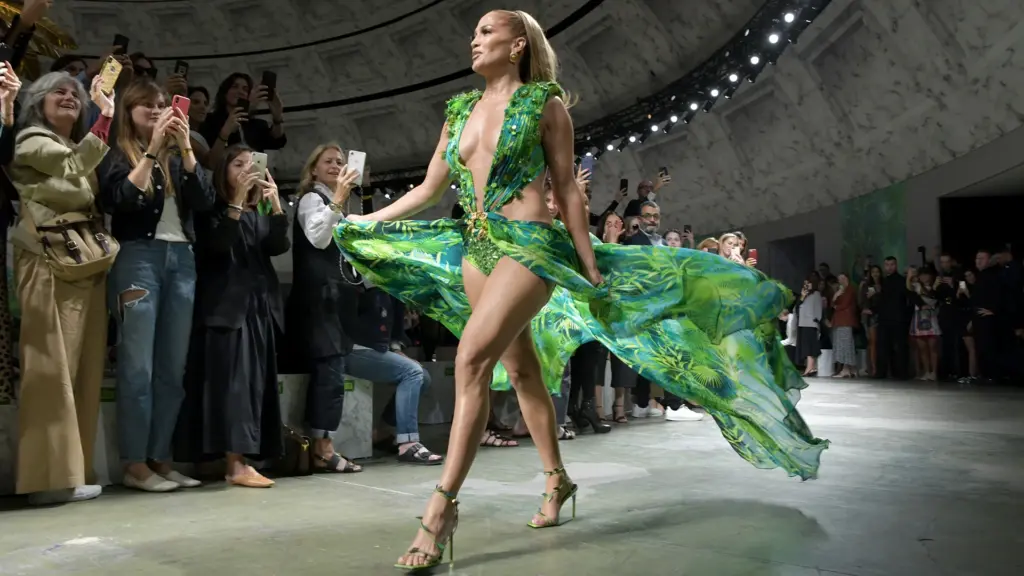
The original 2000 Grammy gown was silk chiffon in an emerald green and tropical blue palm leaf print. The neckline plunged past the navel with a revealing central split. A Medusa head brooch provided the only structural anchor at the waist. Every step Lopez took sent a dramatic cascade of fabric behind her, which is what generated the live television reaction that made the dress a global talking point before the night was over.
“The dress was provocative enough, I guess, to make people really interested,” Lopez told Vogue on the 20th anniversary of wearing it. “When it blew open, everybody was like, what’s going to happen next? Nothing. It’s all taped down.”
The original dress in detail:
- Fabric: Silk chiffon in emerald green and tropical blue palm leaf jungle print
- Neckline: Plunged past the navel with a central split, anchored only by a Medusa head brooch at the waist
- Silhouette: Floor-length with a dramatic train that cascaded with movement, creating the live television visual that drove audience reaction
- Structural element: Secured with fashion tape throughout, a detail Lopez herself confirmed publicly twenty years later
- Designer context: Part of Donatella’s Spring/Summer 2000 collection, her first major standalone collection following the 1997 death of her brother Gianni Versace
How Google Image Search Was Born
The most searched query Google had never been able to answer
In February 2000, Google was three years old. Search results returned pages of text, links, and metadata. There was no way to surface an image directly from a search query, regardless of how many people were looking for one.
After the Grammy broadcast, millions of people typed variations of “Jennifer Lopez green dress” into Google. The volume was unprecedented. As Eric Schmidt wrote in his January 2015 Project Syndicate essay: “This first became apparent after the 2000 Grammy Awards, where Jennifer Lopez wore a green dress that, well, caught the world’s attention. At the time, it was the most popular search query we had ever seen. But we had no surefire way of getting users exactly what they wanted: JLo wearing that dress.”
The Google team recognized the gap in its own product. Within a month, they began building a dedicated image search function. Google Images launched in July 2001 with an index of 250 million images. The dress that made it necessary was the first thing millions of people used it to find.
The sequence from Grammy red carpet to Google product launch:
- February 23, 2000: Lopez arrives at the 42nd Grammy Awards in the Versace jungle dress
- February 24 onward: Search volume for images of the dress becomes the highest Google had recorded to that point
- Google team response: Co-founders Larry Page and Sergey Brin identify image search as a product gap the dress searches made unavoidable
- July 2001: Google Images launches with 250 million images indexed, directly attributable to the dress search volume per Eric Schmidt’s confirmation
- January 2015: Schmidt publicly confirms the connection in a Project Syndicate essay, cementing the story as verified fact rather than internet lore
Lopez found out about the Google Images connection years later. “I found out that because of that night and because of that dress, Google Images was actually created,” she said on her YouTube channel. “That so many people went searching for this and they had nowhere to search a picture at that time on the Internet, they created Google Images.”
Before viral was a word
The green dress moment is routinely described as having “broken the internet before breaking the internet was a thing.” That framing is accurate in a literal sense. The search volume it generated in 2000 was the closest equivalent to a viral moment that the early internet could produce, at a time when the infrastructure to handle visual content at scale did not yet exist.
South Park co-creator Trey Parker wore a replica of the dress to the Academy Awards just one month after Lopez, in March 2000. The fact that images of his version were already circulating and recognizable to audiences demonstrated how quickly the original had become a universally understood cultural reference. The dress had achieved meme-level penetration before the word meme was in common use.
Donatella Versace later reflected: “Today we live in a technological world, but back then, one event prompted the creation of a new tool that now has become part of our lives.”
The SS2020 Runway: 20 Years Later
How Versace turned a fashion archive into a live television event
Nineteen years after the original Grammy moment, Donatella Versace built her entire Spring/Summer 2020 collection around the jungle print and its history. The show took place in Milan on September 20, 2019, with Lopez, then 50 years old and coming off Hustlers, as the closing surprise.
The staging was meticulous and deliberate. After the full model lineup had exited the runway, a screen lit up showing a Google Assistant interface. Donatella’s voiceover asked: “Google, show me pictures of that green Versace dress.” Images of Lopez from the 2000 Grammys flooded the screens. Then the voice returned: “Now show me the real jungle dress.”
Lopez walked out to a standing ovation.
What the SS2020 show staging accomplished for the brand:
- Full circle storytelling: Using Google’s own interface to reference the dress that created Google Images was one of the most self-aware and commercially intelligent pieces of runway theatre in recent memory
- Live surprise activation: The worst-kept secret of the season still produced a genuine crowd reaction because the execution was earned by the brand’s commitment to the full narrative arc
- Anniversary marketing: Turning a 20-year-old dress into a new collection anchor allowed Versace to generate global press coverage without launching an entirely new visual language
- Lopez at 50: The choice to bring Lopez back at 50 rather than simply referencing the 2000 moment with archival footage made a specific statement about the brand’s relationship with women, time, and relevance
- Amber Valletta return: The original runway model for the 1999 Versace show also walked the SS2020 show, connecting the original collection to its anniversary in a way that fashion press covered extensively
The new version of the dress was sleeveless, with additional cut-outs at the hip and embellished with sequins, a more extreme interpretation of the original that pushed the design further without losing the recognizable jungle print identity. Donatella described the audience reaction as “jaw-dropping,” adding: “I am so proud Google Images was invented after Jennifer wore that dress.”
The business context of the reunion
The SS2020 show took place eighteen months after Capri Holdings acquired Versace for $2.12 billion in December 2018. At acquisition, Versace’s annual revenue was approximately $850 million to $900 million. Capri’s stated ambition was to grow that figure to $2 billion.
The SS2020 Lopez moment was one of the most significant earned media events Versace had produced in years. It generated international coverage across fashion, entertainment, and technology media simultaneously, reaching audiences that a standard runway show would not have touched. For a brand that had just been acquired at a $2.12 billion valuation and needed to demonstrate growth potential, a moment that made Versace the most talked-about name in global fashion for 48 hours was precisely the kind of commercial signal Capri needed.
The Versace business timeline around the dress reunion:
- $2.12 billion: Capri Holdings acquisition price for Versace, completed December 2018
- $850 million to $900 million: Versace’s approximate annual revenue at the time of acquisition
- $2 billion: Capri’s stated revenue target for Versace post-acquisition, per SEC filings
- September 2019: SS2020 Lopez reunion show generates global earned media during the first full fashion week cycle under Capri ownership
- $1 billion: Versace’s actual revenue in 2024, having grown from the acquisition baseline but not reaching the $2 billion ambition
- $1.375 billion: Prada’s acquisition price for Versace, completed December 2025, below the $2.12 billion Capri paid in 2018
What the Dress Actually Changed
Fashion, technology, and the architecture of attention
The green Versace dress is the clearest documented example in fashion history of a single garment reshaping infrastructure at scale. It did not just generate cultural conversation. It generated a product. Google Image Search, which now processes billions of queries every day, exists in its current form because one woman wore one dress on one night in February 2000.
That relationship between fashion and technology is now so embedded in how the industry operates that it is taken for granted. Every runway show is designed partly for the Instagram image. Every red carpet look is assessed in terms of search volume and social engagement. The entire ecosystem of fashion media that exists on digital platforms is built on the premise that audiences want to see clothes, not just read about them. Lopez and Versace created the demand that made that infrastructure necessary.
What the dress established as precedent for fashion marketing:
- Visual primacy: Demonstrated that audiences would generate unprecedented engagement to see a specific image, not just read about it, establishing the foundation for visual-first fashion media
- Celebrity as infrastructure driver: A single celebrity appearance at a single event generated enough user demand to force a technology company to build a new product
- Archive as commercial asset: The SS2020 reunion showed that a 20-year-old fashion moment could be reactivated as a contemporary business event with the right execution
- Red carpet as product launch: The Grammys appearance functioned as a global product launch for the jungle print design, with no media budget required
- The non-scarcity of impact: The dress was worn by four celebrities in three months before Lopez. Impact came from person, platform, and moment, not from the garment’s exclusivity
Why the dress still ranks on search 25 years later
A Debenhams poll published in the Daily Telegraph in 2008 ranked the green Versace dress fifth on a list of the most iconic red carpet dresses of all time. The dress continues to generate search volume and cultural reference decades later because it sits at the intersection of three things that do not usually converge: genuine fashion design achievement, a documented technology origin story, and a celebrity moment that has been confirmed, repeated, and referenced enough times to function as verified cultural history rather than fashion mythology.
Every anniversary generates new coverage. The 20th produced the runway reunion. The 25th produced another wave of retrospectives. The dress is, at this point, self-perpetuating as a cultural object in a way that almost no other single fashion moment has managed.
The Bottom Line
The Jennifer Lopez Versace green jungle dress is the most commercially and technologically consequential fashion moment of the past 25 years. It created Google Image Search, which now processes billions of queries daily. It established the template for how celebrity fashion moments generate demand that transcends traditional media. And it gave Versace an archive asset so powerful that it could be reactivated 20 years later to close a Fashion Week show to a standing ovation and generate the brand’s most significant earned media moment in years.
What makes the story unusual is that none of it was planned as a marketing strategy. Lopez almost did not wear the dress, having tried other options first. Her stylist Andrea Lieberman presented it as one of three options before the Grammys. Lopez put it on and decided to take the risk. The cultural machinery that followed was entirely organic, which is exactly why it produced something that manufactured campaigns cannot replicate.
Versace’s acquisition history tells a parallel commercial story. Capri Holdings paid $2.12 billion for the brand in 2018 and could not grow it to the $2 billion revenue target they set. Prada acquired it for $1.375 billion in December 2025, seeing long-term potential that short-term revenue figures understate. What Prada is buying, among other things, is a brand whose single most famous asset is a dress that invented a Google product and still generates search traffic 25 years after it was worn. That kind of cultural capital does not depreciate on a balance sheet, even when revenue does.
The dress that broke the internet before breaking the internet was a phrase did something far more durable than generate clicks. It changed the infrastructure of how the world sees things.