In January 2024, Calvin Klein put Jeremy Allen White on a New York City rooftop in white cotton briefs and filmed him working out. No dialogue. No storyline. No product features explained.
Within 48 hours, the campaign generated $12.7 million in media impact value. By PVH Corp’s own count, the full campaign reached $74 million. Calvin Klein brand mentions spiked 567% above average. The brand gained 100,000 TikTok followers in days. Underwear sales jumped 30% year over year in that first week alone.
That is the return on a few minutes of footage and one actor in his briefs on a rooftop.
None of this is luck. Calvin Klein has been engineering exactly this kind of outsized return from minimal inputs since 1982, when the brand entered the underwear business with a $500,000 campaign and a product that was, on paper, completely ordinary: white cotton briefs. What happened next changed how the world thinks about underwear, luxury, and the power of a logo on an elastic waistband.
1982: The Year Underwear Became Fashion
Before Calvin Klein, men’s underwear was a commodity. It came in three-packs. It was bought by wives and mothers. Nobody aspired to a particular brand of briefs. The category had no cultural relevance whatsoever.
Klein entered the briefs business in 1982, commissioning photographer Bruce Weber for a $500,000 campaign. The star was Olympic pole vaulter Tom Hintnaus, photographed lying across a whitewashed rooftop in Santorini, wearing white Calvin Klein underwear against a clear blue sky.
The image appeared on 25 bus shelter billboards across New York City overnight. By morning, the glass displays were being smashed. The posters were stolen. Stores could not keep the style in stock.
The numbers from the 1982 launch:
- Bloomingdale’s sold $65,000 of Calvin Klein briefs in just two weeks
- First-year underwear sales were projected at $4 million
- Women’s underwear launched in 1983, selling 80,000 pairs in 90 days
- Total underwear sales crossed $70 million within three years of launch
Calvin Klein had not invented a new product. He had invented a new category: designer underwear.
What made the 1982 launch so strategically significant:
- Ordinary product, extraordinary campaign: The briefs were made by Jockey, a standard manufacturer; the only differentiator was the Calvin Klein name on the waistband
- A $500,000 bet on a commodity: That investment in underwear advertising was unheard of in 1982; the budget signalled a fashion launch, not a basics launch
- Public and unavoidable: Bus shelter billboards meant the image reached everyone, not just magazine readers
- Theft as validation: When people smash glass to steal a poster, the brand has already won before a single brief is sold
Klein’s stated goal was simple: convert men’s underwear into a fashion garment worth showing off. The waistband visible above a low jean waistline became a style code that lasted decades.
Why the Logo Waistband Was the Whole Strategy
The product itself was standard. The fabric was basic. The cut was ordinary. The only thing that set Calvin Klein underwear apart was the branding printed across the waistband.
Luxury is usually about the observer: you carry a Gucci bag because people see it. Calvin Klein underwear flipped that logic entirely. It created desire for something that almost nobody sees. The person wearing it knows. And that knowledge is the point.
Why the waistband worked as a status signal:
- Private to public: Worn deliberately above low-rise jeans, the logo moved from hidden to visible, from intimate to aspirational
- Cheapest entry point: A single pair of Calvin Klein underwear cost a fraction of any other item in the brand’s range, making the logo accessible to almost anyone
- Taste over wealth: A Hermès belt signals extreme wealth; a Calvin Klein waistband signals taste; both are status signals, but only one works at global scale
- Habitual repurchase: Once a customer identifies with the brand at this entry level, repurchase becomes automatic rather than considered
The accessible price combined with genuine premium signal is the hardest position in fashion to own. Calvin Klein got there in 1982 and has defended it for over four decades.
The Campaign Playbook That Never Changed
Calvin Klein discovered in 1982 that the formula for selling Calvin Klein underwear was not about the product. It was about the body wearing it, the cultural moment that body represented, and the desire the image could generate.
The brand has run this exact playbook in every decade since.
In 1992, Mark Wahlberg appeared shirtless alongside Kate Moss in a campaign shot by Herb Ritts. Wahlberg snapped his waistband on camera. The ad made it culturally acceptable for men to care about their underwear. The campaign was talked about everywhere from fashion publications to evening news.
In 2015, Justin Bieber posted a photo in Calvin Klein briefs to Instagram with the #MyCalvins hashtag as a genuine fan moment, not a paid post. Calvin Klein signed him. The resulting campaign video accumulated 9.7 million YouTube views and drove 3.6 million additional followers across the brand’s social channels. Kendall Jenner joined the same year, posting Calvin Klein images that generated over 3.5 million Instagram likes in 24 hours.
The consistent elements across every Calvin Klein underwear campaign:
- Culturally relevant face at peak moment: Tom Hintnaus at the 1982 Olympics; Wahlberg at peak Marky Mark fame; Jeremy Allen White the week he won a Golden Globe
- Minimal production: Rooftops, white backgrounds, natural light; the power comes from the image, not from narrative complexity
- Body as the product: The garment is secondary to the person wearing it; the campaign sells aspiration, not cotton
- No explanation needed: The brand never explains what the product does or why it is better; the cultural context does all the work
- Waistband as the constant: Whatever the era, the logo is always visible, always the anchor of the visual
Jung Kook, Jennie, and the K-Pop Extension
The playbook went global in 2023 and 2024 through strategic bets on K-pop.
BTS’ Jung Kook’s fall 2023 Calvin Klein Jeans campaign generated $13.4 million in media impact value in 48 hours, more than any previous campaign in the same window. Blackpink’s Jennie followed with $8.6 million in MIV from her spring 2024 campaign. Disha Patani fronted the Fall 2024 watches campaign, extending the brand into South Asia. Bad Bunny’s fall 2023 jeans campaign covered Latin America.
What the K-pop expansion proved about Calvin Klein’s brand strategy:
- Aspiration is not Western: The logo waistband as a status signal resonates identically in Seoul, Mumbai, and São Paulo
- MIV scales with cultural relevance: Jung Kook’s $13.4M in 48 hours exceeded Jeremy Allen White’s $12.7M in the same window, proving the formula works regardless of geography
- Market-specific faces, universal formula: The production approach never changes; only the ambassador does
- Fan communities as amplifiers: K-pop fandoms distribute campaign content organically at a scale no paid media budget can match
The brand had understood something most fashion houses still struggle with: underwear as a status symbol has no cultural ceiling. The face that makes it aspirational simply changes by market and by moment.
#MyCalvins: When the Brand Became a Movement
In 2014, Calvin Klein launched the #MyCalvins campaign on Instagram with a single mechanic: invite celebrities and everyday users to post themselves in Calvin Klein underwear, complete the sentence “I _____ in #MyCalvins,” and tag the brand.
The results were immediate and compounding.
The hashtag generated more than 1.6 million interactions in the first 48 hours. Kendrick Lamar, FKA Twigs, Justin Bieber, and Kendall Jenner all posted. Despite working with over 600 paid influencers, the flow-on effect was so large that consumers who were not brand ambassadors started posting their own photos spontaneously. By 2020, the hashtag had accumulated over 813,000 tagged posts on Instagram.
Why #MyCalvins was a structural shift in fashion marketing:
- User-generated content at scale: Consumers created the campaign content; Calvin Klein provided only the hashtag and the permission structure
- Democratic aspiration: When Kendall Jenner and an unknown college student post the same hashtag, the brand belongs to both simultaneously
- Perpetual earned media: The hashtag kept generating content years after the initial spend ended; the flywheel did not stop
- Cross-product unity: #MyCalvins worked across underwear, jeans, fragrance, and accessories under a single campaign umbrella
- Community over advertising: People who self-identify as Calvin Klein wearers publicly create loyalty that transactional advertising cannot manufacture
Shawn Mendes and the Social Proof Engine
In 2019, Shawn Mendes posted a Calvin Klein campaign image that accumulated 8 million likes and 450,000 comments in 48 hours, his most engaged Instagram content ever at the time.
The mechanism behind these numbers is not simply celebrity fame.
What makes Calvin Klein’s campaign posts outperform regular celebrity content:
- The brief is the hook: An unexpected, intimate image cuts through regular celebrity content because it is genuinely surprising
- Cross-audience reach: Fashion followers, music fans, and general entertainment accounts all engage and share simultaneously
- Earned media multiplication: Every share, repost, and reaction piece extends the campaign’s reach without additional spend
- The conversation IS the campaign: People arguing about whether a campaign is too provocative, too minimal, or too bold are still talking about Calvin Klein underwear
The brand earns coverage across categories it does not advertise in, all from a single image in cotton briefs on a rooftop.
The Business Model Behind the Briefs
The cultural story of Calvin Klein underwear is well documented. The business model that converts that culture into revenue is less discussed and equally important.
Calvin Klein the designer sold his brand to PVH Corp in 2003 for approximately $400 million. He retained no operational role. PVH turned it into a licensing and direct retail machine operating across every major market in the world.
In FY24, PVH Corp reported $8.65 billion in total revenue, driven by Calvin Klein and Tommy Hilfiger. Calvin Klein revenue held flat on a constant currency basis in FY24, a resilient result against a challenging global macro environment. PVH recorded record gross margins and a double-digit non-GAAP EBIT margin for the full year.
How PVH’s Calvin Klein business model generates revenue:
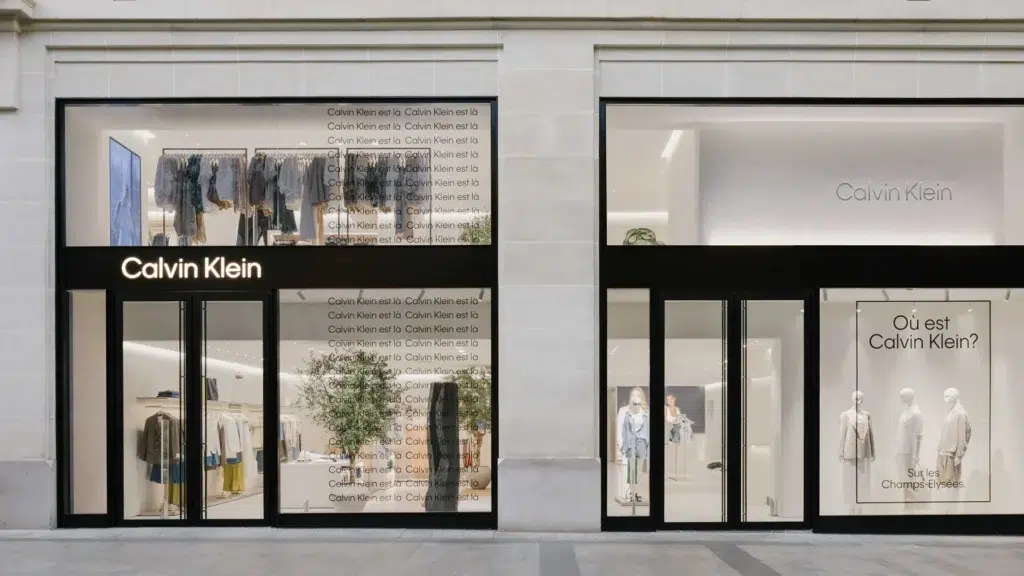
- Owned retail: Flagship stores in key markets including the Paris Champs-Elysees store opened June 2024 and a planned SoHo New York flagship by end of 2025
- Wholesale: Department store distribution in North America and Europe generating volume at scale
- Licensing: Third-party manufacturers pay royalties to produce Calvin Klein underwear in their markets; PVH earns without bearing manufacturing costs
- Fragrance licensing: Coty produces Calvin Klein fragrances globally under a long-term licence; PVH receives royalties without owning any fragrance production
- DTC priority: PVH’s PVH+ Plan has prioritised direct-to-consumer as the primary growth engine, improving margins relative to wholesale
The Price Architecture That Makes the Whole Thing Work
The pricing structure of Calvin Klein underwear is one of the most deliberately engineered in fashion retail.
A three-pack of cotton briefs retails at $35 to $45. A single pair from the Modern Cotton range runs $25 to $35. The Micro Stretch and performance ranges reach $50 per piece.
Why this price point is strategically irreplaceable:
- Accessible enough for anyone: The entry price means the logo waistband is not gated by income level the way most luxury signals are
- Premium enough to matter: At $15 to $20 per brief, the purchase is intentional; nobody accidentally buys Calvin Klein underwear
- Higher than supermarket, lower than luxury: The brand sits exactly where mass aspiration lives; too cheap to be irrelevant, too accessible to be exclusive
- Repeat purchase built in: Underwear is a consumable; the pricing encourages regular replacement rather than one-off purchase
That sweet spot, premium commodity pricing with genuine brand signal, is what makes Calvin Klein underwear commercially indestructible across economic cycles.
Minimalism as the Product, Not Just the Aesthetic
None of the above would work if the product were visually complicated. The reason Calvin Klein underwear functions as a status symbol is that it looks like nothing, which means it goes with everything.
A white brief with a clean elastic waistband. A grey boxer with a logo and nothing else. No pattern, no colour blocking, no decorative detail. The product is as minimal as the advertising.
Klein said it directly: “The only way to advertise is by not focusing on the product.” That principle extends to the design itself. When the garment has no decoration, the logo becomes the entire design. Strip the branding and there is a commodity brief. Keep it and there is aspiration.
Why minimalism is Calvin Klein underwear’s most durable competitive asset:
- Timelessness: No trend-dependent design means the core range never goes out of style; the 1982 brief is still in production with minor updates
- Logo as the entire product: The brand IS the product; every other element is just fabric
- Photography advantage: Plain white product on a plain background produces images that look expensive to produce when they are not
- Universal compatibility: Minimal underwear works under anything, reinforcing habitual repurchase over seasonal replacement
- Barrier to copying: Every competitor can make a white brief; none can replicate 40 years of cultural association with the same waistband
The Collection Relaunch and the Halo Effect
Calvin Klein returned to the New York Fashion Week runway on February 7, 2025, after a six-and-a-half-year absence. Veronica Leoni, previously design director at The Row and formerly at Celine under Phoebe Philo, made her debut as creative director of Calvin Klein Collection.
Her debut was described as “monumental minimalism,” rooted in Klein’s founding design language. Calvin Klein himself attended front row alongside Kate Moss, Christy Turlington, Bad Bunny, Simone Ashley, Disha Patani, FKA Twigs, and Greta Lee.
Why the Collection relaunch matters for the underwear business:
- Halo pricing: A high-fashion runway presence raises the perceived value of every product in the range, including $15 briefs
- Editorial credibility: Fashion press coverage of the Collection generates organic brand storytelling that the underwear line alone cannot earn
- New customer entry: Younger luxury-curious buyers who engage with the Collection become future underwear and jeans customers
- Completeness of brand: A brand with both a high-fashion line and an accessible underwear range can speak to a customer at every stage of their purchasing life
The first runway show in six and a half years signals that PVH is not just managing Calvin Klein as a licensing machine. It is investing in rebuilding the brand’s cultural authority from the top down.
The Bottom Line
Calvin Klein turned the most ordinary garment in a wardrobe into one of fashion’s most recognisable status symbols. A cotton brief that costs pennies to make became a multi-billion dollar revenue line, a global campaign engine generating tens of millions in media value from a single shoot, and a brand entry point worn by everyone from Olympic athletes to K-pop stars to Golden Globe winners.
The strategy has not changed since 1982. Find the most culturally relevant body at the most culturally relevant moment. Strip the setting to almost nothing. Put the logo where it can be seen. Let the world react.
What built Calvin Klein underwear into a $9 billion status symbol:
- The 1982 invention: $500,000 campaign, 25 bus shelter billboards, $65,000 in two-week sales at Bloomingdale’s, and the creation of designer underwear as a category
- The logo waistband: One inch of elastic carrying the entire brand value; the most cost-efficient status signal in fashion
- Decade-by-decade campaign formula: Wahlberg in 1992, Bieber and Jenner in 2015, Mendes in 2019, Jung Kook and Jeremy Allen White in 2023 and 2024
- #MyCalvins: 813,000 consumer posts turning the brand into a participation platform rather than an advertising target
- The price architecture: Accessible enough for anyone, premium enough to matter
- Minimalism as product strategy: A design so stripped back it never dates and makes the logo the only thing that counts
- The Collection relaunch: Veronica Leoni’s February 2025 NYFW debut rebuilding high-fashion credibility that gives the entire brand a stronger foundation
Calvin Klein said it plainly: “The only way to advertise is by not focusing on the product.” His underwear business, now inside an $8.65 billion company, remains the most profitable proof of that principle in fashion history.