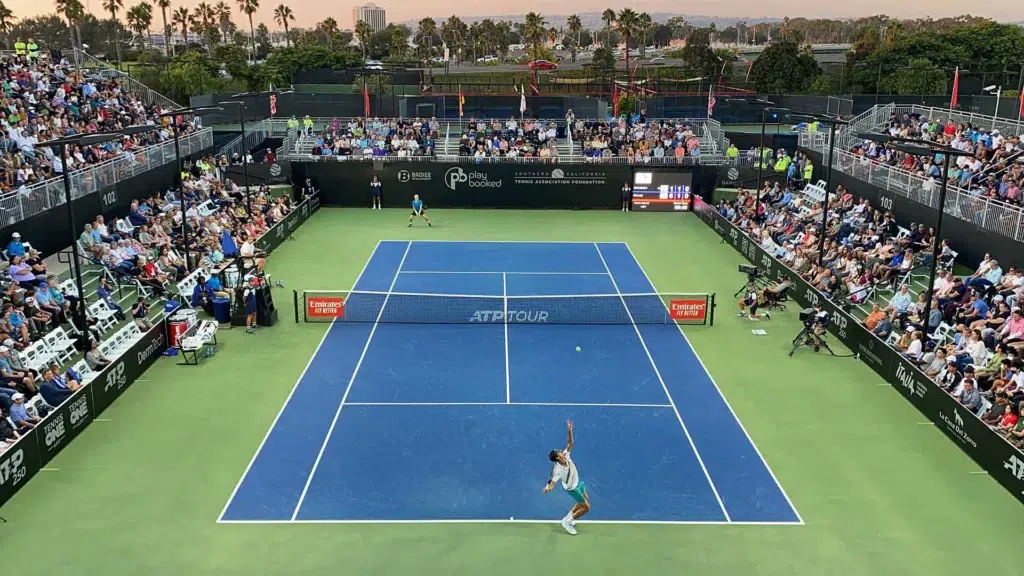
On March 16, 2025, Jack Draper collected $1,201,125 for winning the Indian Wells Open. The same tournament paid WTA champion Mirra Andreeva $1,127,500, marking the first unequal prize money at Indian Wells since 2009. Combined, both tours put up $19.4 million in prize money that week, a 6.63% increase from 2024.
Those numbers describe what players earn. They say nothing about what the tournament earns, how revenue is structured across a Masters 1000 week, or why ATP profit sharing jumped 2.7x in a single year. The economics running underneath the prize money are where the real story is.
ATP 1000 tournaments generate revenue from four sources: broadcast rights, ticketing, local sponsorship, and hospitality. Each flows through the ATP’s 50-50 profit-sharing formula differently. WTA 1000s run on a structurally weaker broadcast model, which is why prize gaps persist even at combined events. None of this appears on the scoreboard.
How a Masters 1000 Actually Makes Money
The Four Revenue Pillars
A Masters 1000 tournament generates revenue across four distinct categories. Each is treated differently under the ATP’s profit-sharing formula, which governs how any surplus above base prize money is split between players and tournament organizers.
Broadcast and streaming rights are managed centrally by ATP Media and allocated directly and in full to the profit-sharing formula as an ATP asset. Local sponsorship and ticketing revenues at combined ATP/WTA events are split 50-50 between the two tours before entering the formula. Data revenues are excluded entirely as ATP property, managed by Tennis Data Innovations and distributed directly to players and tournaments at source.
The four revenue categories at an ATP Masters 1000:
- Broadcast and streaming: Centrally commercialized through ATP Media, allocated fully to the ATP profit-sharing formula
- Ticketing and event day: Local revenue, split 50-50 with WTA at combined events before entering the formula
- Local and title sponsorship: Tournament-level deals, also split 50-50 at combined events
- Data revenues: Excluded from profit sharing, distributed separately through Tennis Data Innovations
Why 2024 Profit Sharing Was 2.7x Higher Than 2023
The $18.3 million in 2024 profit sharing versus $6.6 million in 2023 is not explained by prize money growth alone. Prize money at Masters 1000s increases by 2.5% per year under the OneVision plan. The jump was driven by tournament revenue outpacing base prize money across the nine Masters 1000 events at a rate significant enough to generate a substantially larger surplus.
ATP Chairman Andrea Gaudenzi attributed the result directly to infrastructure investments under OneVision: expanded 96-player draws at Masters 1000s, extended 12-day formats replacing the old 8-day events, and multi-million dollar venue upgrades in Rome, Cincinnati, Shanghai, and Paris. More matches, larger draws, and improved venues drove attendance and broadcast value simultaneously.
What drove the 2024 Masters 1000 revenue surge:
- Expanded draws: 96-player fields at Masters 1000s generate more match inventory, more broadcast sessions, more ticketing rounds
- 12-day format: Two additional days of competition per event multiplied across nine tournaments creates substantial incremental revenue
- Venue upgrades: Improved facilities directly increase hospitality revenue and premium ticket pricing
- New sponsor partners: Nine new global ATP Tour partners signed since 2023, including PIF, Lexus, Yokohama, and Haier
- ATP doubled tournament sponsorship distributions since 2021: Direct financial indicator of commercial growth
The Prize Money Problem Nobody Discusses
What $1.2 Million Actually Represents
Indian Wells 2025 paid its singles champion $1.2 million. Former ATP player Sam Querrey publicly challenged whether that figure was fair. His calculation: the Indian Wells Tennis Garden holds 16,100 seats, Jannik Sinner played six matches to win the 2024 title, and at an average ticket price of $250, those six appearances generated an estimated $30 million in ticket revenue for his matches alone.
The prize-to-revenue ratio is the core tension in tennis economics. Golf’s equivalent: Cam Young won the non-major TPC Sawgrass event in 2025 and collected $4.5 million. Jack Draper won Indian Wells 2025 and collected $1.2 million. Indian Wells has higher global viewership, stronger commercial partnerships, and a larger attendance base than most PGA Tour events outside the majors.
Prize money at ATP 1000s vs. comparable sports events:
- Indian Wells ATP champion (2025): $1,201,125 from an $8.96 million ATP purse
- Miami Open ATP champion (2025): $1,124,380 from a combined $18.8 million purse
- PGA Tour non-major winner (2025): $4.5 million at TPC Sawgrass
- ATP Finals winner (2025): $5.07 million, the highest single-event payout in men’s tennis
- WTA 1000 prize range: $2 million to $10 million per event, with top combined events paying equal to ATP
The WTA Broadcast Gap
The 2025 Indian Wells unequal prize money was a direct consequence of WTA 1000s generating lower broadcast revenue than their ATP counterparts. The WTA Tour confirmed it opted to pay its champion less than the ATP at the same venue, reflecting that the WTA’s central broadcast commercialization does not match the ATP’s scale.
This is the structural imbalance at the heart of 1000-level tournament economics. Combined events, where ATP and WTA play simultaneously at the same venue, split ticketing and local sponsorship 50-50. But broadcast rights are commercialized separately, and the gap in that number flows directly into how much prize money each tour can sustainably offer.
Four Grand Slams have paid equal prize money since 2007. At non-Slam combined events, parity is not guaranteed, and 2025 showed that economic pressure can override historical commitments to equality even at the sport’s marquee events.
The OneVision Blueprint and What It Changed
50-50 Profit Sharing: Tennis’s Structural Shift
Before 2022, ATP tournament economics were opaque. Players earned base prize money and had no visibility into how much a tournament actually generated, what costs were deducted, or whether they were receiving a fair share of the commercial upside. The 50-50 profit-sharing formula, introduced as a central pillar of the OneVision strategic plan and committed to run for 30 years until 2053, changed that architecture.
Three independent financial audits now follow each Masters 1000 tournament. Profits across all nine events are aggregated to minimize outliers from a single high-revenue or loss-making event. Any surplus above the total base prize money paid across the category is then split equally between players and tournament organizers. Players receive no less than base prize money regardless of whether tournaments run at a loss.
How the 50-50 formula works in practice:
- Step 1: Each tournament runs three independent financial audits covering all revenues and costs
- Step 2: Net profits are aggregated across all nine Masters 1000 events for the season
- Step 3: Any surplus above total base prize money for the category is split 50-50
- Step 4: Each player’s share is calculated based on ATP ranking points earned at Masters 1000s during the season
- Step 5: Distribution is announced and paid out in the following season, typically by August
ATP 500s Join the Formula in 2026
In a major structural expansion announced for the 2026 season, ATP 500 tournaments will adopt the same profit-sharing model already operating at Masters 1000 level. This extension directly increases the commercial surface area for player profit participation and signals that the formula is working well enough at the 1000 level to be replicated across a lower tier.
The ATP 500 Bonus Pool is also growing: $3 million available in 2025, up 131% from 2024, with further growth projected into 2026. Challenger Tour prize money is set at $32.4 million for 2026, up 167% since 2022. The financial investment is not limited to the top of the pyramid.
Commercial Growth: Sponsorship and Broadcast
50% Sponsorship Growth Since 2022
The ATP Tour grew its sponsorship revenue by 50% between 2022 and 2024, confirmed in the ATP’s official commercial update. Nine new global partners signed since 2023 include PIF, Lexus, Yokohama, Haier, Waterdrop, and LONGi Solar. Existing partners Emirates, Nitto, and Rolex all renewed. This sponsorship growth is what funded the tournament revenue surplus that produced record profit sharing in 2024.
Saudi Arabia’s Public Investment Fund (PIF) partnership is commercially significant beyond the deal value. PIF signed a major multi-year agreement in 2024 supporting ATP’s global growth, following Saudi Arabia’s broader sports investment strategy across golf, football, boxing, and tennis. The ATP now has direct sovereign wealth fund backing, which changes the ceiling of what commercial deals can look like across the tour’s next cycle.
ATP global commercial metrics (2025):
- Social media following: 13.1 million, up 13.5% year-on-year
- Video views across social channels: 2.9 billion, up 30% year-on-year
- On-site fans: 5.55 million across the ATP Tour, an all-time record
- Broadcast/streaming audience: Projected above 1 billion globally through ATP Media
- New 2025 partners: Polaroid Eyewear, Bitpanda, Stella Artois, Verizon, and Purina Pro Plan
The Indian Wells Model: What Success Looks Like
Indian Wells is the clearest example of what a commercially optimized 1000-level tournament looks like. Owned by Oracle founder Larry Ellison since 2009, the tournament operates the Indian Wells Tennis Garden with a 16,100-seat main stadium, the second-largest permanent tennis stadium in the world. Attendance reached 493,440 in 2024, placing it directly below the four Grand Slams in global tennis attendance.
The combined prize pool at Indian Wells 2025 was $19.4 million. That figure is the floor of what the tournament generates, not the ceiling. Ellison’s ownership model treats the event as a premium sports entertainment product, with multi-week hospitality programmes, premium court-side experiences, and a venue capable of hosting capacity crowds across a two-week event calendar.
Not every Masters 1000 operates at this commercial scale. Events in markets with lower broadcast value, smaller stadium capacities, or less hospitality infrastructure generate proportionally less surplus for the profit-sharing pool. The aggregated formula averages this out, but the underlying commercial gap between Indian Wells and a lower-revenue 1000 event is substantial.
The Bottom Line
ATP 1000 tournaments are no longer just sporting events. They are commercial operations generating enough surplus revenue to distribute $18.3 million to 186 players on top of $261 million in base prize money in a single season. The 50-50 profit-sharing formula, committed through 2053, has created structural alignment between player and tournament financial interests for the first time in the sport’s history.
WTA 1000s face a more difficult commercial reality. Lower broadcast valuations, ongoing prize money gaps at combined events, and a less developed global sponsorship ecosystem mean the financial trajectory diverges sharply from the men’s tour despite sharing venues and audiences at nine combined events annually.
What the data says about where ATP and WTA 1000 economics are heading:
- Prize money will keep rising: 2.5% annual increase locked into the ATP formula through 2053, regardless of profit-sharing outcome
- Profit sharing will grow with revenue: 2024’s 2.7x increase over 2023 was driven by infrastructure investment, which compounds annually
- WTA broadcast gap will determine parity: Equal prize money at combined events depends on WTA closing the broadcast revenue gap, which requires global commercial development
- 500-level adoption confirms the model works: Extending profit sharing to ATP 500s in 2026 is the clearest signal that the 1000-level formula is producing results both players and tournaments endorse
- Saudi money changes the ceiling: PIF’s multi-year ATP partnership opens commercial territory that did not exist in 2021
The hidden economics of ATP and WTA 1000 tournaments are becoming less hidden by design. Three financial audits per event, annual profit-sharing disclosures, and public acknowledgement of broadcast gaps are producing a level of transparency that was structurally absent when the OneVision plan launched in 2022.