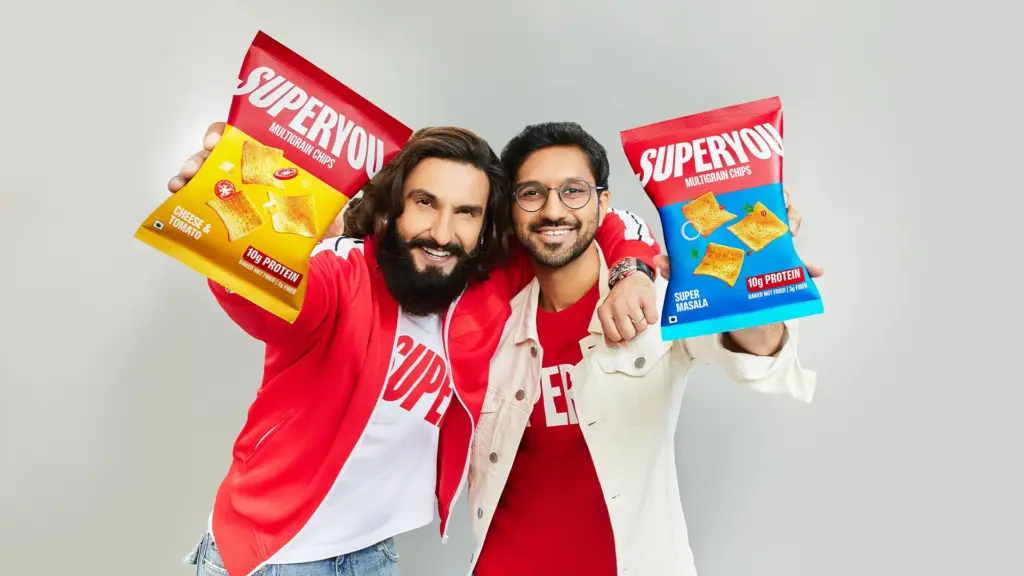
Most celebrity food brands in India take years to find their footing. SuperYou took thirteen months to hit ₹200 crore in annual recurring revenue. Launched in November 2024 by Bollywood actor Ranveer Singh and entrepreneur Nikunj Biyani, SuperYou entered India’s crowded nutrition market with a specific thesis: that 73% of Indians are protein-deficient not because they do not care about health, but because the existing options are either unaffordable, unpalatable, or both. The brand’s answer was to put protein inside snacks that people were already eating anyway.
SuperYou Ranveer Singh is not a standard celebrity endorsement play. Singh acquired a 50% stake in Elite Mindset Private Limited, the company that owns the SuperYou brand, in November 2024 through a co-founder agreement rather than a brand ambassador contract. That equity structure, combined with Nikunj Biyani’s operational expertise and a funding trajectory that has reached $8.5 million across two rounds, makes SuperYou one of the most credibly built celebrity food businesses in Indian startup history.
SuperYou Ranveer Singh is the sharpest execution of the celebrity-as-co-founder model in India’s D2C food space. The numbers through May 2026 suggest it is already outrunning nearly every comparable celebrity food brand that came before it.
Why Ranveer Singh Co-Founded SuperYou
A Basketball Game and a Protein Gap
The collaboration between Ranveer Singh and Nikunj Biyani began not in a boardroom but on a basketball court. Biyani, the nephew of Future Group founder Kishore Biyani and a veteran of the Indian FMCG industry through his years at Future Consumer, had been working on a thesis around protein accessibility in India. When the two connected during a game of basketball, Singh saw the same gap that Biyani had been studying: India is one of the most protein-deficient countries in the world, yet the existing solutions targeted fitness enthusiasts rather than the mainstream consumer.
Singh’s own relationship with nutrition gave the collaboration its authenticity. He has spoken publicly about his journey with fitness and how accessible, enjoyable nutrition options were hard to find even for someone with the resources to hire a team of nutritionists. The insight driving SuperYou was simple: rather than creating a new category of protein products that required consumer behavior change, the brand would inject protein into the formats India already loves, starting with wafer bars and multigrain chips, and expand from there into biscuits, cereals, and other everyday snacking occasions.
- Protein deficiency context: 73% of Indians do not meet the minimum daily protein requirement per data cited by Rainmatter at the time of their Series A investment in December 2024
- Biyani’s background: Nikunj Biyani built his FMCG expertise at Future Consumer under his uncle Kishore Biyani, giving SuperYou operational depth in retail distribution and consumer brand building from day one
- Singh’s equity stake: Acquired a 50% stake in Elite Mindset Private Limited in November 2024, making him a genuine co-founder with equal ownership rather than a paid brand face
- Think9 infrastructure: The brand operates under Think9 Consumer Technologies, a venture builder platform backed by Ashni Biyani that spans food, wellness, beauty, home, and fashion, providing shared operational and distribution infrastructure
- Market entry logic: Rather than creating new consumption habits, SuperYou positions protein inside familiar snack formats already consumed by hundreds of millions of Indians daily
Fermented Yeast Protein: The Technology Differentiator
SuperYou’s products are not built on the standard whey or soy protein that most Indian protein brands rely on. The brand uses fermented yeast protein technology, which produces a clean, vegan, gut-friendly protein source with no dairy, no soy, and no gluten. For a market where lactose intolerance is widespread and vegetarianism runs deep, this is a meaningful formulation choice that broadens the addressable consumer base significantly compared to whey-based competitors.
The fermented yeast protein is also more stable in high-temperature processing than whey, which makes it far better suited to baked snack formats. A wafer bar or multigrain chip made with whey protein tends to denature under heat, compromising both nutritional value and taste. SuperYou’s technology choice was not just about ethics or dietary inclusivity. It was about building products that actually work at scale in the formats they chose to compete in.
- Fermented yeast protein: Clean, vegan, gut-friendly protein with no dairy, soy, or gluten, making SuperYou products accessible to vegetarians, vegans, and lactose-intolerant consumers
- Heat stability advantage: Unlike whey, fermented yeast protein holds its nutritional integrity under the high-temperature baking process used for wafers and multigrain chips
- No refined sugar or palm oil: The original protein wafer bars were formulated with no refined sugar and no palm oil, addressing two of the most common concerns among health-conscious Indian consumers
- 10g protein per serving: Both the wafer bars and multigrain chips deliver 10 grams of protein per pack alongside 3 grams of dietary fiber, making each unit a meaningful nutritional contribution rather than a marginal one
The Journey: From Launch to ₹200 Crore ARR in 13 Months
Phase 1: The Protein Wafer Launch (November 2024)
SuperYou launched in November 2024 with its flagship product, the SuperYou Protein Wafer Bar, introducing a format that had never previously existed in the Indian market. The wafer bar was priced at ₹60, positioned to compete with traditional chocolate bars and wafer snacks that already occupy that price point in convenience retail, modern trade, and quick commerce. The four launch flavors were chocolate, choco-peanut butter, strawberry creme, and cheese, each delivering 10 grams of protein with no added sugar.
The response was immediate and commercially significant. The brand sold 1.6 million units within 90 days of launch, a number that would be strong for any FMCG brand regardless of celebrity involvement. Within weeks of launch, SuperYou secured a Series A investment from Rainmatter Capital, Zerodha’s venture arm led by Nikhil and Nithin Kamath, alongside Gruhas Collective Consumer Fund backed by Nikhil Kamath and Abhijeet Pai. The investment amount was not disclosed at the time but the backing from Rainmatter was strategically significant: the fund had already built a portfolio of health-focused food brands including Ditch The Guilt, Evolved Foods, and Fittr, giving SuperYou access to a network of distribution and regulatory expertise in the nutrition space.
- Launch product: SuperYou Protein Wafer Bar at ₹60, India’s first protein wafer bar, available in four flavors with 10g protein and no added sugar
- 90-day sales: 1.6 million units sold within 90 days of the November 2024 launch per BW Disrupt
- Series A investors: Rainmatter Capital (Zerodha’s VC arm), Gruhas Collective Consumer Fund (Nikhil Kamath and Abhijeet Pai), with investment amount undisclosed
- Rainmatter rationale: Nithin and Nikhil Kamath cited India’s 73% protein deficiency rate and positioned SuperYou’s wafer bars as a snacking and dessert alternative that addresses it at an accessible price point
- Distribution from launch: Available on Amazon, Flipkart, Zepto, Blinkit, and Instamart alongside offline rollout in Reliance, 7-Eleven, Noble Chemist, Wellness Forever, and over 1,000 standalone stores
Phase 2: Multigrain Chips and the Snacking Expansion (2025)
In mid-2025, SuperYou expanded from wafer bars into multigrain protein chips, entering India’s Rs 20,000 crore extruded snacks market directly. The chips were formulated with the same fermented yeast protein technology, delivering 10 grams of protein and 3 grams of dietary fiber per pack in four flavors: Super Masala, Pudina, Cheese and Tomato, and Sour Cream and Onion. Each pack was baked, not fried, positioning it against Lay’s, Bingo, and Kurkure while offering a nutritional profile none of those brands could match.
The timing was deliberate. India’s protein chips segment is projected to grow at a CAGR of 10.8% to reach $99.3 million by 2030 per industry estimates cited at the launch. SuperYou entered before the segment became crowded, staking a first-mover position in a category that is structurally aligned with where Indian snacking is heading: consumers want familiar formats with better nutrition credentials, and they are increasingly willing to pay a premium for it. The chips launch pushed SuperYou’s ARR from ₹150 crore to ₹200 crore between October and December 2025.
- Product specs: Baked not fried, 10g protein, 3g dietary fiber per pack, available in Super Masala, Pudina, Cheese and Tomato, and Sour Cream and Onion
- Category size: India’s extruded snacks market is approximately Rs 20,000 crore, with protein chips projected to grow at 10.8% CAGR to reach $99.3 million by 2030
- First-mover advantage: SuperYou entered the protein chips segment before major FMCG players had launched comparable positioned products, establishing brand recall in a category with limited direct competition
- ARR impact: Brand ARR grew from ₹150 crore in October 2025 to ₹200 crore in December 2025, with the multigrain chips launch as the primary growth driver in that period
- Distribution: Omnichannel rollout covering Amazon, Flipkart, Blinkit, Zepto, Instamart, and offline chains including Reliance, 7-Eleven, Noble Chemist, Wellness Forever, and Ratnadeep
Phase 3: Series B and the Scale Ambition (December 2025)
In December 2025, SuperYou closed its Series B round: ₹63 crore ($7 million) jointly led by V3 Ventures, with participation from Rainmatter and Gruhas Collective Consumer Fund as returning investors. The round pushed total funding to $8.5 million across five investors, with a post-money valuation of ₹600 to ₹660 crore (approximately $66 to $73 million) per the company’s MCA regulatory filings cited by Inc42. Rainmatter’s statement at the time was explicit about their continued conviction: “Our view with SuperYou’s products has not changed since our initial investment. Their progress since the first round has reinforced our conviction in what they’re building.”
The Series B capital is earmarked for three specific priorities: R&D acceleration to develop new product categories India has not yet seen, distribution expansion across both online and offline channels, and headcount growth from the current 58 employees. Nikunj Biyani has set a ₹1,000 crore revenue target with 15% EBITDA within five years, a number that would place SuperYou among the top tier of Indian D2C food businesses. SuperYou also had an earlier ambition of ₹500 crore within three to five years per Bollywood Hungama reporting from November 2025, suggesting the internal targets have been revised upward as growth accelerated.
- Series B details: ₹63 crore ($7 million) led by V3 Ventures, with Rainmatter and Gruhas Collective Consumer Fund as returning investors, closed December 2025
- Post-money valuation: ₹600 to ₹660 crore (approximately $66 to $73 million) per MCA regulatory filings cited by Inc42
- Total funding: $8.5 million raised across two rounds from five investors including Rainmatter, V3 Ventures, and Gruhas Collective Consumer Fund per Tracxn
- Capital deployment plan: R&D for new product categories, distribution expansion across India, and employee headcount growth from 58 staff as of March 2026
- Revenue ambition: ₹1,000 crore in annual revenue with 15% EBITDA within five years of launch, per Nikunj Biyani’s statements to Inc42
The Business Model: How SuperYou Makes Money
D2C and Omnichannel From Day One
SuperYou operates an omnichannel model from the start, a deliberate choice in a market where many D2C brands have stumbled by staying online-only for too long. Online channels including Amazon, Flipkart, Blinkit, Zepto, and Instamart provide quick commerce reach into urban markets where the protein-aware consumer cluster is densest. Offline distribution through Reliance, 7-Eleven, Noble Chemist, Wellness Forever, Ratnadeep, and over 1,000 standalone stores extends reach into tier 2 cities and high-footfall convenience locations that quick commerce does not fully serve.
The pricing architecture is central to the accessibility thesis. Protein wafer bars at ₹60 compete directly with mainstream chocolate and wafer products at the same price point. Multigrain chip packs are priced to sit within reach of the same consumer who buys Lay’s or Kurkure as a daily snack. SuperYou is not asking consumers to pay a health food premium. It is asking them to make a same-cost substitution that happens to be nutritionally superior, which is a materially easier behavioral ask than most health food brands make.
- Online channels: Amazon, Flipkart, Blinkit, Zepto, and Instamart covering quick commerce and marketplace demand across metro and tier 1 cities
- Offline channels: Reliance Smart, 7-Eleven, Noble Chemist, Wellness Forever, Ratnadeep, and 1,000-plus standalone stores providing physical shelf presence in modern and traditional trade
- Protein wafer bar pricing: ₹60 per pack, competitive with mainstream chocolate and wafer snacks at the same price point in convenience retail
- Revenue model: Direct product sales across all channels with no subscription component, generating revenue per SKU through volume at accessible price points rather than high-margin premium positioning
The Market SuperYou Is Going After
Nikunj Biyani laid out the competitive landscape clearly in multiple interviews. India’s biscuit market alone exceeds Rs 50,000 crore. Namkeens and savory snacks sit at Rs 30,000 to Rs 35,000 crore. Chips and extruded snacks account for approximately Rs 20,000 crore. Chocolates sit at a similar level. The chocolate market is SuperYou’s immediate competitive reference for wafer bars, and the extruded snacks market is its reference for chips. The brand is not trying to build a new segment. It is trying to win a position within enormous existing categories by offering a nutritionally superior product at a comparable price.
The next expansion categories Biyani has signaled publicly include breakfast cereals, protein-enhanced biscuits, granola, oats, and protein powders beyond the current supplementation range. Each of these maps onto existing large categories in the Indian FMCG market where protein enhancement creates immediate differentiation without requiring consumer behavior change. The protein powder line, covering whey protein powders and creatine monohydrate supplements, also addresses the fitness supplement buyer who represents a faster-growing but more price-competitive segment.
- Immediate competitive markets: Rs 20,000 crore extruded snacks (chips) and Rs 20,000 crore chocolate market (wafer bars) as primary category references
- Next expansion categories: Breakfast cereals, protein biscuits, granola, oats, and expanded protein powders per Nikunj Biyani’s public statements
- Supplement range: Protein powders and creatine monohydrate already in the portfolio alongside stainless steel shakers, targeting the fitness-focused consumer alongside the mainstream snacker
- Long-term category ambition: Biyani’s stated mission is to make India protein-sufficient by adding protein to what Indians are already eating, an addressable market spanning virtually every category of the Rs 3 lakh crore packaged food industry
The Strategy: What Makes SuperYou Different
Co-Founder, Not Brand Ambassador
The single most important strategic decision behind SuperYou is its ownership structure. Ranveer Singh did not sign a brand ambassador deal with an existing protein brand. He acquired a 50% stake in Elite Mindset Private Limited, the company that owns SuperYou, in November 2024, per DMD Advocates’ legal filing. This makes him a co-founder and co-owner with genuine equity participation in every rupee of revenue the brand generates.
For Indian celebrity food brands, this is still unusual. Most Bollywood-backed food businesses are structured as equity investments after the brand has already launched, or as ambassador contracts dressed up as co-founding arrangements. SuperYou’s structure is cleaner: Singh came in at founding, took a 50% stake, and has been active in brand communication and product storytelling from day one. His marketing reach is an asset the brand owns rather than rents, and his financial returns are directly tied to whether the business succeeds or fails at scale.
- 50% equity stake: Ranveer Singh acquired 50% of Elite Mindset Private Limited in November 2024, confirmed in DMD Advocates’ legal filing on the Rainmatter investment transaction
- Co-founder positioning: Singh is listed as co-founder alongside Nikunj Biyani rather than as brand ambassador, investor, or celebrity partner, reflecting genuine operational involvement in brand strategy
- Marketing cost advantage: Singh’s social media following and celebrity status provide the brand with marketing reach that would cost tens of crores to replicate through paid advertising, at effectively zero incremental cost
- Aligned incentives: Unlike an ambassador deal where Singh earns regardless of business performance, the equity structure means his financial returns are entirely dependent on SuperYou’s commercial success
Think9 as the Operational Engine
Behind the SuperYou brand is Think9 Consumer Technologies, a multi-brand venture builder backed by Ashni Biyani that operates across food, wellness, beauty, home, and fashion. Think9 provides SuperYou with shared operational infrastructure: regulatory compliance, supply chain management, manufacturing relationships, HR, and finance functions that a standalone D2C startup would otherwise need to build from scratch.
This structure explains how SuperYou could move from launch to ₹200 crore ARR in thirteen months without the operational chaos that typically accompanies that speed of growth. Think9’s existing vendor relationships, warehouse infrastructure, and distribution playbooks meant that Nikunj Biyani could focus on product innovation and Ranveer Singh could focus on brand building, while the operational machinery ran underneath both. It is a venture studio model, and SuperYou is the clearest validation of that model’s potential in the Indian D2C food space to date.
- Think9 Consumer Technologies: Multi-brand venture builder backed by Ashni Biyani, providing SuperYou with shared supply chain, compliance, HR, and finance infrastructure from day one
- Speed enabled: Think9’s existing operational infrastructure allowed SuperYou to scale to ₹200 crore ARR within 13 months without building all back-end functions from scratch
- Brand portfolio context: Think9 operates across food, wellness, beauty, home, and fashion, giving SuperYou potential cross-category synergies as it expands into breakfast and supplement categories
The Numbers: SuperYou’s Financial Position
Funding, Valuation, and Revenue
SuperYou has raised $8.5 million across two rounds in its first 13 months of operation. The Series A from Rainmatter Capital, Zerodha’s venture arm, came in December 2024 within weeks of the brand’s launch, reflecting investor confidence in the founding team and product-market thesis before significant revenue data existed. The Series B in December 2025, bringing in ₹63 crore at a post-money valuation of ₹600 to ₹660 crore, came on the back of ₹200 crore in ARR, which transformed the investment proposition from thesis-led to performance-backed.
At a ₹600 to ₹660 crore post-money valuation against ₹200 crore ARR, SuperYou is trading at approximately 3x to 3.3x revenue, a reasonable multiple for a high-growth D2C food brand with strong brand equity and a clear product-market fit validated by 1.6 million wafer units in 90 days and a two-round funding trajectory in under 14 months. For context, top Indian D2C food brands like The Whole Truth Foods have raised capital at higher multiples earlier in their revenue journey, suggesting that SuperYou’s valuation remains conservative relative to comparable brands with similar growth velocity.
- ARR (December 2025): ₹200 crore, achieved 13 months after launch per Entrepreneur India
- Total funding: $8.5 million across two rounds from Rainmatter Capital, V3 Ventures, Gruhas Collective Consumer Fund, and two additional investors per Tracxn
- Post-money valuation: ₹600 to ₹660 crore ($66 to $73 million) per MCA filings cited by Inc42, implying a revenue multiple of approximately 3x to 3.3x on December 2025 ARR
- Employee count: 58 staff as of March 2026 per Tracxn, with headcount growth flagged as a Series B priority
- Revenue target (5-year): ₹1,000 crore with 15% EBITDA per Nikunj Biyani, compared against current ₹200 crore ARR implying a 5x revenue growth target within the same investor-backed window
The Bottom Line
Ranveer Singh co-founding SuperYou rather than endorsing it was the decision that made everything else possible. The equity structure aligned his celebrity reach with actual business outcomes, the fermented yeast protein technology gave the brand a defensible formulation edge, and Think9’s operational infrastructure meant the company could scale without imploding in its first year. ₹200 crore ARR in 13 months is not a number that happens by accident in Indian D2C food. It happens because the product works, the distribution is built correctly, and the brand has genuine consumer pull rather than just celebrity press.
Why SuperYou Ranveer Singh Succeeded:
- Equity over endorsement: Singh’s 50% co-founder stake in Elite Mindset aligned his incentives with business outcomes rather than a fixed fee, making his brand involvement commercially meaningful in both directions
- Right market, right moment: Entering India’s protein snack market in late 2024 positioned SuperYou ahead of the mainstream adoption curve in functional nutrition, with protein chips still a nascent category at launch
- Technology differentiation: Fermented yeast protein with no dairy, soy, or gluten broadened the addressable consumer base beyond the gym-going minority to India’s far larger vegetarian and lactose-intolerant mainstream
- Accessibility pricing: Wafer bars at ₹60 and chips priced competitively against Lay’s and Kurkure removed the health food premium barrier, turning protein consumption into a same-cost substitution rather than an aspirational purchase
- Think9 infrastructure: Operating inside a venture builder with shared supply chain, distribution, and compliance functions allowed SuperYou to scale at D2C speed without D2C operational fragility
- Institutional investor quality: Rainmatter Capital’s involvement within weeks of launch gave SuperYou credibility with retail buyers, subsequent investors, and distribution partners that a purely celebrity-backed brand cannot easily command
The Series B at ₹600 to ₹660 crore valuation in December 2025 confirmed what the 1.6 million unit debut suggested: SuperYou is building something durable, not just riding a celebrity launch wave. The ₹1,000 crore revenue ambition within five years is aggressive, but it is being chased with the right product, the right co-founders, and the right backers. In a market where 73% of the population is protein-deficient and the snack categories the brand is targeting are collectively worth hundreds of thousands of crores, the ceiling is not the constraint. Execution is. And thirteen months in, SuperYou is executing well above where most Indian D2C food brands have managed at the same stage.