In 1954, when Voltas was founded as a technical collaboration between Tata Sons and Volkart Brothers, air conditioning in India meant expensive imports for maharajas and government buildings. Room air conditioners were luxury products priced beyond reach of ordinary Indians. The market barely existed.
Seventy years later, Voltas holds 20.5% of India’s room AC market as of December 2024, the undisputed market leader. The company sold over 2 million air conditioners in FY24, the highest ever achieved by any brand in a single financial year in India. Revenue reached ₹15,413 crore ($1.7 billion) in FY24-25, with room ACs accounting for 60% of total revenue.
Voltas AC market share leadership rests on a foundation competitors cannot easily replicate: the Tata name. In a market where 70% of buyers are first-time purchasers making their inaugural AC purchase, brand trust matters more than specifications. Voltas leveraged Tata’s 150+ year reputation for reliability to dominate a category where customer anxiety about quality, service, and longevity runs high.
This is how a Tata company turned air conditioning from elite luxury into middle-class necessity, building India’s most extensive cooling products distribution network and capturing one-fifth of a market growing toward 30 million units annually by 2030.
Why Tata Brand Trust Converted First-Time Buyers at Scale
India’s AC market differs fundamentally from developed markets in one critical dimension: 70% of annual sales go to first-time buyers according to Voltas MD Jitender Menon. These customers have never owned an AC, never researched compressor types, never compared energy efficiency ratings. They buy on trust, recommendations, and brand familiarity rather than technical specifications.
Voltas exploited this dynamic ruthlessly through the Tata brand. When a first-time buyer in Indore or Nashik walked into an appliance store comparing Voltas, LG, Daikin, and Samsung, the Tata name carried weight that foreign brands could not match despite superior technology. The customer’s father likely drove a Tata truck, his family drank Tata tea, and he aspired to buy a Tata car. This familiarity translated directly to purchase confidence.
The trust factor manifested most powerfully in tier-2 and tier-3 cities where Voltas dominated disproportionately. Urban metros had higher brand awareness across competitors and consumers comfortable evaluating technical specifications. But in Guwahati, Jaipur, and Coimbatore, customers defaulted to brands they knew. Tata meant reliability, and reliability mattered more than energy efficiency when spending ₹30,000-40,000 for the first time.
Why first-time buyer dominance favored Voltas:
- Brand familiarity: Tata present in trucks, tea, cars, steel creating recognition
- Purchase anxiety: First AC buyers needing trust over specifications
- Service confidence: Tata network implying better after-sales support
- Tier-2/3 dominance: Smaller cities preferring known brands over foreign names
- Word-of-mouth: Satisfied Tata customers recommending within communities
- Price-value perception: Tata suggesting fair pricing without premium extraction
Voltas MD Pradeep Bakshi articulated this advantage clearly: “Our wide presence, focus on emerging retail channels, excellent distribution network, strong brand equity and attractive consumer offers have helped us achieve this significant milestone.” The “strong brand equity” referenced was code for Tata trust that no amount of advertising could manufacture for competitors.
The 24,000+ Touchpoint Distribution Moat
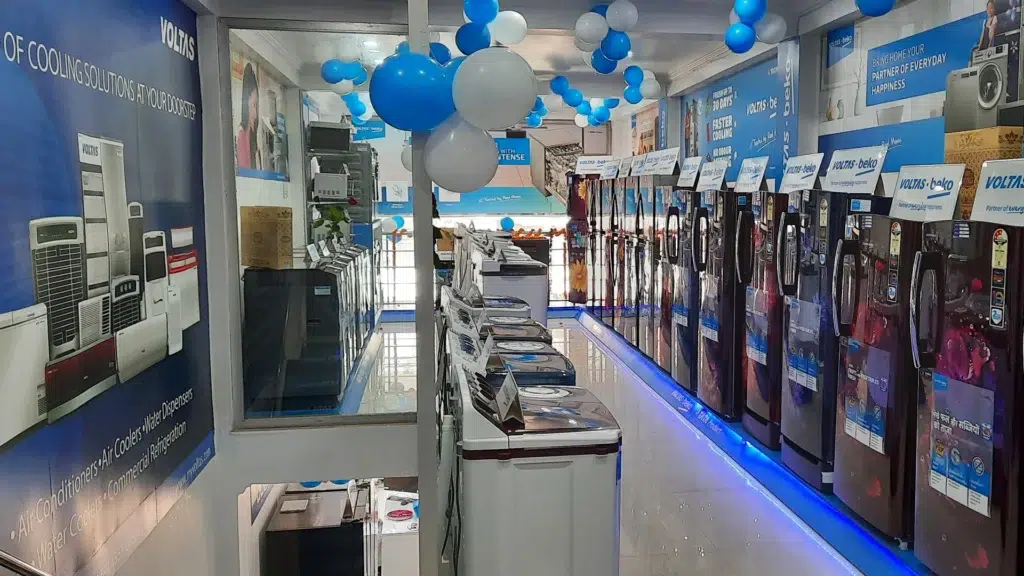
Voltas built India’s most extensive cooling products distribution network with 24,000+ touchpoints as of FY22, giving the brand retail presence competitors could not match. This included exclusive Voltas showrooms, multi-brand electronics retailers, regional distributors, and online partnerships with Amazon and Flipkart.
The distribution density created massive competitive advantage in a category where physical retail still mattered despite e-commerce growth. ACs require installation, service support, and often consumer education about tonnage, energy ratings, and room size compatibility. E-commerce captured 8-12% of AC sales, far below other electronics categories, because customers preferred some offline interaction before purchasing.
Voltas distribution competitive advantages:
- 24,000+ retail touchpoints across India
- Exclusive showrooms in major cities displaying full range
- Multi-brand electronics: Partnerships with Croma, Reliance Digital, Vijay Sales
- Regional distributors: Deep penetration in tier-2/3 cities
- E-commerce: Strong presence on Amazon, Flipkart capturing online sales
- Installation network: Trained technicians ensuring proper setup and customer satisfaction
This distribution moat compounded over decades made Voltas extraordinarily difficult to displace. A new entrant could build better products but could not replicate 24,000 touchpoints without years of investment and relationship building. Even established competitors like Daikin with superior technology struggled to match Voltas’ retail penetration in smaller markets.
Mass-Premium Pricing Capturing India’s Expanding Middle Class
Voltas pricing strategy targeted India’s sweet spot: mass-premium products accessible to expanding middle class but differentiated from pure budget offerings. Room ACs ranged from ₹25,000 for 1-ton fixed speed models to ₹70,000+ for 2-ton inverter variants with advanced features, covering the price spectrum where most Indian consumers shopped.
This pricing positioned Voltas below premium Japanese brands like Daikin and Mitsubishi which commanded ₹50,000-1,00,000+ for comparable tonnage, while staying above pure budget Chinese brands undercutting on price but lacking brand trust. Voltas occupied the middle ground where 60-70% of market volume concentrated.
The strategy worked because it matched India’s income distribution perfectly. Households earning ₹50,000-1,50,000 monthly could afford ₹30,000-50,000 AC purchases but felt uncomfortable spending ₹80,000+ on premium brands. Voltas gave them branded quality at accessible prices, capturing the massive middle market that premium and budget players both missed.
Current Voltas AC pricing across segments (2025):
- 1-ton fixed speed: ₹25,000-35,000 for entry-level cooling
- 1.5-ton inverter: ₹35,000-50,000 for energy-efficient mainstream
- 2-ton inverter: ₹50,000-70,000 for larger rooms with premium features
- Window ACs: ₹20,000-30,000 serving price-sensitive segment (8% of market)
- Adjustable inverter: ₹40,000-60,000 with flexible cooling capacity
- Premium range: ₹70,000+ with AI features, air purification, app control
The fixed-speed to inverter product mix shifted dramatically over the past decade. Inverter ACs represented 70%+ of Voltas sales by FY24 versus <20% a decade earlier, reflecting both consumer preferences for energy efficiency and Voltas’ successful upstream positioning. The company maintained competitiveness across tiers while pushing customers toward higher-margin inverter products.
Energy Efficiency Improvements Reducing Operating Costs
Air conditioner energy efficiency improved dramatically over the past 10 years, with comparable star-rated ACs today consuming nearly 50% less electricity than decade-old models. Voltas invested heavily in inverter compressor technology, larger heat exchangers, and better insulation to reduce power consumption while maintaining cooling performance.
This efficiency improvement addressed a critical barrier to AC adoption in India: operating cost anxiety. Middle-class families willing to spend ₹40,000 on an AC often worried about ₹2,000-3,000 monthly electricity bills making ownership unaffordable. Inverter technology and higher star ratings reduced operating costs to ₹1,000-1,500 monthly, making ownership economically viable.
Technology improvements driving adoption:
- Inverter compressors: Variable speed operation reducing power consumption 30-40%
- Larger heat exchangers: More copper coils improving heat transfer efficiency
- Better insulation: Reducing thermal loss and improving cooling retention
- Energy star ratings: Government-mandated efficiency standards driving innovation
- Eco-friendly refrigerants: R32 replacing R22 with better environmental profile
- Smart features: App control, scheduling, geofencing optimizing usage patterns
The 2 Million Unit Milestone Nobody Expected
Voltas selling over 2 million air conditioners in FY24 marked historic achievement that surprised even the company. This represented 35% year-on-year growth and made Voltas the first brand in India to cross the 2 million annual sales threshold. No competitor had ever achieved this volume in a single financial year.
The milestone came from perfect storm of favorable conditions: extreme summer heat with temperatures exceeding 50°C in several regions, rising disposable incomes, low AC penetration creating massive headroom, and Voltas’ unmatched distribution capturing demand. The company sold 1 million units in just 110 days from January to April 2024, demonstrating the intensity of peak season demand.
But the achievement masked underlying market volatility. In Q1 FY25-26 (April-June 2025), Voltas’ cooling products revenue slumped 25% due to early monsoon showers and milder summer temperatures. This whiplash demonstrated AC industry’s dependence on weather patterns creating boom-bust cycles that made consistent growth challenging.
FY24 milestone drivers and FY25 reality:
- FY24 sales: 2+ million units, 35% YoY growth, historic industry record
- Peak performance: 1 million units sold in 110 days (Jan-April 2024)
- FY24 market size: ~10 million units total market with Voltas capturing 20%+
- Q1 FY25 decline: 25% revenue drop in cooling products from weather impact
- FY25 moderation: Growth expectations reset to 20% from prior 35% trajectory
- Market maturation: Industry evolving from explosive growth to steady expansion
The FY24 performance validated Voltas’ distribution and brand strength but also revealed category’s weather sensitivity creating unpredictable revenue patterns. Management recognized FY24 represented peak performance unlikely to repeat annually, tempering expectations for sustained 30%+ growth rates.
Market Share Fluctuations Through Competitive Cycles
Voltas AC market share fluctuated between 18-24% over the past five years as competitive intensity varied and the company navigated margin versus volume tradeoffs. The brand peaked at 23.4% market share in FY22, fell to 18% by late 2023 amid aggressive pricing from competitors, then recovered to 20.5% by December 2024 through product innovation and distribution expansion.
The market share volatility reflected strategic choices about profitability versus growth. When competitors like Daikin, LG, and Samsung offered aggressive discounts to gain volume, Voltas could either match pricing and protect share while sacrificing margins, or maintain pricing discipline accepting temporary share loss. The company generally chose margins, allowing market share to compress during price wars then recovering share when pricing normalized.
Market share evolution and competitive dynamics:
- FY22: 23.4% market share at peak, industry leader
- FY23-Early FY24: Declined to 18% amid competitive pricing pressure
- Late FY24: Recovered to 20% through new launches and distribution push
- December 2024: 20.5% exit market share maintaining leadership
- Current competitive position: #1 ahead of Daikin (18%), Blue Star (15%), LG (12%)
- Share volatility: 18-24% range reflecting margin-volume tradeoffs
The current 20.5% share represents sustainable equilibrium where Voltas maintains leadership without sacrificing profitability chasing peak share. The company recognized that defending 23-24% share required margin-destructive pricing that shareholders would not support long-term, accepting 20% as comfortable leadership position.
Why Low AC Penetration Makes India Massive Growth Opportunity
Room air conditioner penetration in India stands at less than 10% of households versus 90%+ in developed markets and 60% in China. This penetration gap represents enormous growth runway that excites investors and justifies premium valuations for AC manufacturers despite cyclical volatility.
India currently sells approximately 15 million AC units annually with market expected to double to 30 million units by 2030 at 15% CAGR according to industry projections. This growth will come from first-time buyers as penetration increases, replacement demand remaining negligible given India’s installed base age profile.
The penetration opportunity concentrates in tier-2/3 cities and emerging middle class with incomes reaching AC-affordable thresholds. As India’s per capita GDP approaches $3,000, millions of households annually enter income brackets where ₹40,000 AC purchases become economically feasible. This demographic expansion drives market growth independent of temperature fluctuations.
Growth drivers expanding penetration:
- Current penetration: <10% of Indian households own room ACs
- Market size: 15 million annual units currently, projected 30 million by 2030
- Income growth: Per capita GDP approaching $3,000 expanding affordability
- Urbanization: Tier-2/3 cities contributing majority of growth
- Climate change: Rising temperatures increasing AC necessity perception
- Replacement cycle: 8-10 year product life creating future replacement demand
Voltas positioned to capture disproportionate share of this growth through distribution advantages in exactly the tier-2/3 markets where penetration will expand fastest. While premium brands concentrate on metros, Voltas’ presence in Raipur, Nagpur, and Vijayawada positions the brand where growth will happen.
Expanding Beyond ACs Into Home Appliances Portfolio
Voltas diversified beyond air conditioning into comprehensive home appliances portfolio through multiple brand strategies. The Voltas Beko joint venture with Turkey’s Arçelik sells refrigerators, washing machines, dishwashers, and microwaves leveraging Tata brand trust into new categories.
The appliances expansion made strategic sense as natural adjacency. Customers buying Voltas ACs represented qualified leads for refrigerators and washing machines, enabling cross-selling through existing distribution. The Tata brand credibility that worked in ACs transferred to white goods, giving Voltas Beko advantages versus standalone appliance brands.
Voltas home appliances market positions (2024):
- Refrigerators: 5.1% market share, growing from low base
- Washing machines: 8.3% overall market share by November 2024
- Semi-automatic washers: 16.7% market share in segment
- Air coolers: 11.1% market share, #2 brand position
- Dishwashers: Premium category with limited penetration
- Microwaves: Competitive category with multiple established players
The appliances business remained significantly smaller than room ACs but offered diversification reducing dependence on AC category’s weather-driven volatility. Refrigerators and washing machines demonstrated more consistent demand patterns enabling steadier revenue contribution.
The Bottom Line
Voltas AC market share of 20.5% making it India’s largest cooling company validates that brand trust compounds over decades into competitive advantages competitors cannot easily replicate. From 1954 founding to 2+ million annual unit sales, the journey demonstrates how Tata brand equity, patient distribution building, and mass-premium positioning create durable market leadership.
The ₹15,413 crore revenue in FY24-25 with room ACs contributing 60% proves the category’s commercial significance despite weather-driven volatility. Selling over 2 million ACs in FY24 followed by 25% revenue decline in Q1 FY25 shows the cyclicality that makes AC businesses challenging but the long-term penetration opportunity from <10% current levels justifies continued investment.
What built Voltas’ market leadership:
- Tata brand trust: 150+ year reputation converting first-time buyers
- Distribution density: 24,000+ touchpoints exceeding all competitors
- Mass-premium pricing: ₹25,000-70,000 capturing middle-class affordability
- Tier-2/3 penetration: Presence where growth concentrates
- First-mover advantage: Decades building brand and distribution moats
- Product innovation: Inverter technology and energy efficiency improvements
- Weather adaptability: Managing boom-bust cycles from temperature variations
The challenges ahead include intensifying competition from Daikin which nearly matches Voltas’ 18% share, Chinese brands undercutting on price, and margin pressure from commodity inflation in copper and aluminum. Climate change creates both opportunity through rising temperatures and risk through unpredictable weather patterns disrupting seasonal sales.
But Voltas demonstrated resilience recovering from 18% to 20.5% market share after competitive pressure, validating that brand and distribution moats remain defensible. The company targeting 1% annual share gain to reach ~20% by 2030 appears conservative given penetration runway ahead.
For investors, Voltas represents play on India’s rising middle class, increasing urbanization, and inevitable AC penetration growth from current <10% toward developed market norms. The Tata brand provides downside protection while distribution advantages position the company to capture disproportionate share of industry growth over the coming decade.