
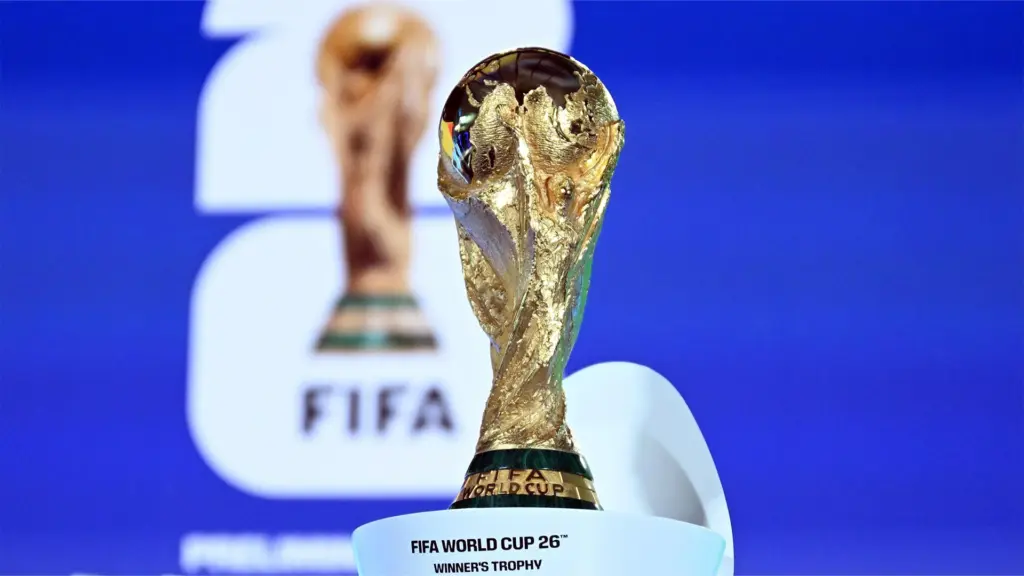
The 2026 FIFA World Cup kicks off on June 11 at Estadio Azteca in Mexico City. Three nations co-host it: the United States, Canada, and Mexico. FIFA projects $8.9 billion in revenue from the tournament, part of a revised $13 billion target for its 2023-26 commercial cycle. The FIFA-WTO study estimated a $40.9 billion GDP boost across all three host countries.
Those numbers are what FIFA puts in front of governments when they bid. What the numbers do not show is how the money actually flows: who earns it, who spends it, and who is left managing the infrastructure bill long after the final whistle.
In May 2026, the American Hotel and Lodging Association released its FIFA World Cup 2026 Hotel Outlook. It surveyed hotels across all 11 US host cities. Eighty percent reported bookings tracking below initial forecasts. In Kansas City, hotel demand fell below normal levels for a typical June and July without any major event at all. In Boston, Philadelphia, San Francisco, and Seattle, respondents described the World Cup as a “non-event.”
The FIFA Revenue Model: Built for FIFA, Not for Hosts
How FIFA Earns $7.5 Billion Without Building a Single Stadium
FIFA generated $7.57 billion in total revenue from the Qatar 2022 World Cup during the 2019-22 commercial cycle, a record at the time. Broadcasting rights contributed $3.43 billion, roughly 45% of total revenue. Marketing and sponsorship added $1.8 billion. Ticketing, licensing, and hospitality covered the rest.
FIFA covered all operating costs during the tournament’s one month of competition. Prize money totaled $440 million, with Argentina receiving $42 million for winning and every group-stage exit guaranteed $9 million. FIFA paid approximately $1.7 billion to Qatar to cover tournament operations. Everything else went to FIFA.
For 2026, FIFA’s revised commercial cycle target is $13 billion. The World Cup alone is projected to generate $8.9 billion of that. Broadcasting rights for 2026 are expected to reach $4.264 billion, a 43% increase over Qatar, driven by the Fox Sports and Telemundo deal worth $1.25 billion for the US market alone. Sponsorship is projected above $2.8 billion. Matchday revenue is expected at $3 billion, a 216% increase over Qatar’s $950 million, reflecting 104 matches across three host countries versus 64 matches in one.
Where FIFA’s 2026 World Cup revenue comes from:
- Broadcasting rights: $4.264 billion projected, a 43% increase over Qatar 2022
- Sponsorship and marketing: $2.8 billion projected, driven by Chinese and Middle Eastern corporate entry into FIFA’s top tiers
- Matchday revenue: $3 billion projected, up 216% from Qatar’s $950 million
- Prize money total: $727 million, with $655 million shared among 48 qualified nations
- 2026 champion prize: $50 million, up from Argentina’s $42 million in 2022
- Host nation operating contribution from FIFA: Fixed payments that cover operations, not construction
What Host Nations Actually Receive
Host nations receive a FIFA contribution covering tournament operations: team hotels, training facilities, logistics, media infrastructure, and local organizing committee costs. This covers the month of competition. It does not cover stadium construction, transport infrastructure, security upgrades, accommodation expansion, or any of the long-term projects governments commit to when bidding.
The bidding process is where the financial asymmetry begins. FIFA’s hosting requirements mandate specific stadium capacities, transport connectivity standards, hotel room availability, and security infrastructure. Governments agree to meet those requirements as a condition of being awarded the tournament. The cost of meeting them is entirely the host nation’s problem.
Qatar 2022: $220 Billion for a Month of Football
The Most Expensive Sporting Event in History
Qatar spent approximately $220 billion on World Cup-related expenditure from 2010 through 2022, according to consistent reporting from Sportico, Forbes, and the Michigan Journal of Economics. The figure is not primarily about football. Less than $10 billion went to stadium construction and tournament operations. The remaining $210 billion funded the infrastructure Qatar used the World Cup as a deadline to build.
That infrastructure included $36 billion for the Doha Metro, $20-25 billion in road construction, a $16 billion airport expansion, $50 billion in hotel development, and the entirely new city of Lusail built specifically to host the tournament’s final. At its peak in 2017, Qatar was spending $500 million per week on capital projects, a figure Qatar’s own finance minister confirmed to the BBC.
To contextualise that spending: Qatar’s GDP was approximately $180 billion in 2022. The World Cup-related expenditure exceeded a full year of national economic output. The equivalent for the United States would be spending roughly $2.3 trillion per year for 12 consecutive years.
Qatar’s $220 billion: where it went:
- Doha Metro system: $36 billion
- Hotel construction and expansion: $50 billion
- Road and highway construction: $20-25 billion
- Airport expansion (Hamad International): $16 billion
- Stadium construction and renovation (8 venues): $6.5-8 billion
- Lusail City construction: Tens of billions for an entirely new urban development
Qatar’s Return: $4.1 Billion in Direct Revenue
Qatar earned an estimated $2.3 to $4.1 billion in direct tournament-related revenue from visitor spending, hotel occupancy, and retail consumption during the 2022 World Cup, according to data cited in multiple post-tournament analyses. FIFA paid Qatar approximately $1.7 billion to cover operating costs. Total direct earnings of roughly $4.1 billion against $220 billion in expenditure is a ratio that requires non-financial justification, which Qatar provided in terms of long-term development, geopolitical visibility, and National Vision 2030 objectives.
The long-term justification is real but unverifiable in the near term. Qatar aims for tourism to represent 12% of GDP by 2030. Whether that target would have been achievable at lower cost without the World Cup as the forcing mechanism is the question no hosting nation can definitively answer.
Brazil 2014: The Stadium Debt That Didn’t End
$13.5 Billion and Four White Elephants
Brazil spent approximately $13.5 billion hosting the 2014 World Cup, with $3.6 billion going to stadium construction across 12 host cities, the largest single expenditure category. The initial bid estimate for stadium costs was 1.9 billion Brazilian real. Brazil’s Federal Court of Audit later documented expenditures reaching 25.5 billion Brazilian real, nearly 13 times the original projection.
The problem was geography. Brazil spread its tournament across 12 cities rather than the required minimum of 8, a decision designed to distribute economic benefit but one that required building or renovating stadiums in cities with no viable post-tournament use case. Manaus, Natal, Cuiabá, and Brasília were identified from the outset as white elephant risks. Academic researchers at the Danish Institute for Sports Studies confirmed the prediction in a 2024 review, finding that average annual stadium audiences in those cities between 2015 and 2022 were 13,733 spectators, in venues built for 40,000 or more.
Brazil’s post-2014 stadium economics:
- Estadio Nacional, Brasilia: The most expensive stadium in Brazilian history, built for a city without a top-division football club
- Arena Amazonia, Manaus: $325 million construction cost, $3 million annual maintenance, local team plays in Brazil’s third division
- Average audience 2015-22 in at-risk stadiums: 13,733 per event in venues built for 40,000+
- Stadium construction cost per spectator: Average $1,000, with Manaus reaching $150,050 per spectator projected over four post-tournament years
- Tax exemptions granted to FIFA: All FIFA expenditure in Brazil was exempted from taxation, including Industrialised Products Tax and Importation Tax
The Wider Economic Calculus
Beyond the stadiums, Brazil’s economic environment deteriorated in the years following the World Cup. Inflation that stood at 3.6% when Brazil was awarded the tournament in 2007 spiked during the infrastructure spending cycle. The public protests that erupted during the 2013 Confederations Cup, and again at the World Cup opening, reflected a population that saw healthcare, education, and transport underfunded while $3.6 billion went to football venues.
The economic benefit that did materialise was concentrated in the one month of competition and dissipated quickly. Tourism showed no sustained long-term increase attributable to the World Cup in cities outside Rio de Janeiro and São Paulo, both of which had strong pre-existing tourism infrastructure that would have performed regardless.
South Africa 2010: The $3.5 Billion Lesson
When the Numbers Don’t Add Up
South Africa spent approximately $3.5 billion hosting the 2010 World Cup, a far lower figure than Brazil or Qatar but still proportionally significant for an emerging economy. The tournament generated substantial short-term GDP uplift and delivered genuine infrastructure improvements including new stadiums, upgraded airports, and expanded transit systems in several cities.
The post-tournament assessment was more complex. Soccer City in Johannesburg and Cape Town Stadium were built at significant cost and have struggled to generate sufficient revenue from post-tournament use. Cape Town Stadium in particular, built for $600 million, generated consistent controversy over maintenance costs paid by the City of Cape Town for a venue primarily used for concerts and occasional rugby rather than football.
South Africa’s experience became a reference point in academic analysis of World Cup hosting: the economic benefits are real but front-loaded, the costs are real and long-term, and the gap between projected and realised tourism spending is a consistent feature of mega-event economics.
Comparison of host nation spending across recent World Cups:
- Qatar 2022: $220 billion, FIFA revenue $7.5 billion
- Russia 2018: $11.6 billion, FIFA revenue $6.42 billion
- Brazil 2014: $13.5 billion, FIFA revenue $5.7 billion
- South Africa 2010: $3.5 billion, FIFA revenue $3.65 billion
- Germany 2006: $4.3 billion, regarded as one of the more economically successful editions
2026: Three Hosts, One Reality Check
The Hotel Data Nobody Expected
The 2026 World Cup was structured specifically to reduce the financial burden on any single nation. Three co-hosts share infrastructure requirements, stadium commitments, and organising costs. The US contributes 11 host cities, Canada contributes 2 (Toronto and Vancouver), and Mexico contributes 3 (Mexico City, Guadalajara, and Monterrey). The expansion to 48 teams and 104 matches spreads the commercial upside across a larger number of events and venues.
The AHLA’s May 2026 Hotel Outlook reported that 80% of surveyed hotels across 11 US host cities were tracking below initial booking forecasts. The report identified three primary factors: FIFA room block overcommitment that created an artificial early demand signal, visa barriers and geopolitical concerns cited by 65-70% of respondents as the top constraint on international travel, and the gap between ticket demand and confirmed hotel stays.
Kansas City’s booking pace fell below normal levels for a June-July period without any major event. Los Angeles, despite hosting some of the tournament’s most significant matches, saw 65-70% of hotels tracking below forecast. European bookings to US host cities for June 2026 dropped 5% compared to the prior year, according to Cirium data, while Asian demand fell 3.6%. The US dollar fell 12% against the euro over the same period, making American travel cheaper for European visitors, not more expensive.
AHLA May 2026 Hotel Outlook key findings by city:
- Kansas City: 85-90% of hotels below forecast, trailing normal June-July demand levels
- Los Angeles: 65-70% below forecast, visa barriers and high labour costs cited
- New York City: Approximately two-thirds below forecast, in line with but not above normal summer demand
- Dallas and Houston: Around 70% tracking below World Cup projections
- Boston, Philadelphia, San Francisco, Seattle: Tournament described as a “non-event” by multiple hotel respondents
Why Mexico and Canada Have Different Exposure
Mexico’s economic exposure to 2026 is proportionally modest. Natixis CIB’s economic analysis published in May 2026 estimated the World Cup’s impact on Mexico’s GDP at 0.1-0.2%, reflecting pre-existing stadium infrastructure that requires less new investment and a domestic tourism industry that will absorb significant spending regardless of international visitor numbers. Estadio Azteca, the Guadalajara venues, and Monterrey’s stadiums all have established post-tournament use cases as active football venues.
Canada’s position is similar. BMO Centre in Calgary, existing stadium infrastructure in Toronto and Vancouver, and the country’s established sports event management infrastructure mean capital expenditure requirements are lower relative to GDP than a single-country host in a developing market.
The United States is the most commercially significant host and the one with the most at stake from the AHLA’s data. FIFA predicted roughly a 50-50 split between domestic and international visitors. The AHLA data shows domestic travellers are currently outpacing international arrivals, which compresses per-visitor spending given that international tourists typically spend more per day than domestic ones.
The FIFA Guarantee Structure: Who Is Protected
What FIFA Promises Hosts and What It Actually Delivers
FIFA covers all operational costs during the tournament’s competition phase. This includes prize money ($727 million for 2026), TV broadcast operations, referee and official costs, anti-doping programmes, and the local organising committee’s direct tournament expenses. For 2026, every qualifying team receives a minimum $12.5 million upon qualification, up from $10.5 million in Qatar.
What FIFA does not guarantee is economic return on the infrastructure investment required to host. The FIFA hosting agreement is structured to protect FIFA’s commercial interests: broadcast quality, sponsor visibility, and operational delivery are all covered. Host nation ROI is explicitly outside FIFA’s contractual responsibility.
The hosting agreement also includes tax exemptions for all FIFA operations within the host country, extending the tradition established in Brazil to every World Cup host. In 2026, all FIFA entities, sponsor activations, and tournament operations are exempt from US, Canadian, and Mexican taxation at the federal level. Host nations forgo taxation on the most commercially active elements of the tournament in exchange for the right to host it.
What FIFA’s hosting agreement includes and excludes:
- Included: All operational costs during competition, prize money, broadcast infrastructure, anti-doping
- Excluded: Stadium construction or renovation costs, transport infrastructure, security upgrades, long-term facility management
- Tax status: FIFA operations exempt from host nation taxation, including sponsor activations
- Host nation financial contribution from FIFA: Fixed operating payment, not linked to FIFA’s commercial revenue
The Bottom Line
The FIFA World Cup generates record revenue for FIFA and genuine short-term economic activity for host nations. The gap between those two facts is where the financial disaster lives.
Qatar spent $220 billion to host a tournament that earned FIFA $7.5 billion. Brazil spent $13.5 billion and is still maintaining stadiums in cities with no football demand. South Africa built Cape Town Stadium for $600 million and spends municipal funds maintaining a venue the city did not need. And in 2026, with the most commercially optimised World Cup in history about to begin, 80% of hotels in US host cities were below booking forecasts five weeks before kickoff, with visa barriers and geopolitical concerns suppressing the international visitor numbers that FIFA promised would transform local economies.
The tournament works as a commercial product. It works for FIFA sponsors, for broadcasters, for the construction and hospitality industries that capture event-period spending. What it does not reliably produce is long-term economic return proportionate to the investment host governments make.
Why World Cup hosting consistently underdelivers for host nations:
- The money goes to FIFA: Broadcast rights, sponsorship, and commercial revenue flow to FIFA, not to host nation governments or economies
- Infrastructure costs are long-term, benefits are short-term: Construction spending lasts years, tourism uplift lasts weeks
- White elephants are structural, not accidental: Stadiums built to FIFA capacity requirements exceed the sustainable demand of most host-city football markets
- Tourism projections are systematically optimistic: Every World Cup produces post-event analyses noting the gap between projected and actual visitor spending
- Tax exemptions transfer revenue from hosts to FIFA: The operating cost that FIFA covers is offset by the taxation that host nations waive
- 2026 is real-time confirmation: AHLA data from May 2026 shows the gap between FIFA’s economic projections and the actual booking behaviour of the international visitors those projections depend on
Nations continue to bid for the World Cup despite the financial evidence because the tournament offers things that economics does not measure: geopolitical positioning, national pride, cultural visibility, and the political capital that comes from hosting the world’s most watched event. Qatar understood this explicitly. So did South Africa and Brazil. The financial cost is not hidden. It is accepted, because for many bidding nations, the non-financial return is the actual point.


Great content! Keep up the good work!