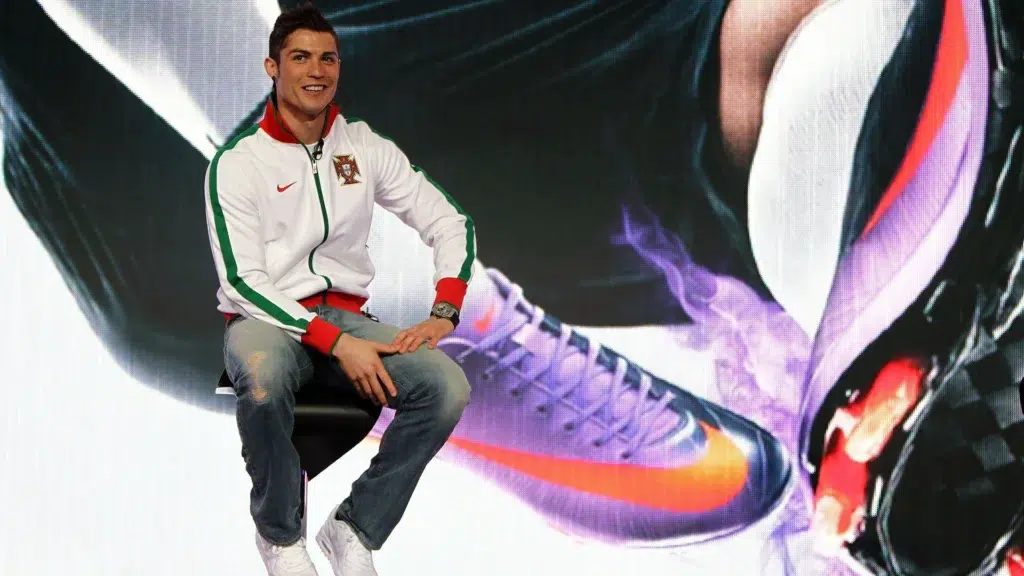
In 2003, Nike signed a teenage winger from Sporting Lisbon who had just moved to Manchester United. The deal was standard: boots, bonuses, a modest fee. Thirteen years later, Ronaldo signed only the third lifetime endorsement contract in Nike’s history, joining Michael Jordan and LeBron James in a category reserved for athletes whose brand value outlasts their playing career.
Two decades in, that bet looks like one of the smartest commercial decisions in the history of sports marketing. Cristiano Ronaldo is the most followed person on Instagram with over 673 million followers as of May 2026. He has scored more goals in the Nike Mercurial than any player in any boot model. And Nike has been beside him for every single one of them.
This is how a football boot deal became a global business empire.
How It Started: 2003 to Real Madrid
The first contract nobody remembers
Ronaldo joined Manchester United in August 2003. He made his debut wearing Nike Mercurial Vapor I boots, the same model he had worn through his one professional season at Sporting Lisbon. The original Nike deal was a standard footballer’s boot agreement: product supply, appearance bonuses, limited scope.
What Nike saw in a 18-year-old winger at Old Trafford was potential rather than certainty. They signed him before anyone could prove he would become what he became. Within two years, the gamble was paying off. By the time Ronaldo turned 20, he was already the central face of Nike’s Mercurial Vapor line.
The early milestones that signaled what was coming:
- 2002: Professional debut at Sporting Lisbon wearing Mercurial Vapor I in the Dark Cinder colourway
- 2003: Manchester United debut in Nike Mercurials, Nike deal signed, commercial relationship begins
- 2004: First Portugal goal at Euro 2004 scored in golden Mercurial Vapor II
- 2007: First Champions League goal, Nike’s marketing investment in Ronaldo begins scaling significantly
- 2009: Real Madrid transfer for a then-world-record fee, Ronaldo becomes Nike’s undisputed flagship footballer globally
The Real Madrid move changed the commercial calculus entirely. Ronaldo was no longer a promising Nike asset. He was Nike’s most important football marketing property at the world’s most watched club.
Growing into the flagship deal
Through his peak Real Madrid years, Ronaldo’s Nike earnings scaled with his on-pitch achievements. According to Football Leaks documents reported by Der Spiegel, his pre-lifetime contract Nike deal paid approximately $17.5 million annually in guaranteed payments, with an additional $4.5 million in performance bonuses tied to achievements like Ballon d’Or wins.
Nike began releasing CR7 signature boots in 2010, timed to coincide with both the launch of the Mercurial Superfly series and Ronaldo’s elevation to global superstar status after his Champions League win at United. Each Ballon d’Or, each major trophy, each milestone produced a new CR7 colourway or limited edition drop.
The Lifetime Deal: November 2016
Only the third contract of its kind in Nike history
On November 7, 2016, the day after Ronaldo signed a new five-year contract extension with Real Madrid, Nike announced a new deal with Ronaldo and published a video in which he said the six words that defined the moment: “This is my brand. For life.”
The terms were not fully disclosed. What Nike confirmed was a lifetime agreement, placing Ronaldo in the same commercial category as Michael Jordan and LeBron James, the only other athletes Nike had ever offered this structure. Based on leaked Football Leaks documents and industry analysis by SalaryLeaks, the deal carries approximately $17.5 million per year in guaranteed fixed payments, with performance and CR7 branded-product bonuses that push realistic total lifetime earnings into the $500 to $600 million range.
What the lifetime structure actually means for both parties:
- Guaranteed payments: Fixed annual fees continue regardless of retirement or club, unlike standard athlete deals that terminate on career end
- CR7 product royalties: Ronaldo receives ongoing payments tied to sales from CR7-branded Mercurial boots and merchandise
- Post-career activation: Nike retains Ronaldo as a brand asset beyond his playing days, similar to how Jordan’s deal works decades after retirement
- Third party only: The Ronaldo lifetime deal is a fixed payment structure, not the profit-sharing arrangement Jordan has, which is why their earnings differ dramatically
The context mattered as much as the contract. In 2016, Ronaldo had just won Euro 2016 with Portugal, his fourth Ballon d’Or, and his third Champions League title. His social media following was generating a level of brand value that no calculation had accounted for when deals of this kind were first structured.
The $500 million social media value nobody planned for
When Hookit, a firm tracking sponsorship value in digital media, analyzed Ronaldo’s social media posts in the 12 months ending June 2016, they estimated he had generated $176 million in media value for Nike through organic and sponsored posts alone. That figure was seven times more than any other athlete on the platform at the time.
The 2016 lifetime deal was not just compensation for what Ronaldo had achieved on the pitch. It was Nike locking in an asset whose social media operation had become, by itself, one of the most valuable marketing channels in sport.
The Mercurial and CR7: A Boot Line Built on One Man
32 signature boots across 12 years
Nike released its first CR7 signature Mercurial boot in 2010 and continued producing them through the 2022 World Cup, totalling 32 signature CR7 releases across Superfly and Vapor silhouettes. Each major career milestone received its own boot:
Signature releases tied directly to Ronaldo’s career milestones:
- 2010: First CR7 Mercurial Superfly at Real Madrid, establishing the signature line
- 2017: CR7 Quinto Triunfo colourway celebrating his fifth Ballon d’Or win, 1,000 pairs released globally
- 2019: CR7 Serie A special edition for his first season at Juventus, featuring the club’s black and white aesthetic
- 2020: CR7 Mercurial Superfly CR100 celebrating his 100 international goals for Portugal
- 2022: Final CR7 signature Mercurial released for the 2022 Qatar World Cup
After 2022, Nike paused new CR7 signature releases. Ronaldo, now 40 and playing for Al-Nassr in Saudi Arabia, began wearing older Mercurial colourways during a period where public appearances in Nike’s current-generation product became less consistent. Industry observers from Footy Headlines and NSS Sports described visible friction between the two parties through 2023 and into 2024.
The 2025 reset ahead of the World Cup
The first concrete signal of a partnership reset came in January 2025, when Ronaldo appeared at Al-Nassr training wearing the Nike Mercurial Vapor 16 from the Attack pack, his first appearance in a current Nike release in some time. In April 2026, Nike launched the CR7 Mercurial Superfly RGN, reviving the exact 2009 Superfly I silhouette most associated with Ronaldo’s peak Real Madrid years.
The boot’s marketing positioned it directly around the 2026 FIFA World Cup, where Adidas holds partnerships with several marquee names. Nike anchoring its World Cup narrative to Ronaldo’s archive and the Mercurial franchise is a familiar strategic move. At 41, Ronaldo remains the most-followed individual on Instagram. He is still competing at professional level. For Nike, the CR7 Superfly RGN signals that the partnership’s commercial weight, despite the cooling between 2022 and 2025, has not been abandoned.
The Numbers Behind the Partnership
What Ronaldo’s brand generates for Nike
The commercial impact of the Ronaldo-Nike partnership is measured in layers, and most of them are not fully public. What is verifiable tells a substantial story.
Hookit’s 2016 estimate of $176 million in annual social media brand value for Nike from Ronaldo’s posts alone was generated when he had a fraction of his current following. As of May 2026, he has 673 million Instagram followers, more than any individual person on the platform, and over 816 million total followers across all social media combined, making him the first person in history to cross one billion cross-platform followers, a milestone he reached in September 2024.
The verified commercial metrics defining Ronaldo’s Nike partnership value:
- 673 million: Instagram followers as of May 2026, the highest of any individual on the platform
- 816 million+: Total cross-platform social media followers, first person in history to cross one billion
- $176 million: Social media brand value generated for Nike in the 12 months to June 2016 per Hookit, when his following was far smaller
- 32: Number of CR7 signature Mercurial boots released between 2010 and 2022
- $500 to $600 million: Estimated realistic guaranteed and bonus lifetime earnings from the Nike partnership per SalaryLeaks analysis of Football Leaks data
- 7 of the top 10: Nike-branded boots among the ten best-selling cleats globally after Brazil’s 2014 World Cup
Nike’s football market position and why Ronaldo matters
Nike holds approximately 32% of the global football boot market, compared to Adidas at around 27%, with the two brands together controlling nearly 60% of the market. The Cristiano Ronaldo partnership has been central to maintaining that lead through an era when Adidas built its own football dominance around Lionel Messi. For two decades, the world’s top two footballers were each the flagship of the sport’s two biggest brands, and that dynamic shaped how the entire industry marketed itself.
Nike’s football campaign investment during the 2014 and 2018 World Cup cycles consistently featured Ronaldo at the centre of global activations. His individual following amplified each campaign’s organic reach in ways that no traditional media spend could replicate. The Hookit analysis was the first time brands could put a quantified number on what that was worth, and the figure was large enough to reshape how Nike structured the lifetime deal entirely.
What Made This Partnership Work For Two Decades
Genuine alignment, not just commercial interest
Ronaldo has worn Nike Mercurials through every major career moment from his first professional goal in 2002 to his 900th career goal in September 2024, scored against Croatia in a Portugal Nations League match in the Nike Mercurial Vapor XVI. He has never worn a different brand’s boot in competition. He has never publicly suggested he wanted to.
When he said in 2016 “this is my brand,” it was not marketing language. His personal CR7 brand, built across fragrance, clothing, hotels, and digital media, mirrors the Nike Mercurial’s positioning: elite performance, sharp aesthetics, relentless ambition. The two brands are structurally compatible in a way that makes the partnership feel less like an endorsement and more like a shared identity.
What sustained the partnership through career transitions that typically end brand deals:
- Identity consistency: Ronaldo’s personal CR7 brand aligns with Nike’s Mercurial positioning across aesthetics, performance, and aspiration
- Platform growth: His social media audience grew continuously across clubs, countries, and career phases, making the partnership more valuable over time rather than less
- On-pitch performance: 900 career goals by September 2024, still active at the top professional level at 40, extending the partnership’s competitive relevance beyond what any contract planner could have modelled
- Boot loyalty: No other brand has ever been worn by Ronaldo in professional competition, giving Nike an authentic exclusivity that cannot be purchased for any price after the fact
- Global audience diversification: Moves to Real Madrid, Juventus, Manchester United, and Al-Nassr each opened new regional markets for Nike’s Mercurial product, with each club fanbase adding to Ronaldo’s commercial reach
The Bottom Line
The Cristiano Ronaldo Nike partnership is the most commercially successful athlete-brand relationship in football history and one of the three most significant in all of sport. What began as a straightforward boot deal in 2003 grew into a lifetime contract, a 32-boot signature line, and a social media asset worth hundreds of millions of dollars annually in generated brand value.
The partnership has survived club changes, career transitions, a cooling period between 2022 and 2025, and the natural question of what a deal built on a playing career looks like after the player stops playing. Nike’s answer to that last question, building a lifetime structure explicitly designed to outlast his boots, is the most honest indicator of what they believe CR7 is actually worth.
Five things that made this the defining football marketing partnership of the modern era:
- Lifetime structure: Only the third lifetime Nike deal ever offered, placing Ronaldo in a category with Michael Jordan and LeBron James
- Social scale: 673 million Instagram followers make him the most followed individual on earth, generating brand value that no contract negotiated before social media could have anticipated
- Boot loyalty: Mercurials from professional debut to 900th career goal, a 22-year unbroken record across every club, country, and competition
- Mutual brand building: CR7’s personal brand empire mirrors Nike’s Mercurial positioning so closely that the partnership strengthens both simultaneously
- Market dominance: Nike holds 32% of the global football boot market in an era defined by competition with Adidas, and Ronaldo’s global reach has been central to maintaining that lead
For any brand trying to understand what long-term athlete partnership strategy actually looks like, this is the case study. Not a campaign. Not a cycle. Two decades.