Fragrance ads are not supposed to go viral. They are supposed to look expensive, feel aspirational, and quietly sell bottles in duty-free shops. Nobody posts reaction videos about a perfume commercial. Nobody waits a full year for one to drop.
Then Chanel announced that Martin Scorsese would direct a new Bleu de Chanel campaign starring Timothée Chalamet, and the rules changed completely.
When the 90-second short film finally released in May 2024, it generated more cultural conversation than most feature films. Fashion media, general entertainment press, and millions of fans on TikTok all had something to say. For Chanel, it was one of the most commercially significant marketing moments in the fragrance’s 14-year history. For the men’s luxury fragrance category as a whole, it set a new standard that the industry is still catching up to.
Why This Campaign Was Different From the Start
The announcement alone became a news story
In May 2023, Chanel announced Timothée Chalamet as the new face of Bleu de Chanel, describing him as a man of “audacious style and unapologetic charm.” The fragrance needed a new ambassador after Gaspard Ulliel, who had fronted Bleu de Chanel since its 2010 launch and starred in Scorsese’s original campaign film, passed away in January 2022 following a skiing accident at age 37.
The choice of Chalamet was deliberate and strategic. Bleu de Chanel is Chanel’s most commercially important men’s fragrance, and whoever fronts it carries the weight of one of the most recognised scent names in the world. Chalamet was coming off Dune and heading into Wonka. His cultural moment was peaking.
What made Chalamet the right casting for Bleu de Chanel:
- Cultural relevance: At 28, he was the defining actor of his generation with a fanbase that skewed young and global
- French connection: Born to a French father and raised partly in Paris, he embodied the Franco-American identity that Bleu de Chanel has always projected
- Fashion credibility: Already a Haider Ackermann regular, he came with high-fashion credentials that pure actors rarely carry
- Authenticity factor: His public persona matched the fragrance’s positioning around self-discovery and refusing to be typecast
Then Chanel announced Scorsese was directing the film. That turned a casting announcement into a genuine cultural event.
A behind-the-scenes video that went viral before the ad did
During filming in New York in spring 2023, a behind-the-scenes video leaked online showing Chalamet sprinting down a train platform toward a camera. The image was raw, unpolished, and completely at odds with the typical fragrance campaign aesthetic. It spread across Twitter, Instagram, and TikTok almost immediately.
That viral moment did something no perfume brand had managed to pull off organically: it made millions of people genuinely curious about a fragrance advertisement. When Chalamet referenced the Queens subway shoot in his November 2023 GQ cover story, saying Scorsese was “bounding up the subway stairs at four in the morning,” the anticipation only grew. The campaign was building cultural capital for a full year before a single finished frame was released.
The Short Film: What Scorsese Actually Made
A 90-second film that felt like cinema
The Bleu de Chanel campaign dropped on May 17, 2024. It ran 90 seconds and felt nothing like a fragrance advertisement.
Shot primarily in black and white with deliberate flashes of blue, the film follows Chalamet as an actor navigating the machinery of celebrity: a Manhattan penthouse, a chauffeured car, a late-night television set, and an encounter with a woman on a train platform played by actress Havana Rose Liu. The soundtrack is Herbie Hancock’s 1983 electro hit Rockit, an unexpected choice that gave the film an energy no orchestral perfume score ever could.
The film’s message was written specifically around Chalamet. Chanel described it as exploring “the delicate ambivalence between the overexposure that comes with fame and the actor’s profound desire to seek authenticity in his craft.” In the final scene, the black-and-white world gives way to full colour as Chalamet’s character plunges into blue and confronts his true self. The tagline: “Find your blue, find yourself.”
What made the short film structurally different from standard fragrance advertising:
- Narrative over aesthetics: Built around a character conflict, not just a beautiful face holding a bottle
- Director’s vision: Scorsese’s cinematic language gave the film weight that no conventional ad director could have provided
- Script written for the talent: The story was created around Chalamet’s specific public identity, not generic luxury positioning
- Colour as storytelling device: The shift from monochrome to blue was a narrative climax, not a visual trick
- No product placement until the end: The fragrance bottle appears only in the final frames, after the story is already told
Chalamet’s own framing of the project set it apart further. He told GQ that for him it was “an opportunity for an enormous education” rather than a brand deal. He said he did not want viewers to “feel like it’s a product.” That mindset, from the talent rather than the brand, is what separated this from every other celebrity fragrance campaign that year.
Scorsese on why the campaign mattered
Scorsese’s first Bleu de Chanel film in 2010 had starred Ulliel and established the fragrance’s cinematic identity at launch. Returning 14 years later with a new face gave the director a specific brief: the world had changed, and so had what masculinity meant in the context of celebrity.
“The world has changed. There’s another aspect to celebrity in a way, which is even more extreme than ten or fifteen years ago,” Scorsese said in campaign materials. His film directly addressed that overstimulation: the paparazzi noise, the talk show appearances, the scripted version of a public life. The blue represented escape from all of it.
For a fragrance built on the idea of a man who “chooses his own way,” it was the most coherent brand storytelling Bleu de Chanel had produced in over a decade.
The Business Behind the Moment
Chanel’s $2.5 billion marketing machine
The Chalamet Bleu de Chanel campaign did not exist in isolation. It was part of a year in which Chanel invested $2.5 billion in brand-support activities, a 20% increase from the previous year, according to Chanel’s 2023 financial results reported by The Impression. The Bleu de Chanel campaign was one of the headline activations that justified that spend, alongside a handbag campaign starring Brad Pitt and Penelope Cruz.
Chanel’s overall business context made the campaign’s timing critical. The house reported $19.7 billion in revenue for 2023, up 16% year on year, with its Fragrance & Beauty division recording “very strong growth across all categories” according to Chanel’s official 2023 financial report. The Timothée Chalamet appointment was specifically named in Chanel’s annual results as a key marketing driver for that performance.
Chanel’s financial performance surrounding the campaign:
- $19.7 billion: Total Chanel revenue in 2023, a 16% increase on 2022, per Chanel’s official results
- $2.5 billion: Brand-support investment in 2023, up 20%, with Bleu de Chanel among headline campaigns
- $4.7 billion: Net profit for 2023, confirming that marketing spend was converting to bottom-line results
- “Very strong growth”: Chanel’s own characterisation of Fragrance & Beauty performance in 2023
- $38 billion: Chanel’s estimated brand value in 2025, ranked the world’s most valuable luxury brand
The appointment of Chalamet was highlighted in Chanel’s official 2023 annual report alongside the Whitney Peak Coco Mademoiselle campaign as one of the two defining ambassador moves of the year. For a brand that does not break out individual fragrance revenue, that level of visibility in financial reporting signals genuine commercial significance.
The L’Exclusif extension: a second campaign in 2024
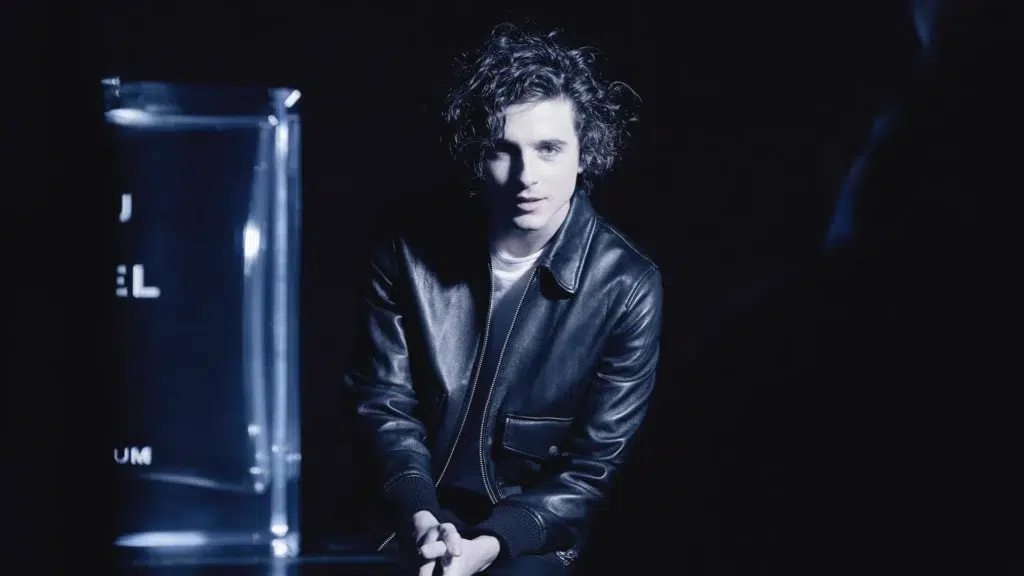
The Scorsese film was not the end of Chalamet’s Bleu de Chanel work. Later in 2024, Chanel launched Bleu de Chanel L’Exclusif, a new concentration of the fragrance developed by in-house perfumer Olivier Polge as an elevated, more intense version of the original.
Polge described his brief as pushing the Bleu signature “to an extreme level,” creating something with “more depth, more texture and more strength” to reflect how men’s tastes in fragrance had evolved. The L’Exclusif carried a woody amber composition built around sandalwood and cistus labdanum, housed in a glossy navy square bottle.
Chalamet fronted the L’Exclusif campaign in a sharply different visual register: a noir-influenced shoot featuring a pinstriped ensemble that signalled sophistication rather than the raw, cinematic energy of the Scorsese film. The campaign launched globally with a dedicated event in Bangkok, with the SCMP reporting directly from the debut.
What the L’Exclusif launch demonstrated about the partnership’s commercial depth:
- Product extension: A new concentration justified by Chalamet’s ability to sell the fragrance’s elevated premium positioning
- Dual campaign strategy: Two distinct visual identities from the same ambassador reaching different consumer mindsets
- Global activation: Bangkok debut followed by international rollout, tapping Chanel’s Asia-Pacific market where revenues topped $10 billion in 2023
- Fragrance tier expansion: L’Exclusif positioned above the standard Bleu line, creating an upsell opportunity within the same brand franchise
Why the Campaign Went Viral
What TikTok did to a luxury fragrance ad
The Scorsese film’s release on May 17, 2024 triggered immediate response across every platform. TikTok reaction videos accumulated millions of views within days. Users who had never engaged with a fragrance campaign were posting their emotional responses to a 90-second ad. The hashtag Bleu de Chanel trended internationally across multiple markets simultaneously.
Several factors produced the viral spread, none of them accidental:
The structural reasons this campaign spread where others don’t:
- A year of anticipation: The announcement, the behind-the-scenes leak, and Chalamet’s GQ interview had built genuine curiosity before a single finished frame existed
- Scorsese’s name as credibility signal: Non-fashion audiences who follow cinema engaged with the campaign purely because of the director
- Chalamet’s fanbase: His audience, built across Dune, Call Me By Your Name, and Wonka, is unusually loyal and highly active on social media
- The film actually delivered: When audiences watched it, the quality matched the hype, which meant positive word-of-mouth rather than disappointment
- Short enough to watch completely: At 90 seconds, the film was short enough for full watch-through on any platform, maximising engagement metrics
The campaign also benefited from timing. It dropped during the Dune: Part Two global release window, when Chalamet’s visibility was at its highest. Every piece of Chalamet content was receiving elevated attention, and the Bleu de Chanel film arrived into that amplified context.
What it changed for men’s fragrance marketing
Before the Chalamet campaign, men’s fragrance advertising operated on a predictable template: a conventionally masculine figure in a dramatic setting, a visual metaphor for freedom or power, and a product shot. The storytelling was functional at best.
The Bleu de Chanel short film demonstrated that men’s fragrance could support genuine cinematic narrative with a real emotional arc. It treated its audience as people who watch films, not just people who buy cologne. The response proved that audience existed and was significantly larger than luxury fragrance brands had assumed.
The men’s luxury fragrance market had been growing steadily, with prestige men’s scent among the fastest-growing beauty categories globally heading into 2024. The Chalamet campaign arrived at exactly the moment the category was ready for a cultural upgrade in how it communicated.
The Bottom Line
The Timothée Chalamet Bleu de Chanel campaign is the most commercially and culturally significant men’s fragrance marketing moment of the decade so far. It worked because every element was aligned: the right talent at the peak of his cultural moment, the right director who understood both cinema and what celebrity had become, and a brand willing to let the story take precedence over the product.
Chanel spent $2.5 billion on brand support in 2023 and named the Chalamet appointment as one of the two defining marketing moves of the year in its official financial results. Fragrance & Beauty recorded “very strong growth” across all categories. The L’Exclusif extension followed, proving the partnership had commercial depth beyond a single viral moment.
What made this campaign a blueprint for luxury fragrance marketing:
- Talent at cultural peak: Chalamet’s appointment coincided with his highest global visibility, maximising campaign reach from launch
- Director as differentiator: Scorsese’s involvement made the campaign newsworthy to audiences who had never engaged with a fragrance brand
- Narrative over product: Treating the ad as a short film, not a commercial, gave audiences a reason to watch it, share it, and talk about it
- Year-long build: The announcement, behind-the-scenes leak, and press interviews created sustained anticipation that most campaigns never generate
- Extension strategy: The L’Exclusif campaign gave the partnership commercial legs beyond the initial viral moment
For any brand trying to understand how to make a fragrance campaign matter in 2024 and beyond, this is the case study. Chanel did not just sell Bleu de Chanel. It made the world want to watch an advertisement.