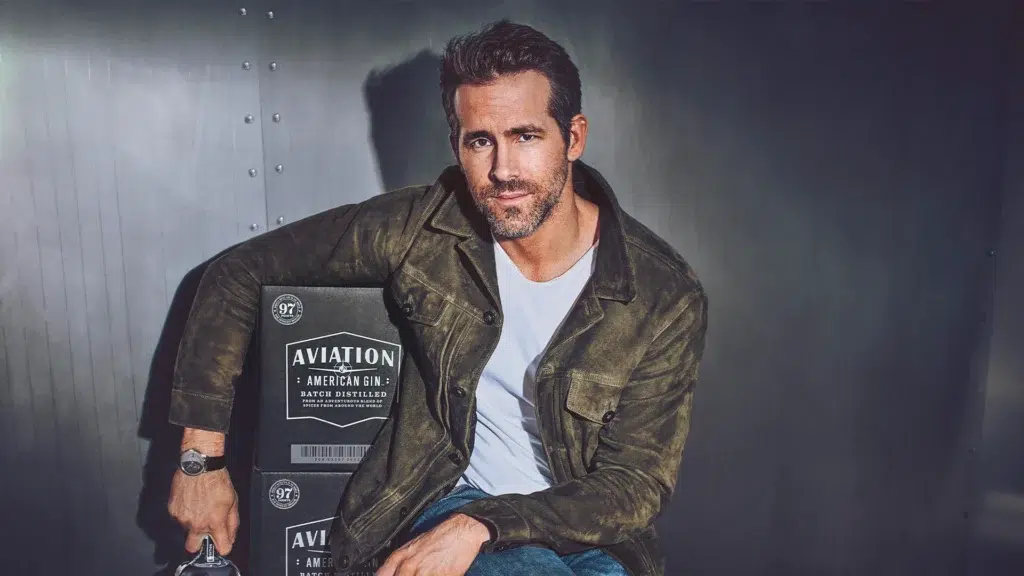
Most celebrities settle for endorsement cheques. Ryan Reynolds wanted equity. In February 2018, the Deadpool star quietly acquired a minority stake in Aviation American Gin, a craft gin brand from Portland, Oregon, that most people outside of bartending circles had never heard of. Two years later, he walked away from a deal worth up to $610 million when spirits giant Diageo acquired the brand in August 2020.
That timeline is not a typo. Reynolds entered entrepreneurship by acquiring an ownership stake in the alcohol brand, and just two years later sold the company to Diageo, the world’s largest producer of spirits. What happened in those twenty-four months is one of the most studied celebrity business plays of the decade.
By the time the deal closed, Aviation Gin Ryan Reynolds had grown more than 100% in sales volume in a single year, become the second-largest super-premium gin brand in the United States, and contributed 40% of the entire super-premium gin category’s growth in 2019. This is how he did it.
The Aviation Gin Ryan Reynolds Results:
- Diageo acquisition price: Up to $610 million, announced August 17, 2020
- Initial upfront payment: $335 million cash at closing
- Performance earn-out: Up to $275 million over ten years based on Aviation’s sales milestones
- Reynolds’ personal payout: Estimated at up to $122 million from the deal
- Sales growth under Reynolds: Over 100% volume growth in 2019 alone
- US market position at sale: Second-largest super-premium gin brand in the United States
- Category contribution (2019): 40% of total US super-premium gin category growth, per IWSR data cited by Diageo
- Wine Enthusiast rating: 97 points, the highest the magazine had ever given to any gin
Aviation Gin Ryan Reynolds is not just a celebrity alcohol story. It is a blueprint for how a Hollywood star can use personality, speed, and creative equity to turn a niche craft brand into a nine-figure exit in under three years.
Why Ryan Reynolds Got Into Gin
From Fan to Co-Owner
Reynolds is not actually the original brains behind Aviation Gin. At first, he was just a fan. After trying the gin and falling for its flavor, he decided he had to be part of it. That genuine personal connection to the product became the cornerstone of everything that followed. When Reynolds talks about Aviation on camera, it does not look like a paid advertisement. It looks like a man who genuinely drinks this gin at home.
Aviation American Gin was founded in 2006 by distiller Christian Krogstad and bartender Ryan Magarian at House Spirits Distillery in Portland, Oregon. The brand was acquired by New York-based Davos Brands in 2016, and Reynolds became co-owner and creative director in February 2018. By the time he came on board, Aviation had a strong reputation in bartending communities, a 97-point Wine Enthusiast score, and was already the second-largest super-premium American gin in the United States. What it lacked was national consumer visibility.
What made Aviation Gin attractive as a business investment:
- Product quality: 97 points from Wine Enthusiast, the highest score the publication had ever awarded to any gin, providing third-party validation before Reynolds joined
- Market position: Already the second-largest super-premium American gin brand in the United States, with trade-level credibility established over a decade of production
- Growth trajectory: Consistent volume growth year-over-year since 2017, with strong demand already established in bartending communities across the country
- Category tailwinds: The US super-premium gin segment was expanding rapidly, driven by consumer premiumization trends across all spirits categories at the time
- Creative gap: A genuinely excellent product with no breakout consumer marketing strategy, exactly the gap Reynolds was positioned to fill through Maximum Effort
The Equity-First Mindset
Reynolds structured his involvement as co-owner and creative director, not as a paid spokesperson. This distinction is everything. He operates through a concept known as value-added investing, where he acquires a stake in companies and uses his own expertise to grow the business. With Aviation, his expertise was not distilling. It was storytelling.
He brought his production company Maximum Effort into the equation immediately. The agency, which he co-founded with marketing executive George Dewey in 2018, became the creative engine behind Aviation’s advertising. Reynolds later described his marketing philosophy as “fast-vertising,” identifying cultural moments and producing high-quality responses within hours rather than weeks. Aviation Gin Ryan Reynolds became the first real-world test case for this approach.
How Reynolds structured the Aviation Gin deal:
- Ownership structure: Acquired an unspecified minority stake in February 2018, serving as both co-owner and creative director, giving him financial upside and full creative authority simultaneously
- Maximum Effort integration: His production company took over all creative advertising for Aviation immediately, allowing rapid turnaround without external agency delays or budget approvals
- No corporate ladder: Reynolds noted that owning the brand meant he could approve and release campaigns in hours rather than going through months of traditional corporate approval processes
- Authentic positioning: Every campaign was designed to feel like entertainment content first and advertising second, driving organic sharing at scale with minimal paid media spend
The Journey: From Portland Craft Gin to $610 Million
Phase 1: Building Brand Awareness (2018)
When Reynolds came on board, Aviation Gin had strong trade credibility but limited consumer recognition outside of craft spirits circles. The first phase was about changing that fast, and without a massive advertising budget. In 2018, Aviation Gin was one of the top 10 trending brands on YouTube and top 3 on all social media combined, according to GlobalData research. That kind of organic traction is worth hundreds of millions in paid media equivalent.
Reynolds wove the brand into his entire public ecosystem. He featured Aviation in his Netflix productions including Red Notice and Deadpool 2. He signed a sleeve and training kit sponsorship deal for Wrexham AFC, the Welsh football club he co-purchased in 2020 with actor Rob McElhenney. He turned every public appearance into a casual endorsement opportunity. The brand gained international exposure across film, sport, and social media simultaneously, without spending what a traditional spirits campaign would cost.
How Reynolds built Aviation’s brand presence in 2018:
- Maximum Effort creative: Reynolds’ agency produced all advertising in-house, allowing rapid turnaround and a consistent brand tone that no external agency could replicate at the same speed
- Film tie-ins: Aviation appeared organically in Reynolds’ Netflix productions including Red Notice and Deadpool 2, reaching global audiences of tens of millions at zero additional media cost
- Social media distribution: Reynolds’ combined following of over 117 million across Instagram, X, TikTok, and Facebook became a free distribution channel for Aviation content at no media cost
- Wrexham sponsorship: Aviation signed a kit and sleeve sponsorship with Wrexham AFC, extending brand visibility into the global football audience through the Welcome to Wrexham documentary
Phase 2: The Viral Moment That Changed Everything (2019)
December 2019 was when Aviation Gin Ryan Reynolds stopped being a niche story and became a global one. Peloton had released a holiday commercial featuring a husband gifting his wife an exercise bike, which went viral for all the wrong reasons. Social media critics called it sexist and tone-deaf, and Peloton’s stock dropped nearly 10% in the days that followed. Reynolds saw an opportunity that most brands would have taken weeks to deliberate over. He moved in seventy-two hours.
Reynolds tracked down Monica Ruiz, the actress from the Peloton ad, and filmed an Aviation Gin response commercial showing her at a bar with two friends, drinks in hand, looking relieved. The ad said nothing explicit about Peloton. It did not need to. Reynolds tweeted the video with the caption “Exercise bike not included” and the internet did the rest. The ad had 9.4 million views on Twitter within 48 hours and approximately 4 million more on YouTube in the first day alone, with zero paid promotion behind the release.
The results of the Peloton moment for Aviation Gin:
- Production speed: Only 15 days elapsed between the Peloton controversy and Aviation Gin’s response commercial going live, a timeline impossible for traditionally structured brands
- Twitter views: 9.4 million views within 48 hours of Reynolds tweeting the ad, driven entirely by organic sharing and international media coverage
- YouTube views: Approximately 4 million views in the first day alone on YouTube, with zero paid promotion behind the release
- Full-year sales impact: 2019 volume growth exceeded 100%, making Aviation one of the fastest-growing gin brands in the United States that year per IWSR data
- Category influence: Aviation contributed 40% of total US super-premium gin category growth in 2019, per IWSR data cited by Diageo in the acquisition announcement
- US retail sales growth: Sales rose from approximately $20 million in 2018 to approximately $40 million in 2019, per Euromonitor data cited by the Wall Street Journal
- Volume milestone: Aviation crossed 110,000 cases in annual volume, growing 28% year-over-year and crossing 100,000 cases for the first time, per Impact Databank
The Peloton moment also became the defining example of Reynolds’ fast-vertising philosophy. He explained that being the owner of the brand meant he did not have to climb a corporate ladder to get approval. He called Monica Ruiz himself, convinced her to do the ad, and had it live before the news cycle moved on. That speed was only possible because of the ownership structure he had insisted on from the beginning.
Phase 3: The Diageo Acquisition (2020)
By mid-2020, Aviation Gin Ryan Reynolds had transformed from a regional craft spirit into one of the fastest-growing premium alcohol brands in North America. Diageo, the world’s largest spirits company and owner of Tanqueray, Johnnie Walker, and Smirnoff, had been watching this trajectory closely. The deal they structured reflected both the brand’s current value and its long-term potential under their global distribution network.
On August 17, 2020, Diageo announced the acquisition of Aviation Gin LLC and Davos Brands LLC for a total consideration of up to $610 million. The deal included an initial cash payment of $335 million, with a further potential earn-out of up to $275 million over ten years based on Aviation’s sales performance. Reynolds retained an ongoing ownership interest in the brand post-acquisition and continued as its creative face, ensuring that the personality-driven marketing that had built the brand would continue under Diageo’s ownership.
Key details of the Diageo acquisition:
- Total deal value: Up to $610 million, structured as $335 million upfront plus up to $275 million in performance-linked earn-out over ten years
- Brands acquired: Aviation Gin LLC and the entire Davos Brands portfolio, including Astral Tequila, Sombra Mezcal, and TYKU Sake
- Diageo’s rationale: CEO Ivan Menezes stated the acquisition aligned with their strategy to acquire high-growth brands with attractive margins that support premiumization in the US market
- Reynolds post-deal: Retained an ongoing ownership interest and continued as creative director, maintaining the marketing approach that had driven the brand’s growth
- Comparable deal: Diageo had previously paid up to $1 billion to acquire Casamigos in 2017, the George Clooney-backed tequila brand, establishing the precedent for this scale of celebrity alcohol acquisition
The Business Model: How Aviation Gin Makes Money
Revenue Streams and Pricing Strategy
Aviation American Gin retails for $27 per 750ml bottle, positioning it in the super-premium gin segment where bottles cost $25 and above. This pricing point is high enough to carry strong margins but accessible enough to attract mainstream consumers trading up from mid-range spirits. The US super-premium gin category generated $918 million in total revenue in 2019, per the Distilled Spirits Council, with Aviation sitting as the second-largest player in that segment.
Under Diageo, Aviation benefits from global distribution infrastructure across 180 countries. The brand was available in 16 countries at the time of the acquisition, including the United States, Canada, the United Kingdom, Ireland, France, Germany, Italy, the Netherlands, Spain, and Australia. Diageo’s distribution network has the capacity to significantly expand that footprint over the ten-year earn-out period, which directly ties into Reynolds’ potential additional $275 million payout.
Aviation Gin’s revenue streams under Diageo:
- Retail price point: $27 per 750ml bottle, placing Aviation in the super-premium segment that drove all US gin category growth from 2017 to 2020
- Global distribution: Available in 16 countries at acquisition, with Diageo’s 180-country network providing significant expansion potential across the ten-year earn-out period
- Distillery and visitor centre: Aviation opened its own distillery and visitor centre in Portland, Oregon in September 2022, adding a tasting room, draft cocktail bar, and gift shop as direct revenue streams
- Limited edition releases: Six Deadpool and Wolverine bottles in 2024, Wrexham AFC collector editions in 2021, and seasonal releases create recurring premium revenue spikes throughout the year
- Earn-out alignment: Reynolds’ potential $275 million additional payout is tied to Aviation’s sales performance, giving him a direct financial incentive to continue driving brand growth post-acquisition
The Maximum Effort Marketing Machine
One of the most important but least discussed aspects of the Aviation Gin Ryan Reynolds business model is how cheaply he built the brand. Maximum Effort produced Aviation’s campaigns in-house. Reynolds has spoken about intentionally using modest budgets, noting that when money is taken away, you replace whatever is lost with character. The Aviation Gin ads were not expensive. They were fast, funny, and culturally aware in a way that no amount of media spend can manufacture.
The marketing approach Reynolds developed has since been described as attention arbitrage. The formula involves identifying a cultural moment, producing a response at speed, releasing it on social media, and letting earned media carry the message. Reynolds applied the same approach to Aviation’s tie-in with Virgin Atlantic, his quarantine cocktail content during Covid-19, and the Deadpool and Wolverine limited edition bottle campaign in April 2024.
How Maximum Effort built Aviation’s brand at minimal cost:
- Fast-vertising model: Reynolds coined the term to describe identifying cultural moments and producing quality response content within hours, bypassing traditional corporate approval chains entirely
- Low production costs: Aviation campaigns were deliberately made on modest budgets, replacing expensive sets and production scale with character, dialogue, and precise cultural timing
- Earned media reliance: The Peloton response ad cost a fraction of a traditional media buy but generated international news coverage worth tens of millions in earned media value
- Cross-property integration: Aviation appeared across Reynolds’ Deadpool films, Wrexham ownership, Virgin Atlantic partnership, and personal social media, creating multi-channel exposure without multi-channel budgets
The Strategy: What Makes Aviation Gin Different
American Gin vs London Dry
Aviation Gin is classified as an American-style gin, meaningfully different from the dominant London Dry style most consumers associate with the category. London Dry gins lead with juniper as the primary botanical note, giving them the sharp, piney character that divides opinion among casual drinkers. Aviation’s recipe, developed by bartender Ryan Magarian in 2006, deliberately softens the juniper and leads with citrus and floral notes from lavender, sweet and bitter orange peel, and cardamom.
The gin uses seven botanicals in total: juniper, lavender, sweet and bitter orange peel, cardamom, coriander, Indian sarsaparilla, and anise seed. These are steeped in grain spirit for 18 hours, then re-distilled in a custom-built 400-gallon pot still and bottled at 84 proof. The result is a gin approachable for consumers previously put off by heavily juniper-forward styles, expanding Aviation’s potential customer base well beyond traditional gin drinkers.
What sets Aviation Gin apart from the competition:
- Botanical profile: Seven botanicals including juniper, lavender, two types of orange peel, cardamom, coriander, Indian sarsaparilla, and anise seed create a more floral and citrus-forward profile than London Dry competitors
- Production method: Botanicals steeped for 18 hours before re-distillation in a custom 400-gallon pot still, then brought to 84 proof with Cascade mountain water for bottling in Portland, Oregon
- Market differentiation: The American-style positioning targets consumers who find traditional gin too juniper-heavy, expanding the addressable market well beyond established gin drinkers
- Industry recognition: Wine Enthusiast awarded Aviation 97 points in 2012, the highest the publication had ever given to any gin, providing decade-long third-party validation of product quality
Celebrity Ownership Done Differently
The celebrity spirits market is crowded. George Clooney sold Casamigos for up to $1 billion. Jay-Z built Armand de Brignac champagne and D’Usse cognac into major assets. Diddy built Ciroc into a vodka giant through a Diageo partnership. What set Aviation Gin Ryan Reynolds apart was the quality of the creative output and the degree to which Reynolds personally drove the marketing at speed rather than lending his name to someone else’s campaign strategy.
Most celebrity alcohol brands use the celebrity’s image in polished, expensive advertising. Reynolds turned Aviation into a platform for genuinely funny, culturally aware content that people shared voluntarily. The brand became known as much for its advertising approach as for the gin itself. This brand personality was Reynolds’ real contribution, and it is the reason Diageo was willing to pay a high multiple of sales for a brand generating $40 million in US retail revenue at the time of the deal.
Why Reynolds’ celebrity ownership model worked where others have not:
- Genuine product affinity: Reynolds was a real fan of Aviation before acquiring his stake, giving his promotion of the brand an authenticity that paid celebrity endorsements rarely achieve
- Self-deprecating humor: Aviation campaigns consistently used Reynolds as the butt of the joke rather than positioning him as aspirational, making the brand feel accessible rather than exclusive
- Cultural participation: Rather than buying cultural relevance through sponsorships, Reynolds created it by participating directly in news cycles, meme culture, and trending conversations at no media cost
- Valuation justification: Diageo paid a high multiple of sales because they were acquiring both the brand and the marketing approach, knowing Reynolds would stay on and continue driving growth post-acquisition
The Numbers: Reynolds’ Aviation Gin Wealth
Valuation and Ownership
Reynolds acquired an unspecified minority stake in Aviation Gin in February 2018 for an undisclosed sum. The exact ownership percentage has never been publicly confirmed. Forbes attempted to obtain the details from Reynolds’ representatives, who acknowledged his significant ownership but declined to provide specific percentages. Based on comparable celebrity alcohol deals and the estimated payout from the Diageo transaction, multiple sources have placed Reynolds’ stake at approximately 20% of the company.
Using that estimate against the $335 million upfront payment, Reynolds’ share of the initial cash payment would be approximately $67 million. With the potential $275 million earn-out over ten years factored in, his total payout from the deal has been estimated at up to $122 million by Yahoo Finance, Benzinga, and Celebrity Net Worth. That figure represents his return on a stake he acquired just over two years before the sale was announced in August 2020.
Breaking down Reynolds’ Aviation Gin payout:
- Estimated ownership stake: Approximately 20%, based on comparable celebrity alcohol deals and publicly estimated payout figures from multiple financial publications
- Upfront cash payout: Approximately $67 million based on a 20% stake in the $335 million initial payment made at closing in 2020
- Total estimated payout: Up to $122 million including the performance earn-out, per estimates from Yahoo Finance, Benzinga, and Celebrity Net Worth
- Time to exit: Approximately two and a half years from February 2018 acquisition to the August 2020 deal announcement, representing an exceptional return on timeline
Aviation Gin Within Reynolds’ Business Empire
The Aviation Gin Ryan Reynolds exit was the first of two landmark nine-figure business deals Reynolds would execute within five years. In March 2023, T-Mobile acquired Mint Mobile, a budget wireless carrier in which Reynolds held approximately 25%, in a deal valued at $1.35 billion. Reynolds’ payout from the Mint Mobile transaction has been estimated at over $330 million. Combined with the Aviation Gin proceeds, Reynolds has reportedly netted over $450 million from these two exits alone.
As of early 2026, Reynolds’ net worth is estimated at approximately $350 million by the majority of financial sources. His business portfolio at this point includes co-ownership of Wrexham AFC, a stake in Alpine Racing’s Formula 1 team acquired in 2023, investments in fintech firm Nuvei which was acquired in April 2024 in a deal valued at $6.3 billion, and ongoing involvement with Maximum Effort. Aviation Gin remains part of that ecosystem through his continuing creative role with Diageo.
Reynolds’ full business portfolio as of early 2026:
- Aviation Gin payout: Estimated at up to $122 million from the $610 million Diageo deal across upfront payment and performance-linked earn-out over ten years
- Mint Mobile payout: Reynolds’ approximately 25% stake generated an estimated $330 million when T-Mobile acquired Mint Mobile in 2023 for $1.35 billion
- Combined business exits: Over $450 million reportedly netted from Aviation Gin and Mint Mobile combined, far exceeding his acting income over the same period
- Net worth in 2026: Estimated at approximately $350 million by Celebrity Net Worth, Parade, and the majority of financial publications as of early 2026
- Current portfolio: Wrexham AFC co-ownership, Alpine F1 team stake, Nuvei investment, Maximum Effort production company, and ongoing Aviation Gin creative involvement under Diageo
The Bottom Line
Ryan Reynolds turned Aviation Gin from a well-regarded craft spirit into a $610 million acquisition target in under three years. He did it without a massive advertising budget, without traditional celebrity endorsement campaigns, and without ever pretending to be something he was not. The Aviation Gin Ryan Reynolds story works because every piece of it was genuine. The product was real, the humor was real, the speed was real, and the ownership stake meant Reynolds had real financial skin in the game from day one.
Why Aviation Gin Ryan Reynolds Succeeded:
- Equity over endorsement: Reynolds insisted on co-ownership and creative control rather than a paid spokesperson deal, ensuring he participated directly in the value he created for the brand
- Speed as competitive advantage: The Peloton response ad, produced and released in under 72 hours, generated more brand awareness than months of traditional advertising at a fraction of the cost
- Authentic product connection: Reynolds was a genuine Aviation fan before acquiring his stake, giving every piece of brand content a credibility that clearly paid brand ambassadors cannot replicate
- Maximum Effort infrastructure: Building his own production and marketing company gave Reynolds the in-house capability to execute fast-vertising campaigns without waiting on external agencies or corporate approvals
- Category timing: Reynolds entered Aviation at the precise moment the US super-premium spirits segment was accelerating, turning consumer premiumization trends into direct sales growth for the brand
- Exit discipline: Reynolds sold when the valuation was at its highest relative to runway, extracting maximum value while staying involved through his ongoing ownership interest under Diageo
The Diageo acquisition validated everything Reynolds had built. The spirits giant was not just buying a gin brand. They were buying the marketing engine, the cultural credibility, and the promise that Ryan Reynolds would stay on as the face of Aviation and keep driving the kind of viral, low-cost, high-impact campaigns that had turned a $40 million revenue brand into a $610 million acquisition. That is a deal structure only possible when the celebrity is also the owner, the creative director, and the genuine believer in the product.
Key Success Factors:
- Brand awareness built: Top 10 trending brand on YouTube and top 3 across all social media in 2018, within the first year of Reynolds’ involvement with Aviation Gin
- Sales growth achieved: US retail sales doubled from approximately $20 million in 2018 to $40 million in 2019, per Euromonitor data cited by the Wall Street Journal
- Market position established: Second-largest super-premium gin brand in the United States at the time of the $610 million Diageo acquisition in August 2020
- Personal return generated: Estimated payout of up to $122 million from a stake acquired just over two years before the sale was announced
Aviation Gin Ryan Reynolds is the case study that every celebrity entrepreneur now gets measured against. It is the proof that the equity model works, that fast creative beats expensive creative, and that genuine product belief combined with the right ownership structure can turn two years of work into a nine-figure exit. Reynolds called it an unusual move at the time. Looking back, it looks like the most obvious thing in the world.