In 1930, a young entrepreneur named Mohammad Manal was riding through the forests surrounding Dehradun when he observed something that would shape the next century of Indian wellness. Local tribals were using herbal remedies with striking effectiveness for conditions that conventional medicine of the era struggled to treat. Manal was not a scientist or a doctor. He was a businessman who recognised something the formal healthcare system had not: that India’s ancient herbal knowledge, if validated by modern science, could become a globally credible product.
That insight gave birth to Himalaya Drug Company, today rebranded as Himalaya Wellness Company. Nearly a century later, the brand sells over 500 products across 106 countries, is the No.1 face wash brand in India, and is constructing a $54.4 million pharmaceutical factory in Dubai to serve global demand.
What Himalaya built is not just a product company. It is a trust architecture, a herbal brand that managed to win over both doctors who prescribe its pharmaceuticals and consumers who buy its face wash by the crore units. No other Indian brand has done both at the same scale simultaneously.
From a Forest Road to Dehradun: The 1930 Origin
Mohammad Manal founded Himalaya Drug Company in Dehradun in 1930 with a belief that Ayurveda, when backed by rigorous modern science, could treat conditions that conventional medicine addressed only partially.
His first formulation was Serpina, extracted from the herb Rauwolfia serpentina, used in Indian traditional medicine for centuries for its calming and hypotensive properties. Serpina became the world’s first anti-hypertensive drug to be commercially launched, a claim that gave the brand scientific credibility from the very beginning. This was not wellness in the modern sense of aromatherapy and essential oils. This was clinical pharmacology derived from herbal ingredients.
Key milestones in Himalaya’s early decades:
- 1930: Founded in Dehradun by Mohammad Manal; Serpina launched as the world’s first anti-hypertensive herbal drug
- 1950s: Company moves its headquarters to Bombay (Mumbai) to access broader markets
- 1955: Liv.52 launched, a hepato-protective drug that becomes the flagship product and one of the top 10 selling drugs in India
- 1975: Meraj Manal, Mohammad’s son, sets up a manufacturing unit in Bangalore, enabling scale and globalisation
- 1996: Himalaya enters the United States market following the Dietary Supplement Health and Education Act of 1994, its first major international expansion
The choice to anchor the brand in science, not just tradition, was the most important decision in Himalaya’s history. It meant that Liv.52 could be prescribed by gastroenterologists, not just stocked at Ayurvedic shops. It meant global regulatory bodies could evaluate Himalaya products against defined standards. And it meant that when the personal care division launched decades later, the trust built through pharmaceuticals transferred seamlessly to face washes and shampoos.
Why Liv.52 Was More Than a Product
Liv.52, the liver protective drug launched in 1955, remains the single most commercially significant product in Himalaya’s history and one of India’s best-known pharmaceutical brands globally.
The drug combines herbs including Himsra and Kasani that had established use in traditional medicine for liver conditions. Himalaya backed the formulation with clinical studies and positioned it to doctors as a hepato-protective agent, generating doctor endorsement that most FMCG brands spend decades trying to achieve.
What Liv.52 built for the Himalaya herbal brand:
- Doctor trust: By getting physicians to prescribe Liv.52, Himalaya established a medical credibility that consumer brands cannot manufacture through advertising alone
- Global proof point: Liv.52 is sold and recommended in over 60 countries; it demonstrated that Indian herbal science could meet international quality expectations
- Revenue foundation: Liv.52 alone, within the pharmaceutical portfolio, ranks consistently among the top 10 selling drugs in India
- Brand permission: A company whose liver drug is trusted by doctors automatically earns consumer permission to launch personal care products under the same name
The 1999 Pivot: From Pharmacy to FMCG
In 1999, Himalaya made its most consequential strategic decision since Liv.52. It launched a personal care range under the name Himalaya Herbals, entering the mass consumer FMCG market for the first time.
The category entry was not random. Himalaya had two decades of brand equity built through the pharmaceutical channel, a network of doctors who recommended its products, and deep ingredient credibility with consumers who trusted the Himalaya name. The personal care launch essentially asked: can we transfer that pharmaceutical trust into everyday purchase decisions?
The answer, evidenced by what followed, was a clear yes.
What the personal care pivot delivered:
- Face wash leadership: Himalaya Purifying Neem Face Wash became and remains India’s No.1 face wash brand across all price segments
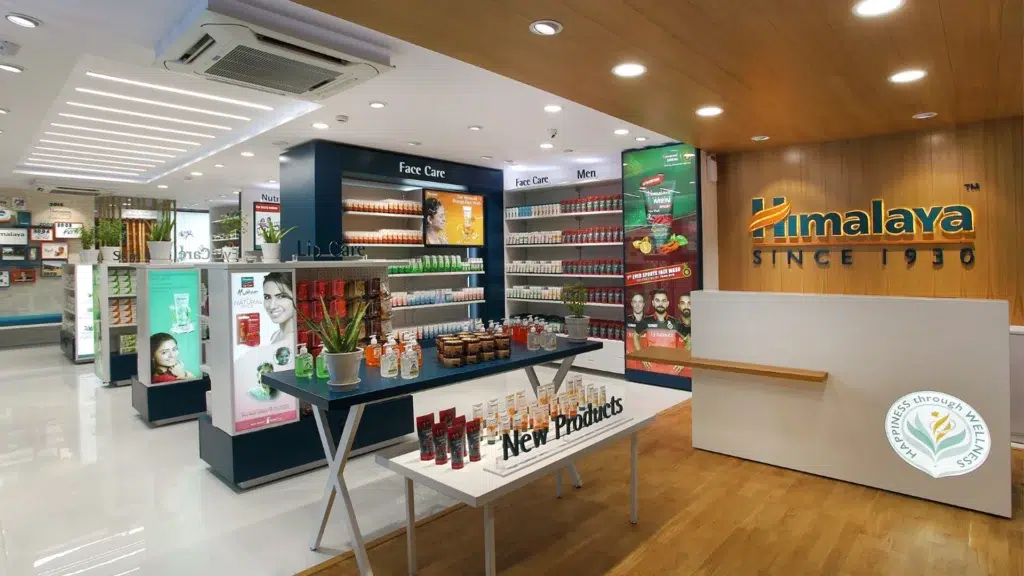
- Category breadth: The division expanded to include shampoos, moisturisers, lip balms, soaps, scrubs, body lotions, and toothpaste under one coherent herbal positioning
- Revenue composition shift: By the time the company hit ₹2,000 crore in turnover, personal care contributed 42% of total revenue, ahead of pharmaceuticals at 33%
- Mass market scale: Products priced from ₹20 toothpaste to premium skincare, giving Himalaya access to every income segment simultaneously
- Retail depth: Distribution expanded from pharmacies and medical stores to supermarkets, general trade, and eventually e-commerce
The Neem Face Wash: A Category Defining Product
No single product tells the Himalaya herbal brand story as completely as the Purifying Neem Face Wash, launched in the early 2000s and still growing.
Neem had been used in Indian households for centuries as an antibacterial and skin-clearing ingredient. Himalaya took this widely understood ingredient, formulated it into a soap-free face wash with clinical backing for acne and pimple reduction, priced it at an accessible ₹90 for 100ml, and distributed it everywhere from pharmacies to grocery stores.
In August 2025, Himalaya reformulated the product with a 5-parts of neem formulation, using the mature leaf, tender leaf, flower, fruit, and stem of the neem plant simultaneously. The updated formula is clinically tested to reduce pimples from Day 5 and fade pimple marks. After 25 years of market leadership, the brand chose to invest in ingredient innovation rather than simply maintain its position.
Why the Neem Face Wash succeeded where competitors failed:
- Ingredient familiarity: Every Indian consumer already knew neem; Himalaya did not have to educate the market on why it worked
- Clinical validation: The soap-free, dermatologically tested positioning bridged the gap between traditional remedy and modern skincare
- Price accessibility: At ₹90 for 100ml, the face wash sits at a price point reachable across income groups in India
- Distribution scale: Available at every chemist, supermarket, and kirana store; the product literally had no access barrier
- Trust inheritance: Consumers who knew Himalaya from Liv.52 or baby care products extended that trust to face care automatically
The Business Architecture: Six Verticals, One Brand
What makes Himalaya Wellness genuinely unusual among Indian consumer companies is its ability to operate credibly across six completely different business verticals under a single brand name.
Most FMCG companies build separate brands for separate categories. Himalaya has run everything under one roof since 1930, relying on the consistency of the herbal, science-backed positioning to hold the entire portfolio together.
Himalaya’s six revenue verticals and what each contributes:
- Therapeutics and pharmaceuticals: Anchored by Liv.52 and a range of Ayurvedic medicines; historically the brand’s highest-trust segment; contributes approximately 33% of revenue
- Personal care: Face washes, shampoos, moisturisers, soaps, toothpaste; 42% of total revenue and the largest single segment; includes India’s No.1 face wash
- Baby care: Launched in 2007; includes baby shampoo, baby lotion, baby wipes and diapers; contributed 15% of turnover when the company was at ₹2,000 crore
- Wellness and nutrition: Ashwagandha capsules, organic supplements, protein products; growing rapidly as India’s supplement market expands
- Animal health: Veterinary herbal products; smaller but strategically useful for institutional credibility
- Men’s range: Himalaya Men face washes, body washes and grooming products; dedicated to the growing Indian male grooming segment
How R&D Holds the Portfolio Together
Every Himalaya product, from Liv.52 to Neem Face Wash to Ashwagandha gummies, traces back to a research process that involves both traditional Ayurvedic literature and modern clinical validation.
The company runs a global R&D centre spanning 92,000 sq. ft. at Dubai Science Park in addition to its research operations in Bengaluru. More than 290 researchers utilise Ayurvedic herbs and minerals across the portfolio.
What Himalaya’s R&D process delivers:
- Ingredient sourcing validation: Every herb in the portfolio is sourced, tested, and standardised before formulation; no ingredient enters production without phytochemical analysis
- Clinical studies: Key products including Liv.52 have decades of published clinical data; the face wash range is dermatologically tested; baby products are ophthalmologically tested
- International regulatory compliance: Products are formulated to meet European Medicines Agency GMP guidelines, WHO standards, and US FDA requirements
- New product pipeline: The research team continuously evaluates traditional Ayurvedic formulations for modern applicability, generating a steady flow of category extensions
- Technology transfer capability: The Dubai Science Park R&D centre is designed to facilitate technology transfer to the new Dubai manufacturing facility
106 Countries: The Global Herbal Brand Story
Himalaya’s international expansion is one of the most consistent and deliberate globalisation stories among Indian consumer brands.
The company entered the US market in 1996 following the Dietary Supplement Health and Education Act, which created a formal regulatory pathway for herbal supplements. As of 2015, the company was present in 91 countries. Today, it sells products across 106 countries with regional headquarters in Dubai, Singapore, and Houston in addition to Bangalore.
How Himalaya built its global herbal brand presence:
- Pharmaceutical-first entry: In most markets, Himalaya entered through the pharmacy channel with Liv.52 and other therapeutic products before introducing personal care; doctor endorsement preceded consumer marketing
- Middle East strength: The Middle East is one of Himalaya’s strongest international markets; the Dubai headquarters reflects this; personal care, baby care, and pharmaceuticals all have strong regional penetration
- US market positioning: In the US, Himalaya Herbal Healthcare products including Ashwagandha, Triphala, and Bacopa are sold as dietary supplements through health food stores, Amazon, and pharmacy chains
- Global-local product adaptation: International product formulations are adapted to local regulatory requirements while maintaining core ingredient integrity
- Regional HQs as growth engines: The Dubai, Singapore, and Houston offices operate as genuine regional business hubs, not just sales offices
The AED 200 Million Dubai Factory
In October 2023, Himalaya broke ground for a herbal pharmaceutical factory at Dubai Industrial City, financed in part by Emirates Development Bank. The investment is ₹1,860 crore equivalent ($54.4 million or AED 200 million).
This is Himalaya’s first manufacturing plant outside India, and its scale signals how seriously the company is treating its global ambitions.
Key details of the Dubai factory:
- Built-up area: 225,000 sq. ft. in Phase 1 at Dubai Industrial City
- Annual production capacity: 3 billion tablets, 15 million syrup bottles, and 3 million units of ointment
- Regulatory compliance: Built to European Medicines Agency GMP, WHO, and US FDA standards simultaneously
- Target markets: Positioned to serve the GCC, Middle East, US, Europe, and select Asia Pacific markets
- Timeline: Capacity designed to serve global volumes through 2030
- Employment: 250 professionals in Phase 1
- Strategic intent: Establishes Dubai as Himalaya’s sourcing and manufacturing hub for global markets, reducing dependence on single-country production
The factory positions Himalaya herbal brand products competitively in global markets by manufacturing closer to the point of sale, enabling faster lead times and compliance with regional regulatory requirements that import-based supply cannot always meet.
Competing in India’s Crowded Herbal Space
Himalaya built its position in Indian herbal healthcare largely without credible competition for the first six decades. That changed dramatically when Patanjali, founded by Baba Ramdev in 2006, entered the market with aggressive pricing and a vocal nationalist positioning.
Patanjali’s rise put pressure on Himalaya’s personal care business through the early 2010s. But the two brands compete on different terms. Patanjali’s positioning is explicitly nationalist and spiritually anchored. Himalaya’s positioning is science-backed and clinically validated. They appeal to overlapping but distinct consumer groups.
How Himalaya’s competitive position differs from rivals:
- Versus Patanjali: Himalaya wins on clinical credibility and doctor endorsement; Patanjali wins on price and nationalist sentiment; Himalaya’s pharmaceutical heritage is a differentiator Patanjali cannot replicate
- Versus Dabur: Both are legacy Indian herbal brands; Dabur is stronger in juices and Chyawanprash; Himalaya dominates face care and baby care; Dabur has a listed company advantage in capital access
- Versus Mamaearth: Mamaearth targets the digital-native, D2C skincare buyer; Himalaya competes on trust heritage, pharmacy reach, and price value; different generations, overlapping category
- Versus multinational personal care brands: Himalaya’s herbal positioning and India-origin story resonate strongly in a post-COVID era of ingredient transparency and clean beauty preferences
The 2025 Brand Campaigns and Positioning
Himalaya’s marketing in 2025 has moved decisively toward purpose-led brand building alongside product campaigns.
In March 2025, Himalaya launched the Himalaya 1derwoman Project on International Women’s Day, positioning the brand as a champion for young women’s empowerment and ambition. The initiative framed Himalaya as India’s No.1 face wash brand investing in India’s No.1 women, creating a brand narrative beyond product efficacy.
Recent campaigns and what they signal about brand direction:
- 1derwoman Project (March 2025): Empowerment of young girls; tied to the brand’s No.1 face wash identity; positions Himalaya beyond a product company into a purpose brand
- #NotFair campaign (2024): Collaboration with RCB Women’s T20 team to challenge fair-skin beauty standards; signals Himalaya’s move toward beauty positivity and inclusivity messaging
- World of Neem launch (2025): Product education campaign ahead of Pimple Acne Positivity Day; combines ingredient storytelling with social awareness positioning
- Neem Face Wash reformulation (August 2025): 5-parts of neem formula campaign; combines clinical data with 25 years of trust messaging to defend market leadership against D2C challengers
The Bottom Line
Himalaya built a global herbal brand the hard way: by earning the trust of doctors before asking for the trust of consumers, by validating traditional Ayurvedic formulations with modern science before putting them on shelves, and by building distribution across pharmacies, supermarkets, and general trade before spending on mass media.
The result is a brand that sells face wash at ₹90 to a college student in Ahmedabad and Ashwagandha supplements at ₹420 to a wellness-conscious buyer in Houston, and is trusted in both transactions because the underlying science is the same.
From Mohammad Manal’s forest road in Dehradun in 1930 to a $54.4 million factory in Dubai in 2025, the Himalaya herbal brand has done something genuinely rare: it has made Indian herbal knowledge globally credible without abandoning what made it trustworthy in the first place.
What the Himalaya brand story teaches about building a lasting healthcare brand:
- Science before marketing: Himalaya spent decades validating formulations before scaling marketing; the reverse sequence, marketing first and science later, is why most herbal brands do not last
- Doctor trust as consumer trust: Pharmaceutical credibility transferred to personal care; you cannot buy this trust; you have to earn it through clinical rigor over decades
- One brand, multiple categories: Running six verticals under one name only works when the core positioning (herbal, safe, scientifically validated) holds across every category simultaneously
- Distribution density over advertising: Himalaya’s reach into pharmacies, chemists, and general trade built repeat purchase before digital advertising existed; that infrastructure is now a moat
The Neem Face Wash that a student picks up at a pharmacy in Pune, and the Liv.52 that a doctor in Frankfurt recommends to a patient with liver concerns, both carry the same brand promise. That consistency, held for nearly a century, is what makes Himalaya one of the most durable brand strategies in Indian business history.