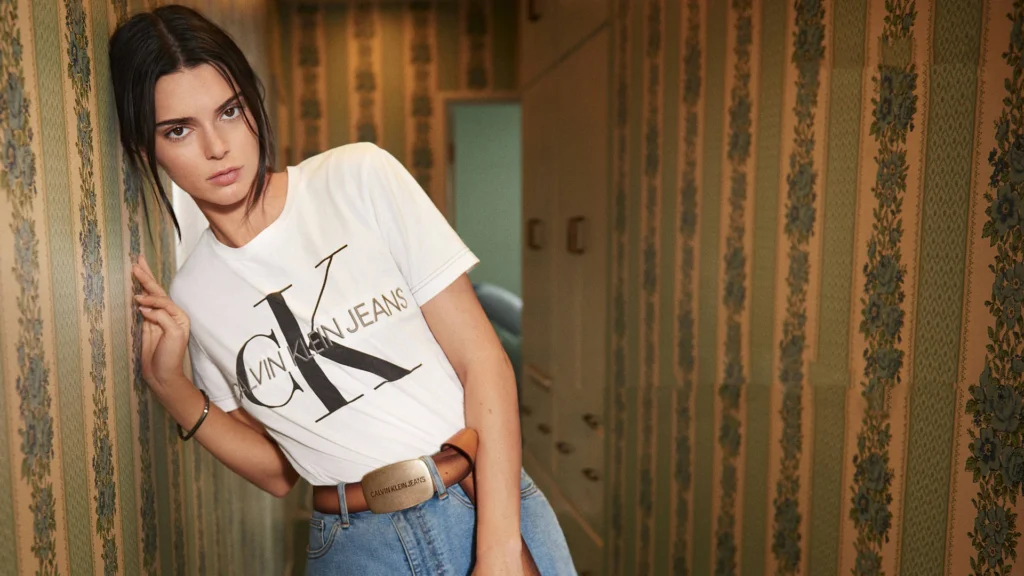
When Kendall Jenner first appeared in a Calvin Klein campaign in 2015, she wasn’t yet the world’s highest-paid model. She was a 19-year-old reality TV personality trying to break into an industry that viewed the Kardashian-Jenner family with skepticism. Ten years later, in 2025, as the partnership approaches its conclusion, Kendall has become the face that best represents what Calvin Klein stands for: effortless American style that transcends trends.
The numbers tell the story of mutual success. Kendall Jenner earned $40 million in 2023 alone, making her the world’s highest-paid model according to Forbes. Calvin Klein, under parent company PVH Corp, generates over $9 billion in annual revenue, with Kendall’s campaigns consistently among the brand’s most-viewed and most-engaged content. The partnership survived multiple creative directors, brand repositioning efforts, and cultural controversies to become one of fashion’s longest-running and most commercially successful celebrity collaborations.
This is the story of how a reality TV star and an American heritage brand built something that outlasted trends, survived crises, and created a blueprint for what authentic long-term partnerships look like in modern fashion marketing.
The 2015 beginning: Reality TV meets American fashion heritage
Why Calvin Klein chose a Kardashian-Jenner in 2015
In 2015, casting Kendall Jenner in a Calvin Klein campaign was controversial. The fashion industry largely dismissed the Kardashian-Jenner family as reality TV celebrities playing at modeling rather than genuine fashion talent. Kendall had walked some runways and shot some editorials, but she hadn’t proven herself as a serious model by traditional industry standards.
Calvin Klein saw something others didn’t: massive social media reach combined with all-American looks that fit their brand aesthetic perfectly. Kendall had 25 million Instagram followers in 2015, an audience that dwarfed most established supermodels. She represented a new generation that consumed fashion primarily through social media rather than print magazines. And crucially, her look was classically American in a way that aligned with Calvin Klein’s heritage.
Strategic factors behind the 2015 casting:
- Social media dominance: 25 million Instagram followers provided guaranteed campaign reach beyond traditional fashion media
- Demographic bridge: Connected Calvin Klein to Gen Z and younger Millennials who followed Keeping Up with the Kardashians
- All-American aesthetic: Jenner’s looks fit Calvin Klein’s classic American beauty standards unlike her more exotic-looking sisters
- Controversy value: Kardashian-Jenner association guaranteed media coverage and cultural conversation around every campaign
- Modeling legitimacy: Kendall’s runway work with Marc Jacobs and Givenchy provided enough fashion credibility to justify the partnership
The first campaign featured Kendall alongside other young models in a group shoot. Calvin Klein wasn’t betting everything on her yet. But the engagement metrics from that first campaign convinced them to invest deeper. Kendall’s posts about the campaign generated millions of interactions, driving traffic to Calvin Klein’s website and stores in ways that traditional model bookings never achieved.
From campaign model to brand face
The relationship evolved rapidly. What started as a single campaign booking in 2015 became a recurring partnership by 2016. By 2017, Kendall was appearing in multiple Calvin Klein campaigns per year across underwear, jeans, and fragrance lines. The brand had recognized that her value extended far beyond a single seasonal shoot.
Kendall’s social media strategy amplified every campaign’s reach. She didn’t just post official campaign images. She shared behind-the-scenes content, personal photos wearing Calvin Klein casually, and stories that made followers feel included in the experience. This organic-feeling promotion, even when contractually obligated, felt more authentic than typical celebrity endorsements.
Partnership evolution milestones:
- 2015: First Calvin Klein campaign appearance in group booking alongside other models
- 2016: Recurring campaign work establishing her as regular Calvin Klein face not one-off celebrity booking
- 2017: Multi-line campaigns across underwear, jeans, and fragrance demonstrating brand’s deepening investment
- 2018-2019: Solo campaign features positioning Kendall as central Calvin Klein muse during Raf Simons creative director era
- 2020-2023: Sustained partnership through COVID, creative director changes, and brand repositioning efforts
The Raf Simons era and artistic elevation
When Calvin Klein tried to become high fashion
From 2016 to 2018, Calvin Klein attempted a dramatic transformation under Raf Simons as Chief Creative Officer. The Belgian designer wanted to elevate the brand from mass-market American sportswear into high-fashion territory. The strategy proved commercially disastrous, with PVH taking $20 million in restructuring charges after Simons’ departure, but it provided Kendall’s most artistically ambitious Calvin Klein work.
The Raf Simons campaigns featured Kendall in avant-garde styling that looked nothing like traditional Calvin Klein advertising. One notable 2018 campaign showed her in a western-inspired look that Vogue described as “channeling a cowgirl.” The images were beautiful but confusing to core Calvin Klein customers who wanted simple, accessible American style, not conceptual fashion.
Raf Simons era characteristics:
- Artistic ambition: Campaigns prioritized fashion credibility over commercial accessibility and mass appeal
- Cultural references: Heavy American iconography including cowboys, quilts, and heartland imagery reimagined through European design lens
- Premium positioning: Attempted to justify higher price points through elevated design and marketing aesthetics
- Commercial failure: Strategy alienated core customers without successfully converting high-fashion consumers to the brand
- Kendall’s versatility: Her ability to execute both accessible and avant-garde content demonstrated professional range
The Simons experiment ultimately failed because Calvin Klein customers didn’t want the brand to be Balenciaga or Vetements. They wanted effortless American style at accessible price points. But the Raf Simons campaigns, including those featuring Kendall, demonstrated that she could execute high-concept fashion content when required, not just commercial catalog work.
Surviving the creative director carousel
The Raf Simons failure triggered multiple leadership changes at Calvin Klein. After his 2018 departure, the brand cycled through various creative directors and marketing strategies, trying to find the right balance between fashion credibility and commercial accessibility. Through all this turmoil, Kendall remained a consistent presence.
This continuity mattered enormously for brand stability. While creative directors came and went, Kendall provided visual and marketing consistency that prevented complete brand identity collapse. Consumers might not know who designed this season’s collection, but they knew Kendall represented Calvin Klein. That recognition protected the brand through its most turbulent period.
Value of Kendall’s continuity during crisis:
- Visual consistency: Her presence maintained recognizable Calvin Klein aesthetic despite changing creative direction
- Consumer trust: Kendall’s continued association signaled brand stability even when leadership churned
- Marketing efficiency: No need to rebuild brand associations with new faces each season
- Social media anchor: Her 293 million followers (as of 2024) provided reliable campaign amplification regardless of creative team
- Crisis insurance: Partnership survived controversies including inappropriate kiss campaigns and creative missteps
The campaigns that defined the partnership
MyCalvins and the democracy of desire
The #MyCalvins campaign, launched in 2014 and featuring Kendall prominently from 2015 onward, represented Calvin Klein’s smartest marketing strategy in decades. Rather than telling consumers what to aspire to, the campaign invited them to share their own Calvin Klein stories. Kendall appeared in official campaign images while regular consumers shared their own #MyCalvins moments on social media.
This democratic approach worked brilliantly because it positioned Calvin Klein as a brand for everyone, not just models and celebrities. Kendall’s participation didn’t feel exclusive or alienating because the campaign explicitly welcomed everyone’s interpretation of Calvin Klein style. Her posts generated millions of engagements while thousands of fans created their own #MyCalvins content that extended the campaign organically.
MyCalvins campaign strategic elements:
- User participation: Invited consumers to create their own Calvin Klein content rather than passively consuming brand messaging
- Hashtag activism: #MyCalvins generated millions of organic posts creating perpetual earned media beyond paid campaigns
- Celebrity anchor: Kendall and other ambassadors provided aspirational examples while regular people made campaigns feel accessible
- Cross-product integration: Single campaign framework worked across underwear, jeans, fragrance, and accessories
- Social-first strategy: Designed for Instagram sharing rather than traditional print advertising from the beginning
The MyCalvins campaigns featuring Kendall consistently generated the highest engagement rates of any Calvin Klein content. When she posted behind-the-scenes MyCalvins content, it regularly surpassed official brand account posts by multiples. This organic amplification justified her compensation and cemented her position as the partnership’s cornerstone.
Underwear campaigns and the art of aspirational accessibility
Kendall’s Calvin Klein underwear campaigns walked a delicate line. They needed to be aspirational enough to drive desire while remaining accessible enough that regular consumers felt included rather than excluded. Kendall’s natural beauty and relatively down-to-earth persona (compared to her sisters) made her perfect for this balance.
The underwear campaigns typically featured Kendall in minimalist styling with neutral backgrounds, putting total focus on product and her physique. Unlike Victoria’s Secret’s fantasy-based marketing, Calvin Klein underwear campaigns felt grounded and real. Kendall looked beautiful but not unattainably so. The message was clear: Calvin Klein underwear looks good on everyone, even if you happen to look like Kendall Jenner.
Underwear campaign formula driving success:
- Minimalist aesthetic: Neutral backgrounds and simple styling kept focus on product not excessive production value
- Body positivity balance: Celebrated Kendall’s physique while avoiding Victoria’s Secret’s increasingly criticized fantasy sexuality
- Product focus: Campaigns highlighted underwear’s comfort, fit, and quality rather than just using Kendall’s image for attention
- Inclusive pricing: Premium positioning but not luxury pricing made products attainable for Kendall’s young fanbase
- Social sharability: Clean, simple images worked perfectly for Instagram feeds creating organic sharing behavior
The business impact: $40 million model and $9 billion brand
How Kendall became the world’s highest-paid model
Forbes declared Kendall Jenner the world’s highest-paid model in 2018, earning $22.5 million that year, and she held the top spot repeatedly including 2023 when she earned $40 million. Her Calvin Klein partnership was central to this financial success, providing steady income that supplemented runway work and other endorsements.
The $40 million figure in 2023 represented a dramatic increase from her early career earnings. While exact Calvin Klein compensation remains confidential, industry analysts estimate top-tier fashion partnerships command $5-10 million annually for sustained ambassadorships like Kendall’s. Multiple Calvin Klein campaigns per year across different product lines likely placed her Calvin Klein earnings in the high seven figures to low eight figures annually.
Earnings breakdown contributing to $40M annual income:
- Calvin Klein partnership: Estimated $5-10 million annually for sustained multi-line ambassadorship
- Runway modeling: High-fashion runway work for Versace, Givenchy, Chanel commanding premium rates
- Editorial and advertising: Additional campaigns beyond Calvin Klein including Adidas, Estée Lauder, and luxury brands
- Social media endorsements: Sponsored Instagram posts reportedly commanding up to $1 million each
- Business ventures: Kendall’s 818 Tequila brand and other entrepreneurial projects generating additional revenue streams
The Calvin Klein partnership also provided career stability that elevated Kendall’s value to other brands. Being the consistent face of an American heritage brand gave her credibility that reality TV fame alone couldn’t provide. Other luxury brands felt more comfortable booking her knowing she’d proven professional reliability through decade-long Calvin Klein relationship.
Calvin Klein’s $9 billion empire and Kendall’s contribution
PVH Corp, Calvin Klein’s parent company, generates over $9 billion in annual revenue across all its brands. While Calvin Klein represents a portion of that total, it remains PVH’s most valuable brand alongside Tommy Hilfiger. Kendall’s campaigns consistently drove measurable engagement and sales metrics that justified her compensation and secured her position through multiple strategic shifts.
Calvin Klein doesn’t disclose ambassador-specific sales attribution, but several public indicators demonstrate Kendall’s commercial impact. Her campaign posts regularly generate 5-10 million likes on Instagram, each representing a consumer touchpoint that traditional advertising couldn’t achieve. Website traffic and product searches spike following major Kendall campaign launches. And most tellingly, Calvin Klein continued investing in the partnership for ten years despite significant brand upheaval, indicating sustained ROI.
Business performance indicators:
- $9 billion+: PVH Corp total annual revenue with Calvin Klein as flagship brand
- Campaign engagement: Kendall’s Calvin Klein posts consistently generate 5-10 million Instagram likes
- Website traffic: Measurable spikes in CalvinKlein.com traffic following major Kendall campaign launches
- Product search interest: Google Trends data shows search spikes for Calvin Klein products when Kendall campaigns launch
- 10-year retention: Brand’s sustained investment through multiple creative directors proves consistent ROI
The partnership also provided crisis insurance during Calvin Klein’s most difficult period. When Raf Simons’ strategy failed and the brand lost its creative direction, Kendall’s consistent presence reassured consumers and investors that Calvin Klein remained relevant despite internal turmoil. This stability value, while hard to quantify financially, was genuine business contribution.
Controversies survived and lessons learned
The inappropriate kiss campaign and backlash
Not every Calvin Klein moment featuring Kendall was commercially successful. A 2019 MyCalvins campaign showed various people kissing, including what some viewers interpreted as an awkward or inappropriate pairing. The campaign generated backlash rather than engagement, forcing Calvin Klein to respond to criticism.
The controversy demonstrated that even successful partnerships face missteps. What mattered was how both parties responded. Calvin Klein listened to feedback and adjusted future campaigns. Kendall continued supporting the brand rather than distancing herself at the first sign of trouble. The partnership survived because both parties treated it as a genuine relationship rather than a transactional endorsement deal.
Crisis management demonstrating partnership strength:
- Immediate response: Calvin Klein acknowledged concerns rather than dismissing criticism or defending problematic content
- Campaign adjustment: Future campaigns incorporated feedback showing brand’s willingness to listen
- Kendall’s loyalty: Her continued association through controversy signaled genuine partnership not just paid promotion
- Learning opportunity: Brand used the incident to refine its understanding of contemporary audience sensitivities
- Relationship resilience: Partnership emerged stronger by proving it could survive mistakes
Family controversies and maintaining separation
Throughout the partnership’s decade, various Kardashian-Jenner family controversies threatened to impact Kendall’s professional relationships. Whether sister Kim’s various scandals, family drama on Keeping Up with the Kardashians, or broader cultural criticism of the family’s influence, Kendall maintained remarkable separation between family association and professional identity.
Calvin Klein benefited from this separation. While Kendall’s initial fame came from her family, her modeling career established independent credibility. The brand never felt like it was endorsing the entire Kardashian-Jenner empire, just Kendall specifically. This allowed Calvin Klein to access her massive social following without the brand baggage that might come from working with some of her more controversial family members.
Maintaining professional separation strategies:
- Independent career building: Kendall’s high-fashion runway work established credibility beyond family association
- Selective family integration: Limited the Kardashian-Jenner family appearances in Calvin Klein content to maintain brand separation
- Professional conduct: Consistent professionalism differentiated her from family members’ sometimes chaotic public behavior
- Brand protection: Calvin Klein strategically positioned partnership as about Kendall individually not her family collectively
- Crisis avoidance: Kendall’s relatively scandal-free personal life prevented family controversies from directly impacting Calvin Klein
The 2024-2025 partnership conclusion and what’s next
Why decade-long partnerships don’t last forever
By 2024, the Kendall Jenner Calvin Klein partnership had achieved everything both parties needed. Kendall had established herself as a legitimate model earning $40 million annually with career security few models ever achieve. Calvin Klein had survived massive creative and strategic upheaval while maintaining brand relevance through a turbulent period. The natural lifecycle of such partnerships meant it was time to evolve.
Fashion partnerships typically last 1-3 years. A decade represents extraordinary longevity indicating genuine alignment and sustained commercial success. But even successful partnerships eventually reach natural conclusions. Brands need to refresh their image, celebrities need to avoid being too closely associated with single brands, and both parties benefit from exploring new creative opportunities.
Factors contributing to partnership’s natural conclusion:
- Mission accomplished: Ten years built everything both parties could achieve together
- Brand refresh needs: Calvin Klein benefits from introducing fresh faces to maintain contemporary relevance
- Career diversification: Kendall avoids becoming too synonymous with single brand at career peak
- Creative exhaustion: Decade of campaigns explored most viable creative territory together
- New opportunities: Both parties can now pursue different partnerships that offer fresh creative challenges
The conclusion doesn’t represent failure. It represents the natural lifecycle of one of fashion’s most successful and longest-running celebrity partnerships reaching its planned endpoint after accomplishing all strategic objectives.
Kendall’s legacy at Calvin Klein
When fashion historians look back at 2010s and 2020s Calvin Klein, Kendall Jenner’s partnership will stand as one of the defining elements. She helped transition the brand from traditional print advertising into social media dominance. She provided stability during creative chaos. And she proved that reality TV fame, when combined with genuine modeling talent and professional conduct, could translate into legitimate fashion credibility.
The Kendall-Calvin Klein partnership also established the blueprint for how modern fashion brands should approach celebrity relationships. Don’t book celebrities for single campaigns. Build decade-long relationships with sustained investment. Don’t just license celebrity names. Find ambassadors who genuinely love and wear your products. Don’t chase trends. Find talent that represents your core brand identity consistently across years.
Kendall’s lasting impact on Calvin Klein:
- Social media transformation: Helped Calvin Klein become one of fashion’s most followed and engaged brands on Instagram
- Stability anchor: Provided visual and marketing consistency through a decade of internal brand turbulence
- Partnership model: Demonstrated the commercial value of sustained long-term celebrity relationships over one-off bookings
- Reality TV legitimacy: Proved that celebrity-model crossovers could work when talent and professionalism backed the fame
- American beauty standard: Her classic all-American looks reaffirmed Calvin Klein’s heritage aesthetic identity
The Bottom Line
The Kendall Jenner Calvin Klein partnership represents one of modern fashion’s most commercially successful and strategically important celebrity collaborations. Over ten years, Kendall evolved from controversial reality TV personality to the world’s highest-paid model earning $40 million annually, with Calvin Klein central to that success. Calvin Klein maintained brand relevance and generated billions in revenue despite creative director turmoil and strategic missteps, with Kendall providing crucial stability and consumer connection.
The partnership worked because it was built on genuine alignment. Kendall actually wore Calvin Klein casually, not just in campaigns. She genuinely embodied the brand’s effortless American aesthetic. And both parties committed to sustained long-term investment rather than chasing short-term buzz. When controversies arose, they handled them together. When creative direction changed, they adapted together. This genuine partnership mentality created compound value that transactional endorsements never achieve.
Key success factors defining decade-long partnership:
- Perfect casting: Kendall’s all-American looks and massive social following aligned perfectly with Calvin Klein’s brand identity
- Sustained commitment: Ten-year partnership outlasted typical 1-3 year celebrity deals creating compound brand equity
- Crisis resilience: Survived Raf Simons failure, inappropriate campaign backlash, and family controversies through mutual loyalty
- Social media mastery: 293 million Instagram followers provided perpetual organic amplification worth millions in advertising value
- Authentic alignment: Genuine product enthusiasm made every campaign feel credible rather than purely transactional
For marketers studying celebrity partnerships, the Kendall-Calvin Klein model proves that the most powerful relationships are those built on long-term commitment and authentic alignment. Kendall became the world’s highest-paid model partly because Calvin Klein invested in her for a decade. Calvin Klein survived its most turbulent period partly because Kendall provided consistent brand representation. That mutual benefit is the hallmark of truly strategic partnerships that create lasting value for both parties.