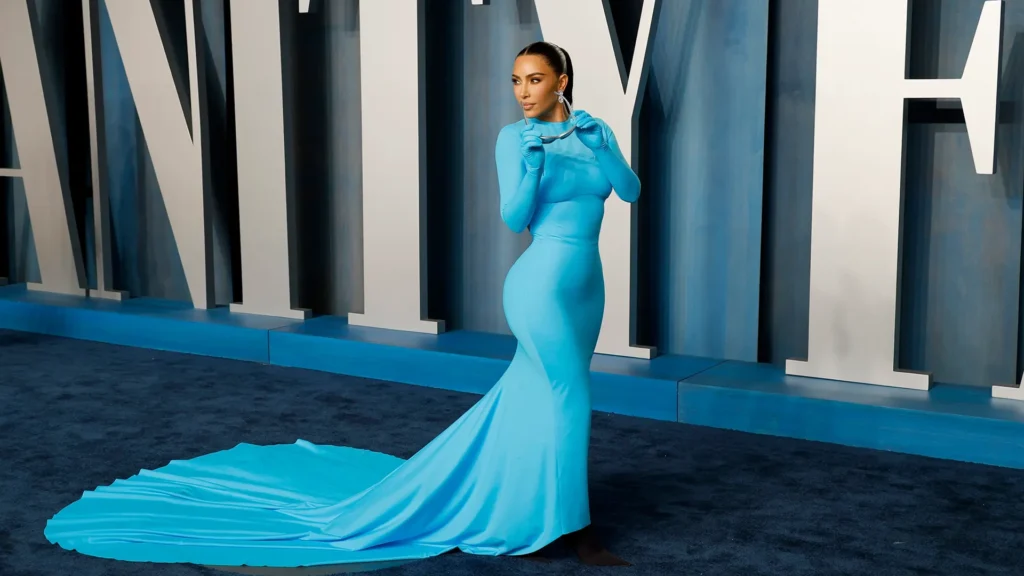
When Kim Kardashian arrived at the 2022 Vanity Fair Oscars afterparty in the electric blue Balenciaga gown visible in this photo, matching gloves and all, it wasn’t just a fashion moment. It was a statement of cultural arrival. A reality TV star turned billionaire entrepreneur was now the most visible face of one of Paris’s most historically significant fashion houses, wearing its clothes exclusively, walking its runways, and turning every public appearance into a free campaign.
The partnership between Kim Kardashian and Balenciaga is one of modern fashion’s most fascinating business stories. Under creative director Demna, Balenciaga’s revenues grew close to $2 billion from an estimated $390 million during his ten-year tenure. Kim was central to that growth story. She became the brand’s walking billboard at a moment when Balenciaga was crossing from niche fashion credibility into full mainstream luxury dominance. And when crisis hit in late 2022, both the brand and Kim navigated it in ways that ultimately made the partnership stronger, not weaker.
This is the story of how a relationship that started through Kanye West, survived a controversial ad scandal, and outlasted Demna’s own departure became one of fashion’s most strategically important celebrity alignments.
How Kanye opened the door and Kim walked through it
The organic beginning nobody planned
Kim Kardashian freely admits the Balenciaga relationship didn’t start with a contract. Speaking at the 2021 People’s Choice Awards where she received a fashion award, she acknowledged the role her ex-husband played: “To Kanye, for really introducing me to the world of fashion. I fell in love with fashion and I am so inspired by so many people.”
Kanye West had developed a close creative relationship with Demna, Balenciaga’s Georgian creative director who joined the brand in 2015. That relationship became the bridge through which Kim entered Balenciaga’s orbit. What started as borrowed looks and front-row appearances gradually evolved into something more intentional. By 2021, Kim wasn’t just wearing Balenciaga occasionally. She was wearing it almost exclusively.
How the relationship developed organically:
- Kanye connection: West’s close friendship with Demna provided direct access and cultural credibility that cold outreach couldn’t replicate
- Attendance progression: Kim attended Balenciaga runway shows from 2015 onward, building genuine relationship with the house
- Aesthetic alignment: Demna’s bodycon silhouettes and covered-up sensuality perfectly suited Kim’s evolving post-SKIMS style
- Mutual elevation: Kim gained high fashion credibility while Balenciaga gained mass culture visibility and mainstream reach
- Personal chemistry: Kim and Demna’s genuine friendship meant the partnership felt authentic rather than transactional
Kim acknowledged on The Kardashians Season 2 finale: “Demna is the main designer of Balenciaga. I think the partnership with Balenciaga definitely came from Kanye, but I really loved their clothes and wore them all the time and it was a really organic relationship that happened.” This authenticity was precisely what made the partnership so commercially powerful from the start.
2021: The year Balenciaga owned Kim’s wardrobe
Calendar year 2021 became the defining year of the Kim-Balenciaga relationship. Kardashian’s year with Balenciaga began with a stunning blue dress at the Vanity Fair Oscar afterparty. The reality star almost exclusively wore Balenciaga to public events for the entire year, becoming Balenciaga creative director Demna Gvasalia’s muse to great success.
The moments stacked up rapidly. In August 2021, Kim made a surprise appearance during Kanye’s Donda album listening party wearing a Balenciaga wedding dress and veil, despite having filed for divorce. In September, she attended the Met Gala alongside Demna himself, both wearing head-to-toe black designs that completely obscured their faces and bodies. Then in October, for her debut stint hosting Saturday Night Live, Kardashian wore three different Balenciaga outfits and changed into a fourth, including a $23,000 sparkly coat, for the afterparty.
The 2021 Balenciaga-Kim moment highlights:
- Vanity Fair Oscar afterparty: Blue gown establishing the silhouette language that would define the partnership visually
- Donda listening party: Balenciaga wedding dress at ex-husband’s event generated global media coverage and conversation
- Met Gala black look: Masked all-black ensemble with Demna became the most talked-about look of the entire gala
- SNL hosting: Five Balenciaga looks across one evening demonstrated unprecedented brand immersion for a TV appearance
- Daily exclusive wearing: Every paparazzi photo, every red carpet, every airport appearance became organic Balenciaga content
The scale of exposure was extraordinary. Kim had over 250 million Instagram followers in 2021. Every Balenciaga look she wore generated thousands of news articles, social media posts, and cultural discussions. The brand wasn’t paying for any of this reach, it was all earned through genuine product enthusiasm. As Kim herself said, “Every day was a campaign anyway, because that’s what I honestly love.”
The official campaigns and runway moments
From organic muse to paid campaign star
By the time her first Balenciaga campaign broke in February 2022, she had been wearing the brand exclusively in public for seven months. The official campaigns were almost an afterthought at that point, simply making formal what consumers already understood. Kim was Balenciaga’s face.
She walked the catwalk at the Balenciaga 51st couture show in 2022, attended numerous Balenciaga runway shows, and co-starred in several campaigns. Another memorable Balenciaga look was a catsuit fashioned from yellow caution tape printed with the brand’s logo, which Kardashian wore to its Autumn/Winter 2022 show. The caution tape look perfectly encapsulated Demna’s ability to transform industrial materials into high fashion, with Kim as the ideal canvas.
Campaign and runway milestones:
- February 2022 campaign: Official first Balenciaga campaign launch after seven months of exclusive organic wearing
- Caution tape catsuit: AW22 show look that went globally viral, generating millions in earned media beyond any paid placement
- 51st Couture runway: Walking alongside Dua Lipa and Nicole Kidman in Balenciaga’s formal couture presentation
- Fall 2022 campaign: Major advertising campaign featuring Kim cementing her as the face of the brand commercially
- January 2024 ambassador: Official title announcement with Nadav Kander campaign showing platinum blonde transformation
In 2022 alone, she clocked a total of seventeen major fashion campaigns and magazine covers, with Balenciaga as the centerpiece of everything. This volume of exposure was unprecedented. Think of another star who felt regularly around in 2023. Anne Hathaway had six campaign and magazine cover moments. Barbie star Margot Robbie had seven. Kim had seventeen.
Why Kim’s body and brand made her the perfect Balenciaga muse
Demna’s Balenciaga had a very specific visual language. Extreme body coverage that somehow remained intensely body-conscious. Monochromatic looks that removed all distraction from silhouette. Garments that covered everything while revealing the form underneath. This aesthetic fit Kim’s post-SKIMS public image perfectly.
Kim had built SKIMS, her billion-dollar shapewear empire, on the philosophy that form and coverage weren’t opposites. Balenciaga under Demna was saying the same thing in fashion language. A fully covered Kim in Balenciaga communicated more sensuality than most celebrities wearing far less because the clothes functioned as second skin rather than concealment.
Aesthetic alignment factors driving visual success:
- Form-fitting coverage: Balenciaga’s covered silhouettes emphasized Kim’s figure while maintaining fashion’s elevated modesty
- SKIMS synergy: Both Balenciaga and SKIMS spoke the same language of shapewear-as-fashion, self-owned aesthetic
- Scale impact: Kim’s physical presence photographed dramatically in Balenciaga’s architectural shapes
- Monochrome mastery: Single-color looks photographed cleanly across all media formats maximizing visual impact
- Spectacle comfort: Kim’s comfort with extreme fashion choices matched Demna’s willingness to push aesthetic boundaries
The $25 million scandal that tested everything
BDSM bears and the November 2022 crisis
November 2022 brought Balenciaga’s biggest crisis in decades. An advertising campaign featured children holding teddy bears dressed in BDSM-inspired gear, generating immediate and explosive public backlash. A second campaign inadvertently included references to child pornography law. The brand became the target of global boycotts, conservative outrage, and genuine consumer anger.
Balenciaga filed a $25 million lawsuit against the producers of the campaign, while simultaneously issuing apologies acknowledging the campaigns were wrong. Demna apologized after the campaign, later stating the ad campaign “unfortunately was the wrong idea and a bad decision from me” and telling The New Yorker that “I didn’t see the creepy part of it.”
Crisis scale and business impact:
- Global boycott: Consumers worldwide called for Balenciaga boycotts across social media platforms
- $25M lawsuit: Brand attempted to distance itself by suing producers, later dropping the case
- Sales damage: Balenciaga’s “difficult” December affected sales in the US, UK, and Middle East, though sales in Asia were not impacted
- Revenue drop: Balenciaga revenue declined to nearly €1.17 billion in 2023, compared to over €1.39 billion in 2022
- Reputational hit: Brand trust metrics declined significantly in Western markets where controversy generated most coverage
Kering CEO Pinault revealed that firings did not occur at Balenciaga in the wake of the problematic campaigns, stating “We’re allowed to make mistakes in a group like Kering. We’re not allowed to make the same mistake twice, but we have a right to make mistakes.” This response drew its own criticism from those who felt accountability was insufficient.
Kim’s response and the reevaluation that wasn’t
Kim Kardashian’s handling of the crisis became as scrutinized as Balenciaga’s own response. Kardashian said she was “re-evaluating” her previous sponsorship deal with the brand after the advertising campaign sparked the major public relations crisis. As a mother of four, her statement about protecting children was necessary and expected.
But the reevaluation didn’t last. In December 2023, Kim boldly stepped out of her Escalade, alongside her sister Kendall Jenner, to find her seat at Balenciaga’s Fall 2024 fashion show in Los Angeles. Her attendance marked her stamp of approval and signaled the relationship had survived. Then in January 2024, the official ambassadorship announcement confirmed everything.
How the partnership survived the crisis:
- Measured response: Kim’s “reevaluation” statement acknowledged concerns without permanently burning the relationship
- Time strategy: Allowing months to pass before reengagement let public memory fade before formal return
- Demna’s survival: Kering kept Demna in his role, signaling the house had a future worth Kim’s continued association
- Brand value assessment: Kim ultimately concluded the long-term partnership value outweighed short-term reputational risk
- Mutual need: Both Kim and Balenciaga needed each other too much for the relationship to end permanently
Though social media commenters still slam Kardashian for associating with Balenciaga in the wake of its late 2022 ad campaign scandals, the affiliation still sends a valuable message: that Kardashian is a part of the fashion world. That fashion credibility has real commercial value that pure Instagram influence could never fully replicate.
Official ambassador and the Erewhon moment
January 2024: Making the relationship formal
In January 2024, Kim Kardashian officially became Balenciaga’s brand ambassador. Her official portrait was shot by documentary photographer Platon. In a campaign photographed by Nadav Kander, she was transformed into a platinum blonde, donning a red wrap dress, black fur coat, and leopard-print stilettos, while carrying a €5,190 Rodeo bag.
Kim stated: “For several years now, Balenciaga’s designs have been a part of my many looks and some of my most iconic fashion moments. This historic fashion house embraces modernity, craftsmanship and takes an innovative approach to design under Demna. For me, this longstanding relationship is built on mutual trust and a commitment to doing what’s right.”
Ambassador deal components and positioning:
- Official title: Brand ambassador replacing the informal muse status that had existed since 2021
- Platon portrait: Documentary photographer known for world leaders and cultural figures added gravitas to announcement
- Nadav Kander campaign: Fashion photographer whose work bridged art and commercial elevated the campaign aesthetically
- Rodeo bag placement: €5,190 product highlighted in campaign signaling luxury positioning not mass market accessibility
- Joining Nicole Kidman and Michelle Yeoh: Elite ambassador roster positioned Kim alongside serious acting heavyweights
The Erewhon collaboration and LA cultural moment
In early 2024, Kim attended Balenciaga’s pre-fall 2024 show in Los Angeles featuring a collaboration with luxury grocery chain Erewhon. She was wearing lace shoe-tights and a plain black Balenciaga hoodie, and told the press that the bag is what designer Demna wanted her to carry.
The Erewhon collaboration was quintessentially LA, quintessentially Demna, and quintessentially Kim. Turning a grocery bag into luxury fashion object, at an event attended by Lil Wayne and Nicole Kidman, in Kim’s home city, with her as the de facto host of the entire cultural moment. The Erewhon capsule collection quickly sold out and drove significant engagement on TikTok, proving the partnership could generate commercial results even in Balenciaga’s post-scandal recovery phase.
Erewhon collab success factors:
- LA cultural specificity: Erewhon represents LA’s premium wellness culture making it perfectly pitched for Kim’s demographic
- Demna’s irony: Luxury grocery bag subverts fashion’s pretension while maintaining Balenciaga’s subversive aesthetic signature
- Instant sellout: Complete sell-through confirmed consumer appetite hadn’t been permanently damaged by 2022 controversy
- TikTok virality: Content-friendly concept generated organic social engagement beyond traditional fashion media
- Kim as cultural bridge: Her presence connected Balenciaga’s European fashion credentials to LA’s celebrity consumer culture
Demna’s departure and what it means for Kim
Ten years, $2 billion, and a move to Gucci
Demna’s run at Balenciaga was a success for Kering financially, growing the brand’s annual revenue from around $350 million to over $2 billion over the course of his tenure. In early 2025, Kering announced Demna would move to Gucci as creative director, leaving Balenciaga after a decade that transformed it from a respected heritage house into a $2 billion cultural phenomenon.
Kering CEO Pinault stated: “Demna’s contribution to the industry, to Balenciaga, and to the Group’s success has been tremendous. His creative power is exactly what Gucci needs.” The departure represented both validation of everything Demna built and an inflection point for everything Kim had built with him personally.
Demna’s legacy at Balenciaga by the numbers:
- Revenue growth: From approximately $390 million to nearly $2 billion during ten-year tenure
- Brand transformation: Converted heritage couture house into contemporary luxury cultural phenomenon
- Mainstream crossover: Made Balenciaga relevant to audiences who’d never previously engaged with Parisian fashion
- Kim partnership: Identified and executed the celebrity partnership that gave Balenciaga its mass culture reach
- Gucci move: Kering deploying his proven commercial abilities to revive its struggling flagship brand
Kim’s position after Demna
The critical question facing the Kim-Balenciaga relationship is whether it was about the house or about Demna. Kim’s friendship was primarily with Demna personally. Her aesthetic alignment was with his specific creative vision. His departure to Gucci creates an interesting dynamic where Kim’s personal loyalty might follow the designer rather than the house.
What’s notable is that Kim’s official ambassadorship was announced in January 2024, months before Demna’s departure was confirmed. This timing suggests Kering was deliberately formalizing the Kim relationship as Demna’s exit became apparent, securing her loyalty to the brand rather than just the designer.
Post-Demna partnership considerations:
- Personal loyalty: Kim’s relationship was primarily with Demna, raising questions about commitment to his successor
- Contract structure: Official January 2024 ambassadorship likely includes multi-year terms protecting Balenciaga through transition
- Gucci opportunity: Demna’s move to Gucci could create potential future Kim-Gucci collaboration given their relationship
- Brand vs designer: Whether consumers associate the Kim aesthetic with Balenciaga or Demna personally will determine partnership’s next chapter
- New creative direction: Balenciaga’s incoming creative director will need to maintain or evolve the partnership to sustain its commercial value
Business impact: What the partnership actually delivered
Balenciaga’s rise from heritage house to $2 billion brand
The numbers tell a clear story. During Demna’s ten-year tenure at Balenciaga, revenues grew close to $2 billion from an estimated $390 million. Kim Kardashian’s involvement, particularly from 2021 onward, was central to the mainstream cultural penetration that drove this growth. The partnership helped transform Balenciaga from a brand fashion insiders loved into one that civilians craved.
The Kim effect on Balenciaga worked differently from typical celebrity endorsements. She didn’t just wear the clothes, she made them part of her daily life narrative. Every Balenciaga appearance became content. Every content piece generated media coverage. Every media piece drove search interest, store traffic, and e-commerce conversions. The compounding effect of sustained, authentic wearing across two years created brand equity that a traditional advertising budget couldn’t purchase.
Revenue trajectory showing partnership’s commercial context:
- Pre-Demna baseline: Approximately $390 million in annual revenue before 2015 creative direction change
- 2021 peak: Balenciaga crossed €1 billion in revenue, coinciding with Kim’s full immersion as brand muse
- 2022 peak: Revenue exceeded €1.39 billion before the advertising scandal impact in Q4
- 2023 decline: Revenue declined to nearly €1.17 billion during post-scandal recovery and restructuring
- Recovery trajectory: Kim’s official January 2024 ambassadorship positioned her as key asset in brand’s rebuilding strategy
The earned media value that made Kim irreplaceable
Traditional fashion houses measure ambassador value through campaign reach and brand awareness metrics. Kim delivered something more valuable: perpetual earned media that operated independently of any campaign cycle. When she wore Balenciaga to SNL, no campaign was running. When she appeared in the Donda wedding dress, there was no shoot scheduled. When she walked the LA street in the Erewhon grocery bag, it became news globally without Balenciaga spending a dollar.
In 2022 alone, Kardashian clocked seventeen major fashion campaigns and magazine covers. The volume of visibility she provided, concentrated on Balenciaga during the partnership’s peak years, is genuinely incalculable in traditional advertising equivalence terms. Kim’s 340 million Instagram followers in 2024 represent direct access to a consumer base that Balenciaga’s own channels could never organically reach.
Earned media advantages the partnership delivered:
- Zero-cost exposure: Daily organic wearing generated global press without advertising expenditure
- Authenticity premium: Earned coverage carries more consumer trust than paid placement across all research metrics
- Crisis resilience: Genuine fan investment in Kim meant her eventual return to Balenciaga after scandal carried credibility
- Cultural bridge: Kim connected Balenciaga to audiences including reality TV fans, beauty enthusiasts, and mainstream consumers
- SNL effect: Three Balenciaga outfits worn on America’s most culturally significant live TV program reached audiences fashion media never touches
The Bottom Line
The Kim Kardashian Balenciaga partnership is a case study in how celebrity relationships can drive luxury brand growth when authenticity, aesthetic alignment, and long-term commitment replace transactional endorsement deals. Balenciaga grew from approximately $390 million to nearly $2 billion in revenue during Demna’s tenure, with Kim’s authentic immersion in the brand providing the mainstream cultural visibility that premium luxury fashion rarely achieves.
The partnership survived what would have ended most celebrity-brand relationships. A major scandal, a public “reevaluation,” Kanye’s involvement as origin story, and ultimately Demna’s departure to Gucci. That survival is the most compelling testament to the partnership’s genuine foundation. This wasn’t two parties fulfilling a contract. It was a genuine creative and commercial alignment that delivered real results for both sides.
Key success factors defining the partnership:
- Organic origin: Relationship started through genuine product love before any commercial arrangement existed
- Sustained authenticity: Two years of daily exclusive wearing before first official campaign made every paid appearance credible
- Crisis navigation: Measured “reevaluation” and eventual return demonstrated maturity rather than opportunistic abandonment
- Aesthetic alignment: Kim’s post-SKIMS sensibility matched Balenciaga’s covered-but-body-conscious vision precisely
- Scale advantage: 340 million followers providing perpetual earned media that no advertising budget could replicate
For marketers studying luxury celebrity partnerships, the Kim-Balenciaga model proves that the most powerful brand relationships are those that begin before the contract. When a celebrity genuinely lives in your clothes, every appearance becomes marketing. As Kim said herself: “Every day was a campaign anyway.” That’s the standard every luxury brand should aspire to, and almost none will achieve.