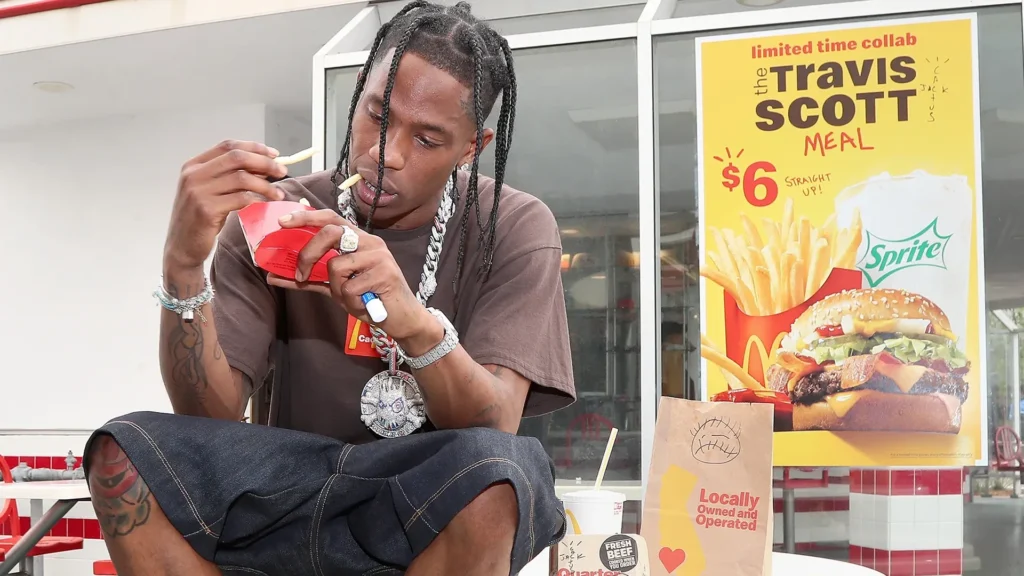
When Travis Scott announced his McDonald’s partnership September 3, 2020, skeptics questioned whether hip-hop’s biggest star could actually move Quarter Pounders. The answer arrived within days. McDonald’s locations nationwide reported ingredient shortages. Fans created TikTok trends playing SICKO MODE at drive-thrus. Merchandise featuring golden arches and Cactus Jack logos sold out in minutes.
By October 8, 2020, McDonald’s reported Q3 2020 sales growth of 4.6 percent, reversing previous quarter’s 8.7 percent decline during COVID-19 pandemic peak. Travis Scott earned estimated $20 million total from partnership, with McDonald’s validating celebrity collaboration strategy dormant since Michael Jordan’s McJordan meal 1992.
Partnership Performance:
- Travis Scott earnings: $20M total ($5M endorsement + $15M merchandise)
- McDonald’s Q3 2020 sales: Up 4.6% after previous quarter’s 8.7% decline
- Promotion duration: September 8 to October 4, 2020 (one month)
- Meal price: $6 for Quarter Pounder combo
- Merchandise: 80+ items sold through shop.travisscott.com
- App growth: 26% daily active user increase during promotion
The Travis Scott McDonald’s collaboration succeeded because it transcended traditional celebrity endorsement. Rather than Scott appearing in commercials promoting McDonald’s, the partnership integrated Cactus Jack brand directly into fast food experience. Customers ordered “Travis Scott Meal” by name. Merchandise transformed McDonald’s logos into streetwear collectibles. Even McDonald’s crew members wore exclusive Cactus Jack-designed uniforms during promotion.
This vertical integration created cultural moment where fast food became fashion statement, proving influencer marketing could generate measurable sales growth while elevating brand perception among Gen Z and millennial consumers McDonald’s struggled reaching through traditional advertising. The collaboration marked first celebrity-named McDonald’s menu item since Michael Jordan’s McJordan 1992, ending 28-year gap.
The $6 Meal That Generated $20 Million for Travis Scott
Why Simple Quarter Pounder Became Cultural Phenomenon
The Travis Scott Meal cost $6 and featured nothing new. Quarter Pounder with cheese, bacon, and lettuce. Medium fries with BBQ sauce. Sprite. McDonald’s already served these items individually. Yet branding combination as “Travis Scott’s favorite order” created artificial scarcity psychology. Fans wanted to “eat like Travis,” experiencing rapper’s routine through accessible $6 transaction.
This parasocial connection drove unprecedented demand. Within first week, McDonald’s issued internal memo acknowledging supply challenges: “It’s been so lit, some of our restaurants have temporarily sold out of some of the ingredients in the meal. We’re working closely with our suppliers, distributors and franchisees to resupply impacted restaurants as quickly as possible.”
Financial Breakdown:
- Total Travis Scott earnings: $20 million (Forbes estimate)
- Endorsement fee: $5 million from McDonald’s partnership
- Merchandise sales: $15 million from Cactus Jack x McDonald’s apparel
- McDonald’s Q2 2020: Sales down 8.7% (COVID impact)
- McDonald’s Q3 2020: Sales up 4.6% (with Travis Scott Meal)
- Net swing: 13.3 percentage point improvement quarter-over-quarter
The shortage validated authenticity. When products sell out, consumers perceive value. Travis Scott McDonald’s shortages created urgency driving additional visits from fans attempting to secure meal before promotion ended. The scarcity psychology typically reserved for limited sneaker drops or concert tickets applied to fast food for first time, demonstrating how celebrity branding could transform commodity products into cultural moments.
The Merchandise Strategy That Outearned the Endorsement
Travis Scott earned $5 million endorsement from McDonald’s but generated $15 million from merchandise, demonstrating where true value resided. The Cactus Jack x McDonald’s collection dropped 80+ items across three September-October 2020 releases, featuring hoodies ($88 retail), t-shirts, work jackets, accessories, and viral Chicken McNugget body pillow.
Merchandise sold exclusively through shop.travisscott.com, with most items selling out within minutes. The merchandise succeeded through strategic nostalgia. Designs incorporated vintage McDonald’s campaigns, retro color schemes, and playful food imagery resonating with consumers who grew up eating Happy Meals. Brown became signature color (matching fries), with sesame seed patterns forming Cactus Jack logos.
Iconic Merchandise Items:
- Chicken McNugget Body Pillow (giant nugget-shaped, instant meme)
- Crew Uniforms (red/yellow mimicking McDonald’s employee attire)
- Work Jacket (“Billions and Billions Served” embroidered back)
- Sesame Seed Hoodie (brown with Cactus Jack logo from sesame seeds)
- Promotional Sticker Hoodie (burger wrapper stickers, $88 retail)
- Lunch Tray (brown plastic with “I’m Lovin’ It” Cactus Jack branding)
- Employee Crew Shirts (became most valuable resale items, $250+ by 2025)
Resale market validated merchandise value. By 2025, mint-condition Travis Scott McDonald’s Crew T-Shirts (originally given to McDonald’s employees, not sold publicly) reach $250+ on StockX and Grailed. Regular merchandise hoodies commanding $200-400 resale depending on design and condition. The appreciation demonstrates how celebrity collaboration transformed commodity fast food branding into collectible streetwear.
One hoodie featured McDonald’s promotional stickers typically holding burger wrappers. Another showcased “Billions and Billions Served” embroidered across back. These details demonstrated attention to McDonald’s visual language while maintaining streetwear credibility. Rather than slapping Travis Scott photo on McDonald’s products, Cactus Jack team deconstructed McDonald’s visual identity then reconstructed through streetwear lens.
The Strategic Timing During COVID-19 Pandemic Peak
How Drive-Thru Focus Made Partnership Pandemic-Proof
McDonald’s launched Travis Scott partnership September 2020 when COVID-19 forced dining room closures nationwide. The timing proved strategic rather than coincidental. With drive-thru and mobile ordering accounting for majority of transactions, celebrity meal promotion aligned perfectly with contactless service model. Customers could participate in cultural moment without indoor dining risk.
McDonald’s invested $6.8 million digital advertising during Travis Scott promotion (September 8 to October 8, 2020), nearly $1 million more than previous month, with two-thirds devoted to desktop video per Pathmatics data. Top-performing creative was 15-second YouTube ad featuring stop-motion Travis Scott action figure (updated from 2015 Rodeo album design) enjoying meal.
Digital Campaign Performance:
- Digital ad spend: $6.8 million during September 8 to October 8, 2020
- Previous month baseline: ~$5.8 million (approximately $1M less)
- Media mix: 66% desktop video, 34% social/display advertising
- Top creative: 15-second YouTube stop-motion action figure ad
- Creative impressions: 15 million U.S. impressions during promotion
- Previous comparable: 5 million impressions (same spend, August 2020)
- Impression efficiency: 3x improvement with Travis Scott creative
The ad generated 15 million impressions, triple comparable previous month’s performance despite similar spend, demonstrating Scott’s audience engagement. The mobile app growth proved particularly significant. McDonald’s app daily active users increased 26 percent during Travis Scott promotion compared to August 2020, with install growth accelerating first week.
This validated partnership’s ability driving digital engagement beyond in-store purchases, creating long-term customer value through app adoption enabling future direct marketing and loyalty program participation. One-time meal purchase generated $6 revenue. App user receiving targeted promotions accumulated loyalty points and accessing exclusive deals represented significantly higher lifetime value.
The TikTok Trend McDonald’s Didn’t Plan But Couldn’t Stop
Travis Scott fans created unauthorized TikTok trend: pulling up to McDonald’s drive-thrus playing SICKO MODE at maximum volume while ordering Travis Scott Meal. Videos showed employees’ reactions ranging from laughter to frustration as bass-heavy track blasted through speaker systems. McDonald’s corporate never officially endorsed trend, yet viral moments generated billions organic impressions amplifying promotion beyond paid advertising.
The TikTok phenomenon demonstrated Gen Z’s creative appropriation of brand campaigns. Rather than passively consuming McDonald’s advertising, young consumers created participatory content transforming transaction into performance. This user-generated content reached audiences traditional commercials couldn’t penetrate, particularly skeptical teenagers viewing corporate advertising with suspicion but embracing peer-created memes and challenges.
Organic Amplification:
- SICKO MODE drive-thru trend generated billions organic impressions
- User-generated TikTok content reached skeptical Gen Z audiences
- McDonald’s never officially endorsed trend
- Participatory framework gave consumers creative ownership
- Peer-created content carried more authenticity than corporate advertising
The organic virality demonstrated most valuable marketing doesn’t come from brands themselves but from consumers enthusiastically participating in brand moments. McDonald’s paid $6.8 million for advertising but received exponentially more reach through free user-generated content, proving authentic celebrity collaborations create participatory frameworks generating organic amplification traditional advertising cannot replicate.
The Cactus Jack Merchandise That Turned McDonald’s Into Streetwear
80+ Items Transforming Fast Food Logos Into Fashion
The Cactus Jack x McDonald’s merchandise collection launched three waves September-October 2020, totaling 80+ items ranging from $15 t-shirts to $88 hoodies. The merchandise succeeded where typical celebrity endorsements fail: genuine design integration. Rather than surface-level branding, Cactus Jack team isolated elements like sesame seeds, french fry patterns, golden arches, and vintage promotional materials, then reconstructed them through streetwear lens.
This approach created products streetwear enthusiasts wanted owning independent of McDonald’s association, while McDonald’s fans appreciated nostalgic callbacks to childhood dining experiences. The Chicken McNugget body pillow became instant meme, selling out immediately despite absurd premise. Life-size cardboard cutouts of Travis Scott allowed fans bringing celebrity into homes.
Why Merchandise Strategy Worked:
- Deconstructed McDonald’s visual language, reconstructed through streetwear
- Products streetwear enthusiasts wanted beyond McDonald’s association
- Nostalgic callbacks to vintage McDonald’s campaigns
- Brown became signature color matching fries
- Sesame seed patterns formed Cactus Jack logos
- Sold exclusively through shop.travisscott.com (not McDonald’s stores)
- $15M merchandise revenue exceeded many artists’ entire album sales
The merchandise transformed promotional campaign into ongoing cultural conversation extending months beyond one-month meal availability. By keeping merchandise sales separate from McDonald’s stores and selling through Travis Scott’s own website, the collaboration maintained streetwear credibility. If merchandise sold at McDonald’s registers, it would feel like corporate merchandise rather than limited drops typical of Supreme or Palace releases.
How Merchandise Changed Celebrity Fast Food Collaborations Forever
Travis Scott McDonald’s merchandise established blueprint subsequent partnerships followed. When BTS collaborated with McDonald’s May-June 2021, merchandise dropped featuring purple packaging and Korean-inspired designs. J Balvin’s October-November 2020 McDonald’s partnership (overlapping Travis Scott’s tail end) included vibrant Colombian color schemes. Saweetie’s partnership featured “Saweetie ‘N Sour” sauce merchandise.
Yet none matched Travis Scott’s merchandise cultural impact. The $15 million merchandise revenue proved celebrity partnerships could monetize beyond endorsement fees through direct-to-consumer apparel sales, creating additional revenue streams while amplifying brand awareness. For McDonald’s, merchandise extended campaign visibility months beyond one-month meal availability.
Post-Travis Scott Partnerships:
- BTS (May-June 2021): Purple packaging, Korean-inspired designs, 40M YouTube ad impressions
- J Balvin (October-November 2020): Colombian color schemes, 23% daily active user growth
- Saweetie: “Saweetie ‘N Sour” sauce merchandise
- All partnerships followed Travis Scott’s merchandise-first blueprint
- None matched $15M merchandise revenue or cultural impact
The strategy influenced how brands approach influencer collaborations across industries. Similar to how Travis Scott transformed McDonald’s, subsequent partnerships between celebrities and mainstream brands increasingly emphasize co-created products over traditional endorsements. This shift from “celebrity uses brand” to “celebrity co-owns brand moment” generates authentic engagement traditional advertising cannot replicate.
The McDonald’s App Growth That Proved Digital Strategy Worked
26% Daily Active User Increase During Promotion
McDonald’s invested heavily in mobile app infrastructure preceding Travis Scott collaboration, positioning digital ordering as pandemic solution. The partnership validated strategy. Daily active users grew 26 percent during Travis Scott promotion compared to August 2020 baseline, demonstrating celebrity collaborations could drive measurable app adoption beyond temporary sales spikes.
The app growth mattered because it created long-term customer relationship. McDonald’s effectively used Travis Scott as customer acquisition cost, paying $5 million endorsement to gain users worth multiples through future transactions. McDonald’s followed Travis Scott with J Balvin (October-November 2020) and BTS (May-June 2021) partnerships.
Subsequent Partnership Results:
- J Balvin: 23% average daily active user growth versus August 2020
- BTS: 40M YouTube ad impressions, 23% week-over-week install growth
- Q2 2021: McDonald’s reported $2.22 earnings per share (better than expected)
- CEO Chris Kempczinski credited “marketing excellence” including celebrity collaborations
The First Celebrity Meal Since Michael Jordan 1992
Travis Scott McDonald’s partnership marked first celebrity-named menu item since Michael Jordan’s McJordan 1992. The 28-year gap reflected McDonald’s traditional advertising conservatism. For decades, the company relied on Ronald McDonald mascot, “I’m Lovin’ It” jingle, and product-focused campaigns emphasizing value and convenience.
COVID-19 forced strategy rethink. With dining rooms closed and competitors like Chick-fil-A and Popeyes gaining momentum through viral chicken sandwiches and social media engagement, McDonald’s needed cultural relevance beyond low prices. Travis Scott provided solution. His 34.5 million Instagram followers (at 2020 launch) offered access to Gen Z consumers viewing McDonald’s as parents’ choice rather than personal preference.
Why McDonald’s Needed Travis Scott:
- First celebrity meal since Michael Jordan 1992 (28-year gap)
- COVID-19 forced digital strategy rethink
- Competitors gaining momentum through social media engagement
- Gen Z viewed McDonald’s as parents’ choice, not personal preference
- 34.5M Instagram followers provided access to younger demographics
- Traditional advertising (Ronald McDonald, jingles) no longer sufficient
Morgan Flatley, McDonald’s U.S. Chief Marketing Officer, acknowledged shift: “We’ve been pushing ourselves recently to go beyond our traditional comfort zone.” The statement revealed internal recognition that traditional marketing no longer sufficed. Celebrity collaborations represented calculated risk, but Travis Scott’s success proved model viability, triggering subsequent partnerships generating measurable returns.
The Bottom Line
Travis Scott McDonald’s collaboration launched September 8, 2020 generated $20 million total earnings including $5 million endorsement and $15 million from Cactus Jack merchandise sales across 80+ item collection, while boosting McDonald’s Q3 2020 sales 4.6 percent reversing previous quarter’s 8.7 percent COVID-19 decline. The $6 Travis Scott Meal featuring Quarter Pounder with bacon, fries with BBQ sauce, and Sprite sold out ingredients nationwide first week, creating unprecedented fast food scarcity psychology.
Why This Partnership Worked:
- Merchandise strategy outearned endorsement ($15M vs $5M)
- User-generated TikTok content generated billions organic impressions
- App growth (26% daily active users) created long-term customer value
- Authentic creative integration beat surface-level celebrity placement
- Scarcity psychology transformed commodity product into cultural moment
- First celebrity meal since Michael Jordan 1992 validated new strategy
McDonald’s app daily active users increased 26 percent during promotion demonstrating celebrity collaborations drive measurable digital engagement beyond temporary sales spikes. The 15-second YouTube ad featuring stop-motion Travis Scott action figure generated 15 million impressions, triple previous comparable creative same spend. TikTok SICKO MODE drive-thru trend generated billions organic impressions beyond $6.8 million paid advertising spend.
Merchandise strategy proved more lucrative than endorsement itself, with resale market validating cultural value as Travis Scott McDonald’s Crew T-shirts reach $250+ by 2025 and limited hoodies commanding $200-400 secondary market prices. The collaboration established blueprint for subsequent BTS, J Balvin, and Saweetie partnerships, demonstrating replicable formula for celebrity fast food collaborations.
Key Lessons for Brands:
- Allow talent creative control rather than dictating brand guidelines
- Merchandise creates additional revenue streams beyond endorsement fees
- User-generated content amplifies campaigns when partnerships give consumers participatory framework
- Digital engagement (app growth) matters more than one-time sales spikes
- Authentic integration requires deconstructing brand identity, reconstructing through celebrity lens
- Scarcity psychology works for commodity products when celebrity branding applied
For brands studying Travis Scott McDonald’s success, lessons transcend fast food industry. Authentic creative integration beats surface-level celebrity placement, with Cactus Jack team deconstructing McDonald’s visual language then reconstructing through streetwear lens creating merchandise streetwear enthusiasts wanted owning independent of McDonald’s association. Most critically, celebrity collaborations require allowing talent creative control, as Scott told Forbes McDonald’s initially resisted his vision before relenting, with final execution validating artist-led approach to mainstream brand partnership.