On February 20, 2008, at Mumbai’s Oberoi Hotel, every single paddle in the auction room shot up when auctioneer Richard Madley announced “Mahendra Singh Dhoni.” Chennai Super Kings paid $1.5 million for the Indian cricket captain, making him the most expensive player in the inaugural Indian Premier League auction.
Eighteen seasons later, the IPL is worth $18.5 billion (according to Houlihan Lokey’s 2025 valuation report).
That’s not a typo. A cricket league that didn’t exist before 2008 is now more valuable per match than the English Premier League, generates more broadcasting revenue than La Liga, and has turned individual franchises into multi-hundred-million-dollar businesses.
MS Dhoni’s Chennai Super Kings are now worth $235 million despite finishing last in the 2025 season. Mumbai Indians, the most decorated franchise with five titles, commands $242 million. Royal Challengers Bangalore, after finally winning their first title in 2025, hit $269 million in valuation.
Compare that to football:
- IPL revenue per match: $13.8 million
- Premier League revenue per match: $11.8 million
- La Liga revenue per match: $9.5 million
The IPL has fewer games (74-78 per season vs 380 for Premier League), yet generates MORE money per match than the world’s richest football league. It achieves this in just 8 weeks instead of 10 months.
How did a cricket tournament from India become more valuable than leagues with 100+ years of history? The answer involves MS Dhoni building a dynasty in Chennai, Mumbai Indians creating a commercial juggernaut, a $6.2 billion broadcasting war, and entertainment that turned cricket stadiums into festivals.
The Beginning: 2007 T20 World Cup Created the Vision
India Wins, Cricket Changes Forever
The IPL didn’t start with a business plan. It started with a trophy.
On September 24, 2007, MS Dhoni’s Indian cricket team won the inaugural ICC T20 World Cup in South Africa. The final against Pakistan came down to the last over. Dhoni made a bold decision: he handed the ball to Joginder Sharma, an unheralded medium pacer, instead of experienced Harbhajan Singh. Pakistan needed 13 runs off 6 balls. Misbah-ul-Haq attempted a scoop shot. Sreesanth caught it. India won by 5 runs. The entire country went crazy. Back home, 150 million Indians celebrated in the streets.
Lalit Modi, then vice-president of the Board of Control for Cricket in India (BCCI), watched from the stands. He’d been working on a franchise-based cricket league for months, but the World Cup victory gave him exactly what he needed.
The Auction That Changed Cricket
In January 2008, eight teams were sold for a combined $724 million. Mumbai Indians went to Reliance Industries for $111.9 million. Chennai Super Kings was bought by India Cements for $91 million.
Modi’s IPL Formula:
- City-based franchises (not state teams like traditional Indian cricket)
- Player auction system (creating competitive balance)
- Entertainment-focused presentation (cheerleaders, music, celebrity owners)
- Shortened format (3 hours vs 8 hours for traditional One-Day cricket)
- Prime-time slots (7 PM and 8 PM starts for maximum viewership)
When MS Dhoni’s name was called at the February 20, 2008 player auction, every franchise wanted him. Chennai Super Kings won the bidding war at $1.5 million per season, nearly four times his base price.
The first IPL season began on April 18, 2008. Brendon McCullum smashed 158 off 73 balls in the opening match, the first IPL century. Television ratings skyrocketed. Rajasthan Royals won the inaugural title, but it was MS Dhoni’s Chennai Super Kings that would define what IPL success actually meant.
Franchise Dynasties Built Billion-Dollar Brands
Chennai Super Kings and Mumbai Indians Set the Standard
CSK didn’t win the first IPL season in 2008, but they established something more valuable: consistency. While other franchises changed captains and strategies frantically, Dhoni built a culture. He retained the core squad. He trusted aging players when others discarded them. He created an environment where players performed under pressure.
Chennai Super Kings:
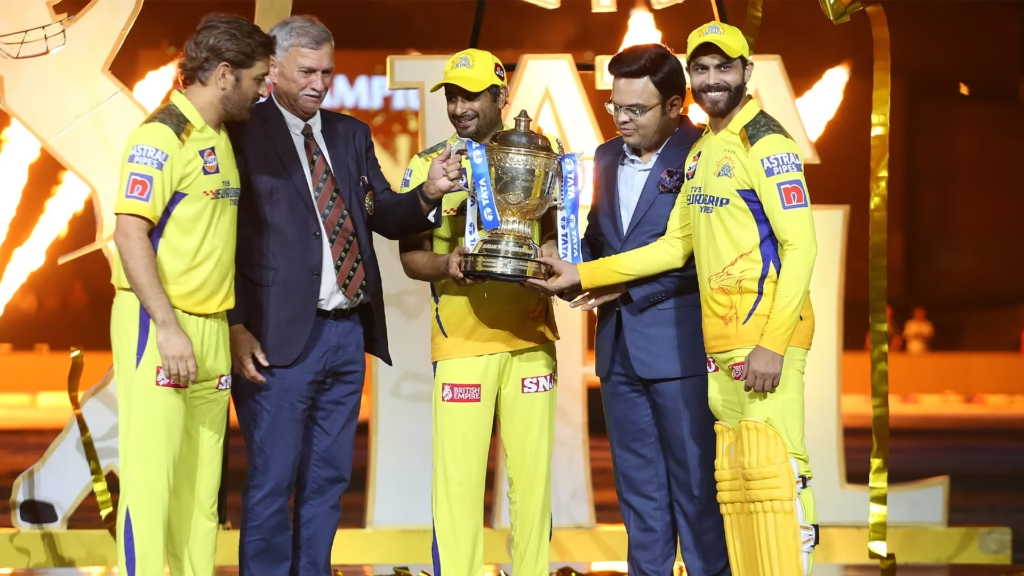
- 5 IPL titles (2010, 2011, 2018, 2021, 2023)
- 10 finals appearances (most in IPL history)
- 12 playoff qualifications in 16 seasons
- Winning percentage: 56.57% (highest in IPL, among the old teams)
- Brand value (2025): $235 million
- Known for: Yellow army, “Whistle Podu” chant, consistent performance
Mumbai Indians watched and learned. Under Rohit Sharma’s captaincy from 2013 onwards, MI built their own dynasty.
Mumbai Indians:
- 5 IPL titles (2013, 2015, 2017, 2019, 2020)
- Most successful franchise (along with CSK)
- 11 playoff appearances in 18 seasons
- Brand value (2025): $242 million
- Known for: Strong finishing, clutch performances, Ambani family backing
Why These Franchises Became So Valuable
- Leadership stability: Unlike franchises that changed captains frequently, MI had Rohit Sharma for 11 years, while CSK had Dhoni for 14 years. When Dhoni finally handed over captaincy to Ruturaj Gaikwad before the 2024 season, it marked the end of an era. But when Gaikwad got injured mid-season in 2025, the 44-year-old Dhoni had to take over again.
- Fan loyalty: At Chennai’s Chepauk Stadium, when Dhoni walks out to bat, decibel levels spike by 15-20 according to stadium measurements. Fans have been known to tear up seeing their hero bat one more time. MI’s Wankhede Stadium consistently sells out, with the Ambani family’s presence adding Bollywood glamour.
- Merchandise dominance: CSK’s number 7 jersey (Dhoni’s number) accounts for 40% of total franchise merchandise sales. When Dhoni retirement rumors surface periodically, jersey sales spike 300-400%.
- The comeback that defined CSK: CSK was banned for two years (2016-2017) due to a spot-fixing scandal involving their owners (not the players). When they returned in 2018, they won the title in their comeback season. It proved their brand was bigger than any temporary setback.
Other Successful Franchises:
- Kolkata Knight Riders: 3 titles (2012, 2014, 2024), owned by Bollywood superstar Shah Rukh Khan, brand value $222 million
- Royal Challengers Bangalore: 0 titles for 17 years until finally winning in 2025. Despite the title drought, RCB had massive brand value ($227 million in 2024) due to Virat Kohli’s fanbase. When RCB finally won in 2025, valuation jumped to $269 million
The key insight: Franchises that built consistent identities around star players and stable leadership became the most valuable. Dhoni at CSK, Rohit at MI, and Kohli at RCB created emotional connections that transcended wins and losses.
The $6.2 Billion Broadcasting Deal
How IPL Beat Every Football League Except NFL
The IPL’s explosion in value came down to one auction in June 2022. The BCCI put IPL media rights up for bid across four packages: TV rights in India, digital rights in India, digital rights to select matches, and global media rights.
Final Results:
- Disney Star won TV rights: ₹23,575 crore ($3.02 billion)
- Viacom18 won digital rights: ₹23,758 crore ($3.05 billion)
- Times Internet won international rights: ₹463 crore ($59 million)
- Total deal: ₹48,390 crore ($6.2 billion for 2023-2027)
- Per-match value: $13.8 million per game
This was a 163% increase over the previous media rights cycle. Five years of IPL generated more broadcasting revenue than most football leagues earn in a decade.
Comparison to Football Leagues (Per-Match Basis):
- IPL: $13.8 million per match
- Premier League: $11.8 million per match
- La Liga: $9.5 million per match
- Bundesliga: $7.2 million per match
- NFL: $44 million per match (still the world leader)
Why the Deal Was So Huge
- Mobile-first market: India had 750 million smartphone users in 2022, growing to 1 billion+ by 2025. Digital rights were worth as much as TV rights for the first time. When Mukesh Ambani (who owns Mumbai Indians through Reliance) launched Jio in 2016 with free data, India’s internet landscape transformed overnight.
- Young demographic: 46% of IPL fans are aged 16-35, exactly the demographic advertisers want.
- Concentrated viewing: IPL runs for just 2 months (April-May), creating concentrated viewership that advertisers love. Unlike Premier League’s 10-month season, the IPL creates urgency and scarcity.
- Prime-time slots: All matches are in evening slots (7 PM or 8 PM IST), guaranteeing massive audiences.
2025 Season Validated the Investment
Viacom18’s JioCinema platform (which merged with Disney’s Hotstar to become JioHotstar in 2024) streamed IPL for free in 2023-2025.
JioHotstar 2025 Opening Weekend:
- 1.37 billion views (35% increase year-over-year)
- 340 million concurrent viewers (likely highest for any sporting event ever)
- Final between RCB and Punjab Kings: 678 million views (most-watched T20 match in history)
The broadcasting windfall transformed franchise economics. BCCI distributes 40-50% of media rights to franchises. Chennai Super Kings reportedly received ₹227 crore ($27 million) in 2023 alone from central distributions, before adding sponsorship, tickets, or merchandise revenue.
But Storm Clouds Appeared in 2025
According to D&P Advisory’s October 2025 report, the IPL ecosystem faced its first real crisis.
IPL Valuation Decline:
- 2023 value: ₹92,500 crore ($10.5 billion)
- 2024 value: ₹82,700 crore ($9.4 billion)
- 2025 value: ₹76,100 crore ($8.7 billion)
- Two-year decline: ₹16,400 crore ($1.9 billion)
Two factors drove this decline:
The Real Money Gaming Ban: India’s 2025 Promotion & Regulation of Online Gaming Act banned fantasy gaming advertisements and sponsorships. Platforms like Dream11 had contributed ₹1,500-2,000 crore ($180-240 million) annually.
The JioStar Merger: When Disney Star and Viacom18 merged into JioStar, competitive bidding for future media rights disappeared.
Despite these headwinds, Houlihan Lokey’s 2025 report valued the IPL’s total business at $18.5 billion (a 12.9% increase), highlighting the league’s fundamental strength.
Auction System Creates Competitive Balance
Why Any Team Can Win Any Year
Unlike football leagues where rich clubs dominate for decades, the IPL built competitive balance into its DNA.
The Player Auction System:
- Every 3 years, teams hold a “mega auction”
- Teams can retain maximum 4-5 players
- All other players go into auction
- Teams have a salary cap (₹120 crore in 2025)
- Players are auctioned to highest bidder within cap constraints
In the 2025 auction held in Jeddah, Saudi Arabia, Rishabh Pant became the most expensive player in IPL history at ₹27 crore ($3.2 million), moving from Delhi Capitals to Lucknow Super Giants. Shreyas Iyer fetched ₹26.75 crore to join Punjab Kings.
Why It Works:
No long-term contracts: Players sign 1-3 year deals, creating constant roster turnover
Equal salary cap: Every team has the same budget, preventing Ambani’s Mumbai Indians or other rich owners from simply buying success
Recent Examples of Parity:
- 2022: Gujarat Titans won the title in their debut season
- 2024: Kolkata Knight Riders won after 10 years of waiting
- 2025: Punjab Kings reached finals despite never winning before; RCB won their first title after 17 years
Compare this to football where Manchester City, Real Madrid, and Bayern Munich dominate year after year. In the IPL, any team can win any year. That unpredictability keeps fans engaged.
Dhoni mastered this system. While other captains chased marquee names, Dhoni identified undervalued players and built chemistry. He bought veterans like Ambati Rayudu, Shane Watson and Robin Uthappa when other teams discarded them.
Entertainment and Stadium Atmosphere
Cricket Meets Bollywood
Lalit Modi’s original vision was “cricket meets entertainment.” The IPL delivered.
What Makes IPL Different:
- Cheerleaders and dancers at every match
- Celebrity owners (Shah Rukh Khan, Preity Zinta) bringing Bollywood glamour
- DJ and music for every boundary and wicket
- Strategic timeouts with entertainment acts
- Player entrances with dramatic music and pyrotechnics
IPL transformed cricket stadiums into entertainment venues. At Chennai’s Chepauk, when Dhoni walks out to bat even at 44 years old (six years after retiring from international cricket), stadiums erupt.
The Results:
- 58% of IPL viewers are under 45 years old
- 40% of IPL viewers are women (vs 20% for international cricket)
- Average stadium occupancy: 85-90% across all venues
- 1 billion+ total viewers in 2025 season
- IPL hashtags trend globally during match days
Mumbai Indians leveraged their Bollywood connections (through Nita Ambani’s star power) to make matches feel like premiere events. The entertainment-first approach boosted sponsorship revenue. Companies weren’t just buying cricket advertising; they were buying integration into entertainment events.
Star Power and the Digital Revolution
How Players Became Bigger Than Teams
IPL franchises built their identities around key players. Dhoni at CSK became synonymous with yellow jerseys and “Whistle Podu” chants. #WhistlePodu trended globally during matches.
Dhoni’s brand value in 2025 stands at ₹913 crore ($102.9 million), making him one of India’s most commercially valuable athletes despite retiring from international cricket in 2020. He endorses 44 brands, more than Bollywood superstars Shah Rukh Khan and Amitabh Bachchan.
Player Brand Values (2024-2025):
- Virat Kohli: ₹1,712 crore ($193 million)
- MS Dhoni: ₹913 crore ($102.9 million)
- Rohit Sharma: ₹422 crore ($48.4 million)
- Hardik Pandya: ₹382 crore ($43.1 million)
These personal brands feed franchise values. When Dhoni retirement rumors periodically surface, CSK’s social media engagement spikes 400%, jersey sales explode, and sponsors call asking about succession plans.
The Mobile-First Strategy
When Jio launched with free data in 2016, the IPL adapted its strategy to mobile-first audiences. By 2025, digital accounted for 60% of total viewership, a complete reversal from TV dominance just five years earlier.
Why the IPL Dominated Digital:
- Short format: 3 hours perfect for mobile viewing
- Regional language streams: Commentary in 8+ languages beyond English/Hindi
- Free streaming: JioCinema made IPL free, then monetized through advertising (₹4,500 crore ad revenue in 2025)
- Vertical video feeds for smartphone viewers
- Fantasy leagues and second-screen experiences
Compare this to football leagues still optimizing primarily for television. The Premier League struggles with digital piracy and lower streaming revenue. The IPL embraced mobile-first digital from the start.
The Numbers: IPL vs Football Leagues
How an 18-Year-Old League Beat 100-Year-Old Giants
League Valuations (2024-2025):
- IPL total business value: $18.5 billion
- English Premier League: Top 5 clubs worth $15 billion combined
- La Liga: Top 3 clubs worth $12.7 billion combined
- Bundesliga: Major clubs $2.9 billion combined
Per Match Value (The Key Metric):
- IPL: $13.8 million per match
- Premier League: $11.8 million per match
- La Liga: $9.5 million per match
- Bundesliga: $7.2 million per match
Top Franchise/Club Valuations:
IPL (2025):
- Royal Challengers Bangalore: $269 million
- Mumbai Indians: $242 million
- Chennai Super Kings: $235 million
- Kolkata Knight Riders: $222 million
Premier League:
- Manchester United: $6.55 billion
- Manchester City: $4.99 billion
- Liverpool: $4.71 billion
The Key Difference
Individual football clubs are worth more because they have 100+ years of history and own stadiums. But the IPL as a LEAGUE generates more money per game than any football competition except the NFL, and does it in 2 months instead of 10.
Why IPL Is More Valuable Per Match:
- Concentrated viewership: 2 months vs 10 months creates urgency
- Prime-time slots: Every match is evening, maximizing viewership
- Mobile-first market: India’s 1 billion+ smartphone users
- Young audience: Advertisers pay premium for 16-35 demographic
- Cricket dominance in India: Cricket is religion, football is hobby
Growth Rate Comparison:
- IPL (2008-2025): 825% growth (from $2B to $18.5B in 18 years)
- Premier League (2008-2025): 150% growth
- La Liga: 100% growth
The Risks: Can IPL Keep Growing?
Challenge 1: The Dhoni Question
MS Dhoni turned 44 in July 2025. He’s played all 18 IPL seasons, 278 matches total. His brand value (₹913 crore) exceeds some franchises’ valuations. But the 2025 season, where CSK finished last despite Dhoni’s return as captain mid-season, showed age catching up.
Former CSK star Dwayne Bravo said: “MSD is not just a name, he is a brand of IPL.” When that brand retires, whether after 2026, or 2027, the IPL loses its most iconic face. No current player commands Dhoni’s pan-India appeal.
Challenge 2: Media Rights Plateau
The JioStar merger eliminated competitive bidding. When the next rights cycle (2028-2032) comes up, there’s no rival to drive prices skyward. Analysts project flat or modest single-digit growth. This hits franchise valuations directly.
Challenge 3: International Calendar Conflicts
IPL’s success inspired rival leagues (Caribbean Premier League, SA20, ILT20). All compete for the same global talent and calendar space. If other leagues grow wealthier (particularly Saudi-backed ventures), the IPL could lose international players.
Challenge 4: Quality Dilution
BCCI has discussed expanding to 94 matches by adding more teams. While generating more short-term revenue, this risks destroying the scarcity value that makes the current format compelling.
Despite these challenges, the IPL has significant growth vectors: global expansion beyond India, Women’s Premier League growth, franchise ecosystem expansion (MI owns teams in Cape Town, Emirates, and New York), and sponsorship diversification into stable sectors like automobiles and banking.
The Bottom Line: IPL’s Winning Formula
The IPL became more valuable than most football leagues by doing what those leagues couldn’t.
The Playbook:
- Dhoni’s CSK and Rohit’s MI built the template for sustained success (5 titles each, consistent performance, loyal fanbases)
- $6.2 billion broadcasting deal (second only to NFL in per-match value)
- Auction system creating competitive balance (7 different champions in 18 seasons)
- Entertainment-first presentation (cricket meets Bollywood)
- Mobile-first digital strategy (60% digital viewership by 2025)
- Concentrated 2-month season (creating urgency and scarcity)
- Prime-time slots every match (7-8 PM maximizing audiences)
The IPL’s business value grew from $2 billion to $18.5 billion in 18 years. Franchises that cost $75-111 million in 2008 are now worth $200-269 million. New franchises in 2022 sold for $940 million despite never playing a match.
The league generates $13.8 million per match, more than the Premier League ($11.8 million), La Liga ($9.5 million), and every other football competition except the NFL.
When Dhoni walks out to bat at Chepauk and stadiums erupt, when fans tear up seeing their 44-year-old hero play one more time, when CSK’s number 7 jersey sales spike 400% on retirement rumors, when MI’s five titles create a commercial juggernaut backed by India’s richest family, when RCB’s 17-year title wait finally ends and valuations jump $42 million overnight, that’s when you know you’ve built something beyond sport.
The IPL proved that competitive balance, entertainment focus, and emotional fan connections can compete with century-old football leagues. It’s not about history. It’s about giving fans what they want: exciting, unpredictable competition with stars they can connect with.
That’s how cricket’s billion-dollar baby became more valuable than football’s giants. And it’s only 18 years old.