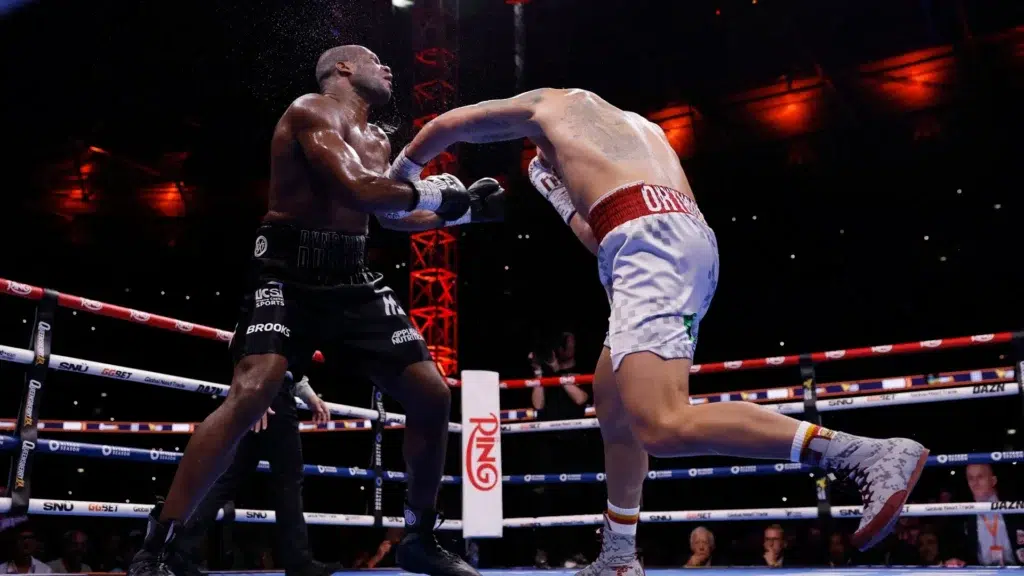
On July 19, 2025, Oleksandr Usyk knocked out Daniel Dubois in round five to retain his WBA, WBO, and IBO heavyweight titles at Wembley Stadium. Dubois earned a reported $5 million purse for the fight. By the time taxes, his management team, trainer, cutman, and camp costs were settled, the British heavyweight likely took home somewhere between $1.5 million and $2 million.
That gap, between the number on the poster and the number in the bank account, is the defining financial reality of professional boxing. It is not a new problem. It is a structural one, built into every contract, every commission arrangement, and every training camp invoice in the sport.
Mike Tyson earned an estimated $400 million across his career. He earned $103 million for a single fight against Lennox Lewis in 2002. One year later, he filed for Chapter 11 bankruptcy protection with $23 million in debt, $13.4 million of which was owed to the IRS alone. Evander Holyfield earned over $250 million in career prize money. He was declared bankrupt in 2012, forced to auction his Olympic medals, championship rings, and fight-worn gloves to cover debts. His 109-room mansion outside Atlanta, purchased for $20 million, was sold for $7.5 million, not enough to cover what he owed the bank.
These are not freak cases. They are the norm. A 2025 study found that over 73% of licensed professional boxers in the United States earned less than $25,000 in total that year. For those at the top, the purses are enormous. What actually reaches the boxer is not.
What the Purse Actually Means
The Number on the Poster Is Not What the Boxer Gets
When a fight is announced and purses are made public, the figure reported is the gross purse, the total contractual payment before any deductions. What a boxer actually receives is entirely different. Boxing has no union, no collective bargaining agreement, and no standardized deduction structure. Every percentage is negotiated individually, and most fighters, especially early in their careers, sign deals without legal representation.
A boxer with a $1 million gross purse faces the following realistic scenario before seeing a single dollar in their bank account.
$1 Million Purse Breakdown:
- Gross purse: $1,000,000
- Federal income tax (39.6%): -$396,000
- Manager fee (20-25%): -$200,000 to $250,000
- Trainer fee (10-15%): -$100,000 to $150,000
- Promoter administrative fee (10%): -$100,000
- Cutman flat fee or 2-3%: -$20,000 to $30,000
- Camp expenses (sparring, travel, accommodation): -$50,000 to $100,000
- Estimated take-home: $300,000 to $420,000
Actual fighters confirm this math. Professional boxer Joey Dawejko stated: “The fighter always ends up with less than half. Depending on who you have, 35-40% of the original purse sounds about right.” Carl Frampton, former two-weight world champion, explained it even more directly: “Your trainer gets 10%, your manager normally gets 25%. Then you have to pay sparring partners, food, travel. Sometimes what sounds like a good purse by the time you break it down and pay taxes on it, is not a lot of dough.”
The fighter who earns $10 million on paper takes home roughly $3.5 million to $4 million. The fighter who earns $100 million takes home $35 million to $40 million. The headline number and the reality are separated by an industry of people whose income depends on the fighter’s gross, not the fighter’s net.
Boxing Has No Protection System
Every other major American professional sport has structures that protect athlete earnings. The NFL has a union, a collective bargaining agreement, minimum salaries, and pension programs. The NBA has guaranteed contracts and a players association that negotiates revenue sharing. MLB has salary arbitration. The NHL has a CBA covering everything from per diem rates to playoff bonuses.
Boxing has none of this. There is no governing body with authority over all promoters. No standardized manager contract. No league minimum wage beyond what individual state athletic commissions require, which can be as low as $500 per fight for non-title bouts. Every boxer negotiates individually, usually from a position of desperation, against promoters and managers who have done this thousands of times before.
What Other Sports Provide That Boxing Does Not:
- NFL: Minimum salary $795,000 (2024), union representation, pension
- NBA: Minimum salary $1.1 million (2024), CBA, revenue sharing
- MLB: Minimum salary $740,000 (2024), arbitration rights, pension
- Boxing: Minimum purse set by state commission, often $500-$1,500 for low-level bouts, no union, no pension
This absence of structure is why the sport produces so many financially devastated champions. The very fighters generating the most revenue have the least institutional protection around how that revenue is distributed.
The People Taking Their Money
Promoters: The Most Powerful Figure in Boxing Finance
The promoter is the central financial figure in professional boxing. Promoters organize events, negotiate television deals, sell tickets, and pay all production costs. In return, they take a percentage of the boxer’s purse. In the United States, state athletic commissions cap the promoter’s share at 33.3% of the fighter’s purse, but in practice, promoters have multiple ways to extract value beyond this cap.
Don King is the most documented case of promoter exploitation in boxing history. Mike Tyson went on to blame fight promoter Don King for illegally taking up to 50% of his earnings from fights and pay-per-view payouts. Tyson sued King for $100 million, and the two ultimately reached a settlement in 2004, with King paying Tyson $14 million.
Promoters typically sign fighters to long-term exclusive contracts early in their careers, often when fighters have no leverage and no alternatives. These contracts give promoters the right to match any offer from a competing promoter, control over who the fighter faces, and a percentage of all earnings during the contract period. By the time a fighter is generating meaningful revenue, they are legally bound to a promoter whose percentage was locked in before either party knew how valuable the fighter would become.
How Promoters Structure Their Earnings:
- Percentage of fighter’s purse: 20-33.3% depending on contract
- Television and streaming rights: Promoters negotiate and retain a share
- Pay-per-view backend: Top-line promoters take a percentage of PPV revenue
- Venue deals: Promoters negotiate venue contracts and retain surplus
- Merchandise: Some promoters retain licensing rights
The distinction between Floyd Mayweather and most fighters illustrates the difference promoter control makes. Mayweather became his own promoter with Mayweather Promotions, eliminating the promoter’s percentage entirely and controlling his own television negotiations. He fought on his own terms, against opponents he selected, and kept the promoter’s share himself. Almost no fighter reaches this position. Mayweather had the leverage to do it because he was, by that point, the sport’s biggest draw.
Managers: 20-25% Before the Boxer Sees Anything
A manager’s role is to negotiate contracts, find fight opportunities, and advise on career decisions. In exchange, managers typically take 20-25% of everything the fighter earns. This percentage applies to the gross purse, before taxes, before any other deductions. A manager who negotiates a $10 million fight earns $2-2.5 million. The boxer then pays taxes on the remaining $7.5-8 million, pays their trainer, cutman, and camp costs, and ends up with a fraction of what the headline number suggested.
Industry insiders confirm the standard: “If the guy has a manager or advisor, that guy will make about 20 to 25 percent of what the fighter makes from the fight. The promoter will make another 20 to 25 percent off the fighter’s side of the purse.” Combined, that is up to 50% of the gross purse gone before taxes, trainers, or any other expense is considered.
In the UK, the structure differs slightly. A promoter cannot manage his fighter and does not take a percentage of the boxer’s purse directly. The breakdown is 10% to the trainer, who pays gym fees and other bills, then the manager is entitled to 25% of what remains. The percentages shift but the fundamental reality does not: most of the money leaves the fighter’s hands before they touch it.
Trainers, Cutmen, and Camp Costs
A head trainer typically earns 10% of the boxer’s purse. For a $10 million fight, that is $1 million to the trainer. For a $100 million fight, it is $10 million. Top trainers like Freddie Roach, Bob Arum, and Roger Mayweather commanded these figures at the peak of their careers. A cutman, who manages cuts between rounds and can determine whether a fighter continues, earns either a flat fee or 2-3% of the purse.
Beyond the percentage cuts, elite fighters run full training camps in the eight to twelve weeks before a fight. These camps are expensive.
Elite Training Camp Costs (8-12 Week Camp):
- Sparring partners (4-6 fighters): $2,000-$5,000 per week each
- Strength and conditioning coach: $5,000-$15,000 total
- Nutritionist: $3,000-$8,000 total
- Sports psychologist: $2,000-$5,000 total
- Physiotherapist and massage therapist: $3,000-$6,000 total
- Accommodation at training facility: $5,000-$20,000 total
- Travel and logistics: $10,000-$30,000 total
- Estimated total camp cost: $50,000 to $150,000+
A fighter earning $5 million for a fight spends $100,000-$150,000 on camp before the first bell rings, on top of the 10% trainer cut ($500,000), 20% manager cut ($1 million), and 39.6% federal tax on what remains. The camp is not optional. It is the cost of being prepared enough to survive twelve rounds.
The Tax Problem Nobody Talks About
Nevada, New York, and the IRS
Most major boxing events take place in Nevada, particularly Las Vegas, which has no state income tax. This is one reason fighters and promoters prefer Nevada as a venue. However, the federal government taxes boxing earnings at the top marginal rate, which was 39.6% at its highest in recent years for fighters in the highest income bracket.
Foreign fighters face an additional layer. The United States imposes withholding tax on non-resident aliens earning income from US-based activities. A British fighter who earns $20 million for a Las Vegas fight faces US federal withholding in addition to UK tax obligations. The exact treatment depends on tax treaties between countries, but international fighters routinely lose 40-50% of their US earnings to combined tax obligations before any other deductions.
Tax Impact on a $10 Million Purse:
- Gross purse: $10,000,000
- Federal income tax (37-39.6%): -$3,700,000 to $3,960,000
- After federal tax: $6,040,000 to $6,300,000
- Manager 20%: -$2,000,000
- Trainer 10%: -$1,000,000
- Camp costs: -$150,000
- Estimated take-home: approximately $2,890,000 to $3,150,000
A fighter who earns $10 million takes home approximately $3 million. One who earns $100 million takes home approximately $30 million. These are still large sums. The problem is that careers are short, expenses during the earning years are enormous, and most fighters have no financial infrastructure to manage what remains.
The Spending Problem: What Happens After the Money Arrives
Mike Tyson: $400 Million Gone in 15 Years
Mike Tyson earned an estimated $400 million across his boxing career. His highest single-fight purse was $103 million for the Lennox Lewis fight in 2002. Shortly after that fight, in 2003, Tyson declared bankruptcy and filings show he was $23 million in debt. He reportedly owed the IRS $13.4 million, the British tax authorities $4 million, plus millions more to attorneys, financial managers, trainers, and even a music producer.
Tyson’s spending was extraordinary even by the standards of athletes who go broke. He traveled with an entourage of 50+ people. He spent $6.3 million on cars. He owned three Bengal tigers that cost $70,000 each to purchase and $125,000 annually for an animal trainer. He spent $580,000 on a single birthday party for 700 guests. He paid a staff member $300,000 a year specifically to shout “guerrilla warfare” at his press conferences.
Mike Tyson’s Documented Spending:
- Mansions: Multiple properties including a 52-room Connecticut estate
- Bengal tigers: $70,000 each, $125,000/year for handler
- Cars: $6.3 million estimated total
- Birthday party (30th): $580,000 for 700 guests
- Jewelry: $173,706 on a single gold chain in one store visit
- Entourage: 50+ people traveling with him at peak
- Don King settlement: Received $14 million but had already lost hundreds of millions more
Tyson’s case is extreme in its specifics but entirely typical in its pattern. Young men from impoverished backgrounds earn more money in one night than their families have earned in generations. They have no financial education, no experience managing wealth, and are surrounded by people whose income depends on the fighter spending.
Evander Holyfield: $250 Million and a 2-Bedroom Apartment
Evander Holyfield earned over £200 million in his career. By the time he retired, he was struggling financially. Holyfield was declared bankrupt in 2012 and forced to auction off almost all of his possessions, in what was believed to be the largest auction of sporting memorabilia by a single person at the time.
Holyfield’s downfall had multiple causes. He bought a $20 million, 109-room mansion in Georgia that cost $1 million annually in maintenance and taxes alone. He had 11 children with six different women, generating enormous ongoing child support obligations. He invested $7.6 million in a restaurant chain that failed. He launched Real Deal Records, a music label that lost millions before closing. His home was eventually sold for $7.5 million, less than half its purchase price, which did not even cover the mortgage balance. Rick Ross bought it for $5.8 million. Holyfield moved to a two-bedroom apartment.
Evander Holyfield’s Financial Collapse:
- Career earnings: $250+ million
- Mansion purchase price: $20 million (109 rooms, 54,000 sq ft)
- Annual maintenance and taxes on mansion: $1 million
- Mortgage debt at foreclosure: $14 million
- Sale price of mansion: $7.5 million (to Rick Ross for $5.8M)
- Failed restaurant investment: $7.6 million loss
- Failed record label: multi-million dollar loss
- Children: 11 with 6 different women
- Net worth in 2025: approximately $1 million
Holyfield was still fighting professionally at age 48 because he needed the money. He took exhibition fights in his 50s for the same reason. The pattern of elite boxers fighting long past their physical peak, taking damage they do not need to take, is almost entirely driven by financial desperation.
Why Boxing Produces This Problem More Than Any Other Sport
Short Careers, Lumpy Income, No Safety Net
A boxer’s career at the elite level typically spans 8-15 years. During that time, they might fight 4-6 times per year at lower levels, dropping to 1-2 times per year as they reach the top. An elite heavyweight champion might fight twice in a year, generating massive income concentrated into two events. The gaps between those events can span 12-18 months, during which training costs, living expenses, entourage costs, and team salaries continue.
This lumpy income pattern creates a structural problem. Large, infrequent payments encourage large, immediate spending. Without financial advisors who understand how to smooth volatile income across time, fighters spend their fight purse in months and are financially exposed during the long gaps before the next payday. Sports like basketball and football pay athletes regular salaries across the season, creating a steadier income pattern. Boxing concentrates everything into two or three events per year at best.
Average Career Length Comparison:
- NFL: 3.3 years average career
- NBA: 4.5 years average career
- MLB: 5.6 years average career
- Boxing (elite level): 8-15 years, but top earnings concentrated in last 3-5 years
- Post-career income: Boxing provides no pension, no league-funded retirement plan
The Entourage and Loyalty Tax
Many elite boxers come from economically disadvantaged backgrounds. When they begin earning significant money, the social pressure to support family members, childhood friends, and community members is intense. This is not unique to boxing, but boxing’s extreme income concentration, the difference between a $100 million fight and $0 in the following year, makes it more financially devastating.
Tyson’s entourage of 50+ people was not just an indulgence. It was a social obligation that fighters in his position typically feel compelled to fulfill. The people in that entourage often have no other income source. They are genuinely dependent on the fighter’s earnings. Cutting them off means cutting off people who were present during the grinding years before the money arrived.
Common Post-Fight Spending Patterns for Elite Boxers:
- Family support: Parents, siblings, extended family placed on informal payroll
- Friends and entourage: Travel, accommodation, living expenses for long-term associates
- Gifts: Cars, jewelry, cash gifts to community members
- Lifestyle inflation: Mansions, luxury cars, expensive habits established at income peak
- Failed business investments: Record labels, restaurants, clothing lines, real estate
No Financial Education, No Infrastructure
Boxing gyms do not teach financial management. The sport has no player development programs, no mandatory financial literacy training for young professionals, and no institutional structure that connects fighters to qualified financial advisors. The people most qualified to advise on sports contracts and wealth management, lawyers and accountants specializing in athlete finance, are expensive. Young fighters starting out typically cannot afford them. By the time they can, they have already signed contracts that will govern their peak earning years.
The contrast with promoters and managers could not be more stark. Don King promoted boxing for decades, developing expertise across hundreds of contracts. A boxer fights 40-50 times in a career. They negotiate their contracts once or twice before signing with a promoter who has done this a thousand times. The information asymmetry is total.
The Fighters Who Beat the System
Floyd Mayweather: How to Actually Keep the Money
Floyd Mayweather is the most financially successful boxer in history not simply because he earned the most, but because he kept the most. Mayweather earned an estimated $1.1 billion across his career, including $300 million for the Conor McGregor fight in 2017 and $250 million for the Manny Pacquiao fight in 2015. He is estimated to have retained the majority of it.
Mayweather achieved this through three structural decisions that most fighters never make. He became his own promoter, eliminating the promoter’s 20-33% cut entirely. He negotiated all his own television and PPV deals directly, capturing revenue that most fighters never see. He maintained extremely tight control over his team, keeping it small and ensuring every person had a clearly defined, financially justified role.
What Mayweather Did Differently:
- Self-promoted: Eliminated promoter cut, retained event revenue
- Owned his TV deals: Negotiated directly with HBO, Showtime, and later streaming
- PPV backend: Received a percentage of every PPV purchase, not just a flat purse
- Small team: Tight inner circle with clear financial roles, not a 50-person entourage
- Business investments: TMT (The Money Team) brand, boxing promotion, strategic licensing
- Financial advisor: Long-term professional financial management throughout career
The Pacquiao fight generated an estimated $600 million in total revenue. Mayweather’s share, as both fighter and promoter, was approximately $250 million. Pacquiao, fighting under a traditional promoter arrangement, earned approximately $120 million gross, which reduced significantly after deductions.
Oscar De La Hoya: The Promoter Path
Oscar De La Hoya earned approximately $700 million during his career and, unlike Tyson and Holyfield, built lasting wealth. His vehicle was Golden Boy Promotions, which he founded in 2002 and built into one of boxing’s major promotional companies. De La Hoya became a promoter himself, capturing value from the other side of the contract rather than losing it.
Golden Boy Promotions has promoted fighters including Canelo Alvarez, whose total career earnings exceed $300 million and whose 11-fight, $365 million deal with DAZN (later renegotiated) represents one of boxing’s largest contracts. De La Hoya’s share as Alvarez’s promoter generated revenue that his boxing career alone never could have.
The Short Career Window Nobody Prepares For
The Clock Runs Faster Than the Money
A boxer’s peak earning years are brief. Most fighters are at their commercial peak for 5-7 years. The physical deterioration from professional boxing, concussions, accumulated damage, and aging, compresses the window during which premium purses are achievable. When that window closes, income essentially disappears overnight.
Unlike an investment banker whose income reduces gradually through retirement, a boxer’s income stops between fights and stops permanently after career’s end. There is no severance. No pension. No gradual wind-down. One fight is their last fight, and often they do not know it was their last until afterward.
Income Pattern of a Typical Elite Boxer:
- Age 18-24: Building record, earning $2,000-$50,000 per fight
- Age 24-28: Rising contender, earning $100,000-$1 million per fight
- Age 28-33: Peak earning years, $5 million to $100 million per fight
- Age 33-38: Decline phase, earnings falling, injuries mounting
- Age 38+: Career over, often fighting exhibitions for financial survival
- Post-career: No institutional income, depleted savings, no pension
The fighters who do retain wealth, Mayweather, De La Hoya, and a small number of others, all built income streams outside the ring before their careers ended. Most wait until after their career is over to think about what comes next, by which point the money is already gone.
The Bottom Line: A Sport Designed to Leave Athletes Broke
Boxing generates billions of dollars in annual revenue through pay-per-view, streaming deals, venue ticket sales, and sponsorships. The fighters who create that value, who take the punches and fill the arenas, systematically receive the smallest share of what they generate.
Mike Tyson earned $400 million and was $23 million in debt. Evander Holyfield earned $250 million and now lives in a two-bedroom apartment. These outcomes are not individual failures. They are the predictable result of a sport with no union, no minimum salaries, no pension, no mandatory financial literacy, and an industry of professionals whose income is calculated as a percentage of whatever the fighter earns.
Why boxers go broke in five numbers:
- 30-40%: What a boxer realistically takes home after all deductions
- 39.6%: Federal tax rate at peak boxing earnings (Nevada fights)
- $400M: Mike Tyson’s career earnings before his 2003 bankruptcy
- $250M: Evander Holyfield’s career earnings before his 2012 bankruptcy
- $0: What boxing’s pension plan provides, because boxing has no pension plan
The rare exceptions, Mayweather, De La Hoya, a handful of others, built financial security by taking control of the business side of boxing rather than simply performing in it. They became promoters and business owners rather than remaining fighters who handed their economic fate to someone else. Most boxers never reach the leverage required to make that transition, and by the time they understand the system, the system has already taken most of their money.
Boxing will keep producing millionaires who die broke until it produces the structural protections that every other major American sport has had for decades. Until then, the next Mike Tyson is already signing contracts he does not fully understand, with people who understand them very well.