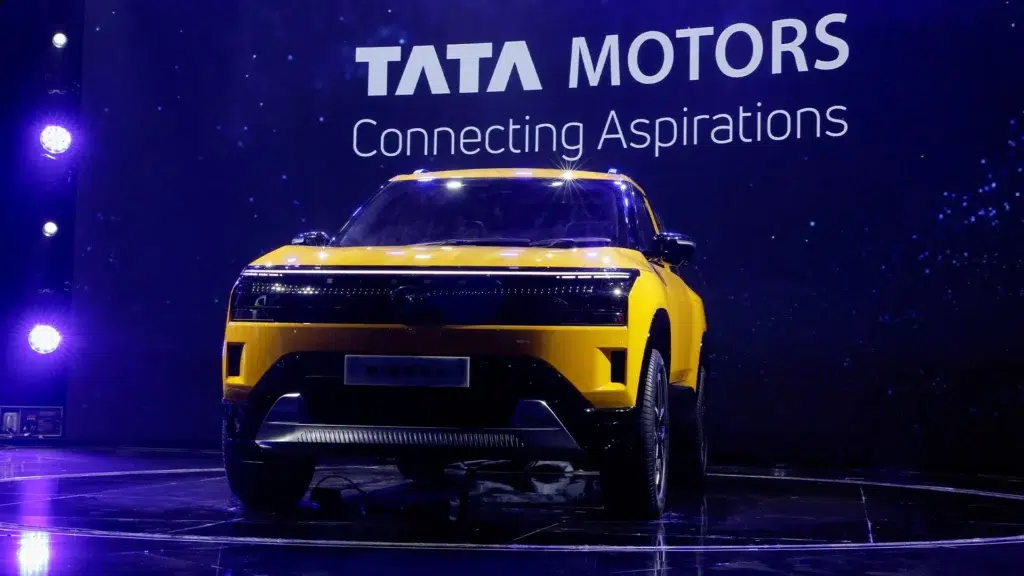
In 2017, Tata Motors’ chairman N. Chandrasekaran stood before investors and said something most CEOs would never admit publicly: the company was losing money on every passenger car it sold in India.
The numbers backed him up. The passenger vehicle division had posted a loss of ₹2,800 crore in FY17 on revenues of ₹49,100 crore. Market share had collapsed to around 5.5%. The product portfolio was ageing, the brand was associated with government fleets and taxis, and younger buyers were simply not considering Tata. Meanwhile, Maruti and Hyundai between them controlled over 70% of the market.
Eight years later, the picture looks entirely different. Tata Motors posted a record net profit of ₹28,100 crore in FY25, its highest ever. The Nexon crossed 9.1 lakh cumulative sales. The company’s EV division, TATA.ev, surpassed 2.5 lakh cumulative EV sales by December 2025, holding a 66% share of all electric passenger vehicles ever sold in India. The business was restructured into two separate listed entities in October 2025, with the CV division listing at ₹330 per share on the BSE on November 12.
This is not just a product story. It is one of the most complete corporate turnarounds in Indian automotive history.
The Rock Bottom That Made the Turnaround Possible
To understand how far Tata Motors has come, you have to understand how bad it actually got.
The passenger vehicle business had been bleeding for years by 2016. The Nano experiment, launched with the best of intentions as a ₹1 lakh car for the masses, had ended in a brand image disaster. The association with cheapness clung to the company even as it tried to move upmarket. Tata cars were consistently rated poorly in safety tests. The Indica and Indigo, which had once been bold indigenous launches, had aged without meaningful updates.
In January 2014, Global NCAP published its first-ever independent crash test results for Indian-made cars. The Tata Nano scored zero stars for adult occupant safety. The Tata Indica scored one star. The damage to brand perception was severe.
What was broken in Tata’s PV business going into FY17:
- Market share: Just 5.5% in the April-July 2017 period, against Maruti’s dominance above 50%
- Product portfolio: Aging models on legacy platforms with no compelling new launches in pipeline
- Brand image: Strongly associated with taxis, government fleets, and budget commuter cars
- Safety reputation: Zero and one-star Global NCAP ratings destroying purchase consideration
- Financial losses: ₹2,800 crore loss in FY17 despite ₹49,100 crore in revenue
- Consumer perception: Young buyers actively avoiding the brand; no aspirational value
The commercial vehicle business was also under pressure, and JLR, the British luxury brand acquired for ₹10,000 crore in 2008, was navigating Brexit uncertainty and a worsening China situation.
The Chandrasekaran Mandate: Rebuild From the Product Up
When N. Chandrasekaran took over as Chairman in 2017, the internal assessment was stark. The turnaround could not be driven by discounting or marketing alone. It required a completely new product philosophy, a new design language, and a willingness to exit segments that were dragging the brand down.
The strategy, formalized as Turnaround 2.0, had three clear pillars: win decisively in commercial vehicles, win sustainably in passenger vehicles, and win proactively in EVs. The PV approach specifically required Tata to stop defending every segment and instead concentrate firepower on a smaller set of products built to genuinely compete.
Tata exited the taxi-focused volume market, discontinued nine ageing models in three years, and committed to building every new car on a modern platform with five-star safety, contemporary design, and features that could compete against Korean and Japanese rivals. The Nexon, launched in September 2017, was the first test of whether this plan could actually work.
The Nexon: One Car That Changed Everything
The Nexon launched in September 2017 as Tata’s first compact SUV. It was also the most consequential product decision the company made in a decade.
The compact SUV segment in 2017 was dominated by the Maruti Brezza and Ford EcoSport. Tata had no credibility in this space. The Nexon arrived on the new Agile Light Flexible Advanced (ALFA) platform with a design shaped by Impact Design philosophy, sharp angles, a strong stance, and a premium-feeling interior that did not look like anything Tata had produced before.
Sales started modestly. In FY18, the Nexon sold 27,547 units. Then came the number that changed everything.
In December 2018, the Nexon became the first Indian-made car to score a five-star rating for adult occupant safety in a Global NCAP crash test. For a company whose safety credibility had been destroyed by the Nano’s zero-star result just four years earlier, this was a complete image reversal. Tata was not just making safer cars. It was making the safest cars in its price range in India.
Nexon’s sales journey in numbers:
- FY18: 27,547 units (brand new entry into segment)
- FY22: 1,24,130 units (India’s No. 1 best-selling SUV)
- FY23: 1,72,138 units (best fiscal performance ever, up 39% YoY)
- FY24: 1,71,929 units (held No. 1 SUV title for third consecutive year)
- FY25: 1,63,087 units (No. 7 overall as sibling Punch took top spot)
- January 2026: 23,365 units in a single month, up 17% MoM
- Cumulative by September 2025: 9,10,181 units, first Tata SUV to cross 9 lakh sales
The Nexon’s growth trajectory mirrors Tata’s entire turnaround arc. What started as a bet on safety and design became the commercial backbone of the company’s revival, accounting for 29% of all Tata PV sales even in FY25.
Why the Five-Star Safety Rating Was a Business Strategy, Not Just a Feature
Most automakers pursue safety certification quietly. Tata Motors turned it into the loudest marketing message in Indian automotive history.
In a market where buyers were traditionally sold on features like sunroofs, large touchscreens, and cruise control, Tata’s “Safest Cars in India” positioning was a genuine disruption. Vivek Srivatsa, head of marketing at Tata Motors PV, acknowledged it openly: “Today, a huge number of our customers put safety as the number one reason why they buy a Tata car.”
The Altroz followed in 2020 with its own five-star Global NCAP rating. The Punch received five stars in Bharat NCAP in 2023. The Nexon repeated its five-star score under the stricter Bharat NCAP protocol in October 2024. Safety became a brand pillar that Maruti Suzuki, which dominated every other category, simply could not match for years.
The Punch Takes the Baton in FY25
The Nexon’s biggest competition in FY25 came from within its own family. The Tata Punch, launched in October 2021, outsold the Nexon every month from January 2024 onward and became India’s No. 1 SUV in FY25 with 1,96,572 units, accounting for 35% of Tata’s total PV sales.
This is not a cannibalisation problem. It is a portfolio strength problem that every company wants to have. In FY25, Tata Motors sold 5,53,585 passenger vehicles in total, its PV market share holding steady at 13.2% despite an increasingly competitive market. The Nexon is already fighting back in FY26, reclaiming the No. 1 SUV title in H1 FY26 with 89,557 units, up 24% YoY.
TATA.ev: Building India’s EV Market From Scratch
While the Nexon was rebuilding Tata’s brand in the ICE segment, the company was simultaneously making a bet that most Indian automakers were not willing to make: that electric vehicles would go mainstream in India faster than the market expected, and that the company that got there first and built the ecosystem around EVs would dominate for years.
The Nexon.ev launched in January 2020. It was priced at under ₹14 lakh, making it the first mainstream electric SUV in India accessible to a large buyer base. It came with real-world range, a form factor buyers already trusted, and the same five-star safety credentials as its petrol sibling.
In FY21, the Nexon EV sold 3,000 units and held a 64.4% share of the entire electric passenger vehicle segment in India. That segment was tiny. But Tata was not building for that market. It was building for the market three years ahead.
TATA.ev milestones through December 2025:
- January 2020: Nexon.ev launched under ₹14 lakh, first mainstream electric SUV in India
- October 2022: Tiago.ev launched at ₹8.5 lakh; sold 10,000 units on day one of bookings
- FY22: EV volumes up 353% YoY; 19,105 units sold; EV penetration in Tata PV at 7.4%
- FY25: 64,726 EVs sold; 200,000 cumulative EV milestone crossed
- December 2025: 2,50,000 cumulative EVs sold; 66% share of all EVs ever sold in India
- CY25 full year: 70,004 EVs sold, up 13% YoY; Nexon.ev first Indian EV to cross 1 lakh cumulative sales
The Tiago.ev launch in 2022 deserves special mention. At a starting price of ₹8.49 lakh, it was the most affordable electric car in India at the time and sold 10,000 units on the first day of bookings. That single moment validated Tata’s thesis: price accessibility, not technology anxiety, was the main barrier holding Indian EV adoption back.
The Ecosystem Bet That Competitors Cannot Simply Copy
Tata Motors did not launch EVs in isolation. It built an ecosystem that competitors would need years and massive capital to replicate.
In FY22, Tata Motors incorporated a separate entity, Tata Passenger Electric Mobility Limited (TPEML), exclusively focused on accelerating the EV business and its enabling infrastructure. This structure allowed the company to attract dedicated EV investment, separate EV accounting from the broader PV business, and build partnerships across the Tata group.
The TATA.ev ecosystem as of early 2026:
- Charging network: Over 2 lakh charging points including home, community, and public chargers through partner CPOs
- Fast charging hubs: 100 MegaCharging Hubs live across key national corridors with up to 120kW charging speeds
- Service network: Approximately 1,500 dedicated EV service bays across India with over 5,000 specially trained EV technicians
- Tata Power synergy: Access to Tata group’s power generation and distribution infrastructure for charging rollout
- Battery supply: Long-term supply relationships including domestic cell manufacturing partnerships reducing import dependence
By December 2025, Tata Motors’ EVs were being used in over 1,000 towns and cities across India. 84% of TATA.ev owners reported using their vehicle as their primary mode of transport, averaging around 20,000 km per year. These are not aspirational buyers sitting on a luxury product. These are daily commuters fully converted to electric.
The Market Share Challenge: Competition Is Finally Arriving
The EV market Tata Motors built largely alone is now crowded. This is the one significant headwind in the turnaround story.
In CY25, Tata Motors sold 70,004 EVs but its annual market share fell to 40%, down from 62% in CY24 and 73% in CY23. JSW MG Motor India has been the biggest challenger, driven by the Windsor EV which became India’s best-selling EV from its September 2024 launch. JSW MG’s share hit 29% in CY25. Fleet sales, which had padded Tata’s EV numbers significantly, fell from 26,000 units in CY23 to 2,000 units in CY24 as institutional buyers diversified.
Mahindra’s entry into the segment with the XEV 9e and BE 6 in late 2024 brought serious competition at higher price points. Hyundai’s Creta Electric launched in January 2025 added another mainstream rival.
Tata’s response is product-led. The Harrier.ev launched in FY25. The Sierra EV and a refreshed Punch.ev are confirmed for 2026. The Avinya range of premium EVs above ₹30 lakh is also expected in CY26, targeting the segment where Tata currently has no representation. Shailesh Chandra, Managing Director of Tata Motors Passenger Vehicles, has publicly stated the target of reclaiming a 45-50% EV market share.
The Financial Turnaround: From ₹2,800 Crore Loss to Record Profits
The product and EV strategy ultimately has to show up in the financials. And in FY25, it showed up emphatically.
Tata Motors group posted record consolidated revenues of ₹4,39,695 crore in FY25, up 1.3% year on year. Net profit came in at ₹28,100 crore, the highest in the company’s history. PBT (before exceptional items) reached ₹34,330 crore, up ₹4,963 crore over FY24. The automotive business turned net cash positive for the first time, with a net cash balance of ₹1,000 crore after years of heavy debt.
Free cash flows from automotive operations stood at ₹22,400 crore for FY25. Finance costs fell by ₹2,510 crore to ₹5,083 crore as gross debt reduced through the year.
Tata Motors consolidated financial highlights:
- FY17 PV loss: ₹2,800 crore on ₹49,100 crore revenue
- FY25 consolidated revenue: ₹4,39,695 crore (record)
- FY25 net profit: ₹28,100 crore (highest ever)
- FY25 PBT (bei): ₹34,330 crore, up ₹4,963 crore YoY
- FY25 automotive free cash flow: ₹22,400 crore
- Net automotive debt: net cash positive for first time ever
JLR, which accounts for the dominant share of group revenue, delivered its tenth consecutive profitable quarter in FY25, with full-year revenue of £29 billion and PBT (bei) of £2,489 million, the best in a decade. Revenue at the domestic PV business grew from ₹47,868 crore in FY23 to ₹48,445 crore in FY25 despite a challenging year for volumes.
The Demerger: Unlocking Structural Value
In March 2024, Tata Motors announced one of the most significant structural decisions in its history: a demerger into two separate listed companies. The commercial vehicles business would become Tata Motors Commercial Vehicles Limited (TMCV), while the passenger vehicles, EVs, and JLR would remain under Tata Motors Passenger Vehicles Limited (TMPV).
The demerger became effective from October 1, 2025, with October 14 as the record date. TMCV shares listed on BSE and NSE on November 12, 2025, at ₹330.25 per share, a 26% premium over the discovered price of ₹261. Shareholders received one TMCV share for every share held in the parent company.
The logic is straightforward. A commercial vehicle business optimized for India’s freight and infrastructure economy has fundamentally different capital allocation needs, investor profiles, and growth levers compared to a premium PV and EV business with global JLR exposure. Running them as one entity was creating strategic noise in both directions.
JLR: The Tata Acquisition That Kept on Giving
The acquisition of Jaguar Land Rover for ₹10,000 crore in 2008 was widely criticized at the time as an overreach by an Indian company buying two struggling British luxury brands. By FY25, it looked like one of the best acquisitions in global automotive history.
JLR revenues jumped from ₹2.23 lakh crore in FY23 to ₹3.14 lakh crore in FY25. EBITDA more than doubled from ₹25,733 crore to ₹44,963 crore. JLR swung from a net loss of ₹472 crore in FY23 to a net profit of ₹19,010 crore in FY25. Defender wholesales hit a new record of 1,15,404 units in FY25. Range Rover Sport wholesales rose 19.7% YoY.
The Range Rover Electric is now in production preparation at Solihull with a waiting list exceeding 61,000 units even before commercial launch. The Jaguar Type 00 concept has received over 32,000 expressions of interest globally as the brand prepares its full electric pivot.
The Multi-Powertrain Strategy Securing Future Growth
One of the most important decisions Tata Motors made in the turnaround period was not to bet entirely on one powertrain. While competitors were forced to choose between ICE and EV investments, Tata built a portfolio covering petrol, diesel, CNG, and electric across the same model lines.
The Nexon alone is now available in petrol, diesel, CNG (launched September 2024), and electric variants, with 85 variants across the four powertrains as of early 2025. This breadth makes the Nexon relevant to a first-time buyer in a Tier-3 city choosing CNG for running cost, a Mumbai professional choosing EV for charging at home, and a family in Rajasthan choosing diesel for highway range.
Tata Motors’ multi-powertrain portfolio as of FY26:
- Petrol: Tiago, Altroz, Nexon, Punch, Harrier, Safari, Curvv
- Diesel: Nexon, Harrier, Safari (focus on range and highway use cases)
- CNG: Tiago CNG, Nexon CNG, Punch CNG (launched FY24); CNG grew over 50% YoY in FY25 and now accounts for 25% of Tata PV sales
- Electric: Tiago.ev, Punch.ev, Nexon.ev, Curvv.ev, Harrier.ev (EV penetration at 11% of Tata PV in FY25)
- Upcoming: Sierra EV and Punch EV in CY26, Avinya premium EVs above ₹30 lakh
CNG’s rise within Tata’s portfolio is significant. The segment grew over 50% YoY in FY25 and accounted for 25% of Tata PV volumes, validating the multi-powertrain thesis in a market where fuel price volatility remains a real consumer concern.
The Safety and Design Investment That Rebuilt Brand Trust
The turnaround story is also a design story. Tata’s Impact Design philosophy, introduced with the Zest and Bolt in 2014 and significantly refined for Nexon and subsequent models, gave the brand a visual language that was modern, bold, and distinctly Tata without looking like a cheaper version of a Korean car.
Pratap Bose, the design chief who shaped this language, consistently pushed for proportions and surface treatment that would stand out in traffic, not blend in. The result is a brand family that looks coherent across eight models and across four powertrains, a visual consistency that Tata had never achieved before.
The Bharat Mobility Expo 2025 showcase underlined how far the design ambition has come. The Harrier.ev with remote summon technology, the Avinya X luxury EV concept, and the reimagined Sierra EV nameplate represent a brand that has moved from recovering to genuinely leading design conversation in the Indian market.
The Bottom Line
The Tata Motors turnaround is one of the few genuine cases in Indian business of a company diagnosing exactly what was wrong, accepting the pain of fixing it, and then building something structurally better on the other side.
The ₹2,800 crore PV loss of FY17 forced decisions that might never have been made from a position of comfort. Exiting the taxi market, killing nine old models, committing to five-star safety, investing in EVs before the market was ready, and building charging infrastructure that would take years to pay off. All of it was uncomfortable. All of it was right.
The FY25 report card speaks for itself: ₹28,100 crore net profit, 9.1 lakh Nexon units sold, 2.5 lakh EVs on Indian roads, 66% share of India’s cumulative EV market, 13.2% PV market share, and a demerger that has unlocked independent value for both the CV and PV businesses.
What drove the Tata Motors turnaround:
- Nexon as the anchor: A single product that rebuilt safety credibility, design perception, and market share simultaneously
- Five-star safety strategy: Turned a liability into a brand differentiator that competitors spent years catching up to
- First-mover EV advantage: Launched in 2020 when no other Indian brand had a mainstream EV; built 2.5 lakh cumulative sales before serious competition arrived
- Ecosystem investment: Charging infrastructure, service bays, and EV training that competitors cannot replicate overnight
- Multi-powertrain breadth: Petrol, diesel, CNG, and electric across the same models capturing demand across every buyer type and geography
- Portfolio discipline: Stopped defending ageing segments and concentrated on products that could actually win
- JLR recovery: The ₹10,000 crore 2008 acquisition now generating ₹19,010 crore net profit in FY25 alone
The challenges ahead are real. EV market share has declined from 73% to 40% as Mahindra, JSW MG, and Hyundai stepped up. The PV business still earns thin margins compared to JLR. And JLR itself faces tariff uncertainty following US trade policy shifts in 2025.
But the structural transformation is complete. Tata Motors is no longer turning around. It is defending a lead.