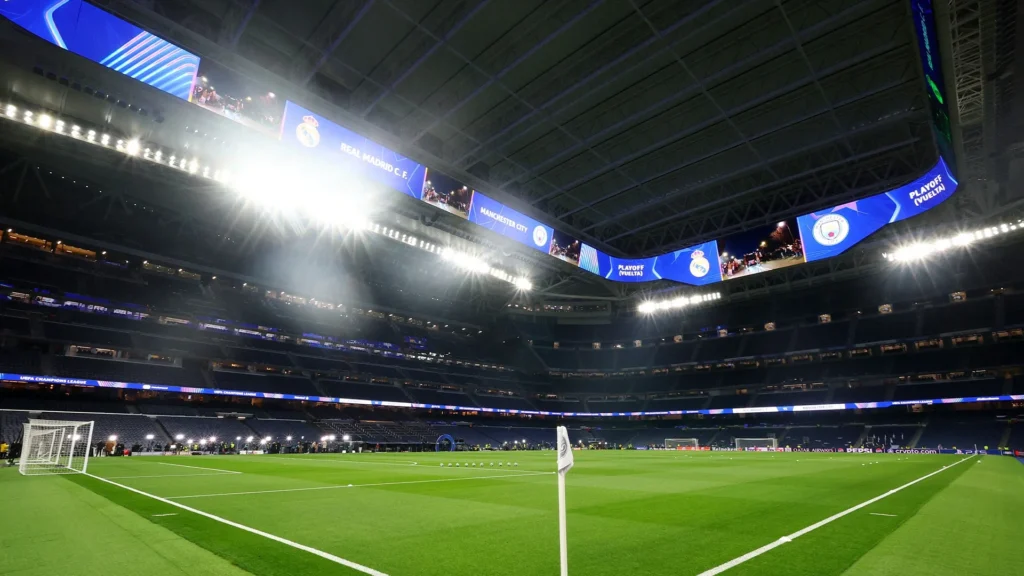
On November 16, 2025, the Miami Dolphins defeated the Washington Commanders 16-13 at the Santiago Bernabéu Stadium in Madrid. It was the NFL’s first regular-season game in Spain. The 72,000 fans in attendance watched American football played on a field that, 24 hours earlier, was stored underground in a climate-controlled greenhouse.
The next day, the grass returned. Real Madrid played Leganés. The stadium transformed back into a football venue in under 20 hours.
This is the €1.347 billion vision Florentino Pérez built: a stadium that generates €1 million per day, hosts 365 events annually, and produces more revenue than any sports venue in history. Real Madrid became the first football club to exceed €1 billion in annual revenue during 2023-24, reaching €1.185 billion in 2024-25. The Santiago Bernabéu drives 29-34% of that total.
The renovated Bernabéu doesn’t just host football matches 25 times per year. It operates as a commercial entertainment complex 365 days annually, generating more revenue per square meter than almost any venue on earth. Here’s how a football stadium became a €400 million annual revenue machine.
The €1.347 Billion Renovation That Changed Everything
From €400 Million Budget to €1.3 Billion Reality
The Santiago Bernabéu, originally opened in 1947, underwent one of history’s most ambitious sports venue transformations. Between 2019 and 2024, Real Madrid invested €1.347 billion to reimagine the stadium as a year-round entertainment complex.
The costs escalated dramatically from initial projections:
- Original Budget (2014): €400 million
- Revised Budget (2019): €575 million
- Final Cost (2024): €1.347 billion (more than triple original estimate)
- Financing: Three loans totaling over €1 billion since 2018
- Annual Debt Payment: €65-71 million through 2049
- Current Stadium Value: Estimated over €2 billion
The escalating costs reflect Real Madrid’s refusal to compromise. Other clubs considered cost-cutting measures. Florentino Pérez demanded perfection. The result is a stadium whose annual revenue already covers its debt payments while generating €300+ million in additional income.
What Makes the New Santiago Bernabéu Different
The renovation transformed a traditional football stadium into a technological marvel:
- Retractable Roof: 12 mobile trusses covering 21,000 square meters, closes in under 20 minutes
- Retractable Pitch: Six-layer underground storage system with automated irrigation and LED grow lights
- 360-Degree LED Screen: Panoramic ribbon display encircling entire seating bowl
- Steel Façade: Metallic exterior allowing massive projection displays visible across Madrid
- Capacity: 81,044 seats (added 4,000 during renovation)
- VIP Boxes: 200 exclusive skyboxes at €50,000 annual subscription each
- Sky Bernabéu: Luxury hospitality area with Formula 1-level premium experiences
The underground pitch system represents the renovation’s technological centerpiece. The grass literally disappears into a climate-controlled greenhouse beneath the stadium, leaving a concrete floor ready for concerts, NBA exhibition games, tennis matches, conventions, or NFL games. Transformation time is just 20 hours from football pitch to event space and back.
How Santiago Bernabéu Generates €400 Million Annually
Breaking Down the Revenue Streams
Real Madrid became the first professional sports organization to exceed €1 billion in annual revenue during the 2023-24 season. By 2024-25, that figure reached €1.185 billion, a 10% increase driven almost entirely by the renovated Bernabéu.
Santiago Bernabéu Annual Revenue Breakdown (2024-25):
Matchday Revenue: €400 million
- Football matches (La Liga, Champions League, Copa del Rey)
- €10 million average per match
- 19 La Liga home games, 6+ Champions League matches
- Ticket sales, concessions, merchandise on match days
VIP and Premium Seating: €83+ million
- 200 skyboxes at €50,000 annual subscription
- Premium seating: €300-2,000 per match depending on opponent
- Champions League matches: €800-1,500 for VIP packages
- Includes hotel stays, exclusive stadium access, first-class dining
Museum and Stadium Tours: €75 million
- 6,000 visitors daily, 2+ million annually
- Entry fees, guided tours, exclusive experiences
- RM Experience premium tour packages
- Open 365 days per year (except Christmas Day)
Non-Football Events: €100 million potential (currently paused)
- Concerts (suspended September 2024 due to noise complaints)
- NFL games (first game November 2025)
- Basketball exhibitions, tennis matches
- Corporate events, conventions, trade shows
Retail and Merchandise: €50+ million
- Official Real Madrid store inside stadium
- Shops open until midnight on match days
- 39.6% revenue increase from previous year
- Expanded commercial spaces still under development
Total Stadium Revenue: €354-400 million annually
Compare this to pre-renovation figures: the old Bernabéu generated €150-200 million annually from all sources. The renovated venue more than doubled revenue in its first full operational year.
Revenue Per Day: €1.1 Million Average
The math shows incredible efficiency: €400 million ÷ 365 days = €1.1 million per day. Even on non-match days, the Bernabéu generates over €1 million through tours, retail, corporate events, and commercial activities. On match days, that figure spikes to €10+ million.
The €10 Million Matchday: Maximizing Every Game
How One Real Madrid Match Generates €10 Million
A single Real Madrid home match at the Santiago Bernabéu generates approximately €10 million in revenue. That’s not just ticket sales but a comprehensive commercial operation maximizing every aspect of the matchday experience.
€10 Million Matchday Revenue Breakdown:
Ticket Sales: €3-4 million
- 81,044 seat capacity
- Average ticket price: €50-70 for general admission
- Premium seats: €300-2,000 depending on opponent and section
- Season tickets sold out with excess demand
VIP Hospitality: €2-3 million
- 200 skyboxes at premium per-game rates
- Champions League VIP packages: €800-1,500
- Sky Bernabéu luxury experiences (when fully operational)
- Corporate packages including dining, hotel, exclusive access
Concessions and Food Service: €1.5-2 million
- 81,000 fans purchasing food, beverages, snacks
- Premium dining in VIP areas
- Expanded catering facilities throughout stadium
- Bars and restaurants open before and after matches
Merchandise and Retail: €1-1.5 million
- Official store packed with fans buying jerseys, scarves, souvenirs
- Stores remain open until midnight on match days
- Impulse purchases before and after matches
- Limited edition matchday merchandise
Sponsorship and Advertising: €1-2 million per game
- LED advertising throughout stadium
- 360-degree screen displaying partner brands
- Major sponsors: Emirates (jersey), Adidas (kit), HP (technology)
Parking and Transportation: €500,000
- Premium parking for VIP ticket holders
- General parking fees
- Transportation partnerships
Real Madrid played 25 home matches in 2023-24 (19 La Liga, 6 Champions League). At €10 million per match, that’s €250 million just from football.
Champions League Matches Drive Premium Revenue
Champions League matches generate significantly higher revenue than La Liga fixtures. When Real Madrid hosts elite opponents like Manchester City, Bayern Munich, or Liverpool, ticket prices double, VIP packages sell at premium rates, and global television exposure multiplies sponsorship value.
A Champions League quarterfinal or semifinal at the Bernabéu can generate €15-20 million in a single match. This is why Real Madrid’s consistent Champions League qualification matters financially, not just sportingly.
The Museum That Generates €75 Million Annually
2 Million Visitors Creating Year-Round Revenue
While matchdays generate massive revenue, the Santiago Bernabéu operates as a major tourist attraction 365 days per year. The museum and stadium tour experience attracts approximately 6,000 visitors daily, generating €75 million annually.
Museum and Tour Economics:
- Daily Visitors: 6,000 average
- Annual Visitors: 2+ million
- Entry Fee: €35-40 per adult
- Annual Revenue: €75 million
- Operating Hours: 10 AM to 7 PM daily (except Christmas)
The tour experience includes access to the trophy room displaying 15 Champions League trophies and 36 La Liga titles, a walk through the player tunnel onto the pitch, visits to team locker rooms and press conference room, interactive museum with Real Madrid history exhibits, panoramic views from premium seating areas, and access to newly renovated facilities and technology displays.
Premium Tour Packages Drive Higher Spending
The RM Experience premium tour package offers exclusive access to areas regular visitors can’t see, priced at €60-80 per person. These premium tours accommodate smaller groups and provide behind-the-scenes access to broadcast facilities, VIP areas, and technical systems.
Global Stadium Tourism Comparison:
- Santiago Bernabéu: 2+ million annual visitors
- Camp Nou (Barcelona): 1.7 million before renovation
- Allianz Arena (Bayern Munich): 400,000
- Old Trafford (Manchester United): 300,000
The Bernabéu attracts more tourists than any football stadium globally, generating more revenue per visitor through premium experiences and expanded retail offerings.
Non-Football Events: The €100 Million Opportunity
Concerts Generated €44 Million in Six Months Before Ban
Florentino Pérez envisioned the Bernabéu hosting 365 events annually: football matches, concerts, NFL games, NBA exhibitions, corporate conventions, and cultural events. The retractable pitch and roof were specifically designed for this vision.
Between December 2023 and September 2024, the Bernabéu hosted several major concerts including Taylor Swift in May 2024 and Duki in July 2024. In those first six months, non-football events generated €44 million in revenue, putting the stadium on pace for €100+ million annually from concerts and special events alone.
Then came the noise complaints. Local residents filed formal complaints about noise levels exceeding Madrid’s 55-decibel limit for residential areas. On September 15, 2024, Real Madrid suspended all upcoming concerts indefinitely while working to resolve soundproofing issues.
The Soundproofing Solution Costs €60 Million
Real Madrid’s response to the concert ban shows commitment to the 365-day revenue model:
- Hired top British engineering firm specializing in acoustic solutions
- Installing additional soundproofing materials throughout stadium
- Implementing noise-dampening technology in roof and façade
- Expected completion: Mid-2026
- Estimated additional cost: €60+ million
As of December 2025, concerts remain suspended. Real Madrid officials express optimism that soundproofing improvements will allow events to resume in 2026, but legal and regulatory hurdles remain. The financial impact of the ban is potentially €50-100 million in lost annual revenue.
NFL Generates €8-10 Million Per Game
While concerts remain suspended, the NFL game on November 16, 2025 demonstrated the Bernabéu’s non-football revenue potential. That single game generated an estimated €8-10 million in revenue:
- Ticket sales: €4-5 million
- Concessions and merchandise: €2-3 million
- Sponsorship and media: €2-3 million
The NFL plans to return to the Bernabéu for multiple games through 2028 under a partnership with Real Madrid. If the stadium hosts 2-3 NFL games annually plus resumes concerts (10-15 events per year), non-football event revenue could reach €150-200 million. That would push total stadium revenue beyond €500 million annually.
Florentino Pérez: The Vision Behind €1.3 Billion
Why Pérez Bet Everything on Stadium Revenue
Florentino Pérez became Real Madrid president in 2000, was re-elected in 2009, and has held the position continuously for 25 years. The Santiago Bernabéu renovation represents his defining legacy project.
In 2012, Florentino Pérez announced plans to renovate the Santiago Bernabéu. Critics called it unnecessary. The existing stadium functioned adequately. Capacity was sufficient. Why spend hundreds of millions on cosmetic improvements?
Pérez’s response revealed his thinking: “Real Madrid must have the world’s most advanced football stadium, capable of generating revenue 365 days per year. Football matches happen 25 times per season. The stadium sits empty 340 days annually. That’s not acceptable.”
His vision transformed the Bernabéu from a football stadium into a global entertainment landmark rivaling Madison Square Garden, Wembley Stadium, or the O2 Arena.
Pérez’s Business Philosophy
- Debt Is Investment: Real Madrid’s €1.1 billion stadium debt is structured through long-term loans at favorable interest rates. Pérez argues debt used for revenue-generating assets is good debt, not bad debt.
- Infrastructure Creates Value: The renovated Bernabéu’s estimated €2 billion value far exceeds the €1.347 billion investment, creating €650+ million in equity.
- Diversified Revenue: Football revenue fluctuates based on sporting success. Stadium revenue remains constant regardless of whether Real Madrid wins trophies.
- Competitive Advantage: While Barcelona tore down Camp Nou for a ground-up rebuild (expected completion 2028), Real Madrid renovated without relocating, maintaining operations and revenue throughout construction.
The Sixth Street Partnership
In 2022, Florentino Pérez negotiated a deal with American investment firm Sixth Street and hospitality company Legends. Under the 20-year partnership, Sixth Street invested €360 million for a 30% share in the Bernabéu’s commercial operations (excluding season ticket sales).
This partnership provided immediate capital to complete the renovation while bringing expertise in venue management, hospitality operations, and commercial optimization. Legends manages VIP experiences, premium seating, and corporate events at venues like Yankee Stadium, Dallas Cowboys’ AT&T Stadium, and SoFi Stadium.
Pérez’s strategy: sell a minority stake in stadium operations to finance completion, while retaining majority control and benefiting from experienced partners who’ve managed the world’s most profitable venues.
Real Madrid: First Club to €1 Billion Revenue
The Santiago Bernabéu Drives 34% of Total Revenue
Real Madrid’s total club revenue reached €1.185 billion in the 2024-25 season, making them the first football club to surpass €1 billion in two consecutive years. The Santiago Bernabéu drives 29-34% of that total.
Real Madrid Revenue Breakdown (2024-25):
- Matchday Revenue: €400 million (stadium-related)
- Broadcasting Revenue: €405 million (La Liga, Champions League TV deals)
- Commercial Revenue: €380 million (sponsorships, merchandising, licensing)
- Total: €1.185 billion
The Largest Revenue Gap in Football History
Deloitte’s Football Money League 2025 ranked clubs by total revenue, revealing an unprecedented gap:
- Real Madrid: €1.185 billion (2024-25)
- Manchester City: €822 million (2023-24)
- Paris Saint-Germain: €779 million (2023-24)
- Manchester United: €745 million (2023-24)
- Bayern Munich: €744 million (2023-24)
The €363 million gap between Real Madrid and Manchester City represents the largest first-to-second revenue gap Deloitte has ever recorded. The renovated Bernabéu accounts for most of that difference.
Financial Stability Despite Massive Debt
Real Madrid’s financial reports show remarkable stability despite €1.1 billion in stadium debt:
- Cash Reserves: €166 million (June 2025)
- Net Worth: €598 million
- Post-Tax Profit: €24.3 million (2024-25)
- Debt-to-Equity Ratio: 0.0 (excluding stadium project)
- Stadium Debt: €1.1 billion, structured through 2049
Real Madrid accounts for stadium debt separately from operating finances. The club operates profitably with zero net debt in football operations, while servicing stadium loans through the Bernabéu’s own revenue. This financial engineering allows Real Madrid to spend €200+ million on players like Kylian Mbappé, Jude Bellingham, and Endrick while simultaneously paying down €65-71 million annually in stadium debt.
How Santiago Bernabéu Compares to Global Stadiums
Top 5 Most Profitable Stadiums Worldwide
The Santiago Bernabéu now stands among the world’s most profitable sports venues. Here’s how it compares to global competitors:
Stadium Annual Revenue Comparison:
AT&T Stadium (Dallas Cowboys): $621 million (~€570 million)
- NFL games, concerts, college football
- Hosts more non-NFL events than any stadium
- Revenue per seat: ~€5,700
SoFi Stadium (LA Rams/Chargers): $500+ million (~€460 million)
- Two NFL teams, concerts, Super Bowl hosting
- Opened 2020, cost $5.5 billion
- Revenue per seat: ~€6,500
Wembley Stadium (England FA): £420 million (~€490 million)
- England national team, FA Cup finals, concerts
- Hosts 25+ concerts annually
- Revenue per seat: ~€5,500
Tottenham Hotspur Stadium: £350 million (~€410 million)
- Football, NFL games, concerts, tours
- Features retractable pitch for NFL
- Revenue per seat: ~€6,500
Santiago Bernabéu (Real Madrid): €400 million
- Football matches, tours, retail, events
- Operates 365 days per year
- Revenue per seat: €4,900
The Santiago Bernabéu ranks among the top 5 most profitable stadiums globally, generating more revenue than iconic venues like Madison Square Garden, O2 Arena, or Camp Nou (pre-renovation).
What Makes AT&T Stadium and SoFi Higher Revenue
AT&T Stadium and SoFi Stadium benefit from NFL economics with 16 minimum events per season, higher ticket prices than football, and massive corporate sponsorships. Wembley Stadium hosts 25+ concerts annually without noise restrictions. Tottenham Hotspur Stadium operates with fewer regulatory constraints and hosts NFL regularly.
Santiago Bernabéu generates €400 million despite concert suspension and ongoing construction. When concerts resume and construction completes in 2026, the Bernabéu projects €500-600 million annual revenue, potentially surpassing every stadium except AT&T Stadium and SoFi Stadium.
Is €1.3 Billion Worth It? The ROI Analysis
The Financial Math Shows Massive Returns
Real Madrid borrowed €1.1 billion to renovate the Santiago Bernabéu. The club will pay €65-71 million annually through 2049 servicing that debt. Was it worth it?
The Math:
- Annual Debt Payment: €65-71 million
- Annual Stadium Revenue Increase: €200-250 million (from €150M to €350-400M)
- Net Gain: €130-185 million per year
Even accounting for debt service, the renovated Bernabéu generates €130-185 million more annually than the old stadium. Over 25 years, that’s €3.25-4.6 billion in additional revenue against a €1.347 billion investment. The return on investment is 2.4-3.4x over the debt repayment period.
Beyond Financial Returns
The Bernabéu’s value transcends spreadsheet calculations:
- Competitive Advantage: The revenue funds €200+ million transfer windows, allowing Real Madrid to sign players like Kylian Mbappé, Jude Bellingham, and Endrick while competitors operate under financial constraints.
- Global Brand Enhancement: The futuristic stadium elevates Real Madrid’s image as the world’s most prestigious club, driving commercial partnerships and global fan engagement.
- Operational Independence: Stadium revenue provides financial stability regardless of sporting success, unlike broadcasting income tied to Champions League qualification.
- Asset Appreciation: The Bernabéu’s estimated €2 billion value gives Real Madrid a tangible asset worth more than many clubs’ entire valuations. Barcelona’s total club value is estimated at €5 billion. The Santiago Bernabéu alone is worth €2 billion, representing 40% of Barcelona’s entire valuation.
The Concert Ban Risk
The model depends on concerts resuming. If Madrid’s noise regulations permanently prevent the stadium from hosting 15-20 concerts annually, projected revenue drops by €100+ million. That would extend the payback period and reduce ROI significantly.
Real Madrid is betting €60+ million on soundproofing solutions. If those fail, the €1.3 billion investment becomes much harder to justify financially. But even without concerts, the Bernabéu generates €350-400 million annually, still doubling pre-renovation revenue.
Why Santiago Bernabéu Makes €400 Million Annually
The Real Madrid Brand Power
Real Madrid is the world’s most valuable football club brand, worth an estimated €6.6 billion. The club has 680+ million fans worldwide, 160+ million social media followers, legendary players throughout history, 15 Champions League titles (most in history), and 36 La Liga titles (most in history).
This brand drives tourism. When visitors come to Madrid, they visit the Bernabéu. When fans worldwide travel to Spain, Real Madrid is a must-see destination.
Madrid’s Tourism Market Advantage
Madrid attracts 10+ million international tourists annually as Spain’s capital and cultural center. The city offers world-class museums like Prado and Reina Sofía, historic landmarks including Royal Palace and Plaza Mayor, thriving nightlife and restaurant scene, and central location for Spain travel.
The Bernabéu benefits from Madrid’s tourism infrastructure. Visitors come for the city and include the stadium tour in their itinerary, generating 2+ million annual visitors. Compare this to Dortmund’s Signal Iduna Park (400,000 annual visitors) or Liverpool’s Anfield (300,000 visitors). Real Madrid’s location in a major global tourism destination multiplies revenue potential.
Premium Experience Economics
The Bernabéu’s 200 VIP skyboxes at €50,000 annual subscription generate €10 million alone. Champions League VIP packages at €800-1,500 per seat create €5+ million per match. This premium pricing works because Real Madrid attracts corporate clients entertaining executives, wealthy fans willing to pay for exclusive experiences, celebrities and influencers seeking luxury, and international visitors for whom €1,500 is reasonable for a once-in-a-lifetime experience.
Clubs in smaller markets struggle to command such pricing. The Bernabéu’s premium revenue model requires Madrid’s concentration of wealth and global customer base.
365-Day Operations Model
The retractable pitch and roof enable year-round monetization. While other stadiums sit empty 340 days per year, the Bernabéu generates revenue daily through museum and tours (€75M annually), retail operations (€50M annually), corporate events and conventions, and restaurant and hospitality operations.
This diversification protects against sporting failure. Even if Real Madrid missed the Champions League, stadium revenue would remain largely intact.
The Bottom Line: Stadium Economics Changed Forever
The Santiago Bernabéu proves that modern sports stadiums must function as year-round entertainment venues to maximize financial returns. Clubs can no longer justify stadiums sitting empty 340 days per year when renovations allow concerts, corporate events, tourism, and non-traditional sports.
Santiago Bernabéu Revenue Impact:
- Generates €400 million annually (€500-600M when concerts resume)
- Doubled pre-renovation revenue from €150-200M to €350-400M
- Drives 29-34% of Real Madrid’s record €1.185 billion total revenue
- Creates €130-185M net annual gain after debt payments
- Valued at €2 billion against €1.347 billion investment cost
Barcelona is building a new €1.5 billion Camp Nou scheduled for completion in 2028 with similar technology. Manchester United committed to a new €2+ billion stadium project, citing the Bernabéu as proof that modern venues generate exponentially more revenue. Liverpool expanded Anfield to increase matchday revenue from €95 million to €130+ million annually, still far below the Bernabéu’s levels.
The Santiago Bernabéu represents a blueprint every major club is now copying. Elite clubs in major markets like Barcelona, Manchester United, Bayern Munich, and Juventus now understand that stadium infrastructure determines long-term financial competitiveness.
Florentino Pérez’s €1.347 billion gamble succeeded. The stadium pays for itself while generating hundreds of millions in additional revenue annually. Real Madrid operates with zero net debt in football operations, spends €200+ million on players, and maintains a €2 billion stadium asset.
That’s not just good business. That’s the future of football economics.