In the summer of 1998, a 168-year-old Scottish suiting mill arrived in India with something most textile brands could not claim: a heritage so old it predated the British Raj.
Reid & Taylor had been weaving worsted wool in the mills of Langholm, Dumfriesshire since 1830. Its fabrics had dressed royalty, statesmen, and the international elite for generations. When S. Kumars Nationwide Limited brought the brand to India through a licensing and manufacturing agreement, the pitch was simple. This was not just another suiting brand. This was the finest worsted suiting cloth in the world, now made in India.
The strategy worked spectacularly. Reid & Taylor India grew into the second largest suiting brand in the Indian luxury segment. The Mysore plant produced premium worsted fabrics. Amitabh Bachchan’s face was on every hoarding. Singapore’s sovereign wealth fund GIC invested ₹900 crore for a 25.4% stake, valuing the Indian subsidiary at ₹3,540 crore. An IPO was planned at ₹1,000 crore.
Then, everything collapsed.
By 2019, the National Company Law Tribunal ordered liquidation. The Mysore plant shut down, leaving 1,400 workers without jobs. The brand that had dressed India’s boardrooms went into insolvency in less than a decade of reaching its peak.
What happened between that peak and that collapse, and what happened next, is one of the most complete brand stories in Indian fashion history.
A Scottish Mill, 190 Years of Heritage
Reid & Taylor did not begin as a fashion brand. It began as a mill.
Alexander Reid founded the business in Langholm in the Scottish Borders in 1830. The region was known for its wool trade, and Reid’s operation focused on producing high-quality worsted fabric from the wool of local sheep. The financing came from Joseph Taylor, whose name was added to the company. From that partnership came a brand that would go on to clothe some of the most powerful people in the world for nearly two centuries.
Worsted fabric, the kind Reid & Taylor specialised in, is distinct from regular wool. The fibres are combed parallel before spinning, producing a smooth, hard-wearing, and drape-perfect cloth used almost exclusively for formal suiting. It resists creasing, holds a tailored silhouette, and breathes better than synthetic alternatives. For anyone who has worn a properly made wool suit, the difference is immediately obvious.
What made Reid & Taylor’s heritage genuinely valuable:
- Founded 1830: 168 years of documented craftsmanship before entering India, older than most Indian institutions
- Royal warrant holders: The brand held royal warrants and supplied fabric to European aristocracy and heads of state
- Langholm provenance: Scottish Borders wool is among the finest in the world, and Reid & Taylor’s mills were among the most respected in the region
- Worsted specialisation: The brand focused exclusively on worsted suiting rather than spreading across fabric categories, building deep expertise in one technically demanding segment
- Global distribution: By the 1980s, Reid & Taylor was exporting to the United States, Japan, and European markets, establishing international credibility before the India entry
When S. Kumars brought Reid & Taylor to India in 1998, they were not just licensing a name. They were licensing 168 years of verified premium positioning. In a market where Indian consumers were increasingly aspirational and Western heritage was a genuine purchase driver, the timing could not have been better.
Why S. Kumars Was the Right Indian Partner
S. Kumars Nationwide Limited, founded by the Kumar family in Mumbai, was one of India’s largest integrated textile companies by the 1990s. It had manufacturing capacity across multiple fibre categories, a pan-India distribution network through over 30,000 multi-brand outlets, and the institutional relationships to set up a greenfield manufacturing plant quickly.
In 1998, SKNL entered into a collaboration with Reid & Taylor of Scotland for manufacturing and marketing the Reid & Taylor worsted suiting in India, and set up a luxury suiting plant at Mysore in Karnataka specifically for the brand.
The Mysore plant was built to produce fabrics that could legitimately carry the Reid & Taylor name. This was not a badge-licensing arrangement where foreign heritage was slapped onto locally made commodity fabric. The plant used genuine worsted processing techniques, imported wool blends, and quality controls that justified the premium pricing the brand needed to command in India’s upper segment.
Pierce Brosnan, Amitabh Bachchan, and the Making of a Brand
When Reid & Taylor India launched its first advertising campaign, it made a choice that seemed obvious: hire James Bond.
Pierce Brosnan was playing Bond in the GoldenEye and Tomorrow Never Dies era when S. Kumars signed him as brand ambassador. The campaign was built around the Bond aesthetic: sophisticated, international, impeccably dressed. The logic was sound on paper. Worsted suiting, British heritage, a global superspy. It should have worked.
It did not.
Indian customers did not identify with Brosnan, and the firm had to rethink its India marketing strategy entirely. The campaign had misread the Indian market’s relationship with Western celebrity. In the late 1990s and early 2000s, Indian consumers were not looking to aspirational Western figures for fashion validation. They were looking to aspirational Indian figures.
In 2003, S. Kumars made the correction that changed everything. Amitabh Bachchan was signed as brand ambassador for Reid & Taylor India.
The impact was immediate. Bachchan, then in his late 50s and in the middle of a remarkable career resurgence driven by Kaun Banega Crorepati and a string of successful films, represented exactly what Reid & Taylor needed to be in India: authoritative, distinguished, aspirational, and quintessentially Indian. The combination of Scottish heritage with Bachchan’s face gave Reid & Taylor a positioning that no competitor could replicate.
What the Bachchan association delivered commercially:
- Non-metro penetration: The company explicitly noted that the Bachchan association translated into higher reach from non-metro cities, where his brand pull was even stronger than in metros
- Trust transfer: Bachchan’s reputation for personal integrity extended to the brand he represented; customers who trusted him trusted the fabric
- Event marketing credibility: Reid & Taylor sponsored polo championships, giving the brand an elite sporting association that reinforced its premium positioning
- Aspirational reach: The combination of a global heritage brand with India’s biggest star created the kind of aspiration that drove purchase decisions across income groups
The GIC Investment That Validated Everything
By 2008, Reid & Taylor India had grown into a business that attracted attention beyond the fashion industry.
The Government of Singapore Investment Corporation (GIC) invested ₹900 crore for a 25.4% stake in Reid & Taylor India, valuing the subsidiary at ₹3,540 crore, which was actually higher than its parent company SKNL’s valuation of ₹2,240 crore.
Let that sink in. The subsidiary was worth more than the parent.
For a sovereign wealth fund managing over $100 billion globally to deploy ₹900 crore into an Indian textile and apparel brand, the due diligence would have been thorough and the conviction high. GIC had identified Reid & Taylor as a market leader in India’s luxury fabric segment with a growth runway that justified a valuation nearly 60% above the parent company. The brand revenues at the time were at ₹1,750 crore with an EBITDA of ₹400 crore, healthy margins for a premium consumer brand.
An IPO at ₹1,000 crore was planned for 2011, intended to fund an ambitious expansion into 15 flagship and 160 exclusive stores across India. Had it happened, Reid & Taylor India could have been one of the most successful branded textile listings in the country.
The Debt Trap That Swallowed the Brand
The IPO never happened.
In 2011, S. Kumars announced and then shelved the ₹1,000 crore public offer citing unfavourable market conditions. This was the moment the brand’s trajectory changed permanently. Without fresh equity capital, the ambitious expansion plan stalled. Without the expansion executing as planned, the growth story that justified the GIC valuation began to look uncertain. And without growth certainty, the debt that SKNL had accumulated to fund its multi-brand, multi-category expansion became unmanageable.
At its peak in FY12, SKNL’s profits jumped to ₹470.84 crore. But the company had drawn up plans assuming funds would come that did not materialise. When highly leveraged, interest burden suffocates. SKNL’s debt pile reached ₹4,484 crore by March 2013, causing defaults on interest commitments.
The Reid & Taylor brand itself had not failed commercially. It was a victim of its parent company’s capital structure decisions made elsewhere in the group. SKNL had used debt to fund acquisitions and expansions across its portfolio of brands, and when market conditions tightened and the IPO window closed, the interest burden became a spiral from which there was no internal exit.
The sequence of events that destroyed the brand:
- 2011: ₹1,000 crore IPO shelved due to market conditions; expansion plans frozen
- 2013: SKNL debt reaches ₹4,484 crore; promoters begin pledging shares with financial institutions
- 2015: Promoter group and entities hold only 3.59% stake as pledged shares are redeemed; brand advertisements vanish from media
- 2016-2018: IDBI Bank initiates insolvency proceedings against SKNL; Edelweiss Asset Reconstruction drags Reid & Taylor India separately to insolvency court
- December 2018: Committee of creditors votes to liquidate Reid & Taylor India
- February 2019: NCLT orders liquidation of RTIL
- May 2019: Mysore factory shuts down; 1,400 workers rendered jobless
What Brand Strategy Experts Said About the Collapse
The collapse generated pointed commentary from brand strategists who had watched the brand’s trajectory closely.
Brand consultant Harish Bijoor, who had studied the Reid & Taylor brand at its peak, put it plainly: “What happened with Reid & Taylor shows how branding is a clear calculation and once your product is built, you should calculate whether your company will be able to spend in future or will be able to deliver what has been promised. If not, then sustainability is not only difficult but impossible.”
The insight cuts to the core of what actually failed. Reid & Taylor India’s brand equity was genuine. The fabric quality was real. The Bachchan association had worked. The GIC investment had validated the business fundamentals. What failed was not the brand. What failed was the financial architecture around it.
The lesson for Indian businesses is structural: a genuinely strong brand can be destroyed by leverage decisions made in a completely different part of the same group. Reid & Taylor India was solvent and growing. It was pulled under by SKNL’s unrelated debt obligations.
Finquest Group and the Second Coming
In 2020, Finquest Group acquired Reid & Taylor through the NCLT liquidation process, purchasing the brand, the Mysore manufacturing facility, and the associated intellectual property.
The acquisition was a calculated bet on one of India’s most recognisable textile heritage brands sitting dormant purely because of its former parent’s financial collapse. The brand equity, built over two decades through Bachchan’s association, GIC’s validation, and genuine product quality, had not disappeared during the insolvency proceedings. It was simply waiting for an owner with the capital and intent to activate it.
Finquest Group, led by Chairman Hardik Patel, invested over ₹750 crore in revitalising the brand. This was not a cautious bet. It was a comprehensive rebuild.
What Finquest invested in during the revival:
- Mysore factory restart: The suiting manufacturing facility was brought back into full operation, restoring worsted fabric production under the Reid & Taylor quality standards
- Bharuch shirting unit acquisition: Finquest acquired a premium 100% cotton shirting unit at Bharuch with an investment of over ₹300 crore, a one-of-a-kind manufacturing unit spread over 35 acres with annual capacity of over 18 million metres, expanding the brand from suiting into shirting
- Workforce rebuild: Reid & Taylor under Finquest employs over 2,000 individuals across India, with the manufacturing and retail teams built from the ground up
- Distribution rebuild: Reid & Taylor expanded to over 1,200 multi-brand outlets and exclusive brand outlets across India
The move into shirting was strategically significant. A customer who buys Reid & Taylor suiting fabric from a local tailor was now also a potential customer for Reid & Taylor shirts from an exclusive brand outlet. The brand’s occasion coverage expanded from purely formal suiting to the full formal and smart-casual wardrobe.
Vicky Kaushal and the Young India Play
Amitabh Bachchan had built Reid & Taylor’s brand among aspirational India’s establishment generation. For the revival to work in 2024, the brand needed a face that spoke to men in their twenties and thirties who had grown up after the Bachchan era.
In October 2024, Reid & Taylor announced Bollywood actor Vicky Kaushal as its new brand ambassador, describing him as embodying the modern Reid & Taylor man: sophisticated, dynamic, and elegant.
Kaushal, who had won a National Award for Uri: The Surgical Strike in 2019 and built a following that extends from multiplex cities to small-town India, brings a very different energy to the brand than Bachchan. Where Bachchan projected authority and seniority, Kaushal projects aspiration and accessibility. The shift is deliberate: Reid & Taylor is not just targeting the 50-year-old executive buying suiting fabric. It is targeting the 28-year-old professional buying his first premium shirt for a job interview.
The Retail Expansion Strategy in 2024-2025
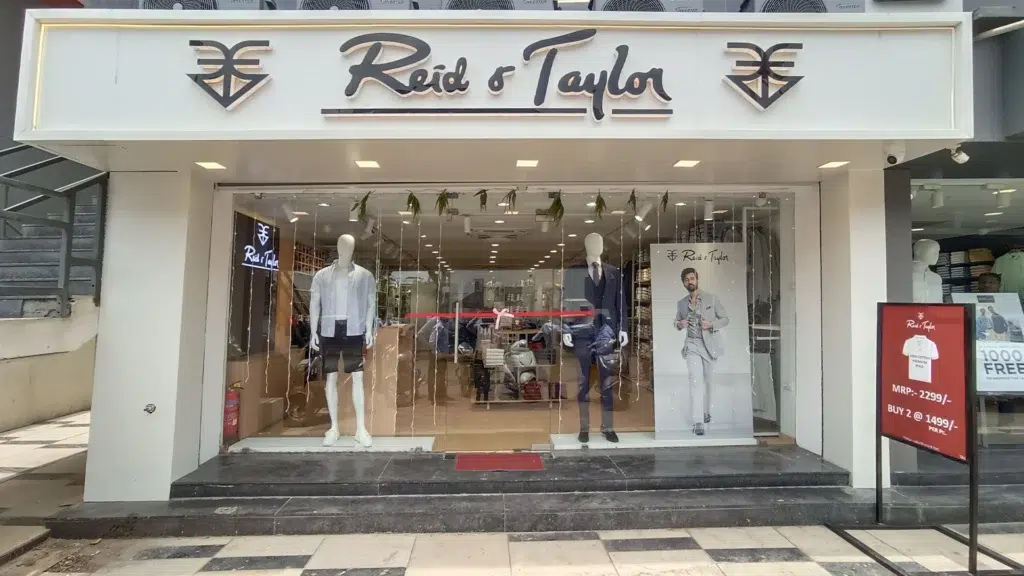
The most visible evidence of Reid & Taylor’s revival is the pace of retail expansion.
In April 2024 alone, the brand launched seven new stores in Mumbai, a pace of retail opening that signals genuine conviction in the brand’s commercial recovery. The target of 40 operational stores by the end of FY25 was set as a marker for the brand’s standalone retail ambitions. Franchise partnerships were activated in Andhra Pradesh, Telangana, Punjab, Haryana, and Delhi.
The retail strategy runs on two parallel tracks. The exclusive brand outlet network, which gives Reid & Taylor complete control over brand environment, customer experience, and pricing, sits alongside the broader multi-brand outlet distribution that provides volume and geographic reach into Tier-2 and Tier-3 markets where the brand has existing brand recall from the Bachchan era.
What the current Reid & Taylor retail model looks like:
- EBO network: Exclusive brand outlets in premium high-street locations in Mumbai, Gujarat, and other key markets; April 2024 saw seven Mumbai openings in a single month
- MBO distribution: Over 1,200 outlets covering smaller cities and towns where brand recall from the SKNL era is still strong
- Online launch: Official e-commerce platform reidandtaylor.in launched; brand listed on Myntra for digital-first younger buyers
- Franchise model: Partnerships with local entrepreneurs in Andhra Pradesh, Telangana, Punjab, Haryana, and Delhi reducing the capital intensity of geographic expansion
- Omnichannel integration: Physical store insights used to calibrate online assortment, with the digital and physical channels designed to complement rather than compete
25% Monthly Growth and a Denim Range
The commercial results in 2024 backed the confidence of the expansion.
Reid & Taylor recorded consistent month-on-month like-for-like growth above 25% from October 2024 onward, a number that, if sustained, would imply a near-tripling of the business on a same-store basis within a year. Subrata Siddhanta, CEO of Apparel and Retail, attributed the growth to a consumer-centric approach to product design and a sharper focus on what the Reid & Taylor customer actually wears.
Consumer research within the revived brand revealed that 40% of Reid & Taylor buyers preferred daywear and casualwear over purely formal suiting. This was a significant finding. The brand had historically been anchored to occasions: the job interview, the wedding reception, the boardroom presentation. The research pointed toward a customer who wanted premium fabric quality for everyday wear, not just special occasions.
The response was product expansion. Reid & Taylor launched its first-ever denim range in February 2025, diversifying into a category that had never previously been part of the brand’s portfolio. Plans for innerwear and women’s wear were also publicly announced, pointing toward a Reid & Taylor that is eventually a full menswear and lifestyle brand rather than a suiting specialist.
The Indian Premium Menswear Market Reid & Taylor Is Re-entering
The market Reid & Taylor is returning to in 2025 is significantly different from the one it left in 2019.
India’s premium menswear segment has grown substantially. The total apparel market in India is expected to cross ₹7.5 lakh crore by 2027. The premium and super-premium segment, where Reid & Taylor competes, is growing at approximately 12-15% annually, faster than the mass market, driven by rising disposable incomes, the formalisation of India’s corporate culture post-pandemic, and a younger professional class with genuine spend on workwear.
The branded suiting market in India is led by Raymond, which commands the largest share across price points. Arvind Mills, Grasim’s Siyaram brands, and international entries like Van Heusen and Peter England from Aditya Birla Fashion compete across the mid-premium segment. Reid & Taylor’s positioning sits at the top of this pyramid, alongside Reid & Taylor’s natural competitor in the super-premium worsted segment, Vimal.
The competitive landscape Reid & Taylor operates in:
- Raymond: Market leader in Indian suiting across segments; owns the Park Avenue and Raymond Ready-to-Wear sub-brands; strongest distribution network
- Siyaram’s: Strong presence in mid-premium and value suiting; aggressive rural and semi-urban distribution
- Arvind Brands: Owns Flying Machine and operates Arrow, Calvin Klein, Tommy Hilfiger India under licence; competes in premium shirts and formals
- Vimal (Reliance): Premium positioning with a large distribution network; targets the aspirational mid-premium buyer
- Van Heusen / Louis Philippe: Aditya Birla Fashion brands dominating the premium office wear segment with strong mall retail presence
Reid & Taylor’s advantage against this field is the one asset none of these brands can manufacture: authentic international heritage combined with India-specific brand recall built over two decades. The brand’s 190-year Scottish provenance is not replicated by any domestic competitor.
The Worsted Suiting Advantage in a Polyester-Dominated Market
One of the most underappreciated aspects of Reid & Taylor’s premium positioning is what the fabric actually delivers compared to what most Indian suiting brands sell.
A significant portion of the Indian branded suiting market runs on polyester-viscose blends: cheaper to produce, easier to care for, but fundamentally inferior in terms of breathability, drape, and longevity. Premium worsted wool suits breathe significantly better in Indian heat with air conditioning, hold their shape through long working days, and develop a patina of wear that synthetic blends do not.
The Mysore plant produces genuine worsted suiting in a market where most competitors are not willing to absorb the cost of doing so. The new Bharuch shirting unit produces 100% cotton shirts at a scale of 18 million metres annually. In a market where the category’s growth is driven by consumers who are willing to pay more for quality they can actually feel, Reid & Taylor’s vertical manufacturing commitment is a genuine competitive asset.
The Bottom Line
Reid & Taylor India is one of the most complete brand stories in Indian fashion. A 190-year-old Scottish heritage brand entered India in 1998 on the back of genuine quality and aggressive marketing. It became the second largest luxury suiting brand in the country, attracted a ₹900 crore sovereign wealth fund investment, and was valued higher than its own parent company. Then it was destroyed not by market failure but by a debt spiral it had no part in creating.
The revival under Finquest Group is real. ₹750 crore reinvested. Two manufacturing facilities running. 1,200 outlets. Vicky Kaushal signed as ambassador. Seven Mumbai stores in one month. Twenty-five percent month-on-month same-store growth. A denim range launched. An e-commerce platform live.
The structural logic of the revival is strong because the brand equity never actually disappeared. Indian consumers who grew up watching Amitabh Bachchan in Reid & Taylor campaigns still associate the name with premium quality. The Finquest team is not building awareness. It is re-activating memory.
What the Reid & Taylor brand story actually teaches about Indian market strategy:
- Heritage is a durable asset: Twenty years of dormancy and an insolvency process did not erase the brand’s equity; consumer recall outlasted the company’s financial collapse
- Ambassador fit matters more than fame: Pierce Brosnan failed because he was globally famous but locally irrelevant; Bachchan succeeded because he was the most relevant aspirational figure in Indian culture at exactly the right moment
- Debt kills brands that products cannot: Reid & Taylor’s collapse was not a market rejection; it was a capital structure failure in the parent group that had nothing to do with whether customers valued the brand
- Vertical manufacturing creates pricing power: Owning the factory that makes your fabric gives Reid & Taylor a cost and quality argument that badge-licensees simply cannot make
- Young India needs a new entry point: Vicky Kaushal’s appointment signals that the brand understands its revival requires both retaining the established base and acquiring a generation that did not grow up with the Bachchan campaigns
- Category expansion is necessary: The 40% daywear finding and the denim range launch show a brand that has understood it cannot survive as a purely occasion-driven suiting specialist in a casualisation-era market
The question for 2026 is whether the 25% monthly growth numbers are sustainable as the revival effect normalises and the brand competes on pure merit against Raymond’s distribution dominance and Aditya Birla’s portfolio breadth. The foundation is stronger than at any point since the GIC investment. What Reid & Taylor does with it now is the next chapter of a story that has already survived more than most brands are built to handle.