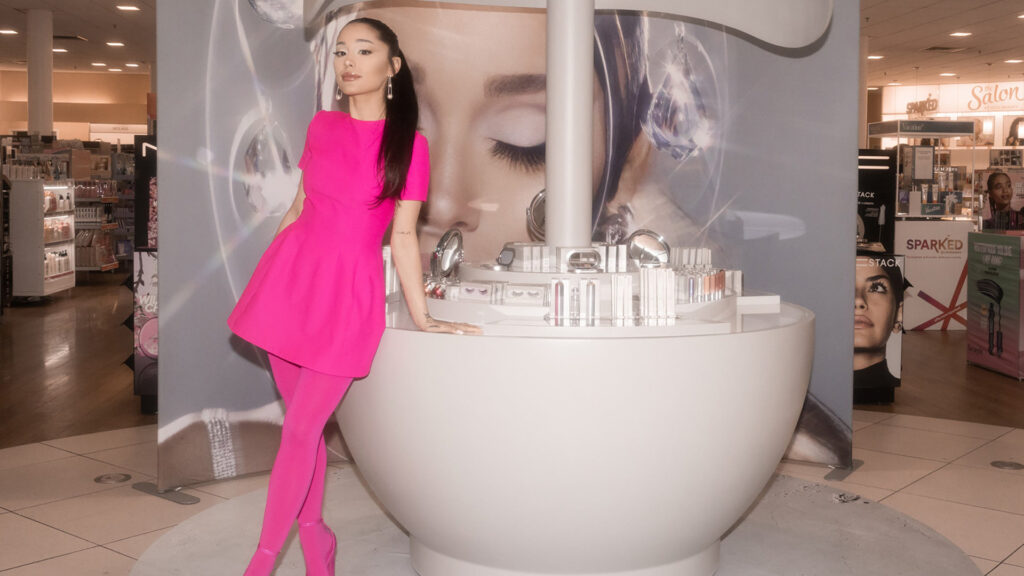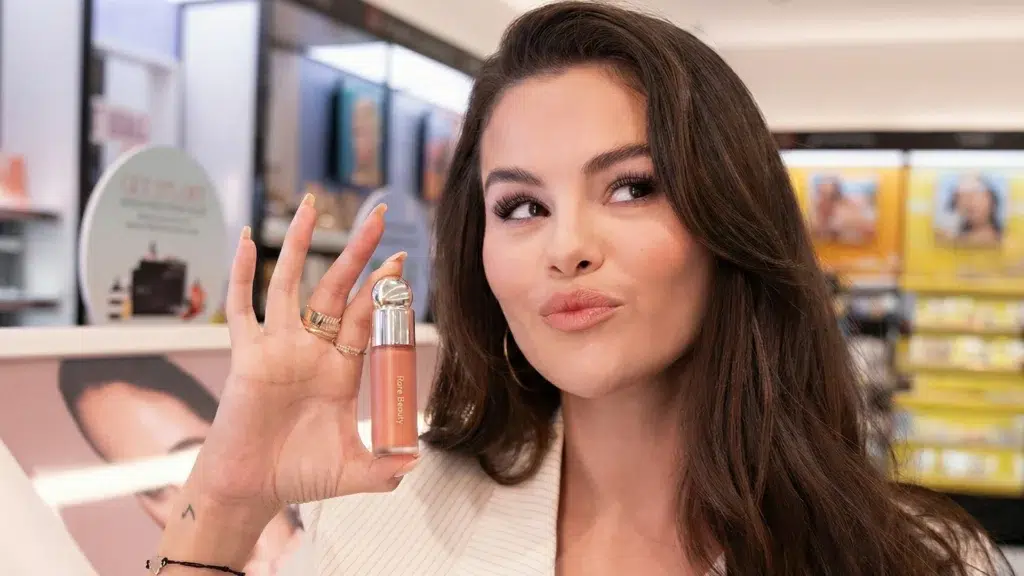
When Selena Gomez launched Rare Beauty in September 2020 during the height of COVID-19 lockdowns, skeptics questioned whether another celebrity beauty brand could succeed. The market was already saturated with Kylie Cosmetics, Fenty Beauty, and dozens of other famous-name brands. Three months into launch, Rare Beauty’s viral Soft Pinch Liquid Blush sold out completely across Sephora stores nationwide.
Five years later, Rare Beauty stands valued at $2.7 billion as of October 2025, making it one of the most successful celebrity beauty brands in history. The brand crossed $540 million in net sales in the 12 months ending February 2024 and sells one Soft Pinch Liquid Blush every three seconds globally.
The Rare Beauty Results:
- Current valuation: $2.7 billion (October 2025, Fortune Magazine)
- Annual revenue: $540+ million in 12 months ending February 2024
- Selena’s stake: 51% ownership worth $1.4+ billion
- Market position: #1 in makeup/cosmetics influencer marketing, beating Kylie Cosmetics and Fenty Beauty
- Sephora ranking: Top-selling brand globally, #1 blush brand
- Viral product: Soft Pinch Liquid Blush sells every 3 seconds, $70M+ in sales from single SKU
- Blush market share: 26% of all blush sales at Sephora
- Social media: 8.4M Instagram, 4.9M TikTok, fastest-growing celebrity beauty brand
- Mental health fund: $20+ million raised for Rare Impact Fund
The story of how Rare Beauty became worth more than Hailey Bieber’s Rhode (sold to e.l.f. for $1 billion), approached Kylie Cosmetics’ peak valuation, and beat Rihanna’s Fenty Beauty in influencer marketing reveals the power of authentic mission-driven branding combined with viral product innovation.
How Rare Beauty Started: From Mental Health Advocate to Beauty Mogul
The Idea: Beauty Without Perfection
Rare Beauty wasn’t Selena Gomez’s first business venture, but it became her most successful. Born July 22, 1992, Selena rose to fame as a Disney Channel star on Wizards of Waverly Place (2007-2012), then transitioned to music with four studio albums and acting in projects like Only Murders in the Building.
But the origin of Rare Beauty stems from Selena’s personal mental health journey. Diagnosed with lupus in 2015, anxiety and depression, and undergoing a kidney transplant in 2017, Selena became one of Hollywood’s most vocal mental health advocates. She noticed beauty industry standards promoting unrealistic perfection, exacerbating the insecurity she battled herself.
The Founding Philosophy:
- Mission: “Break down unrealistic standards of perfection” in beauty industry
- Vision: Makeup as tool for self-expression, not covering perceived flaws
- Target audience: Gen Z and millennials (ages 18-35) seeking authenticity
- Competitive gap: Unlike Kylie Cosmetics’ glamour or Fenty Beauty’s luxury positioning, Rare Beauty emphasized accessibility and mental health
- Founding date: February 22, 2019 (official incorporation)
- Public announcement: February 4, 2020 via social media
Building the Team
Unlike many celebrity beauty brands that license the name to established manufacturers, Selena spent two years developing Rare Beauty before launch. She hired Scott Friedman, previously CEO of Smashbox Cosmetics and Laura Mercier, as CEO. She also brought on industry veterans from Estée Lauder, Glossier, and MAC Cosmetics.
“A lot of people would have preconceived ideas of what I’m good at, and I should stay in my lane,” Selena told Fortune Magazine at the October 2025 Most Powerful Women Summit. “But what I’m here to do is make a difference.”
Launch Strategy:
- Launch date: September 3, 2020 (during COVID-19 pandemic)
- Distribution: Exclusive partnership with Sephora North America, plus RareBeauty.com
- Initial SKU count: 150 products across lips, eyes, face, complexion
- Price positioning: $15-45, competing with MAC, NARS, Benefit
- Inclusivity: 48 foundation shades, Made Accessible packaging for disabilities
- Mental health commitment: 1% of all sales donated to Rare Impact Fund
The September 2020 launch timing seemed terrible. Makeup sales had plummeted 30-40% due to COVID-19 lockdowns and mask-wearing. But Selena’s authenticity resonated. Her social media posts showed her applying makeup in her bathroom, not a professional studio. She talked openly about acne, anxiety, and imperfection.
The Viral Breakthrough: Soft Pinch Liquid Blush
How a $25 Blush Built a Billion-Dollar Brand
The product that transformed Rare Beauty from celebrity side project to beauty industry powerhouse was the $25 Soft Pinch Liquid Blush. Launched with the initial 2020 lineup in 11 shades (now 13), the liquid blush became TikTok’s first truly viral beauty product.
The blush’s extreme pigmentation initially caused problems. Early TikTok videos showed creators struggling with the product, accidentally applying too much and looking like clowns. But this “mistake” became a feature. Creators taught each other the “one dot” technique, apply just one tiny dot per cheek and blend. The hashtag #rarebeautyblush exploded to 417 million views by end of 2022.
Soft Pinch Liquid Blush Performance:
- Sales velocity: One blush sold every 3 seconds globally (2024)
- Units sold: 3.1+ million units through 2022
- Revenue from single SKU: $70+ million (as of July 2022)
- Market dominance: #1 bestselling blush at Sephora globally
- Market share: 26% of all blush sales at Sephora
- Price point: $25 (accessible compared to luxury competitors)
- Shade range: 13 shades in matte and dewy finishes
- Longevity: 12-hour wear, minimal fading
Unlike Kylie Cosmetics’ lip kits that required constant restocking or Fenty Beauty’s initial foundation shortage, Rare Beauty managed to keep Soft Pinch Liquid Blush mostly in stock while maintaining scarcity perception. The product’s success sparked the 2022 “blush boom” industry-wide, with brands like Rhode, r.e.m. beauty, and Charlotte Tilbury rushing to launch liquid blush competitors.
The TikTok Strategy
Rare Beauty didn’t pay for TikTok advertising initially. Instead, organic user-generated content drove explosive growth. Beauty influencers like Mikayla Nogueira (14.8M followers), Alix Earle (7.4M followers), and hundreds of smaller creators featured Soft Pinch Liquid Blush in makeup tutorials.
Selena herself appeared in TikTok videos doing her makeup, often using one fingertip to apply products. These authentic moments, not polished ads, resonated with Gen Z consumers tired of unrealistic beauty standards promoted by brands like Kylie Cosmetics and Fenty Beauty.
Social Media Growth:
- TikTok followers: 1.2M (2023) growing to 4.9M (2025)
- Instagram followers: 6.4M (2023) growing to 8.4M (2025)
- Fastest-growing celebrity beauty brand: Outpaced Kylie Cosmetics, Fenty Beauty, Rhode on social media
- User-generated content: Millions of #rarebeauty posts organically created
- Influencer marketing rank: #1 in makeup/cosmetics with 825K VIT score, beating Kylie Cosmetics (560K) and Fenty Beauty (525K)

💖 Rare Beauty Soft Pinch Cheek & Lip Trio – Matte Blush, Liquid Blush & Tinted Lip Oil
🛒 Shop Now on AmazonRare Beauty Business Model: How It Makes Money
Revenue Streams and Distribution
Unlike many celebrity beauty brands that sell primarily direct-to-consumer, Rare Beauty’s exclusive Sephora partnership provided immediate global distribution. This contrasts with Kylie Cosmetics’ early D2C model or Rhode’s initial website-only strategy.
Distribution Channels:
- Sephora exclusive: North America, Europe, Middle East, Asia-Pacific
- Space NK: United Kingdom and Ireland (2022 launch, sold out immediately)
- RareBeauty.com: Direct-to-consumer website
- TikTok Shop: Launched 2024, driving additional revenue
- Geographic reach: 50+ countries worldwide
- Retail footprint: Thousands of Sephora stores globally
Revenue Breakdown 2024:
- 12-month revenue (ending February 2024): $540+ million
- Previous year (2023): $400 million
- 2022: ~$350 million
- Growth rate: 35-50% year-over-year
- International sales: Nearly 50% of total revenue
- Best-selling category: Blush products (30%+ of revenue)
Product Portfolio Expansion
While Soft Pinch Liquid Blush remains the hero product, Rare Beauty expanded strategically into complementary categories without oversaturating.
Current Product Categories:
- Complexion: Liquid Touch Weightless Foundation (48 shades), Positive Light Tinted Moisturizer, Liquid Touch Brightening Concealer
- Blush: Soft Pinch Liquid Blush, Stay Vulnerable Melting Cream Blush, Soft Pinch Luminous Powder Blush, Soft Pinch Matte Bouncy Blush (March 2025)
- Lips: Soft Pinch Tinted Lip Oil Stain, Lip Souffle Matte Lip Cream, Kind Words Matte Lipstick
- Eyes: Perfect Strokes Universal Volumizing Mascara, Brow Harmony Shape & Fill Duo
- Contour/Bronze: Soft Pinch Liquid Contour (January 2025), Warm Wishes Effortless Bronzer Stick
- Highlight: Positive Light Liquid Luminizer
- Body Care: Soft Pinch collection (December 2023) for body, calming scents
- Fragrance: Rare Eau de Parfum (2024)
This measured expansion contrasts with Kylie Cosmetics’ rapid SKU proliferation or r.e.m. beauty’s frequent limited edition drops that struggled to maintain consistent sales.
The $2.7 Billion Valuation: Sale Talks and Billionaire Status
From Sale Process to Pause
In March 2024, Bloomberg reported that Selena hired advisers to explore selling Rare Beauty at a $2 billion valuation. Investment banks met with potential strategic buyers (likely Estée Lauder, L’Oréal, Coty, Unilever) but Selena never personally met with suitors.
By September 2024, the sale process paused. According to Axios, strategic buyers were reluctant to pay $2+ billion for a “mono-brand” heavily dependent on Selena’s personal involvement. Unlike Fenty Beauty (owned by LVMH) or Rhode (sold to e.l.f. Beauty for $1 billion in 2025), Rare Beauty hadn’t found the right buyer at the right price.
Sale Process Timeline:
- March 2024: Hired Goldman Sachs to explore $2B sale
- June 2024: Sale talks stall, no formal offers received
- September 2024: Process paused, Bloomberg declares Selena billionaire anyway
- October 2025: Valuation revised upward to $2.7B by Fortune Magazine
- Current status: No active sale process, Selena exploring IPO or waiting for better offer
Selena’s Billionaire Status
Despite the paused sale process, Bloomberg declared Selena Gomez a billionaire in September 2024 with estimated net worth of $1.3 billion. Forbes later revised this to $700 million (similar to Kylie Cosmetics controversy), but the $2.7 billion Rare Beauty valuation suggests Selena’s 51% stake is worth $1.4+ billion alone.
Selena Gomez Net Worth Breakdown (2025):
- Rare Beauty stake: 51% of $2.7B = $1.38 billion
- Only Murders in the Building: $10M+ per season (3 seasons so far)
- Music career: $16M+ lifetime earnings from albums, tours, streaming
- Endorsements: Puma ($30M), Coach ($10M), Louis Vuitton
- Real estate: $35M Beverly Hills mansion (purchased February 2025 with fiancé Benny Blanco)
- Other ventures: Wondermind mental health platform (struggling), Serendipity kitchen line
- Total net worth: $1.3-1.7 billion (disputed between Bloomberg and Forbes)
At age 33 (turning 33 in July 2025), Selena became one of America’s youngest self-made female billionaires, second only to Taylor Swift ($1.7B) among entertainers.
Rare Beauty vs. Competitors: Beating Kylie, Fenty, and Rhode
The Celebrity Beauty Brand Battle
Rare Beauty launched into the most crowded celebrity beauty market in history. Rihanna’s Fenty Beauty (2017) had revolutionized shade inclusivity. Kylie Cosmetics (2015) proved social media could sell hundreds of millions in lip kits. Hailey Bieber’s Rhode (2022) dominated skincare. Ariana Grande’s r.e.m. beauty launched the same year as Rare Beauty (2020).
Yet Rare Beauty beat them all in key metrics.
Influencer Marketing Rankings (2024 Traackr VIT Score):
- Rare Beauty: 825,000 VIT score
- Kylie Cosmetics: 560,000 VIT score
- Fenty Beauty: 525,000 VIT score
- r.e.m. beauty: 453,000 VIT score
- Rhode: Not in top 10 (skincare category instead)
Key Competitive Advantages:
- Authentic mission: Mental health focus resonated deeper than Kylie Cosmetics’ glamour or Fenty Beauty’s luxury positioning
- Viral products: Soft Pinch Liquid Blush became cultural phenomenon, unlike Fenty’s diverse but not viral lineup
- Founder involvement: Selena personally uses and promotes products daily, versus Kylie’s declining involvement in Kylie Cosmetics
- Price accessibility: $25 blush competed with mass market while feeling prestige, perfect positioning
- Consistent growth: 35-50% year-over-year versus Kylie Cosmetics’ decline from peak
- Sephora partnership: Immediate global distribution versus Rhode’s initial website-only strategy
What Rare Beauty Did Better Than Kylie Cosmetics
The comparison to Kylie Cosmetics is particularly striking. Both launched with signature lip products (Kylie’s lip kits, Rare Beauty’s lip products). Both built on massive social media followings (Kylie’s 392M Instagram vs. Selena’s 425M Instagram in 2025). Both targeted young women through influencer marketing.
But Rare Beauty sustained growth where Kylie Cosmetics faltered.
Kylie Cosmetics challenges Rare Beauty avoided:
- Revenue inflation: Kylie Cosmetics faced Forbes controversy over inflated revenue claims, Rare Beauty’s $540M verified by industry sources
- Declining sales: Kylie Cosmetics e-commerce fell from $68.7M (2017) to $29M (2024), Rare Beauty grew 35-50% annually
- Founder fatigue: Kylie launched competing brands (Kylie Skin, Kylie Baby, Khy fashion), Selena stayed focused on Rare Beauty
- Quality issues: Kylie Cosmetics faced product quality complaints, Rare Beauty maintains 4.5+ star ratings
- Mission drift: Kylie Cosmetics became just another celebrity brand, Rare Beauty’s mental health mission differentiated it

✨ Rare Beauty by Selena Gomez Soft Pinch Tinted Lip Oil – Happy Shade
🛒 Shop Now on AmazonThe Rare Impact Fund: $20M+ for Mental Health
Business With a Cause
What truly separates Rare Beauty from competitors like Kylie Cosmetics, Fenty Beauty, and Rhode is the Rare Impact Fund. Selena pledged 1% of all sales to support mental health services for underserved communities, particularly youth.
By 2025, the fund raised over $20 million and supported nearly 2 million people through partnerships with organizations like:
Rare Impact Fund Partnerships:
- Mental Health First Aid: Training programs in schools
- National Alliance on Mental Illness (NAMI): Support groups and resources
- Crisis Text Line: Free 24/7 crisis support
- The Jed Foundation: Teen and young adult mental health
- Born This Way Foundation: Lady Gaga’s youth mental health organization
“It’s not a side initiative, it’s baked into our business,” said Katie Welch, Rare Beauty CMO. Unlike corporate social responsibility programs at larger beauty conglomerates, Rare Beauty’s mental health mission drives product development, marketing, and community building.
Impact Metrics:
- Total raised: $20+ million (2020-2025)
- People supported: Nearly 2 million individuals
- Donation model: 1% of every sale, not just profits
- Selena’s additional funding: $5M personal donation to Rare Impact Fund
- Community engagement: Monthly mental health discussions on social media
This mission-driven approach resonated particularly with Gen Z consumers, who research brand values before purchasing. A 2024 study found 73% of Gen Z prefer brands supporting causes they care about, helping explain why Rare Beauty beats Kylie Cosmetics and Fenty Beauty in influencer marketing despite having smaller celebrity founder.
Current Performance and Future Plans: 2025 and Beyond
Maintaining Momentum
As of late 2025, Rare Beauty shows no signs of slowing. The brand continues innovating with product launches like Soft Pinch Liquid Contour (January 2025) and Soft Pinch Matte Bouncy Blush (March 2025), expanding the viral Soft Pinch franchise.
2025 Performance Highlights:
- Valuation: $2.7 billion (October 2025, up from $2B in March 2024)
- Sephora status: Top-selling brand globally across all categories
- New product launches: Soft Pinch Liquid Contour (January), Soft Pinch Matte Bouncy Blush (March)
- Social media growth: 8.4M Instagram, 4.9M TikTok
- Geographic expansion: Entered Latin America, expanded in Asia-Pacific
- Awards: Time Magazine’s Most Influential Companies 2024, Webby Award Best Social Brand
Competition Intensifies
However, competition grows fiercer. Hailey Bieber’s Rhode sold to e.l.f. Beauty for $1 billion in 2025, then launched at Sephora in September 2025 with record-breaking $15 million first-week sales, outpacing both Rare Beauty and Fenty Beauty’s Sephora launches.
Other celebrity beauty brands continue launching:
- Sabrina Carpenter beauty line (rumored 2026 launch)
- Dua Lipa x Versace Atelier fragrance and color cosmetics
- Serena Williams’ Wyn Beauty (launched 2024)
- Ciara’s OAM skincare (established 2022)
The key question: Can Rare Beauty maintain 35-50% growth as market saturates and Selena’s attention potentially divides between beauty, acting (Only Murders in the Building), music (collaborations with fiancé Benny Blanco), and other ventures?
The Bottom Line: What Makes Rare Beauty Different
Selena Gomez’s Rare Beauty journey from September 2020 launch to $2.7 billion valuation in October 2025 demonstrates how authentic mission-driven branding combined with viral product innovation can build a beauty empire faster than traditional celebrity licensing deals.
Why Rare Beauty Succeeded Where Others Struggled:
- Authentic mission: Mental health advocacy wasn’t marketing gimmick, it was Selena’s lived experience creating genuine consumer connection
- Viral product innovation: Soft Pinch Liquid Blush became cultural phenomenon through TikTok, not paid advertising
- Strategic distribution: Sephora exclusive partnership provided immediate global reach versus slow website-only builds
- Consistent founder involvement: Selena personally uses and promotes products daily unlike declining involvement at Kylie Cosmetics
- Measured expansion: Added categories strategically (contour, body care, fragrance) without oversaturating SKU count
- Price positioning: $15-45 range competed with MAC and NARS while feeling accessible, perfect sweet spot
Unlike Kylie Cosmetics which faced Forbes controversy over revenue inflation or Fenty Beauty which struggled with profitability under LVMH ownership, Rare Beauty delivered verified revenue growth (35-50% annually) while maintaining brand integrity and founder authenticity.
Key Success Factors:
- Gen Z alignment: Mental health focus, authenticity, accessibility resonated with target demographic better than luxury positioning
- TikTok mastery: User-generated content drove growth more effectively than paid influencer campaigns at competitors
- Product quality: 4.5+ star ratings and 12-hour wear claims delivered on promises unlike quality issues at other celebrity brands
- Sephora partnership: Being top-selling brand globally at Sephora validates commercial success beyond social media hype
- Mission-driven ROI: $20M+ raised for Rare Impact Fund proved business can profit while making social impact
- Founder credibility: Selena’s mental health journey and authenticity created trust competitors couldn’t replicate
The comparison to Hailey Bieber’s Rhode (sold for $1B) and Kylie Cosmetics (sold 51% for $600M, valued at $1.2B peak) shows Rare Beauty’s $2.7B valuation isn’t inflated. The brand crossed $540M in annual revenue, maintains top Sephora rankings, and sells one viral product every 3 seconds globally.
Lessons for Celebrity Beauty Brands:
- Mission matters: Authentic causes resonate deeper than celebrity glamour alone
- Patience pays: Rare Beauty spent 2 years developing before launch versus rushed celebrity product drops
- Distribution is destiny: Sephora partnership provided scale impossible with D2C-only models
- Quality compounds: One viral product (Soft Pinch Liquid Blush) can sustain billion-dollar valuations
- Founder involvement required: Selena’s daily use and promotion justified premium valuation
- Know your audience: Gen Z values authenticity, accessibility, mental health over luxury and perfection
Current Reality 2025:
- Valuation: $2.7 billion (October 2025)
- Annual revenue: $540+ million and growing
- Market position: #1 influencer marketing in makeup/cosmetics, beating Kylie Cosmetics and Fenty Beauty
- Sale status: No active process, exploring IPO or waiting for strategic buyer
- Selena’s stake: 51% worth $1.38+ billion
- Future challenges: Maintaining growth as market saturates, competition from Rhode’s e.l.f. launch
Whether Rare Beauty eventually sells to a beauty conglomerate like Estée Lauder or L’Oréal, goes public via IPO, or remains independent under Selena’s majority ownership, the brand already achieved what seemed impossible in crowded 2020 market: building a $2.7 billion beauty empire during a pandemic by promoting mental health and selling blush that made people feel good in their own skin.
For Selena Gomez at age 33, Rare Beauty proved that “staying in her lane” wasn’t necessary. Making a difference, as she told Fortune Magazine, meant building one of the most valuable celebrity beauty brands in history and using its success to support 2 million people struggling with mental health. That’s rare indeed.