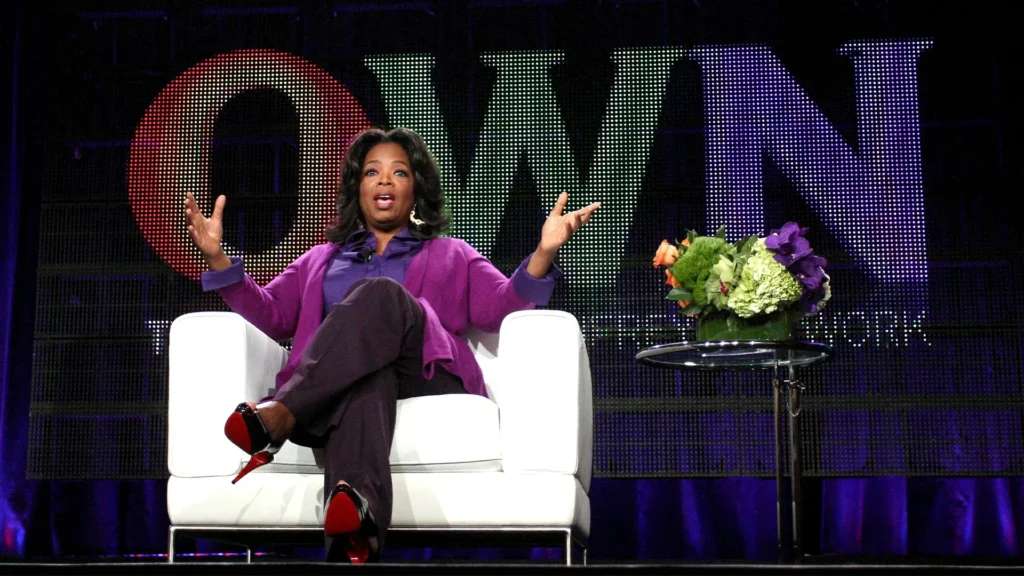
When Oprah Winfrey launched OWN (Oprah Winfrey Network) on January 1, 2011, expectations were astronomical. This was Oprah, the queen of daytime television who’d dominated talk shows for 25 years, built a billion-dollar media empire, and commanded unprecedented influence over American culture and consumer behavior.
The network would surely succeed on her name alone. Right? Wrong. Catastrophically wrong.
The OWN Network Oprah Results:
- Disaster years (2011-2013): Lost $330 million ($142M in 2011, $143M in 2012, $45M in 2013)
- Current revenue (2025): $75-85 million annually
- Profitability: Achieved 2017, maintains 10-15% profit margins
- Household reach: 80+ million households
- Current valuation: $400-500 million
- Oprah’s ownership: 95% stake worth $380-475 million
- Annual income: $23-34 million from OWN
OWN’s first three years became one of the most public failures in television history hemorrhaging viewers, cycling through executives, and nearly collapsing entirely. Critics declared it Oprah’s first major business failure predicting shutdown.
The Genesis: Why Oprah Created OWN Network
The End of an Era
In November 2009, Oprah Winfrey made a shocking announcement: after 25 years, The Oprah Winfrey Show would end in 2011. The daytime talk show was a cultural institution airing on 212 U.S. stations, reaching 7-8 million daily viewers, generating over $300 million in annual revenue, and making Oprah one of the world’s wealthiest entertainers.
Why walk away from guaranteed success? Oprah wanted creative freedom and ownership. As host of a syndicated show, she didn’t own the format or control distribution. The show aired on ABC-owned stations and other networks, with Harpo Productions producing but not fully controlling the property.
The Vision:
- Complete creative control: Cable network offered ownership of all content
- Generational wealth: Media brand transcending her personal presence
- Distribution leverage: Building platform beyond individual shows
- Legacy creation: Sustainable business beyond her hosting career
The Discovery Partnership
In 2008, Oprah partnered with Discovery Communications (now Warner Bros. Discovery) to launch OWN Network Oprah. Discovery contributed 50% ownership stake (later adjusted), $100+ million investment in network infrastructure, distribution leverage negotiating with cable operators, and operational support with experienced television executives.
Oprah contributed 50% ownership stake (later increased to 95% majority), her brand name and media credibility, content programming and creative direction, personal appearances and promotion, and Harpo Productions’ existing content library.
Launch Strategy:
- Immediate distribution: Rebranding Discovery Health Channel provided distribution in 74 million households
- Perfect setup: Oprah’s brand + Discovery’s infrastructure + guaranteed distribution seemed to equal inevitable success
- Reality: Proved far more complicated than anticipated
The Disaster Years: 2011-2013
Launch and Immediate Problems
OWN launched January 1, 2011 with primetime programming including Oprah’s Next Chapter (Oprah interviewing celebrities), Your OWN Show (reality competition for talk show hosts), Oprah Presents Master Class (celebrities sharing life lessons), and various lifestyle and self-help shows aligned with Oprah brand.
The problems emerged immediately. Low ratings as despite massive hype, OWN’s debut week averaged just 505,000 viewers in primetime far below expectations. By comparison, established cable networks like USA and TNT averaged 2-3 million primetime viewers.
Critical Failures:
- Content confusion: Programming felt unfocused mixing inspirational content, reality shows, talk formats without clear identity
- Oprah’s limited presence: Audiences expected Oprah herself but she appeared in limited programming, just once weekly
- Executive turnover: Christina Norman fired after five months, replacement lasted eight months creating instability
- Massive losses: $142M (2011), $143M (2012), $45M (2013) totaling $330M in three years
Crisis Point: 2013
By 2013, OWN was in crisis. Average primetime viewership had fallen to 220,000-250,000 making it one of cable’s least-watched networks. Industry analysts questioned whether the network would survive.
David Zaslav, Discovery Communications CEO (now Warner Bros. Discovery CEO), publicly acknowledged OWN Network Oprah’s struggles but committed to supporting turnaround. Oprah herself admitted in interviews that launching OWN was “harder than I thought” and “the most difficult thing I’ve ever done.”
Turnaround Required:
- Dramatic changes: Crisis forced strategic pivots
- Public failure: Most visible business setback in Oprah’s career
- Industry skepticism: Analysts predicted shutdown
- Discovery commitment: Patient capital provided runway for recovery
The Turnaround: 2013-2017
Strategic Pivots
Oprah got hands-on by moving from California to OWN’s offices in West Hollywood, becoming deeply involved in daily operations. She’d previously maintained distance trusting executives to run the network. That approach failed. She took direct creative control, greenlit shows personally, and appeared in more programming.
Programming overhaul shifted strategy dramatically. OWN partnered with Tyler Perry to produce scripted series targeting African American audiences, an underserved cable demographic. Developed compelling docuseries and reality shows with emotional depth. Reduced dependence on Oprah’s personal appearances building shows that worked without her.
Additional Changes:
- Target audience clarity: Embraced African American women (35-54) as core audience rather than trying to appeal to everyone
- Financial restructuring: Discovery invested additional capital while Oprah increased ownership stake
- Time to build: Reduced immediate financial pressure giving OWN time to build audience
- Focused strategy: Clear demographic targeting versus broad appeal
The Hit Shows That Saved OWN
The Haves and the Have Nots (2013-2021) as Tyler Perry’s primetime soap opera about two families became OWN’s first massive hit. The show launched with 1.8 million viewers and consistently delivered 2-3 million weekly viewers making it cable’s highest-rated scripted series among African American audiences running eight seasons and 196 episodes.
If Loving You Is Wrong (2014-2020) was another Tyler Perry drama about suburban neighbors averaging 1.5-2 million weekly viewers becoming OWN’s second hit. Queen Sugar (2016-2022) executive produced by Ava DuVernay and Oprah attracted critical acclaim and Emmy nominations with 500,000-800,000 viewers positioning OWN as serious content creator.
Additional Hits:
- Greenleaf (2016-2020): Drama about Memphis megachurch averaged 2-3 million viewers per episode becoming one of cable’s top dramas
- Love & Marriage: Huntsville (2019-present): Reality series following three African American couples became surprise hit averaging 1.5+ million viewers spawning spinoffs
- The Oprah Conversation (2020-present): Interview series addressing timely cultural issues featuring Barack Obama, Dolly Parton maintaining OWN’s prestige
These shows, particularly the Tyler Perry dramas, transformed OWN Network Oprah from failing network to must-watch destination for African American audiences demonstrating the power of targeted programming.
The Business Model: How OWN Makes Money
Revenue Streams
Affiliate fees representing 50-55% of revenue come as cable and satellite operators including Comcast, Charter, DirecTV pay OWN monthly fees per subscriber for carrying the network. As of 2025, OWN reaches 80+ million households generating estimated $35-40 million annually in affiliate fees.
Advertising at 40-45% of revenue sees advertisers paying for commercial spots during programming. OWN’s focused demographic (African American women 35-54 with household income $50,000+) makes it attractive to advertisers seeking this audience.
Additional Revenue:
- Major advertisers: Consumer packaged goods companies (P&G, Unilever), automotive brands, financial services, telecommunications companies
- Annual advertising revenue: Estimated $30-35 million
- Content licensing (5-10%): OWN licenses programming to streaming platforms (Netflix, Hulu, HBO Max) and international broadcasters
- Licensing revenue: Shows like Queen Sugar and Greenleaf generate estimated $5-10 million annually
Cost Structure and Profitability
Content production consumes $40-50 million annually for scripted dramas, reality shows, and specials. Operations including staff salaries, facilities, technology run $15-20 million. Marketing for promotional campaigns and advertising costs $8-12 million.
Net profit margin runs 10-15% generating estimated annual profit of $8-12 million. While modest compared to Oprah’s overall $3 billion net worth, OWN’s profitability represents successful turnaround from disaster with potential for growth through streaming expansion.
Total Annual Revenue (2024-2025):
- Combined revenue: $75-85 million
- Profitability achieved: 2017 after six years
- Current margins: 10-15% sustainable for niche cable network
- Profit distribution: $8-12 million annually
The Numbers: Oprah’s OWN Wealth
OWN Valuation and Ownership
Current ownership structure in 2025 shows Oprah Winfrey holding 95% ownership increased from initial 50% and Warner Bros. Discovery holding 5% ownership decreased from initial 50%. This ownership shift occurred through multiple restructurings as Oprah bought increased stakes from Discovery particularly after achieving profitability.
Network valuation in 2025 sits at $400-500 million reflecting profitable operations with $75-85 million annual revenue, strong brand identity and loyal audience, content library value with hundreds of hours of owned programming, and distribution in 80+ million households.
Oprah’s Stake Value:
- Current worth: $380-475 million (95% of total valuation)
- OWN in total wealth: Represents approximately 13-16% of Oprah’s $3 billion net worth
- Wealth breakdown: Harpo Productions $150-200M, OWN Network $380-475M, Weight Watchers stake $50-100M, real estate $200-300M, investment portfolio $1.5-2B
Annual Earnings from OWN
Oprah’s personal income from OWN Network Oprah includes salary as network executive at $10-15 million annually, profit share from 95% ownership at $8-11 million annually, and appearance fees for OWN programming at $5-8 million annually totaling $23-34 million.
This supplements her other income sources including speaking fees at $1-2 million per event, Weight Watchers compensation, investment returns, and content licensing demonstrating OWN’s significant contribution to ongoing earnings.
The Strategy: What Makes OWN Work Now
Niche Focus Over Broad Appeal
OWN abandoned trying to appeal to everyone instead focusing on African American women. This provided clear programming direction, attracted loyal audience, and made the network valuable to advertisers seeking this demographic demonstrating the power of targeted strategy.
Rather than producing everything in-house, OWN partnered with proven creators including Tyler Perry and Ava DuVernay who understood the target audience. This reduced production risk while ensuring quality content showing smart collaboration beats vertical integration.
Balancing Prestige and Populism:
- Critically acclaimed: Prestige dramas like Queen Sugar build cultural credibility
- Popular entertainment: Love & Marriage franchise maintains ratings
- Strategic mix: Combines critical acclaim with commercial success
- Oprah as brand: Network succeeded when Oprah became brand behind programming rather than appearing in every show
Multi-Platform Expansion
OWN expanded beyond linear television with OWN app featuring streaming content, YouTube channel with 1+ million subscribers, social media presence including Instagram with 2+ million followers, and podcast partnerships reaching audiences beyond traditional cable.
Patient capital from Discovery/Warner Bros. as Discovery’s willingness to absorb $330 million in losses during turnaround years provided runway most startups never receive allowing strategic experimentation and gradual audience building.
The Bottom Line
Oprah Winfrey’s OWN Network represents one of media’s most dramatic turnarounds. From $330 million disaster losing money for three years ($142M in 2011, $143M in 2012, $45M in 2013) to profitable $75-85 million annual revenue cable empire reaching 80+ million households, OWN’s journey demonstrates resilience, strategic adaptation, and the power of niche programming.
Why OWN Network Oprah Succeeded:
- Celebrity brands need more than fame: Oprah’s name alone couldn’t save OWN; success required quality content, clear strategy, operational excellence
- Niche focus beats broad appeal: OWN succeeded by embracing specific audience rather than trying to appeal to everyone creating sustainable business
- Failing fast and pivoting matters: Willingness to acknowledge failure, fire executives, overhaul programming, and pivot strategy prevented total collapse
- Patient capital provides advantage: Discovery’s $330 million in losses during turnaround years gave OWN time to find its footing
- Distribution is king: Launch leveraging Discovery Health Channel’s existing distribution in 74 million households proved crucial
- Success takes time: OWN took six years to achieve profitability; media businesses require long-term thinking not quick wins
What separates OWN from typical celebrity failures is Oprah’s willingness to acknowledge problems, take direct control investing additional capital buying increased ownership to 95%, and completely overhaul strategy. Rather than ego-driven stubbornness, she embraced humility, accepted advice, and made difficult decisions including ceding creative control to producers like Tyler Perry who understood the audience better.
Key Success Factors:
- Tyler Perry partnership: His shows (The Haves and the Have Nots, If Loving You Is Wrong) delivered 2-3 million weekly viewers saving network financially
- African American content: Proved demand for quality scripted content targeting this demographic
- Prestige projects: Queen Sugar and Greenleaf elevated OWN’s cultural credibility beyond commercial success
- Ownership evolution: Oprah increased stake from 50% to 95% as network achieved profitability
For Oprah personally, OWN represents 13-16% of her $3 billion net worth with $380-475 million stake while generating $23-34 million in annual income through salary, profit share, and appearance fees. While not her largest wealth component, OWN provides ongoing revenue, brand relevance, and platform for storytelling aligned with her values.
The network faces significant challenges including cable TV decline with viewership dropping 8-10% annually, streaming competition from Netflix, Hulu, Disney+ investing billions, rising content costs at $2-4 million per episode for quality scripted dramas, and succession planning as Oprah ages requiring transition to sustainability beyond her personal involvement.
However, OWN’s focused strategy targeting African American women, strong content partnerships with proven creators, and multi-platform expansion position it for continued success in evolving media landscape. The network that nearly collapsed in 2013 with 220,000-250,000 primetime viewers has become sustainable business reaching 80+ million households.
Perhaps most importantly, OWN demonstrates that failure doesn’t have to be permanent. Through strategic thinking, operational excellence, and willingness to adapt, even the most public disasters can transform into successes proving that resilience and smart strategy matter more than initial setbacks. From disaster to success generating $75-85 million annually with 10-15% profit margins, OWN’s journey proves that in media, it’s not about avoiding failure but about how you respond when it happens demonstrating Oprah’s business acumen beyond her television charisma.