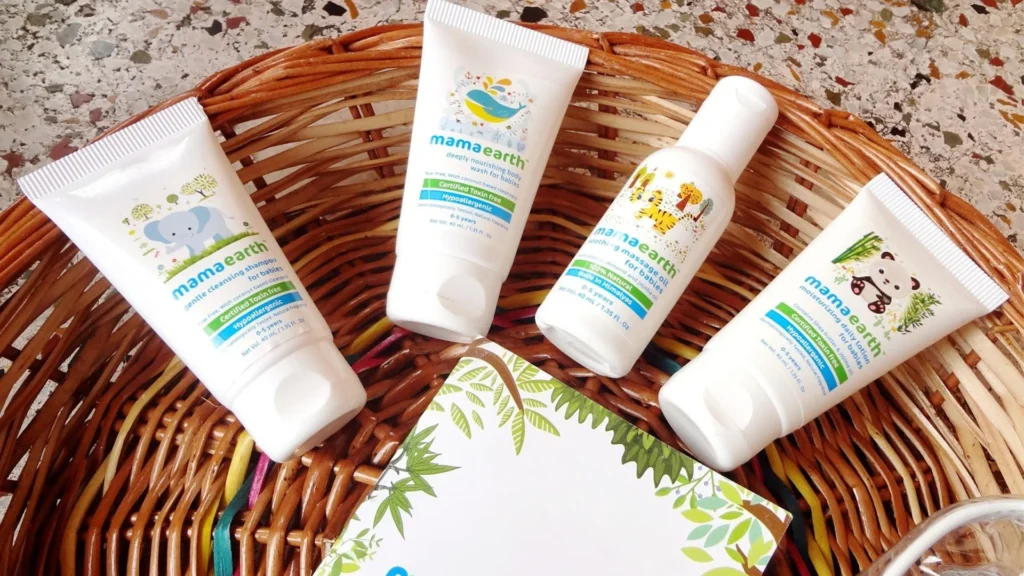
When Ghazal and Varun Alagh couldn’t find safe, toxin-free baby care products for their newborn son Agastya in 2016, they faced a choice every parent dreads: either import expensive products from abroad or use locally available items filled with harmful chemicals banned in developed countries. Instead of accepting these options, they spent sleepless nights researching formulations, building an R&D team, and pursuing certifications that would eventually make Mamaearth Asia’s first MADE SAFE certified brand. That personal frustration with India’s baby care market became the foundation for what would grow into Honasa Consumer, a company that reached ₹2,067 crore in revenue for FY 2025.
What makes Mamaearth’s journey particularly instructive isn’t just the impressive growth numbers. It’s how the brand used a toxin-free positioning strategy to disrupt India’s crowded personal care market, built a digital-first D2C model that generated ₹534 crore in Q4 FY25 alone, and created a house of brands including The Derma Co., Aqualogica, Dr. Sheth’s, and BBlunt that collectively command significant market share. By FY25, Honasa served over 236,000 retail outlets, became India’s third-largest skincare brand according to Euromonitor, and demonstrated that conscious consumerism combined with strategic brand building could create lasting competitive advantages in even the most saturated categories.
The Personal Problem That Became a Business Opportunity
The founding story of Mamaearth illustrates a principle that many successful D2C brands share: the best business ideas often come from solving problems you personally experience. When Ghazal and Varun Alagh became parents in 2016, they discovered their infant son had sensitive skin that reacted badly to most products available in India. Their research revealed an uncomfortable truth: Indian baby care products contained toxins like parabens, sulfates, silicones, and synthetic fragrances that were banned or restricted in markets like the US and Europe.
The market gap they identified:
- Most Indian baby care products contained 8,000+ known toxins
- No domestic brands offered international safety certifications
- Imported safe products were expensive and inconvenient
- Indian parents lacked transparent ingredient information
- No brand specifically addressed problems like mosquito bites common in India
The couple had to order suitable products from the United States, an expensive and inconvenient arrangement that highlighted a massive market opportunity. They weren’t just facing a personal inconvenience, they were uncovering a systemic problem affecting millions of Indian parents who wanted safe products but had no accessible options.
From Concept to Asia’s First MADE SAFE Brand
Varun Alagh brought FMCG expertise from companies like Hindustan Unilever, Smirnoff, and Coca-Cola. Ghazal Alagh contributed entrepreneurial experience (she had previously founded Dietexpert) and a design background from studies at the New York Academy of Art. Together, they invested approximately ₹90 lakh of their own capital to launch Honasa Consumer Private Limited in September 2016, introducing the Mamaearth brand in December 2016.
The breakthrough came when Mamaearth became Asia’s first brand to receive the MADE SAFE certification, a rigorous standard that screens for over 6,500 known toxic chemicals. This wasn’t just marketing positioning, it was a verifiable competitive advantage that no other Indian brand could claim. The certification gave nervous parents tangible proof that Mamaearth products were genuinely toxin-free, building trust in a category where trust is everything.

🌿 Mamaearth Rosemary Hair Fall Control Kit – Up to 94% Stronger Hair & 93% Less Hair Fall
🛒 Shop Now on AmazonThe Toxin-Free Positioning Strategy
Mamaearth’s core positioning strategy revolved around a simple but powerful promise: 100% toxin-free products made with natural ingredients that meet international safety standards. This positioning worked because it tapped into three converging trends: rising health consciousness among millennial parents, growing skepticism about chemical-laden FMCG products, and increasing willingness to pay premium prices for verified safety.
Why toxin-free positioning resonated:
- Millennial parents research products extensively before buying
- Chemical safety concerns intensified after various product scandals
- Social media amplified awareness of harmful ingredients
- International travel exposed Indians to safer product standards
- Indian market had zero credible domestic toxin-free brands
The positioning required more than just claims. Mamaearth invested heavily in transparency, listing all ingredients clearly, explaining why specific natural ingredients were chosen, and maintaining certifications that verified their toxin-free promise. The brand educated consumers about specific toxins to avoid (parabens, sulfates, mineral oil, synthetic fragrances) and positioned itself as the solution for parents who wouldn’t compromise on safety.
Expanding Beyond Baby Care
While Mamaearth launched with seven baby care products, the toxin-free positioning proved applicable to far broader categories. The founders quickly realized that health-conscious adults also wanted toxin-free personal care products but had even fewer options than parents did for baby products. This insight drove rapid product expansion.
Product expansion timeline:
- 2016: Launched with 7 baby care SKUs (creams, lotions, shampoos)
- 2017-2018: Expanded to 50+ products across baby care
- 2019: Entered adult skincare and haircare categories
- 2020-2021: Grew to 140+ SKUs across multiple categories
- 2022-present: Launched multiple brands beyond Mamaearth
By FY25, the portfolio included face washes, shampoos, serums, sunscreens, body care products, and wellness items, all maintaining the toxin-free promise. The expansion from baby care to personal care multiplied the addressable market while keeping the core brand promise intact.
The Digital-First D2C Model
Mamaearth’s growth strategy centered on a digital-first, direct-to-consumer approach that bypassed traditional FMCG distribution challenges. Rather than fighting for shelf space in retail stores dominated by established players, Mamaearth built its own D2C platform and leveraged e-commerce marketplaces where discovery was driven by search, reviews, and digital marketing rather than physical shelf presence.
Digital-first advantages:
- Lower customer acquisition costs than traditional retail
- Direct consumer relationships and feedback loops
- Faster product iteration based on real-time data
- Higher margins by eliminating multiple distribution layers
- Ability to educate consumers through content marketing
The D2C model allowed Mamaearth to test products with batches as small as 4,000-5,000 units, validate demand through direct consumer response, and scale production based on actual market pull rather than pushing inventory through distribution channels. This capital-efficient approach enabled rapid product innovation while minimizing inventory risk.
The Omnichannel Expansion Strategy
While Mamaearth started digital-first, the founders recognized that long-term dominance in India’s personal care market required offline presence. The company pursued a careful omnichannel strategy that maintained digital strength while building retail distribution.
Channel distribution evolution:
- Phase 1 (2016-2018): Own website and Amazon/Flipkart marketplaces
- Phase 2 (2019-2021): Added modern trade (supermarkets, pharmacy chains)
- Phase 3 (2022-2024): Expanded to traditional retail via Project Neev
- Phase 4 (2025): Direct distribution to 236,000+ outlets
Project Neev, launched in FY25, represented a major strategic shift. Instead of relying on third-party distributors, Honasa built direct distribution to India’s top 50 cities. This transition temporarily impacted profitability (net profit fell from ₹110 crore in FY24 to ₹73 crore in FY25) but doubled offline reach from 50,000 to 100,000 directly served outlets, with plans to reach 150,000 by FY26.
By Q4 FY25, direct distributors contributed 71% of Honasa’s business, up from 38% in FY24. This direct distribution model gave Honasa better control over pricing, merchandising, and consumer experience while building relationships with retailers that competitors using traditional distribution couldn’t match.
Building a House of Brands Strategy
Mamaearth’s success created a platform for Honasa to pursue a “house of brands” strategy, launching or acquiring multiple brands that served different consumer segments while leveraging common infrastructure. This strategy addressed a key limitation: a single brand can only stretch so far before diluting its positioning.
Honasa’s multi-brand portfolio:
- Mamaearth: Mass-market toxin-free personal care
- The Derma Co.: Dermatologist-backed premium skincare (₹100 crore+ offline revenue)
- Aqualogica: Hydration-focused skincare for younger consumers
- Dr. Sheth’s: Prestige skincare with advanced formulations
- BBlunt: Salon-quality hair care
- Ayuga: Ayurveda-based wellness
- Recent investments: Fang (oral care), Reginald Men (men’s grooming)
The Strategic Logic of Multiple Brands
The house of brands approach solved several strategic challenges simultaneously. Each brand could maintain distinct positioning, pricing, and target demographics without competing directly. The Derma Co., for example, operates in the premium skincare segment with dermatologist endorsements and higher price points than Mamaearth, capturing consumers willing to pay more for specialized solutions.
Newer brands like Aqualogica grew 30%+ year-over-year in FY25, while The Derma Co. established strong presence through chemist networks by positioning as a medical-grade skincare brand. This diversification reduced dependence on Mamaearth alone and allowed Honasa to capture multiple segments of India’s growing personal care market.
The infrastructure advantages were significant. All brands leveraged Honasa’s direct distribution network, R&D capabilities, manufacturing relationships, and digital marketing expertise. Fixed costs spread across multiple brands improved unit economics while each brand maintained independent positioning in consumers’ minds.

✨ Mamaearth Rice Dewy Bright Face Wash – For Glass Skin & Hydrated Glow (Pack of 2)
🛒 Shop Now on AmazonThe Social Media and Influencer Marketing Machine
Mamaearth’s growth was powered by sophisticated digital marketing that went far beyond traditional advertising. The brand recognized early that millennial parents spent significant time on social media and made purchase decisions based on peer recommendations, reviews, and influencer endorsements more than TV commercials.
Digital marketing strategy:
- Heavy investment in influencer partnerships (parent bloggers, beauty influencers)
- User-generated content campaigns encouraging customers to share experiences
- Educational content explaining toxins and ingredient benefits
- Targeted Facebook and Instagram ads based on life stage (new parents, skincare enthusiasts)
- Amazon and Flipkart optimization (reviews, search rankings, Prime Day campaigns)
The “mum-powered” approach was central to Mamaearth’s marketing. The company directly engaged mothers in product development, testing, and marketing, creating authentic advocacy that paid advertising couldn’t buy. When real mothers shared genuine experiences using Mamaearth products on their babies, it generated credibility that traditional brand messaging never could.
Ghazal Alagh’s visibility as a co-founder, artist, and eventually Shark Tank India judge created additional brand equity. Her personal story as a mother who created Mamaearth because she couldn’t find safe products resonated with the target audience and positioned the brand as authentically mission-driven rather than purely commercial.
The Financial Journey from Startup to Listed Company
Mamaearth’s financial trajectory demonstrates both the opportunities and challenges of scaling a D2C brand. The company achieved profitability relatively early compared to most startups, reaching ₹100 crore revenue within three years of launch. However, the path from profitable startup to listed public company required navigating growth pains and strategic transitions.
Financial milestones:
- FY22: ₹964 crore revenue (109% growth)
- FY23: ₹1,360 crore revenue but ₹151 crore net loss
- FY24: ₹1,920 crore revenue, ₹110 crore net profit
- FY25: ₹2,067 crore revenue, ₹73 crore net profit (34% decline)
- Q4 FY25: ₹534 crore revenue (13% growth), ₹25 crore net profit
The IPO and Post-Listing Challenges
Honasa Consumer’s October 2023 IPO valued the company at approximately ₹24,000 crore, achieving unicorn status. The listing price was ₹324 per share. However, by November 2024, the stock had fallen to around ₹227, reducing market cap to ₹7,300 crore and costing the company its unicorn valuation.
The post-IPO challenges reflected operational realities. Project Neev’s transition to direct distribution required significant upfront investment in infrastructure, logistics, and inventory. Modern trade expansion brought lower per-unit revenue despite higher volumes. EBITDA margins compressed from 7.1% in FY24 to 3.3% in FY25 as the company prioritized market share expansion over short-term profitability.
Yet Q4 FY25 showed recovery signs. Revenue grew 13.3% year-over-year with volume growth of 21.2%, indicating strong underlying consumer demand. Gross profit margin improved 76 basis points to 70.7% through better product mix and operational efficiencies. Management expects FY26 to deliver double-digit revenue growth as Project Neev’s benefits materialize.
The Bottom Line
Mamaearth’s toxin-free strategy teaches several critical lessons about modern D2C brand building. First, the best brand positions often come from solving real personal problems rather than identifying theoretical market gaps. Ghazal and Varun Alagh’s frustration as parents gave them authentic insight into what consumers actually wanted, not what focus groups said they wanted. This personal connection to the problem created missionary zeal that powered the brand through early challenges.
Key strategic lessons:
- Verifiable differentiation matters: MADE SAFE certification provided proof, not just claims
- Education creates categories: Mamaearth taught consumers about toxins before selling products
- Digital-first enables rapid testing: D2C model allowed fast iteration and market validation
- Omnichannel requires patience: Offline expansion takes years and temporary profit hits
- House of brands captures more market: Multiple brands serve different segments better than one stretched brand
- Founder visibility builds brand: Ghazal’s public presence created authentic connection
- Early profitability enables independence: Cash generation reduced venture capital dependence
The financial reality:
- ₹2,067 crore annual revenue (FY25)
- ₹73 crore net profit despite restructuring costs
- 236,000+ retail outlets served
- India’s third-largest skincare brand (Euromonitor)
- ₹8,774 crore market capitalization (December 2025)
- Five major brands in portfolio plus strategic investments
What didn’t work perfectly:
- IPO timing coincided with offline restructuring pain
- Market cap fell from ₹24,000 crore to ₹7,300 crore
- Profitability declined during Project Neev transition
- Competition intensified from both traditional and new D2C brands
The most important insight from Mamaearth’s journey is that successful D2C brand building requires balancing multiple tensions simultaneously. The company had to be mission-driven (toxin-free promise) while being commercially ruthless (aggressive expansion). It needed to maintain premium positioning (safety certification) while achieving mass-market scale (236,000 outlets). It had to invest heavily in growth (Project Neev) while maintaining profitability expectations from public market investors.
For entrepreneurs studying Mamaearth’s trajectory, the lessons are clear: start with a genuine consumer insight rooted in personal experience, build verifiable differentiation that competitors cannot easily copy, use digital channels for capital-efficient customer acquisition and product validation, expand omnichannel carefully with realistic timelines for payback, and consider a house of brands strategy once the first brand proves the model.
Mamaearth proved that a toxin-free positioning strategy could disrupt India’s personal care market despite competition from giants like Hindustan Unilever, Procter & Gamble, and Dabur. The brand demonstrated that conscious consumerism wasn’t just a niche trend but a genuine shift in how millennial parents and adults make purchase decisions. Most importantly, Mamaearth showed that Indian founders could build world-class FMCG brands using modern D2C playbooks rather than accepting that established players had unassailable advantages.
The journey from frustrated parents ordering baby products from abroad to operating a ₹2,067 crore business serving millions of consumers took less than nine years. That speed of scaling, while navigating profitability, competition, IPO pressures, and strategic transitions, offers a playbook for the next generation of Indian D2C founders trying to build category-defining brands.