When Calvin Klein released its Spring 2024 campaign featuring Jeremy Allen White on January 4, 2024, the fashion industry wasn’t expecting what happened next. The 33-year-old actor from “The Bear” appeared on a New York City rooftop in the brand’s iconic white cotton underwear, and within 48 hours, the campaign generated $12.7 million in media impact value.
By the end of the first week, underwear sales had jumped 30% year-over-year. Within months, the campaign accumulated $74 million in total media impressions. PVH Corp’s CEO declared Calvin Klein was driving “more consumer engagement than at any other time in the history of the brand.” This wasn’t just another celebrity endorsement. This was a masterclass in how authentic casting and strategic simplicity could rescue a struggling heritage brand.
Campaign Results:
- Launch: January 4, 2024 (Spring 2024 collection)
- First 48 hours: $12.7M media impact value
- First week: 30% underwear sales increase year-over-year
- Total campaign: $74M media impressions
- Q1 2024: First revenue increase for Calvin Klein North America since 2022
- Photographer: Mert Alas (Turkish-British fashion photographer)
- Music: Lesley Gore’s “You Don’t Own Me”
The campaign succeeded because it understood something competitors missed: in 2024’s oversaturated influencer market, authenticity matters more than production value. Jeremy Allen White wasn’t just wearing Calvin Klein. He embodied the brand’s minimalist aesthetic in ways that felt genuine rather than manufactured.
Why Calvin Klein Needed a Reset
The Heritage Brand Crisis
Calvin Klein entered 2024 in trouble. PVH Corp, the parent company owning both Calvin Klein and Tommy Hilfiger, had spent years trying to stabilize the brand after walking away from significant heritage volume. In 2022, PVH launched the PVH+ plan, a multi-year initiative aimed at reaching $12.5 billion in global revenue by 2025 while boosting consumer loyalty and brand desirability.
The problem wasn’t just financial. It was cultural. Calvin Klein had lost relevance with Gen Z and Gen Alpha consumers who discovered fashion through TikTok rather than department stores. The brand needed to meet a new generation where they lived: online, on social media, consuming content that felt authentic rather than advertised.
Brand Challenges:
- PVH+ plan: Launched 2022, targeting $12.5B global revenue by 2025
- Heritage volume loss: Divested innerwear brands, sold heritage business to Authentic Brands Group
- Gen Z/Alpha: Discovered fashion through digital platforms, not department stores
- Q1 2024: First quarter since 2022 with North America revenue increase
- Competition: Oversaturated influencer market requiring differentiation
- Distribution: Department store model struggling against direct-to-consumer brands
Calvin Klein’s combination of department store distribution and licensing partnerships had built “incredible brand awareness” according to retail analysts, but awareness without cultural relevance doesn’t drive sales. The brand needed a jolt that would translate media impact into actual revenue.
The Strategic Celebrity Calculation
Calvin Klein’s decision to cast Jeremy Allen White wasn’t random. At 33, White represented something specific in 2024’s celebrity landscape. He wasn’t an A-list movie star commanding eight-figure endorsement deals. He was an Emmy-winning television actor whose FX on Hulu series “The Bear” had become a cultural phenomenon among exactly the demographic Calvin Klein needed to capture.
White’s character Carmen “Carmy” Berzatto wore simple white T-shirts and denim throughout “The Bear,” creating a natural aesthetic alignment with Calvin Klein’s minimalist philosophy. His New York City roots (White is a native New Yorker) provided geographic authenticity when the campaign was shot in his hometown. Most importantly, White’s rising star trajectory meant his visibility was increasing rather than plateauing.
Strategic Casting Advantages:
- Age 33: Appealed to millennials while resonating with Gen Z
- “The Bear”: Emmy-winning cultural phenomenon on streaming
- Aesthetic alignment: Character wore white T-shirts and denim
- New York native: Geographic authenticity for NYC shoot
- Rising trajectory: Visibility increasing with Season 3 premiere
- Cost efficiency: Emerging star vs established A-lister pricing
- Golden Globes: Wore Calvin Klein to high-profile events
- Authentic usage: Natural fit with minimalist lifestyle
The Campaign That Broke the Internet
Mert Alas’s Stripped-Down Vision
Calvin Klein hired Mert Alas, one half of the legendary fashion photography duo Mert and Marcus, to shoot the campaign. Alas’s decision was radical in its simplicity: a tattered rooftop sofa, downtown New York City setting, natural lighting, and White in Calvin Klein’s most iconic underwear styles including white cotton boxer briefs.
The video showed White climbing stairs to a rooftop wearing a white singlet and black active shorts, then stripping down to Calvin Klein underwear. He stretched, flexed, stared intensely into the camera, and lay down on the sofa. The soundtrack was Lesley Gore’s 1963 feminist anthem “You Don’t Own Me,” adding layers of meaning about autonomy and self-possession.
Production Elements:
- Photographer: Mert Alas (legendary fashion photography duo Mert and Marcus)
- Location: Downtown New York City rooftop
- Setting: Tattered sofa, natural lighting, minimal production
- Styling: White cotton boxer briefs, Calvin Klein’s most iconic styles
- Music: Lesley Gore’s “You Don’t Own Me” (1963 feminist anthem)
- Concept: Authentically New York, stripped-down simplicity
What made the campaign work wasn’t elaborate production. It was the refusal of elaborate production. In an era when fashion campaigns compete through increasingly baroque concepts, Calvin Klein went the opposite direction: radical simplicity that felt real rather than staged.
The Viral Explosion
Within 24 hours of release, Jeremy Allen White’s name became one of the most talked-about topics on X (formerly Twitter). The brand’s first TikTok video promoting the campaign drummed up 4.5 million views within the first several days. The rooftop sofa from the shoot was later posted for sale on Facebook Marketplace, generating additional press coverage and social media attention.
By the first week, underwear sales had jumped 30% year-over-year. By April, PVH CEO Stefan Larsson was attributing record consumer engagement to campaigns like White’s. The $74 million in total media impressions represented value that couldn’t be purchased through traditional advertising spend.
Viral Performance:
- 24 hours: White’s name trending on X (formerly Twitter)
- First days: 4.5M TikTok views on first campaign video
- First week: 30% underwear sales increase YoY
- Total campaign: $74M media impressions
- Sofa from shoot: Posted on Facebook Marketplace, generated additional press
- April 2024: CEO credited record consumer engagement
Why Authenticity Beat Production Value
The Gen Z Digital Strategy
Calvin Klein’s digital-first approach recognized that Gen Z and Gen Alpha consumers shop digitally first. The campaign launched on calvinklein.com and social media rather than through traditional magazine spreads or television commercials. Content pulsed out on @calvinklein social channels throughout the week, appearing on high-impact out-of-home placements globally only after establishing social media traction.
This strategy acknowledged a fundamental shift in fashion marketing. Traditional luxury brands still prioritized print advertising and television. Calvin Klein understood that for younger consumers, social media wasn’t supplementary to the campaign. It was the campaign.
Digital-First Strategy:
- Launch: Calvinklein.com and social media (not traditional media first)
- Social rollout: Content pulsed throughout week on @calvinklein
- Out-of-home: Appeared after establishing social traction
- Gen Z/Alpha: Digital-first shopping behavior
- TikTok virality: Organic sharing drove awareness beyond paid media
The Authentic New York Connection
Multiple marketing analysts noted that the campaign’s authenticity stemmed from genuine connections. Jeremy Allen White is from New York. The campaign was shot in New York. The aesthetic was authentically New York rather than aspirationally somewhere else. This created credibility that international shoots in exotic locations couldn’t replicate.
As one retail analyst explained: “If you think of American fashion, you think of New York. Everything about this campaign was just authentically New York, even Jeremy Allen White is from New York. It really created a really authentic campaign from that perspective.”
Authenticity Factors:
- White: Native New Yorker shooting in hometown
- Location: Downtown NYC (not exotic international location)
- Aesthetic: Authentically New York urban grit
- Character alignment: Carmy from “The Bear” wore similar minimalist style
- Credibility: Genuine connection vs aspirational fantasy
The August 2024 Follow-Up Campaign
Striking While Hot
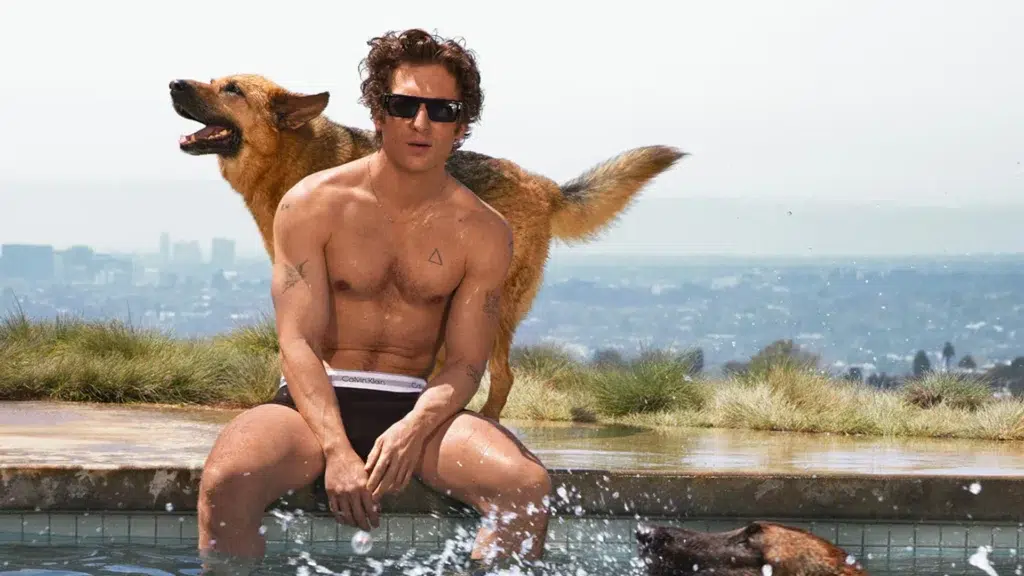
On August 27, 2024, Calvin Klein released a second campaign featuring Jeremy Allen White. This time, White headed to Los Angeles for a poolside shoot showcasing Fall 2024 underwear and denim styles. Mert Alas returned to direct and photograph, maintaining creative continuity. The video was set to The Shacks’ “Crimson and Clover,” creating a relaxed, sun-drenched aesthetic.
The fall campaign featured White wearing Calvin Klein’s 90s Straight, Slim Fit and Standard Straight Jeans, the 90s Trucker Jacket, Monogram Logo T-Shirt, Modern Cotton Air and Cotton Classic underwear, and new Calvin Klein sunglasses. The styling emphasized “casual rockstar-off-duty” and denim-on-denim looks.
Fall 2024 Campaign:
- Release: August 27, 2024
- Location: Los Angeles poolside (West Coast expansion)
- Director: Mert Alas (creative continuity)
- Music: The Shacks’ “Crimson and Clover”
- Products: 90s denim styles, trucker jacket, underwear, sunglasses
- Aesthetic: Sun-drenched, relaxed, Americana-inspired
White’s statement about the follow-up reflected the partnership’s evolution: “Calvin Klein’s aesthetic has always been timeless, and it was great to be back with them and the entire creative team for this new campaign.” The familiarity between brand and talent created natural progression rather than forced repetition.
The Business Impact Calvin Klein Needed
Q1 2024: First Revenue Increase Since 2022
The Jeremy Allen White campaign’s timing proved critical for Calvin Klein’s business turnaround. Q1 2024 results marked the first quarter since 2022 when Calvin Klein North America saw a revenue increase. While PVH Corp doesn’t break out specific revenue attributable to individual campaigns, CEO Stefan Larsson directly credited the White campaign when discussing brand health.
In the April 2024 earnings call with analysts, Larsson explained: “We saw the impact of this work earlier this year with the launch of our spring campaign featuring Jeremy Allen White, and we are excited to build on this strong momentum as Calvin’s global product engine takes hold.”
Financial Turnaround:
- Q1 2024: First Calvin Klein North America revenue increase since 2022
- CEO attribution: Larsson directly credited White campaign
- Brand engagement: “More than at any other time in brand history”
- PVH+ plan: Progress toward $12.5B global revenue target by 2025
- Marketing effectiveness: Drove revenue through brand-building, not just direct sales
The Media Impact Value Mathematics
The $74 million in media impressions represented value Calvin Klein obtained without equivalent advertising spend. When brands generate earned media through viral campaigns, they receive coverage, social sharing, and consumer conversations that paid advertising cannot replicate.
Retail analysts emphasized that while media impact value doesn’t directly translate to revenue, it creates top-of-mind awareness that influences purchase decisions when consumers shop for underwear, denim, or casual basics. The campaign positioned Calvin Klein as culturally relevant rather than legacy brand, particularly important for Gen Z consumers prioritizing brands that feel current.
Media Value Breakdown:
- $12.7M: First 48 hours media impact value
- $74M: Total campaign media impressions
- Earned media: Coverage beyond paid advertising spend
- Brand positioning: Culturally relevant vs legacy brand
- Consumer awareness: Top-of-mind when shopping for basics
What Competitors Couldn’t Copy
The Authenticity Problem
Multiple fashion brands attempted similar campaigns following Calvin Klein’s success, but struggled to replicate the authenticity that made White’s campaign work. The challenge wasn’t finding attractive celebrities willing to pose in underwear. It was finding celebrities whose lifestyle, aesthetic, and public persona naturally aligned with the brand’s identity.
Marketing analysts cautioned against copying the formula without understanding the underlying strategy. As one explained: “To choose a personality to tell a brand’s story in the most effective manner requires understanding accelerators of relevance.” The combination of White’s rising star power, “The Bear” cultural relevance, New York authenticity, and minimalist aesthetic created convergence that couldn’t be manufactured.
Why Others Failed:
- Celebrity selection: Finding natural brand alignment, not just attractive spokespeople
- Timing: White’s rising trajectory during “The Bear” Season 3 launch
- Authenticity: Genuine New York roots vs manufactured cool
- Aesthetic alignment: Character’s minimalist style matching brand philosophy
- Cultural relevance: “The Bear” zeitgeist among target demographic
The Long-Term Brand Building vs Short-Term Sales
Retail analysts noted that Calvin Klein’s approach represented sophisticated understanding of marketing as brand-building rather than direct sales driver. While the 30% first-week sales increase provided immediate validation, the real value came from repositioning Calvin Klein as relevant to younger consumers who had written off the brand as their parents’ underwear.
PVH historically excels at “driving ad spending on brand-building marketing,” according to industry observers. The Jeremy Allen White campaign demonstrated that investing in cultural relevance pays dividends beyond quarterly results, creating sustained consumer loyalty that justifies premium pricing for products that aren’t revolutionary in functionality.
The Bottom Line
The Jeremy Allen White Calvin Klein campaign launched January 4, 2024 will be studied for years as a case study in how heritage brands can rescue relevance through authentic celebrity partnerships. It generated $12.7 million in media impact value within 48 hours, drove 30% underwear sales increase in the first week, and accumulated $74 million in total media impressions.
Why This Succeeded:
- Authentic casting: White’s New York roots, “The Bear” aesthetic alignment
- Digital-first strategy: Met Gen Z/Alpha where they consume content
- Radical simplicity: Stripped-down production felt genuine vs manufactured
- Strategic timing: Launched during “The Bear” Season 3 cultural momentum
- Creative continuity: Mert Alas maintained visual consistency across campaigns
Most importantly, it marked the first quarter since 2022 when Calvin Klein North America saw revenue increase. PVH CEO Stefan Larsson directly credited the campaign when discussing brand health, stating Calvin Klein was driving “more consumer engagement than at any other time in the history of the brand.”
The campaign succeeded by understanding that in 2024’s oversaturated influencer market, authenticity beats production value. White wasn’t hired because he looked good in underwear. He was hired because his aesthetic, lifestyle, and cultural relevance naturally aligned with Calvin Klein’s minimalist philosophy. The rooftop sofa wasn’t elaborate set design. It was deliberate rejection of elaborate set design.
For fashion brands studying Calvin Klein’s turnaround, the lesson transcends celebrity selection. Strategic authenticity requires finding talent whose public persona genuinely embodies brand values, timing campaigns to cultural momentum rather than arbitrary quarterly calendars, and trusting that simplified production emphasizing genuine moments resonates more than over-produced fantasy.
The follow-up August 2024 campaign featuring White in Los Angeles demonstrated Calvin Klein’s commitment to building sustained partnership rather than one-off viral moment. By maintaining creative continuity with Mert Alas and evolving the aesthetic from New York grit to California sun, the brand showed sophisticated understanding that celebrity partnerships compound value over time.
Jeremy Allen White gave Calvin Klein something money alone couldn’t buy: cultural credibility with the exact demographic that had abandoned the brand. The 30% sales increase validated the strategy financially. The $74 million in media impressions validated it culturally. The Q1 2024 revenue increase after two years of decline validated it strategically.
When a heritage brand loses relevance, the instinct is elaborate rebranding campaigns with massive production budgets. Calvin Klein did the opposite: a tattered rooftop sofa, natural lighting, and an Emmy-winning actor whose character already wore white T-shirts. Sometimes the most radical strategy is radical simplicity executed with authentic partnerships.