Let’s Start with a Story
Imagine you have a small pizza shop. Business is good, and people love your pizza. You want to open 5 more locations across the city, but there’s a problem: you need $500,000, and you only have $100,000 saved.
What can you do?
You have three options:
Option 1: Take a bank loan
- You borrow $400,000
- You must pay it back with interest, whether your business does well or not
- If business fails, you still owe the bank money
Option 2: Find a business partner
- Someone gives you $400,000
- In return, they own 80% of your business (because they put in $400,000 and you put in $100,000)
- Now you only own 20% of your own business
Option 3: Find many small partners
- Instead of one partner, you find 400 people
- Each person gives you $1,000
- Each person owns a tiny piece (0.2%) of your business
- You keep a bigger share for yourself
Option 3 is basically what the stock market does.
When you find many small partners and give each of them a piece of ownership, you’re selling “shares” or “stocks” of your business. The stock market is simply the place where this happens in an organized way.
What is a Stock?
Let’s make this super clear.
A stock is a piece of a company. That’s it.
Think of a company like a pizza. If you cut that pizza into 8 slices, each slice is one share of stock. If the pizza is cut into 1,000,000 slices, each tiny slice is one share.
Here’s a real example:
Apple (the iPhone company) has about 15 billion shares. That means Apple is divided into 15 billion tiny pieces.
- If you buy 1 share, you own one tiny piece of Apple
- If you buy 100 shares, you own 100 tiny pieces of Apple
- If you buy 1,000,000 shares, you own 1 million tiny pieces of Apple
Now here’s the interesting part: When you own a share of Apple, you actually own a piece of the company.
You own a tiny piece of:
- Every iPhone they sell
- Every Macbook they make
- Every Apple Store around the world
- All their cash in the bank
- Everything
You’re not just a customer anymore. You’re an owner.
Why Would a Company Sell Pieces of Itself?
Let’s understand this with a story.
The Netflix Story:
Back in 1997, Netflix was just starting. It was a company that mailed DVDs to people’s homes. (Yes, actual DVDs in envelopes!)
The founders, Reed Hastings and Marc Randolph, had a big dream: they wanted to stream movies over the internet directly to people’s TVs and computers. But this dream needed a LOT of money:
- Money to build technology
- Money to license movies and TV shows
- Money to hire engineers
- Money to market the service
They didn’t have millions of dollars sitting around. So in 2002, Netflix decided to “go public” – which means they started selling shares of Netflix on the stock market.
Here’s what happened:
- Netflix said: “We’ll divide our company into millions of shares”
- They offered these shares to anyone who wanted to buy them
- Thousands of people bought Netflix shares
- Netflix collected all that money
- Netflix used that money to build the streaming service we know today
The result?
People who bought Netflix stock in 2002 for around $15 per share (adjusted for splits) have seen incredible growth. As of October 2025, Netflix stock trades around $1,160 per share!
Netflix got the money it needed to grow, and investors who believed in Netflix made a lot of money.
That’s why companies sell stock: to get money to grow their business.
Why Would Someone Buy a Stock?
Why would YOU want to buy a piece of a company?
The answer is simple: to make money.
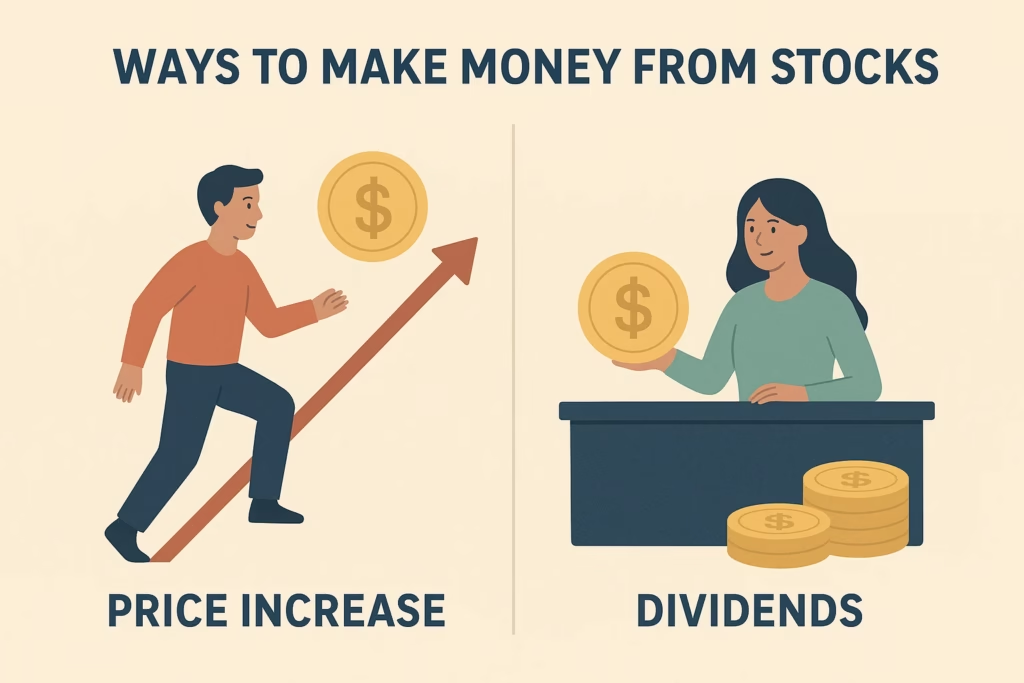
There are two ways you make money from stocks:
Way #1: The Stock Price Goes Up
Let’s use a simple example.
You buy one share of McDonald’s for $100 today.
One year later, McDonald’s:
- Opens 500 new restaurants
- Makes record profits
- Becomes more valuable
Now people are willing to pay $130 for one share of McDonald’s.
You sell your share for $130.
You made $30 profit. That’s a 30% return on your money.
Compare this to putting $100 in a savings account at a bank, which might give you $2 in interest for the whole year. That’s only 2%!
Way #2: The Company Pays You Dividends
Some companies share their profits directly with shareholders. This is called a “dividend.”
Here’s how it works:
Let’s say Coca-Cola makes $10 billion in profit this year. The company needs to decide what to do with that money. They have options:
- Build new factories
- Buy new equipment
- Save it for emergencies
- Give some back to the owners (shareholders)
Coca-Cola decides to give back $2 billion to shareholders as dividends.
If you own 100 shares of Coca-Cola, you might receive $184 in dividend payments that year. That money gets deposited into your account. You didn’t have to work for it. You just owned the stock.
What Makes Stock Prices Go Up and Down?
This is one of the most important things to understand. Stock prices change constantly – every second of every day the market is open.
Why?
Because of supply and demand.
Let me explain with a simple example:
Imagine you’re at a farmers market, and there’s only one vendor selling fresh strawberries. He has 100 boxes.
Scenario A:
- 20 people want to buy strawberries
- 100 boxes available
- Seller says: “Strawberries are $5 per box”
- Everyone who wants strawberries gets them easily
Scenario B:
- 200 people want to buy strawberries
- Only 100 boxes available
- Now there’s competition! People start offering more money
- “I’ll pay $10 per box!”
- “I’ll pay $15!”
- Price goes up because demand is high and supply is limited
Scenario C:
- Only 5 people want strawberries
- 100 boxes available
- Seller is worried they won’t sell out
- “Strawberries are now $3 per box! Please buy!”
- Price goes down because supply is high and demand is low
The stock market works EXACTLY the same way.
Let’s See This with a Real Company: Tesla
Let me show you how this works with actual events from 2025:
Event 1: Good News (Stock Goes Up)
In early October 2025:
- Tesla announced strong Q3 delivery numbers
- They set a new quarterly record for Supercharger installations
- Investors thought: “Wow, Tesla is doing great! I want to own Tesla stock!”
- Many people tried to buy Tesla stock
- Not enough people wanted to sell
- Price went up significantly, with the stock trading around $440-$447 per share
Why? Because demand increased.
Event 2: Challenges (Stock Volatility)
Throughout 2025:
- Tesla faced investigations into its self-driving features
- CEO Elon Musk’s compensation package became controversial
- The stock experienced ups and downs
- Some days it would rise, some days it would fall
Event 3: Mixed Reactions
In October 2025:
- Some days the government announced new regulations – stock dropped
- Some days Tesla announced new technology breakthroughs – stock rose
- Some days the economy looked uncertain – stock dropped
- Some days Tesla reported great sales numbers – stock rose
The stock price bounces up and down based on news, reports, and what investors think will happen in the future.
Currently in October 2025, Tesla stock is trading around $440-$447 per share.
What Really Affects Stock Prices?
Let me break this down into simple categories:
1. Company News
Good news that makes stock go up:
- Company makes more money than expected
- Company launches a successful product
- Company beats its competitors
- Company gets a new big contract
Example: When Apple announced the iPhone 17 in 2025 with strong pre-order numbers, Apple stock climbed to record highs, reaching around $254 per share.
Bad news that makes stock go down:
- Company makes less money than expected
- Product launch fails
- Company loses customers to competitors
- Company faces lawsuits or scandals
Example: When a major tech company faces regulatory investigations, its stock often drops immediately as investors worry about potential fines and restrictions.
2. Economic News
Sometimes it’s not about the company – it’s about the whole economy.
Good economic news:
- Government reports that unemployment is low (more people have jobs)
- Economy is growing
- People are spending money
When the economy is good, most stocks go up because companies make more money when people are spending.
Bad economic news:
- Recession fears
- High unemployment
- High inflation (things getting expensive)
When the economy is bad, most stocks go down because companies make less money when people stop spending.
3. Industry Trends
Sometimes entire industries move together.
Example 1: When COVID-19 pandemic started in 2020:
- Travel stocks crashed (airlines, hotels, cruise lines) – nobody was traveling
- Video call stocks soared (Zoom, Microsoft Teams) – everyone was working from home
- Streaming stocks soared (Netflix, Disney+) – everyone was stuck at home
Example 2: As electric vehicles became popular in the 2020s:
- Tesla stock surged dramatically
- Other electric vehicle company stocks went up
- Traditional car company stocks struggled to adapt
4. What Investors Think Will Happen in the Future
This is really important: Stock prices are based on the future, not just the present.
Let me explain with an example:
Amazon in 1999:
- Amazon was barely making any profit
- They were losing money actually
- But their stock price was high
Why? Because investors believed: “In the future, everyone will shop online. Amazon will dominate. It will be huge.”
They were right! People were buying the future potential, not the current profits.
Another example – A failing company:
Even if a company is doing okay today, if investors think it will fail in the future, the stock price drops now.
Example: Blockbuster Video in 2008:
- Still had stores and customers
- But investors saw Netflix coming
- They thought: “In the future, nobody will rent DVDs from stores”
- Blockbuster stock dropped to almost zero
- By 2010, Blockbuster was bankrupt
The lesson: Stock prices reflect what people think will happen in the future, not just what’s happening today.
How Does the Stock Market Impact the Economy?
The stock market isn’t just about individual companies or investors. It actually affects the entire economy and everyone in it – even people who don’t own stocks.
Let me explain how.
1. Companies Get Money to Grow and Create Jobs
Remember our pizza shop story from the beginning? When companies sell stock, they get money to expand. And when they expand, they create jobs.
Real example: Amazon
- 1997: Amazon goes public on the stock market, raises $54 million
- Uses that money to expand from just books to everything
- 2000: Has 7,600 employees
- 2010: Has 33,700 employees
- 2020: Has 1,300,000 employees
- 2025: Has over 1,550,000 employees
That’s over a million and a half jobs created! And it started with money raised from the stock market.
This happens with thousands of companies. The stock market provides money for:
- Tech companies to hire programmers
- Manufacturing companies to build factories
- Retail companies to open stores
- Pharmaceutical companies to research new medicines
More companies growing = More jobs = Stronger economy
2. The “Wealth Effect”
Here’s something interesting that economists have discovered:
When the stock market goes up, people spend more money. When it goes down, people spend less.
Let me show you why:
Meet Sarah:
- Sarah has $200,000 in stocks for retirement
- Stock market goes up 20% in a year
- Now Sarah’s account is worth $240,000
- Sarah thinks: “I’m doing well! My retirement is secure!”
- Sarah feels confident and decides to buy a new car and take a vacation
- Sarah spends $35,000
Now meet John:
- John also has $200,000 in stocks
- Stock market goes down 20%
- Now John’s account is worth $160,000
- John thinks: “Oh no, I’m losing money! I need to be careful.”
- John cancels his vacation and decides not to buy a new car
- John saves money instead
Now multiply this by millions of people. When the stock market goes up:
- Millions of people feel wealthier
- They spend more money
- Businesses make more sales
- Businesses hire more workers
- Economy grows!
When the stock market goes down:
- Millions of people feel poorer
- They spend less money
- Businesses make fewer sales
- Businesses lay off workers
- Economy slows down
Real example: The 2008 Financial Crisis
In 2008, the stock market crashed. It fell almost 50%.
What happened?
- People saw their retirement savings cut in half
- They got scared and stopped spending money
- Businesses lost customers
- Businesses started closing and laying off workers
- Unemployment went from 5% to 10%
- Economy went into a recession
The stock market crash didn’t just hurt investors – it hurt everyone.
3. Retirement and Future Security
Here’s something that affects almost everyone:
Most retirement money is invested in the stock market.
In the United States:
- 401(k) retirement plans invest in stocks
- Pension funds invest in stocks
- Government retirement funds invest in stocks
Other countries have similar systems.
Why does this matter?
Let me show you with numbers:
Person A: Saves but doesn’t invest in stocks
- Saves $300 per month for 30 years in a savings account (1% interest)
- Total saved: $108,000
- Account value after 30 years: $125,000
Person B: Saves and invests in stocks
- Invests $300 per month for 30 years in stock market (average 10% return)
- Total saved: $108,000
- Account value after 30 years: $565,000
That’s $440,000 more!
The stock market helps people retire comfortably. Without it, most people wouldn’t have enough money for retirement.
How Does the Stock Market Impact YOUR Wealth?
Even if you’ve never bought a single stock, the stock market probably affects your life. Let me show you how.
1. Your Job Probably Depends on It
Let’s say you work at a car dealership. You don’t own any stocks. Does the stock market affect you?
Yes! Here’s how:
- Stock market does well → People feel wealthy → People buy more cars → Your dealership sells more cars → Your job is secure, maybe you get a raise
- Stock market does poorly → People feel poor → People stop buying cars → Your dealership sells fewer cars → You might lose your job
This applies to almost every job:
- Restaurant worker: People eat out more when stocks are up
- Retail worker: People shop more when stocks are up
- Construction worker: More projects happen when stocks are up
- Teacher: Schools get more funding when the economy (driven by stocks) is strong
2. Inflation – Your Money Losing Value
Here’s something important: money loses value over time.
This is called inflation. Let me explain:
In 1990:
- A movie ticket cost $4
- A gallon of milk cost $2
- A new car cost $15,000
In 2025:
- A movie ticket costs $15
- A gallon of milk costs $4
- A new car costs $48,000
Everything got more expensive! That’s inflation. On average, prices go up about 3% per year.
What does this mean?
If you have $10,000 cash under your mattress:
- Today it can buy $10,000 worth of stuff
- In 10 years, it will only buy about $7,400 worth of stuff (same money, less buying power)
- In 20 years, it will only buy about $5,500 worth of stuff
You’re losing money by just keeping cash!
But the stock market historically grows about 10% per year on average. So:
$10,000 in cash:
- 10 years: Worth $7,400 in buying power
- 20 years: Worth $5,500 in buying power
$10,000 invested in stocks:
- 10 years: Worth $25,900
- 20 years: Worth $67,300
The stock market helps you beat inflation and actually grow your wealth.
3. Building Real Wealth Over Time
Let me tell you a story about two friends:
Mike (Who Doesn’t Invest):
- Age 25: Gets his first job, makes $3,000 per month
- Saves $500 per month in a savings account (1% interest)
- Does this for 40 years until age 65
- Total saved: $240,000
- Account value: $296,000
Jennifer (Who Invests in Stocks):
- Age 25: Gets her first job, makes $3,000 per month
- Invests $500 per month in stock market (10% average return)
- Does this for 40 years until age 65
- Total saved: $240,000
- Account value: $2,655,000
Jennifer has over $2.3 MILLION more than Mike!
Same amount saved every month. The only difference? Jennifer invested in the stock market.
This is the power of compound growth. Your money makes money, then that money makes money, and so on.
Different Stock Markets Around the World
Stock markets exist in almost every country. Let me tell you about the major ones:
United States – The Largest
New York Stock Exchange (NYSE)
- The biggest stock market in the world
- Located on Wall Street in New York City
- Home to huge companies like:
- Coca-Cola (drinks)
- Walmart (retail stores)
- Johnson & Johnson (healthcare)
- Disney (entertainment)
NASDAQ
- Second largest in the US
- Focuses more on technology companies
- Home to:
- Apple (iPhones, computers) – around $254/share in Oct 2025
- Microsoft (Windows, Office)
- Amazon (online shopping) – around $217/share in Oct 2025
- Google (search engine)
- Meta/Facebook (social media)
Together, the US stock exchanges are worth about $62 trillion as of 2025. That’s more than twice the size of the entire US economy!
Other Major Markets
London Stock Exchange (United Kingdom)
- One of the oldest stock exchanges (over 300 years old!)
- Companies like Shell (oil), HSBC (banking), Unilever (consumer goods)
Tokyo Stock Exchange (Japan)
- Largest in Asia
- Companies like Toyota (cars), Sony (electronics), Nintendo (gaming)
Shanghai Stock Exchange (China)
- Fast-growing market
- Many Chinese companies like banks and manufacturers
Euronext (Europe)
- Serves multiple European countries
- Companies from France, Netherlands, Belgium, Portugal
Bombay Stock Exchange (India)
- One of Asia’s oldest
- Over 5,000 companies listed
You can invest in companies from any of these markets! Your investment platform might let you buy shares in Toyota (Japan), Samsung (South Korea), or Nestle (Switzerland) just as easily as buying Apple or Microsoft.
Who’s Buying and Selling Stocks?
You might wonder: who are all these people buying and selling stocks every day?
Let me break it down:
1. Regular People (Retail Investors)
This is people like you, your parents, your neighbors.
Examples:
- A teacher investing $200 per month for retirement
- A young professional buying her first shares of Tesla
- A retiree living off dividend income from stocks
- A college student investing $50 per month
These days, anyone with a smartphone can buy stocks using apps like Robinhood, Fidelity, or Charles Schwab. You can start with as little as $1!
2. Institutional Investors (The Big Players)
These are organizations managing huge amounts of money:
Pension Funds:
- Organizations managing retirement money for millions of workers
- Example: California Public Employees Retirement Fund manages $400+ billion
Mutual Funds:
- Companies that pool money from many people and invest it
- Example: Fidelity, Vanguard, BlackRock
- If you have a 401(k), you’re probably invested in mutual funds
Hedge Funds:
- Professional investment firms managing money for wealthy clients
- Try to beat the market using complex strategies
Insurance Companies:
- Use stock investments to grow money they’ll need to pay future claims
Banks:
- Invest their own money and customer money in stocks
These institutional investors own about 80% of all stocks! But remember, they’re often investing on behalf of regular people (like through pension funds and mutual funds).
3. The Company Itself
Sometimes companies buy their own stock! This is called a “stock buyback.”
Why would they do this?
When Apple buys back its own shares:
- There are fewer shares available in the market
- Each remaining share becomes slightly more valuable
- It’s a way to return money to shareholders
Example: In 2023, Apple bought back $90 billion worth of its own stock!
Common Fears About Stock Markets
Many people are scared to invest in stocks. Let me address the biggest fears:
Fear #1: “I’ll lose all my money!”
The truth: This is extremely unlikely if you invest wisely.
Yes, stock prices go up and down. Yes, some companies fail. But here’s what history shows:
If you invest in a broad group of companies (like through an index fund that owns pieces of 500 different companies):
- Over any 1-year period: You might gain money or lose money
- Over any 5-year period: You’ll almost certainly make money
- Over any 20-year period: You’ve ALWAYS made money historically
Since 1926, the U.S. stock market has never had a 20-year period with negative returns.
Even if you invested right before the 1929 crash, or the 2008 crisis, or any crash, if you held on for 20 years, you made money.
Fear #2: “Isn’t it basically gambling?”
The truth: No. Gambling and investing are completely different.
Gambling (like a casino):
- Purely random, based on luck
- The house always has an advantage
- The longer you play, the more likely you’ll lose
- You’re hoping for a lucky break
Investing in stocks:
- Based on real businesses making real products
- Companies grow over time as economy grows
- The longer you hold, the more likely you’ll win
- You’re participating in economic growth
Example: If you bought Disney stock 30 years ago, you owned a piece of:
- Theme parks that make money every day
- Movies that earn billions
- TV networks
- Streaming services
Your ownership grew more valuable as Disney grew. That’s not gambling – that’s business ownership.
Fear #3: “I need to be rich to start investing”
The truth: You can start with almost any amount.
Back in the old days (1980s-1990s):
- You needed a stockbroker
- Minimum investment: $1,000 or more
- Paid high fees
Today (2025):
- No minimums on many platforms
- Can buy partial shares (own a piece of one share)
- Many apps have zero fees
Real example: Amazon stock costs about $217 per share (as of October 2025). You might think you need $217 to invest in Amazon.
Wrong! With fractional shares, you can invest $5 and own a tiny piece of one Amazon share.
Want to own pieces of Apple, Google, and Microsoft? You can do it with $10 total.
Fear #4: “I don’t know anything about stocks, so I’ll mess up”
The truth: You don’t need to be an expert.
Here’s what Warren Buffett (one of the world’s richest investors) recommends for most people:
“Just buy an index fund and hold it forever.”
An index fund is like a basket that holds tiny pieces of hundreds of different companies. You don’t need to:
- Research individual companies
- Read financial statements
- Time the market
- Watch the news constantly
Just invest regularly in an index fund and let it grow over decades. It’s that simple.
Fear #5: “What if the market crashes right after I invest?”
The truth: Market crashes happen, and they’re actually opportunities.
Real example – The 2020 COVID Crash:
March 2020:
- Stock market fell 34% in one month
- Everyone panicked
- News was terrifying
Person A (Panic Seller):
- Had $10,000 invested
- Saw it drop to $6,600
- Got scared and sold everything
- Locked in a $3,400 loss
Person B (Patient Investor):
- Had $10,000 invested
- Saw it drop to $6,600
- Didn’t panic, kept holding
- Five months later: Back to $10,000
- One year later: $14,000
- Three years later: $20,000
The lesson: If you don’t sell during a crash, you don’t lock in losses. The market has always recovered.
Historical fact: The stock market has crashed many times:
- 1929 (Great Depression)
- 1987 (Black Monday)
- 2000 (Dot-com bubble)
- 2008 (Financial crisis)
- 2020 (COVID)
And every single time, it recovered and went higher than before.
A Complete Example: Your First Year as an Investor
Let me walk you through what it might look like if you started investing today in October 2025.
Meet Alex:
- Age 28
- Makes $3,500 per month after taxes
- Decides to invest $300 per month in stocks
Month 1 (October 2025)
Alex opens an investment account and buys:
- $100 in an S&P 500 index fund (owns pieces of 500 large U.S. companies)
- $100 in Tesla stock (around $445/share)
- $100 in Coca-Cola stock
Total invested: $300 Account value: $300
Alex feels excited!
Month 3 (December 2025)
Alex has been investing $300 every month.
Total invested: $900
But then… uncertainty! Tech stocks experience volatility as investors worry about various factors.
Account value: $855
Alex lost $45! Alex feels nervous but remembers: “Don’t panic. Hold for the long term.”
Month 6 (March 2026)
Alex keeps investing $300 every month no matter what.
Total invested: $1,800
Good news! The economy shows strong growth. Companies report solid earnings.
Account value: $2,100
Alex is up $300! (That’s a 17% gain)
Alex feels great!
Month 9 (June 2026)
Total invested: $2,700
Markets are flat this month. Not much happening.
Account value: $2,750
Alex is up $50. Not exciting, but positive.
Month 12 (September 2026)
Alex has been investing every single month for a full year.
Total invested: $3,600 Account value: $3,960
Alex made $360 profit! That’s a 10% return on investment.
Plus, Coca-Cola paid $52 in dividends throughout the year.
Total gain: $412
What Alex Learned:
- Some months were scary (down $45)
- Some months were exciting (up $300)
- Most months were boring
- But by staying consistent and not panicking, Alex made money
The Single Most Important Thing to Remember
If you remember nothing else from this entire guide, remember this:
Time in the market beats timing the market.
Let me explain what this means:
Timing the market means trying to predict:
- When to buy (waiting for the “perfect” moment)
- When to sell (trying to avoid crashes)
- Which stocks will go up
- Which stocks will go down
This is incredibly hard. Even professional investors with decades of experience get it wrong most of the time.
Time in the market means:
- Start investing as early as possible
- Invest regularly (every month)
- Hold for many years
- Don’t try to predict the future
Real comparison:
Person A (Tries to time the market):
- Waits for the “perfect” moment to invest
- Misses out on growth while waiting
- Gets scared during crashes and sells
- Tries to buy back when things feel safe (usually at higher prices)
- Result over 20 years: 3-5% average return
Person B (Focuses on time in market):
- Invests $300 every month no matter what
- Doesn’t check prices constantly
- Holds through ups and downs
- Never sells
- Result over 20 years: 9-11% average return
The difference? Hundreds of thousands of dollars!
Your Next Steps
You now understand:
- What stocks are (pieces of companies)
- What stock markets are (organized places to buy/sell stocks)
- Why they exist (companies need money to grow, investors want to build wealth)
- How they work (supply and demand)
- Why prices change (news, economy, future expectations)
- How they impact the economy (jobs, wealth effect, retirement)
- How they affect YOU (job security, beating inflation, building wealth)
So what should you do now?
Step 1: Keep learning (you’re already doing this!)
Step 2: Understand your financial situation
- How much can you invest per month?
- What are your goals? (retirement, house down payment, financial freedom)
- What’s your timeline? (5 years, 20 years, 40 years)
Step 3: Learn about different ways to invest
- Individual stocks vs index funds
- Retirement accounts vs regular investment accounts
- Risk levels and diversification
Step 4: Start small
- You don’t need thousands of dollars
- Start with whatever you can afford
- Even $10 or $50 per month is fine!
- The important thing is to START
Step 5: Be patient
- Wealth building takes time
- Don’t expect to get rich in a year
- Think in decades, not days
Let’s Recap
The stock market might seem complicated and scary at first. But at its core, it’s simple:
- Companies need money to grow
- People want to build wealth
- The stock market brings them together
Throughout history, the stock market has:
- Funded the creation of life-saving medicines
- Enabled new technologies that changed our lives
- Created millions of jobs
- Helped regular people retire comfortably
You don’t need to be wealthy, genius, or lucky to benefit from the stock market.
You just need to:
- Start learning (which you’re doing right now)
- Start small
- Stay consistent
- Be patient
- Think long-term
Every single wealthy investor started exactly where you are right now: knowing nothing, maybe a little scared, but willing to learn.
Welcome to your financial journey. You’ve taken the first step by understanding what stock markets are and why they matter.
The next steps are up to you.
Remember: This is educational content. The stock market involves risk, and you could lose money. Always invest money you can afford to lose, and consider speaking with a financial advisor for personalized advice. Past performance doesn’t guarantee future results.