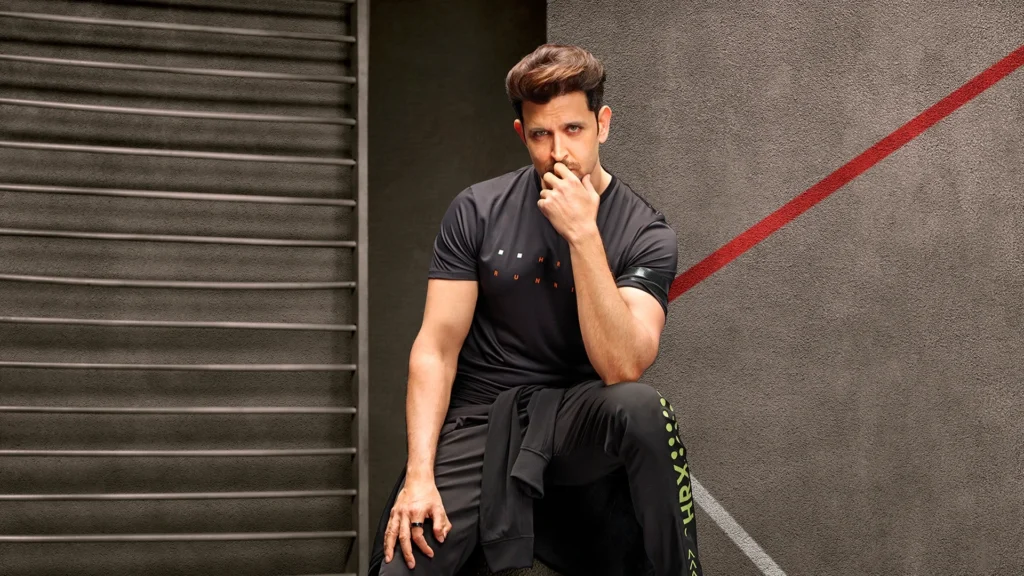
When Hrithik Roshan launched HRX (an abbreviation of his own name) in 2013, India’s fitness apparel market was dominated by international giants like Nike, Adidas, and Puma. The idea of a Bollywood actor creating a legitimate fitness brand seemed like another celebrity endorsement deal dressed up as entrepreneurship.
Fast forward to 2025, and HRX has become India’s largest homegrown athleisure brand, generating annual revenues exceeding ₹200 crore, selling over 2 million products annually, and achieving what few celebrity brands manage: genuine market credibility and consumer loyalty beyond the star’s fan base.
The HRX Hrithik Roshan Results:
- Annual revenue: ₹200-220 crore (2024-2025) with 15-20% CAGR since launch
- Products sold: 2+ million annually across apparel, footwear, accessories
- Brand valuation: ₹600-800 crore (3-4x revenue multiple)
- Hrithik’s stake value: ₹180-320 crore (estimated 30-40% ownership)
- Annual earnings: ₹10-15 crore from profit share and royalties
- Market position: India’s largest homegrown athleisure brand
HRX isn’t just Hrithik Roshan’s name on t-shirts but a case study in how celebrity equity, when combined with product quality, strategic distribution partnerships, and authentic brand positioning, can create sustainable businesses in India’s rapidly growing ₹54,000 crore sportswear market.
The Genesis: Why Hrithik Created HRX
The Personal Fitness Journey
Hrithik Roshan’s physical transformation has been legendary in Bollywood since his debut in Kaho Naa… Pyaar Hai in 2000. But what many don’t know is that his fitness obsession stems from overcoming childhood stammering and physical challenges, not vanity.
Born with an extra thumb and struggling with a speech impediment, young Hrithik turned to physical fitness as a way to build confidence. By his teenage years, fitness became his identity. When he entered Bollywood, his Greek God physique became his signature, setting new standards for male actors.
Authentic Fitness Foundation:
- Film showcase: Krrish (2006), Dhoom 2 (2006), Bang Bang (2014) showcased unprecedented physicality
- Training commitment: Performing own stunts, training 6 days weekly, maintaining single-digit body fat year-round
- Domain expertise: Authentic fitness journey gave Hrithik genuine credibility most celebrity entrepreneurs lack
- Signature identity: Physical transformation became his brand differentiator in industry
The Market Opportunity
By 2012-2013, India’s fitness consciousness was exploding. Gym memberships were growing 15-20% annually, yoga was being rediscovered, and urban Indians were increasingly adopting active lifestyles. Yet affordable, quality fitness apparel remained scarce.
International brands were expensive at ₹2,000-4,000 for basic t-shirts and catered primarily to serious athletes. Local brands existed but lacked quality and design sensibility. The mass market relied on generic sportswear without technical features or aspirational branding.
The Gap HRX Filled:
- Positioning: Create premium-quality fitness apparel at accessible price points (₹500-2,000)
- Target: Not professional athletes but everyday fitness enthusiasts wanting to look good while working out
- Strategic partnership: Exclusive partnership with Myntra, then India’s leading online fashion retailer
- Zero inventory risk: Myntra handled manufacturing, warehousing, logistics
Rather than launching independently, Hrithik made a strategic decision that would define HRX Hrithik Roshan’s trajectory: partnering with Myntra (later acquired by Flipkart in 2014) gave the brand built-in distribution to millions of users, professional execution in design and merchandising, financial backing for scaling production, while Hrithik retained creative control and brand ownership.
The Business Model: How HRX Makes Money
Product Range and Pricing
HRX operates across multiple categories. Apparel representing 70% of revenue includes men’s t-shirts at ₹499-999, shorts at ₹699-1,299, trackpants at ₹899-1,799, jackets at ₹1,499-2,999, plus women’s sports bras at ₹599-1,199, tights at ₹799-1,499, tops at ₹499-899, and kids’ t-shirts and shorts at ₹399-799.
Footwear representing 20% of revenue includes training shoes at ₹1,499-2,999, running shoes at ₹1,999-3,999, and casual sneakers at ₹1,299-2,499. Accessories at 10% of revenue include gym bags at ₹999-2,499, water bottles at ₹299-699, resistance bands and yoga mats at ₹299-1,299, plus smart fitness watches at ₹4,999-12,999.
Revenue Streams:
- Primary: Myntra sales (80-85% of revenue): HRX remains primarily sold through Myntra’s site and app, exclusive partnership ensures focused brand presentation
- Secondary: Cult.fit integration (10-12% of revenue): Partnership with India’s leading fitness platform, estimated ₹20-25 crore annually
- Tertiary: Offline retail (5-8% of revenue): Shop-in-shops at Shoppers Stop, standalone stores, Cult.fit retail, estimated ₹10-15 crore annually
The Economics: Margins and Profitability
HRX operates on a partnership model with Myntra affecting its economics. Manufacturing cost runs ₹200-800 per product depending on category, Myntra commission takes 20-30% of selling price, marketing and overheads consume 10-15% of revenue, and Hrithik’s royalty or profit share is estimated at 5-10% of revenue.
Industry experts estimate HRX’s net margins at 8-12%, which translates to approximately ₹16-26 crore annual profit split between Hrithik Roshan’s entity and Myntra/Flipkart. While margins are lower than independent brands at 15-20%, the partnership model provides zero working capital requirement, no inventory risk, Myntra’s scale economies, and reduced marketing costs through platform integration.
Hrithik’s Personal Returns:
- Annual earnings: Estimated ₹10-15 crore through profit share and royalties
- Indirect benefits: Sustained brand visibility, alignment with fitness image
- Total contribution: ₹80-120 crore to overall net worth of ₹2,000+ crore over 12 years
The Strategy: What Makes HRX Different
Authentic Founder Credibility
Unlike many celebrity brands where the founder’s involvement is superficial, Hrithik actively uses HRX Hrithik Roshan products. His social media with 50+ million Instagram followers regularly features him training in HRX gear, providing authentic endorsement that money can’t buy.
This authenticity resonates with consumers who view HRX as Hrithik’s personal fitness philosophy manifested in products, not just a licensing deal demonstrating the power of genuine celebrity involvement.
Accessible Premium Positioning:
- Price range: ₹499-2,999 accessible to middle-class Indians
- Quality standards: Justify premium over mass-market alternatives
- Brand messaging: “Be Your Best Self” and “Keep Going” emphasize personal improvement
- Target expansion: Beyond hardcore gym-goers to casual fitness enthusiasts
Design and Technical Features
HRX invests in fabric technology and design features including moisture-wicking fabrics for t-shirts and shorts, four-way stretch materials for flexibility, flatlock seams to prevent chafing, reflective elements for outdoor training, and anti-odor treatments.
While not matching international brands’ advanced technologies, HRX delivers legitimate functional benefits at its price point, differentiating from purely fashion-oriented sportswear.
Integrated Marketing Ecosystem:
- Hrithik’s social media: 50+ million combined followers receive regular HRX content
- Myntra’s platform: Featured placements during sales events reaching 20+ million registered users
- Cult.fit partnership: In-gym branding, co-branded workouts reaching 2+ million active members
- Influencer collaborations: Fitness influencers amplify messaging to niche communities
The Market Context: India’s Fitness Boom
HRX’s success reflects broader market trends transforming India’s fitness and wellness landscape. India’s sportswear market in 2024-2025 reached ₹54,000 crore (approximately $6.5 billion) growing at 12-15% CAGR with athleisure segment at ₹18,000-20,000 crore growing 18-20% annually.
Market Drivers:
- Rising fitness consciousness: Gym memberships grew from 3 million (2015) to 10+ million (2024)
- Athleisure trend: Sportswear no longer limited to gyms, Indians increasingly wear athletic apparel casually
- Affluent middle class: 350+ million people with increasing disposable income for lifestyle products
- Post-pandemic health awareness: COVID-19 dramatically accelerated fitness awareness, home workouts became mainstream
- Government initiatives: Fit India Movement launched 2019 promoted fitness awareness
Competitive Landscape
HRX competes in a crowded market. International giants include Nike at ₹2,000+ crore India revenue, Adidas at ₹1,800+ crore, Puma at ₹1,400+ crore, plus Reebok, Under Armour, and Asics.
Indian brands include Kalenji (Decathlon’s private label, market leader in affordable sports gear), Nivia and Cosco as traditional Indian sports brands, Alcis Sports as premium Indian activewear, and Boldfit as online-first fitness accessories. Celebrity brands include Virat Kohli’s Wrogn (lifestyle, not pure activewear) and MS Dhoni’s Seven (lifestyle apparel).
HRX’s Competitive Advantage:
- Authentic fitness positioning: Unlike lifestyle-focused celebrity brands
- Accessible pricing: Unlike international giants
- Quality delivery: Unlike mass-market alternatives
- Unique market position: Occupying sweet spot others miss
The Cult.fit Partnership: Strategic Masterstroke
What Cult.fit Brought to HRX
The 2019 partnership between HRX Hrithik Roshan and Cult.fit represented strategic evolution beyond pure retail. Experiential connection through Cult.fit’s 100+ fitness centers across 8+ Indian cities provided physical touchpoints where customers could experience the brand while working out.
Credibility from association with India’s leading fitness platform reinforced HRX’s positioning as genuine fitness brand versus fashion label. Offline distribution through Cult.fit stores became HRX retail outlets, providing offline presence without massive capital expenditure.
Partnership Benefits:
- Co-branded content: HRX workouts on Cult.fit app gave brand presence in users’ actual fitness routines
- Data and insights: Access to Cult.fit user data informed product development
- Business impact: Contributed estimated ₹20-25 crore to annual revenue
- Brand perception: Positioned HRX as fitness ecosystem partner rather than just apparel brand
The Cult.fit partnership positioned HRX beyond pure apparel into fitness lifestyle, opening possibilities for future expansion into supplements, equipment, and digital fitness content demonstrating strategic thinking beyond traditional retail.
Challenges and Criticisms
Dependence on Myntra
Despite success, HRX faces ongoing challenges. Approximately 80-85% revenue concentration in a single channel creates risk. If Myntra relationship sours or Flipkart decides to prioritize other brands, HRX could face distribution challenges though gradual offline expansion and Cult.fit partnership provide alternative channels.
Celebrity brands often struggle when the founder’s star power wanes. Hrithik remains one of Bollywood’s biggest stars, but what happens if his career trajectory changes? However, HRX has built standalone brand equity beyond Hrithik’s stardom with many customers buying for product quality and design, not just celebrity association.
Additional Challenges:
- Limited innovation: Doesn’t match Nike’s Dri-FIT or Adidas’ Climacool, but targets casual enthusiasts not professional athletes
- Online-heavy distribution: Many Indians prefer trying apparel before purchasing, limiting market penetration
- Competitive pressure: International brands aggressively expanding while new D2C fitness brands emerge monthly
The Bottom Line
Hrithik Roshan’s HRX represents one of India’s most successful celebrity brand ventures, generating ₹200+ crore annual revenue, selling 2+ million products yearly, and establishing genuine market credibility in India’s competitive ₹54,000 crore sportswear market projected to reach ₹95,000-1,00,000 crore by 2030.
Why HRX Hrithik Roshan Succeeded:
- Authentic expertise matters: Hrithik’s genuine fitness credibility gave HRX legitimacy that manufactured celebrity brands lack
- Strategic partnerships over solo ventures: Myntra partnership provided manufacturing, distribution, operational expertise Hrithik couldn’t build independently
- Price positioning is everything: Accessible premium positioning at ₹500-3,000 captured India’s aspirational middle class
- Evolve beyond the founder: While Hrithik remains central, brand has built standalone equity through product quality, design, partnerships
- Ride market tailwinds: Launched as India’s fitness consciousness was accelerating, timing aligned with macro trends
- Integrated marketing ecosystems: Leveraged Hrithik’s social media, Myntra’s platform, Cult.fit’s network for cost-effective marketing
What separates HRX from typical celebrity licensing deals is authentic founder expertise, strategic partnership execution, accessible premium positioning, and alignment with India’s fitness boom. Hrithik didn’t just lend his name to someone else’s product but built a legitimate brand reflecting his personal fitness philosophy and targeting a clear market opportunity.
Key Success Factors:
- Myntra partnership: While creating channel dependence, provided operational excellence and scale economies enabling rapid growth without massive capital investment
- Cult.fit integration: Added experiential dimension, positioning HRX beyond pure apparel into fitness lifestyle
- Personal returns: Contributed ₹180-320 crore to Hrithik’s net worth while reinforcing fitness brand positioning supporting ₹400+ crore annual endorsement portfolio
- Future potential: Well-positioned to capture growing share, potentially reaching ₹400-500 crore annual revenue within 3-5 years
The Myntra partnership, while creating channel dependence, provided operational excellence and scale economies that enabled rapid growth without massive capital investment totaling 15-20% CAGR since launch. The Cult.fit integration added experiential dimension, positioning HRX beyond pure apparel into fitness lifestyle ecosystem.
For Hrithik personally, HRX has contributed ₹180-320 crore to his net worth while reinforcing his fitness brand positioning that supports his ₹400+ crore annual endorsement portfolio. The actor-entrepreneur model provides multiple revenue streams and long-term wealth creation beyond film earnings demonstrating the value of authentic celebrity entrepreneurship.
As India’s sportswear market is projected to reach ₹95,000-1,00,000 crore by 2030, HRX is well-positioned to capture growing share through omnichannel expansion including standalone stores, premium retail partnerships, and airport outlets reducing Myntra dependence, category diversification into supplements, fitness equipment, wellness products, technology integration with smart wearables and fitness tracking apps, sustainability focus on recycled materials and eco-friendly manufacturing, and international expansion targeting 30+ million Indian diaspora.
The journey from 2013 launch to ₹200+ crore fitness empire demonstrates that celebrity entrepreneurship, when executed with strategic discipline, authentic expertise, and operational partnerships, can create sustainable businesses that transcend the founder’s fame. HRX isn’t just Hrithik Roshan’s side project but a legitimate fitness brand that’s earned its place in India’s competitive activewear market proving that when celebrities leverage genuine domain expertise and partner strategically, extraordinary business value is possible.