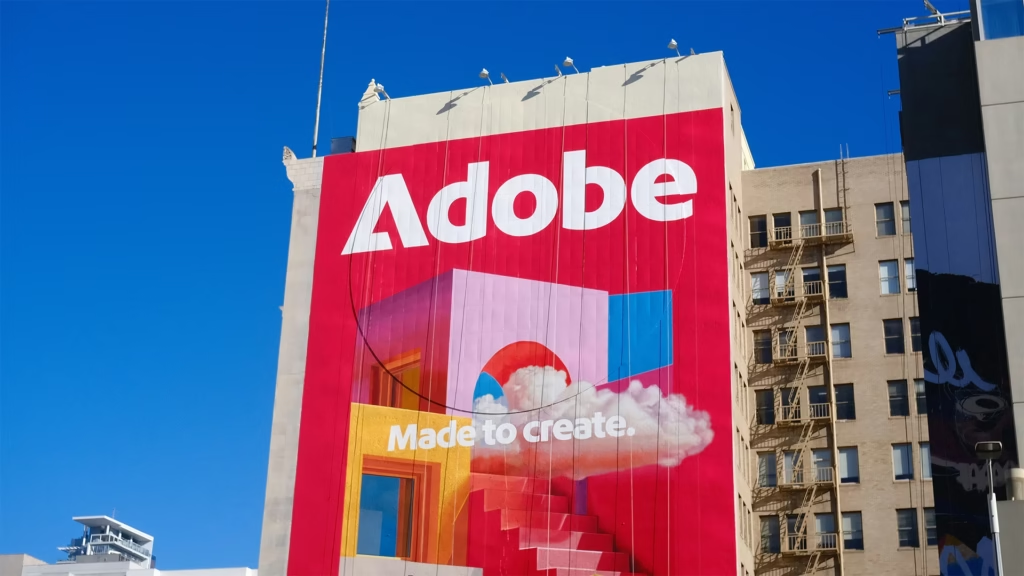
In May 2013, Adobe announced that it would stop selling Creative Suite perpetual licenses and transition entirely to Creative Cloud subscriptions. Customers who wanted Photoshop, Illustrator, or InDesign would no longer buy software for $1,200+ upfront ownership but instead pay monthly fees for access. The reaction was explosive. Petitions demanding Adobe reverse course gathered over 50,000 signatures. Social media erupted with accusations of greed and betrayal. Adobe’s stock dropped 12% as investors worried about revenue collapse during transition. Industry analysts questioned whether forcing subscriptions on professionals who preferred ownership would trigger mass defection to competitors.
Yet by 2024, Adobe generated $21.5 billion in annual revenue, nearly triple the $4.2 billion earned in 2011 when the company first introduced subscription options. Creative Cloud reached 37 million paid subscribers adding nearly 1 million new customers quarterly. Subscription revenue comprises 94% of total sales, providing predictable recurring income that Wall Street values at premium multiples. The company’s operating margins expanded from mid-20% range to 46%, generating record profits despite cutting prices dramatically through subscription accessibility.
The Business Model Adobe Abandoned
Understanding Adobe’s transformation requires examining what the company gave up. Before 2011, Adobe operated classic perpetual software licensing where customers paid substantial upfront costs for permanent ownership of specific versions. Creative Suite 6 Master Collection cost $2,599, while individual apps like Photoshop ran $699. Customers owned these versions indefinitely but received no updates beyond bug fixes. Major feature improvements required purchasing new versions at full price or upgrade pricing around $375-$550.
This model created predictable problems. Revenue fluctuated dramatically based on version release cycles, spiking when new Creative Suite launched then declining until the next release 18-24 months later. Customers delayed upgrades when current versions met needs, stretching upgrade cycles to three or four years. This created cash flow unpredictability and made financial forecasting challenging. Wall Street penalized this lumpiness with lower valuation multiples compared to recurring revenue businesses.
The perpetual licensing problems:
- Creative Suite 6 Master Collection: $2,599 upfront
- Individual apps like Photoshop: $699
- Upgrade pricing: $375-$550 for new versions
- Revenue fluctuated with 18-24 month release cycles
- Customers delayed upgrades stretching cycles to 3-4 years
- Cash flow unpredictability making forecasting challenging
- Piracy rates exceeding 40% in some markets
- Nearly half of Photoshop users never paid
- Activation codes and copy protection couldn’t prevent piracy
- Cloud competitors: Canva, Pixlr, Sketch offering cheaper alternatives
Competitive Threats and Market Shifts
By 2010, cloud-based competitors threatened Adobe’s market position. Startups offered specialized tools at lower prices or even free browser-based alternatives to Photoshop and Illustrator. These competitors targeted prosumer markets where Adobe’s high prices created opportunities for “good enough” solutions. Canva emerged for graphic design, Pixlr for photo editing, Sketch for interface design. While none matched Adobe’s professional capabilities initially, they captured growing segments of casual creators who couldn’t justify $1,200 investments.
The Phased Transition Strategy
Adobe didn’t flip switches overnight despite dramatic 2013 announcement. The company implemented carefully staged transition starting in 2011 with Creative Cloud introduction alongside traditional perpetual licenses. This dual-offering period let customers choose between ownership and subscription while Adobe refined cloud infrastructure, tested pricing, and educated markets about subscription benefits. Only after validating that subscriptions worked did Adobe commit to subscription-only strategy.
The staged transition approach:
- 2011: Creative Cloud introduced alongside perpetual licenses
- Dual-offering period for testing and refinement
- Validated subscriptions worked before full commitment
- May 2013: Announced end of perpetual licenses
- Customer reaction: 50,000+ petition signatures, stock dropped 12%
- Discovered retention rates exceeded initial models
- Optimal pricing tiers identified
- Individual creator plans: $55 monthly
- Photography bundles: $10
- Student discounts: $20
- Enterprise team plans: volume pricing
The phased approach provided critical learning opportunities. Adobe discovered that subscription customers had significantly lower churn than expected, with retention rates exceeding initial models. The company learned optimal pricing tiers: individual creator plans at $55 monthly, photography bundles at $10, student discounts at $20, and enterprise team plans with volume pricing.
Managing the Revenue Valley
Adobe predicted and accepted $200 million revenue gap in 2013 as subscription model ramped while perpetual license sales declined. This “valley of death” was necessary: customers paying $1,200 upfront generated immediate revenue, while $55 monthly subscribers took nearly two years of payments to match that amount. During transition, Adobe collected less cash despite growing customer counts. Only patient capital and stakeholder communication prevented panic during this difficult period.
CFO Mark Garrett’s communication strategy:
- 2011: Stood before investor conferences with radical message
- “Ignore traditional metrics, revenue and profits will drop temporarily”
- “Watch subscriber counts and annualized recurring revenue instead”
- Transparency about “swallowing the fish” where costs rise as revenue falls
- Created realistic expectations about three-year transition
- Predicted $200 million revenue gap in 2013
- $1,200 upfront vs. $55 monthly taking two years to match
Why Subscriptions Won Over Skeptics
Despite fierce initial resistance, subscriptions eventually convinced most customers through genuine value delivery exceeding perpetual license benefits. The accessibility advantage proved most powerful: $55 monthly removed $1,200 barrier preventing access for freelancers, students, and hobbyists. Subscription pricing let aspiring creatives afford professional tools earlier in careers when cash-strapped, building Adobe loyalty that lasted as incomes grew. This market expansion generated subscriber numbers impossible under perpetual licensing.
The subscription value proposition:
- Accessibility: $55 monthly vs. $1,200 upfront barrier
- Continuous updates replacing 18-month version-release waits
- No upgrade fees for features Adobe completed months earlier
- Always current with latest capabilities
- Cloud collaboration impossible with desktop-only software
- Asset sharing, version control, collaborative editing
- Syncing across devices
- Essential during COVID-19 remote work transitions
- Piracy solution through cloud-connected authentication
- Student conversions: $20 monthly vs. pirated versions
Continuous updates replaced frustrating version-release waits. Perpetual license customers waited 18 months for significant improvements, then paid upgrade fees for features Adobe had completed months earlier. Subscriptions delivered improvements immediately upon release, keeping customers always current with latest capabilities. This eliminated the calculation of whether new versions justified upgrade costs, since subscribers received everything automatically.
The Piracy Solution
Subscriptions solved piracy more effectively than any copy protection scheme. Cloud-connected authentication meant Adobe could verify legitimate usage continually rather than relying on activation codes shared or cracked. Users attempting to pirate subscriptions found the experience sufficiently broken that paying $55 monthly became easier than maintaining pirated versions missing cloud features. This converted significant piracy populations into paying customers, recovering revenue perpetual licensing never captured.
The Financial Transformation Results
Adobe’s financial results validated the subscription model spectacularly. Revenue grew from $4.2 billion in 2011 to $21.5 billion in 2024, compound annual growth of approximately 13%. More importantly, revenue predictability transformed. Instead of lumpy quarterly results swinging based on product launches, subscription model generated steady recurring income growing reliably quarter over quarter. This predictability earned premium Wall Street valuations, with Adobe’s stock multiplying over 10x from 2013 announcement to 2024.
The transformation metrics:
- 2011 revenue: $4.2 billion
- 2024 revenue: $21.5 billion (nearly triple, 13% CAGR)
- Creative Cloud subscribers: 37 million (adding 1M quarterly)
- Subscription revenue: 94% of total sales
- Operating margins: mid-20% range to 46%
- Stock multiplied 10x+ from 2013 to 2024
- Digital Media ARR: $17.33 billion (end of 2024)
- Operating cash flows: $8.06 billion in 2024
- Revenue predictability with steady quarterly growth
- Premium Wall Street valuations vs. transaction-based competitors
Operating margins expanded from mid-20% range before transition to 46% in 2024. Subscription businesses demonstrate superior unit economics at scale: initial customer acquisition costs get amortized over years of recurring payments, while marginal costs of serving additional subscribers approaches zero for cloud software. Adobe’s high retention rates meant most subscription revenue became highly profitable after first year’s acquisition costs were recovered.
Cash Flow and Capital Efficiency
The subscription model improved cash collection timing unexpectedly. While monthly payments took longer to equal upfront perpetual license fees, subscription customers paid continuously for years rather than making single purchases. Customer lifetime value averaged far higher under subscriptions than perpetual licensing because relationships lasted indefinitely rather than ending after one-time transactions. This transformed Adobe’s business from transactional to relational, aligning company success with ongoing customer satisfaction.
The Bottom Line
Adobe’s transformation from perpetual licenses to subscriptions represents one of software history’s most successful business model innovations. By accepting temporary pain during transition, the company tripled revenue to $21.5 billion, expanded to 37 million subscribers, and achieved 94% recurring revenue with industry-leading 46% operating margins. The subscription model democratized access to professional creative tools, bringing Adobe to millions previously excluded by upfront costs while generating superior financial results for the company.
The transformation achievement:
- Revenue tripled: $4.2B (2011) to $21.5B (2024)
- Subscribers: 37 million adding 1M quarterly
- Subscription revenue: 94% of total sales
- Operating margins: 46% (from mid-20% range)
- Stock multiplied 10x+ from 2013 to 2024
- Digital Media ARR: $17.33 billion
- Operating cash flows: $8.06 billion in 2024
- May 2013: Ended perpetual licenses (50K+ petition signatures, 12% stock drop)
The strategic pillars:
- Phased transition starting 2011 with dual-offering period
- Accessibility: $55 monthly vs. $1,200 upfront barrier
- Continuous updates replacing 18-month version cycles
- Cloud collaboration: asset sharing, version control, cross-device syncing
- Piracy solution through cloud-connected authentication
- Student pipeline: $20 monthly building lifelong loyalty
- CFO Mark Garrett’s transparent investor communication
- Accepted $200M revenue gap during 2013 transition valley
- Organizational alignment: sales comp, product development, finance forecasting
Key lessons for subscription transitions:
- Genuine customer value is non-negotiable (accessibility, updates, collaboration)
- Patient capital and stakeholder management determine survival through valleys
- Phased transitions reduce risk while enabling learning
- Organizational alignment across all functions essential (sales, product, finance, ops)
- Subscription customers require relational vs. transactional approach
- Customer lifetime value far exceeds one-time purchases
- Revenue predictability earns premium Wall Street valuations
- Unit economics improve at scale (CAC amortized over years)
What made Adobe’s transformation work:
- Started with dual-offering in 2011 vs. abrupt 2013 switch
- Validated retention rates and pricing before full commitment
- Removed $1,200 barrier enabling freelancers, students, hobbyists
- Continuous feature delivery eliminating upgrade fee calculations
- Psychological benefit of always having newest features
- Cloud collaboration became essential during COVID-19 remote work
- Converted piracy populations into paying customers
- Student discounts building next-generation loyalty
- Transparent communication about temporary revenue declines
- Reorganized sales compensation valuing lifetime value and retention
- Shifted product development to continuous delivery vs. discrete versions
Adobe’s transformation reveals how companies can successfully shift business models when the new approach delivers genuine customer value despite initial resistance. The subscription model lowered barriers to entry from $1,200 to $55 monthly, bringing Adobe tools to freelancers, students, and small businesses previously excluded by high upfront costs. Continuous updates replaced 18-month version cycles, keeping software current without upgrade fees. Cloud integration enabled collaboration features impossible with desktop-only perpetual licenses.
The success came from recognizing that customer resistance to subscriptions reflected fear of change rather than fundamental opposition to models delivering genuine value. By proving that $55 monthly access with continuous updates, cloud collaboration, and always-current software served customer interests better than $1,200 perpetual licenses with infrequent upgrades, Adobe converted skeptics into advocates. The transformation required patience through difficult transition years and courage to disrupt a profitable business model proactively rather than waiting for competitors to force change.
For companies considering subscription transitions, Adobe demonstrates that established businesses can successfully shift models when executing with customer focus, stakeholder communication, and organizational alignment. The subscription model isn’t appropriate for every business, but where it delivers superior customer value through accessibility, continuous improvement, and enhanced features, customers will embrace it despite initial resistance. Adobe proved that sometimes the boldest strategic moves, the ones triggering customer petitions and stock drops when announced, create the most value when executed with conviction and patience to see transformations through their difficult early stages to successful long-term outcomes.