In 1993, one of Italy’s most famous luxury brands was effectively broke.
Gucci, founded in Florence in 1921 by Guccio Gucci as a small leather goods and luggage shop, had spent the 1980s destroying itself from the inside. Family feuds had paralysed decision-making for years. The founding family had licensed the brand onto anything and everything: ashtrays, coffee mugs, plastic handbags, canvas goods that cost pennies to make. The double-G logo, once synonymous with Italian craftsmanship, had become a symbol of cheap mass production.
By 1993, Gucci had lost $22 million on $230 million in sales. Creditors were chasing the company for payments. A Bahrain-based investment group named Investcorp had taken over full ownership after the family lost control, and they had inherited a company one bad quarter away from insolvency.
What happened over the next three decades is unlike anything else in the history of luxury fashion. Gucci did not just recover. It rebuilt completely, twice. It turned $230 million in near-bankrupt revenue into $10.9 billion at its peak. And then, just as it looked invincible, it fell again.
This is the story of how Gucci died twice and came back richer each time.
The First Death: How a Family Destroyed a Fashion House
Guccio Gucci opened his first leather goods shop in Florence in 1921. He had spent years working as a lift operator at the Savoy Hotel in London, observing how wealthy guests traveled and what quality luggage they carried. When he returned to Italy, he built what he had seen: handcrafted leather bags, shoes, and luggage for a clientele that expected excellence.
The brand grew steadily. By the 1950s and 1960s, Gucci was the choice of European royalty, Hollywood stars, and the international jet set. Grace Kelly, Audrey Hepburn, and Jackie Kennedy were photographed with Gucci pieces. The bamboo-handled bag, the horsebit loafer, the silk scarf with the iconic repeating GG pattern: these became permanent fixtures of aspirational luxury.
The problems began when the second generation took over.
How the Gucci family dismantled what Guccio built:
- Over-licensing: The family sold the right to put the GG logo on over 22,000 products including plastic bags, ashtrays, and cigarette lighters, flooding the market with cheap products bearing the brand’s name
- Family warfare: Aldo Gucci, who built the American expansion in the 1950s, was convicted of tax evasion in 1986 and sentenced to prison, leaving the brand rudderless
- Maurizio’s mismanagement: Guccio’s grandson Maurizio inherited control in 1983, fired experienced staff, moved headquarters to Milan in an expensive vanity move, and ran up debts trying to reposition the brand upmarket without the business discipline to execute
- Financial collapse: By 1992, Gucci America had lost over $30 million, not counting past debts exceeding $100 million
- Brand equity destruction: By the early 1990s, Gucci was associated with fake goods, discount outlets, and duty-free shops rather than luxury craftsmanship
Investcorp took full control in 1993 and immediately began the painful work of pulling the brand out of near-bankruptcy. They cut distribution, closed franchise outlets, slashed the licensed product portfolio, and began an urgent search for leadership that could rebuild what the family had spent a decade tearing apart.
The Murder That Closed a Chapter
On the morning of March 27, 1995, Maurizio Gucci was shot dead on the steps of his Milan office building. His ex-wife Patrizia Reggiani had hired a hitman. She was convicted in 1998 and sentenced to 29 years in prison.
The murder closed the Gucci family chapter permanently. Maurizio had already been ousted from the business and the family had already lost control. But his killing removed any ambiguity about whether the founding family might ever return. The story of Gucci from 1995 onward would be written entirely by outsiders.
The first outsider to write it was an American designer from Texas.
Tom Ford and the First Resurrection
Tom Ford arrived at Gucci in 1990 as a women’s ready-to-wear designer. He was young, ambitious, and working at a company too distracted by its family implosion to notice what it had.
When Investcorp promoted Ford to creative director in 1994 and Domenico De Sole to CEO in 1995, they made the two most consequential appointments in Gucci brand strategy history. The pair had complete creative and commercial freedom, a clean slate, and a mandate to rebuild from the ground up.
Ford’s response was total reinvention. He erased the cluttered, logo-heavy aesthetic that had cheapened the brand and replaced it with something no luxury house was doing in 1994: deliberate, unapologetic, high-impact sexuality. Velvet suits in deep jewel tones, satin shirts, Tom Ford invented an entirely new visual identity for the brand. The Autumn/Winter 1995 collection stunned the fashion industry.
It also saved the company.
What the Tom Ford era delivered in numbers:
- 1993 revenue: $230 million, loss of $22 million
- 1995: First profitable year under Ford; brand momentum building
- 1999: PPR (now Kering) acquired a controlling stake for $2.9 billion
- 2000: Revenue crossed $2 billion, a near 10x increase in seven years
- 2004: Ford and De Sole depart after a dispute with Kering over creative control
The turnaround remains the most cited case study in luxury brand management. Ford did not simply improve Gucci. He redefined what Gucci was, replacing a damaged legacy identity with a new one built entirely on his own creative authority.
De Sole’s Commercial Architecture
Tom Ford provided the creative firepower. Domenico De Sole provided the business structure without which the creative work could not have been monetised.
De Sole’s first move was to cut Gucci’s distribution aggressively. He closed franchise outlets, exited duty-free shops, and reduced the number of wholesale accounts to concentrate sales in directly operated stores where Gucci controlled the environment, the pricing, and the customer experience. This move, uncomfortable and costly in the short term, was what luxury brands spend years trying to achieve.
De Sole also oversaw the LVMH battle of 1999, one of the most dramatic corporate confrontations in luxury history. When Bernard Arnault’s LVMH began quietly accumulating Gucci shares in early 1999, reaching 34% without making a formal bid, De Sole and Ford moved to block a hostile takeover by bringing in PPR (now Kering) as a white knight. François Pinault’s group paid $2.9 billion for a controlling stake, and the LVMH assault was defeated.
Why Ford and De Sole Left and What It Meant
In April 2004, both Ford and De Sole resigned from Gucci after a dispute with Kering’s new leadership over creative control and the strategic direction of the group’s expanding portfolio. The departure was acrimonious and public.
Their exit created a question that would define Gucci brand strategy for the next decade: could the brand sustain its identity without the people who had invented it?
The answer, under Frida Giannini from 2006 to 2014, was a qualified no. Giannini produced commercially solid but creatively unfocused collections. Revenue grew steadily, reaching €3.9 billion by 2014. But the brand was coasting on the equity Ford had built rather than building new equity. By 2015, Gucci was slowing, losing cultural relevance, and searching for its next reason to exist.
The second death was quieter than the first. But it was real.
Alessandro Michele and the Second Resurrection
In January 2015, Gucci made one of the strangest creative director appointments in luxury history.
Alessandro Michele was not a famous name. He had joined Gucci as an accessories designer in 2002 and had spent thirteen years working quietly in the background. He had never led a design team, never shown a collection, and had not been on any shortlist of expected creative director candidates. When Frida Giannini departed in early 2015 with a collection already scheduled to show in five days, Michele assembled something in that window that changed the brand permanently.
His debut menswear collection for Autumn/Winter 2015 featured men in pussy-bow blouses, oversized fur coats, round glasses, and embroidered florals. It was maximalism, nostalgia, and gender fluidity combined into a visual vocabulary that nobody in luxury fashion had claimed. The fashion press stopped.
Within one year, Gucci was the most talked-about brand in the world.
Michele’s Gucci in numbers:
- 2015 revenue: €3.9 billion (stagnant, brand struggling)
- 2016: Revenue begins accelerating as Michele’s collections hit retail
- 2019: Revenue reaches €9.6 billion, profits of €3.9 billion; a complete transformation in four years
- 2021: Revenue at €9.7 billion despite pandemic disruption
- 2022: Revenue peaks at €10.49 billion, the highest in Gucci’s history
- 2015 to 2022: Revenue grew from €3.9 billion to over €10 billion, more than doubling in seven years
The growth numbers are extraordinary. But the cultural impact was equally significant. Michele turned Gucci into a brand that musicians, artists, and a new generation of luxury consumers wanted to associate with publicly. Harry Styles wore head-to-toe Gucci on tour. Lana Del Rey, Dakota Johnson, and Jared Leto became the faces of the brand. The Gucci Garden concept store in Florence became a pilgrimage site.
The Maximalism Thesis That Won a Generation
Michele’s creative thesis was deliberate and coherent: in a luxury market moving toward quiet minimalism under brands like Celine, The Row, and early-era Bottega Veneta, Gucci would go the other direction completely.
Where competitors whispered, Michele shouted. Where others stripped back, he layered on. The double-G logo was not hidden. It was celebrated, stacked, printed, embroidered. Gucci’s brand strategy under Michele was built on visibility as a feature rather than a compromise.
This worked for one specific reason: it attracted a younger, more diverse, more digitally engaged customer who had never bought luxury before. First-generation luxury buyers in China, Southeast Asia, and among younger Western consumers did not want the quiet brand codes that old money recognised. They wanted to be seen. Michele’s Gucci let them be seen.
What made the Michele era commercially explosive:
- Celebrity organic adoption: Harry Styles, Billie Eilish, and Lana Del Rey wore Michele’s Gucci without being paid; the cultural credibility was genuine
- Collaboration strategy: The Gucci x Adidas collection unveiled in 2021 earned Gucci the title of hottest brand in Lyst Index’s quarterly report, reaching audiences beyond traditional luxury
- Digital mastery: Gucci’s Instagram presence under Michele was among the most followed in luxury, driving media impact value that competitors spent years trying to match
- Gender fluidity positioning: By designing for all genders simultaneously, Michele expanded the addressable market for a single collection
- Entry-level product growth: Accessories and entry-level leather goods grew substantially, bringing younger buyers into the brand at lower price points and creating a pipeline for future high-value purchases
The Seeds of the Next Crisis
The success contained its own problem, and it was structural.
As Michele’s maximalism attracted increasingly aspirational buyers at lower price points, the brand’s visibility among middle-market consumers began to undermine its desirability among the high-net-worth buyers at the top of the luxury pyramid. The discerning customers who sustain luxury pricing power were noticing that Gucci was everywhere.
Analysts began describing a “desirability gap”: a growing perception among wealthy consumers that the brand had become too accessible, too recognisable among the wrong cohort. The same brand codes that had made Gucci exciting to young buyers were making it feel less exclusive to the buyers who had the highest lifetime value.
In November 2022, Kering announced Michele’s departure. The brand that had doubled revenue in seven years now needed to find its third identity.
The Third Creative Crisis: De Sarno, Demna, and a Brand in Transition
Sabato De Sarno was appointed creative director in January 2023 with a brief that seemed logical: pull Gucci back from maximalist overexposure, rebuild desirability at the high end, and find a quieter, more classically Italian identity that would appeal to the mature luxury consumer.
His debut collection in September 2023 was a “palate cleanser,” as one analyst described it. Clean silhouettes, deep red as a signature colour, wearable basics over theatrical statement pieces. The intention was clear. The commercial response was not what Kering had hoped.
Revenue fell 6% in 2023 after reaching a historic high of €10.49 billion in 2022. Then in 2024, the bottom fell out.
Gucci’s financial decline in the De Sarno era:
- 2022: €10.49 billion revenue, historic peak
- 2023: Revenue down 6% as De Sarno’s quieter aesthetic failed to generate purchase urgency
- 2024 full year: Revenue down 23% to €7.65 billion, returning to 2020 pandemic-era levels
- 2024 Q4: Revenue down 24% on a comparable basis; wholesale revenue down 53%
- 2024 recurring operating income: Down 51% to €1.61 billion
- Kering group operating income: Down 46% in 2024 to €2.6 billion
- Kering shares: Down approximately 60% over five years
On February 6, 2025, Kering announced that De Sarno was leaving the role with immediate effect, just weeks before a scheduled Milan Fashion Week show. The Fall-Winter 2025 collection was presented by the Gucci design office.
What Went Wrong With the De Sarno Reset
The failure was not purely De Sarno’s. The strategic problem was deeper.
Gucci under Michele had been built on aspirational buyer volume. When the brand tried to become quieter and more exclusive, two things happened simultaneously: the aspirational buyers who had driven volume lost interest, and the high-net-worth buyers the brand was trying to win back were not convinced by the transition.
The timing made it worse. The global luxury market slowed sharply in 2024 as post-pandemic spending normalised, Chinese consumer confidence weakened, and the macroeconomic environment tightened. Brands with strong heritage positioning and tight distribution, like Hermes and Chanel, weathered this environment well. Gucci, mid-transition without a clear identity, did not.
Luxury analyst Luca Solca at Bernstein described De Sarno’s designs as not fitting “the exuberant image that consumers have built of Gucci in the past 30 years.” That image, built over three decades of Tom Ford and Alessandro Michele, had become an expectation that a quiet, minimal aesthetic simply could not meet.
Demna: The Third Act Begins
On March 13, 2025, Kering announced that Demna Gvasalia, the Georgian designer who had spent a decade at Balenciaga redefining what a luxury brand could look like in the streetwear era, would become Gucci’s new artistic director. He took up the role in early July 2025.
In early 2026, Demna released his first Gucci campaign, titled “La Famiglia,” which generated significant industry attention and signalled a direction that blended Gucci’s Italian heritage with the cultural provocation that had defined his Balenciaga years.
The appointment was bold. Demna’s Balenciaga had produced the chunky Triple S sneakers, the Ikea-bag-inspired tote, destroyed sneakers selling for hundreds, and the culturally dominant logo-heavy pieces that defined luxury streetwear for a generation. He had proven the ability to make a brand simultaneously controversial, coveted, and commercially powerful.
Kering chairman François-Henri Pinault said it plainly: “His creative power is exactly what Gucci needs.”
Whether Demna’s third reinvention of Gucci brand strategy can match what Tom Ford did in the 1990s and what Michele did from 2015 onward remains the defining question in luxury fashion heading into 2026. The runway results and commercial data will not arrive until late 2026 at the earliest.
The Creative Director Model: Gucci’s Greatest Strength and Biggest Risk
Gucci’s entire brand strategy is built on one unconventional bet: entrust the whole brand identity to a single creative director, give them near-complete authority, and let them rebuild the brand in their own image.
This is not how most luxury brands operate. Chanel, Hermès, and Louis Vuitton maintain brand DNA that is larger than any individual creative. The aesthetic evolves but the core identity persists across designer transitions.
Gucci does the opposite. Each creative era is a near-complete reset. Tom Ford’s Gucci looked almost nothing like pre-Ford Gucci. Michele’s Gucci looked nothing like Ford’s. Demna’s Gucci will look nothing like Michele’s.
The risk and reward of Gucci’s creative director model:
- Upside: Each new creative era generates enormous media attention, cultural conversation, and new customer acquisition; two of the three eras produced explosive commercial growth
- Downside: Transition periods between creative directors are commercially vulnerable; the brand loses its identity anchor, customers become uncertain, and buying pauses
- Dependency risk: A brand whose identity is entirely defined by one person’s vision is exposed every time that person leaves
- Recovery speed: Gucci has shown the ability to recover fully from creative crises, but the timeline is years rather than months
- Kering’s bet: The parent company’s fortunes are tied to Gucci in a way that amplifies both the gains and the losses; Gucci represents roughly 45% of Kering’s revenue
The model has produced extraordinary outcomes when the creative bet was right. Tom Ford grew revenue nearly 10x. Michele doubled it again. No competitor in luxury has achieved equivalent growth through equivalent periods.
But the model also means that Gucci’s brand value is perpetually one wrong appointment away from another crisis. The 2024 revenue collapse to €7.65 billion happened within two years of a creative director change. The previous transition took four years to fully resolve.
The Bottom Line
Gucci is the most dramatic story in luxury fashion because it has refused to stand still long enough to decay quietly.
Other brands protect their identity through stability, consistency, and the gradual accumulation of heritage. Gucci’s brand strategy has always been the opposite: when the current identity stops working, burn it down and build something entirely new on the same foundation of Italian craftsmanship and the double-G logo.
This has worked twice. Tom Ford took Gucci from $22 million in losses to $2 billion in revenue in seven years. Alessandro Michele doubled revenue from €3.9 billion to €10.49 billion in the same timeframe. Both rescues were complete, dramatic, and commercially extraordinary.
The third rescue is now underway.
What Gucci’s brand history actually teaches:
- Creative directors are the product: At Gucci, the designer IS the brand strategy; not the logo, not the heritage, not the price architecture
- Transitions are the vulnerability: Every creative director change has produced a commercial decline before the recovery begins; managing transition speed is Gucci’s biggest operational challenge
- Aspirational volume creates desirability risk: The Michele era’s success with entry-level buyers at scale contributed directly to the desirability gap that triggered his departure
- Distribution discipline matters: De Sole’s reduction of wholesale accounts in the late 1990s was as important as Ford’s design work; brand strategy without distribution strategy is incomplete
- Recovery is always possible: Gucci has proven twice that a brand can recover from near-death; the question for 2026 is whether Demna can make it three times
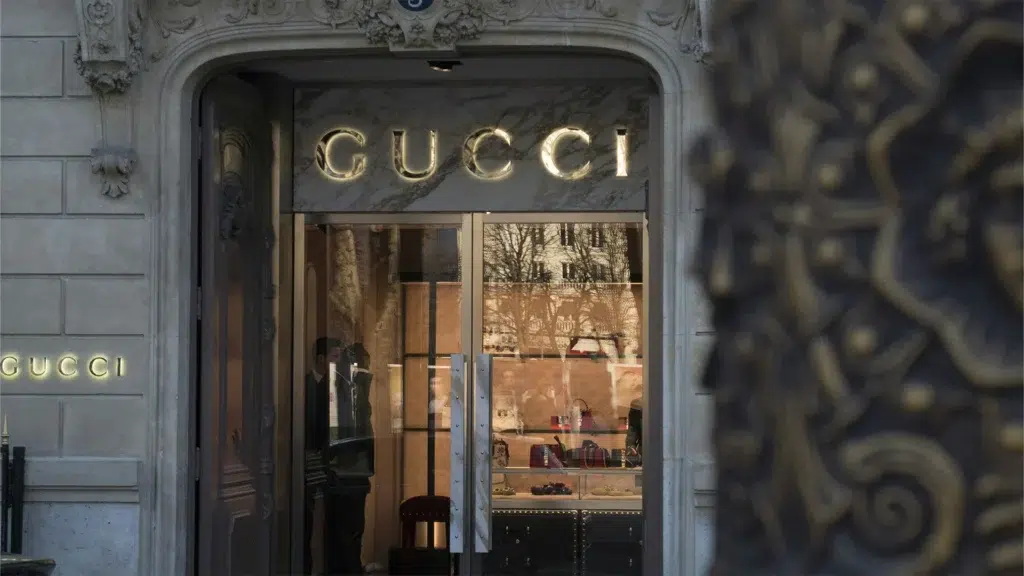
The Gucci store in Florence where Guccio Gucci opened in 1921 still exists. The double-G logo that his family nearly destroyed still commands some of the highest prices in accessible luxury. The brand that lost $22 million in 1993 generated €7.65 billion in revenue in 2024, even in one of its weakest years.
That is what a brand that knows how to come back looks like.