In March 2021, inside Disney headquarters, ESPN executives signed contracts that would define the network’s next decade: $2.7 billion annually for Monday Night Football, $2.6 billion per year for NBA rights, $470 million annually for college football. The total tab exceeded $113 billion in sports broadcasting rights through 2033.
Bob Iger called it “bold but necessary.” Wall Street called it reckless. Three months later, ESPN launched its flagship streaming app in August 2025 at $29.99 monthly, attempting to recoup those massive investments while cable subscribers vanished at a rate of 18,000 per day.
The Numbers Behind ESPN’s Sports Rights Crisis:
- NFL Rights: $2.7 billion annually through 2033 (42% increase from previous deal)
- NBA Rights: $2.6 billion per year starting 2025-26 (86% increase)
- Cable Subscribers Lost: 25 million homes since 2013 (from 99 million to 74 million)
- Daily Subscriber Losses 2025: 18,000 cord-cutters every single day
- Projected 2025 Losses: 7 million cable subscribers by year-end
- Streaming Launch: August 21, 2025 at $29.99/month
Here’s the central question: Did ESPN overpay for sports broadcasting rights, or did it have no choice? And with cord-cutting accelerating, cable subscribers abandoning traditional TV at unprecedented rates, and streaming economics unproven, what happens next to the self-proclaimed “Worldwide Leader in Sports”?
The $2.7 Billion Monday Night Football Deal
ESPN Pays 35% More for 33% Fewer Viewers
When ESPN secured Monday Night Football rights in 2021 for $2.7 billion annually through 2033, it represented a 42% increase over the previous deal’s $1.9 billion per year. The network didn’t just buy football games. It bought survival.
ESPN’s NFL Broadcasting Rights Package:
- Annual Cost: $2.7 billion per year (highest among all NFL broadcast partners)
- Contract Length: 11 years (2023-2033)
- Games Per Season: 23 NFL games (up from 17 in previous deal)
- Super Bowl Rights: ABC broadcasts Super Bowl in 2026, 2030
- Flex Scheduling: Ability to move games to better time slots
- Streaming Rights: All games available on ESPN+ streaming platform
For context, CBS, Fox, and NBC each pay around $2 billion annually for their NFL packages. Yet ESPN pays $700 million more per year despite Monday Night Football consistently drawing lower ratings than Sunday Night Football on NBC or Sunday afternoon games on CBS and Fox.
Monday Night Football Viewership Reality:
- 2024 season average: 13.7 million viewers per game
- NBC Sunday Night Football: 20.8 million viewers average
- CBS Sunday afternoon: 19.6 million viewers average
- Thursday Night Football (Amazon): 11.8 million viewers average
ESPN is paying a 35% premium over other networks for games that draw 33% fewer viewers than Sunday night broadcasts. Why?
Because Losing the NFL Would Be Catastrophic
Monday Night Football isn’t just ESPN’s most-watched programming, it’s the tentpole justifying the network’s $9.50 per subscriber monthly fee charged to cable operators. Without the NFL, ESPN loses leverage in carriage negotiations. Without leverage, cable operators drop the channel or pay less. Without that revenue, ESPN’s entire business model collapses.
The NFL knew this. Commissioner Roger Goodell negotiated accordingly. ESPN had no leverage, so it paid whatever the NFL demanded.
The $76 Billion NBA Deal: Doubling Down While Losing Subscribers
86% Rights Increase as Cord-Cutting Accelerates
In July 2024, the NBA announced an 11-year, $76 billion media rights deal starting with the 2025-26 season. ESPN’s portion is $2.6 billion annually, an 86% increase from the $1.4 billion it currently pays.
ESPN’s NBA Broadcasting Rights Breakdown:
- Annual Cost: $2.6 billion per year (2025-2036)
- Regular Season Games: 80 games per season on ESPN/ABC
- ABC Saturday Primetime: Flagship broadcast slot
- NBA Finals: Exclusive rights through 2036 on ABC
- Conference Finals: One series per year
- Christmas Day Games: All five NBA games exclusively
- NBA Draft: Full broadcast rights
- Increased from previous deal: +$1.2 billion annually
The New NBA Rights Competition:
- NBC: $2.5 billion annually (returning after 23-year absence)
- Amazon Prime Video: $1.8 billion per year for Thursday night games
- TNT Sports: Lost rights after 40 years, couldn’t match Amazon’s offer
ESPN outbid NBC and Amazon to retain NBA Finals rights, but at what cost? The network is now committed to paying $2.6 billion annually for basketball while its subscriber base erodes faster than at any point in company history.
NBA Viewership Doesn’t Justify the Cost
NBA Regular Season Viewership 2024-25:
- ESPN Wednesday night games: 1.63 million average viewers
- TNT Thursday night games: 1.54 million average viewers
- ABC Saturday prime: 3.2 million average viewers
- NBA Finals 2024 (ABC): 11.3 million average per game
Compare ESPN’s $2.6 billion annual NBA payment to its subscriber revenue reality: with 74 million subscribers paying $9.50 monthly, ESPN generates $8.4 billion annually from cable fees. Add in $2.7 billion for NFL rights, $2.6 billion for NBA rights, $470 million for college football, and suddenly ESPN is spending nearly 70% of its subscriber revenue on just three sports properties.
That math doesn’t work when you’re losing 7 million subscribers annually.
The Cord-Cutting Crisis That Changed Everything
25 Million Subscribers Lost Since 2013
ESPN’s sports rights strategy made perfect sense in 2013 when 99 million American homes paid for the network. By 2025, that number crashed to 74 million, and it’s dropping faster every year.
ESPN’s Subscriber Collapse Timeline:
- 2013: 99 million subscribers (peak)
- 2018: 85 million subscribers (14 million lost in 5 years)
- 2021: 76 million subscribers
- 2023: 74 million subscribers (4 million lost in 12 months)
- 2025: 67 million projected by year-end (7 million decline in 2025 alone)
- 2026 Projection: 57.9 million subscribers (Kagan/S&P Global forecast)
The Devastating Math of Cord-Cutting
Every million subscribers ESPN loses costs the network approximately $114 million in annual revenue ($9.50 monthly fee × 12 months × 1 million subscribers). The 7 million subscribers ESPN is projected to lose in 2025 equals $798 million in lost annual revenue.
Meanwhile, ESPN’s sports rights costs aren’t declining. They’re increasing: NFL rights increase from $1.9 billion to $2.7 billion (2023), NBA rights increase from $1.4 billion to $2.6 billion (2025), and College Football Playoff rights cost $470 million annually through 2026.
Why Cord-Cutting Accelerated in 2025:
- Rising Cable Costs: Average cable bill hit $217 monthly (up from $123 in 2015)
- Streaming Alternatives: Netflix, Hulu, Prime Video offer entertainment without sports
- Younger Demographics: 59% of US households have no traditional cable/satellite TV
- Live TV Streaming Losses: Fubo, Hulu + Live TV lost 602,000 subscribers in Q1 2025
- Sports-Only Viewers Leaving: Once NFL season ends, many cancel cable entirely
The most damaging trend is ESPN isn’t just losing casual viewers. It’s losing sports fans who previously justified cable subscriptions solely for live sports. When Amazon offers Thursday Night Football, NBC streams Sunday Night Football on Peacock, and Apple TV+ carries Friday night baseball, ESPN’s monopoly on sports access evaporated.
The August 2025 Streaming Gamble: ESPN’s $30 Bet
Flagship Service Launched at $29.99 Monthly
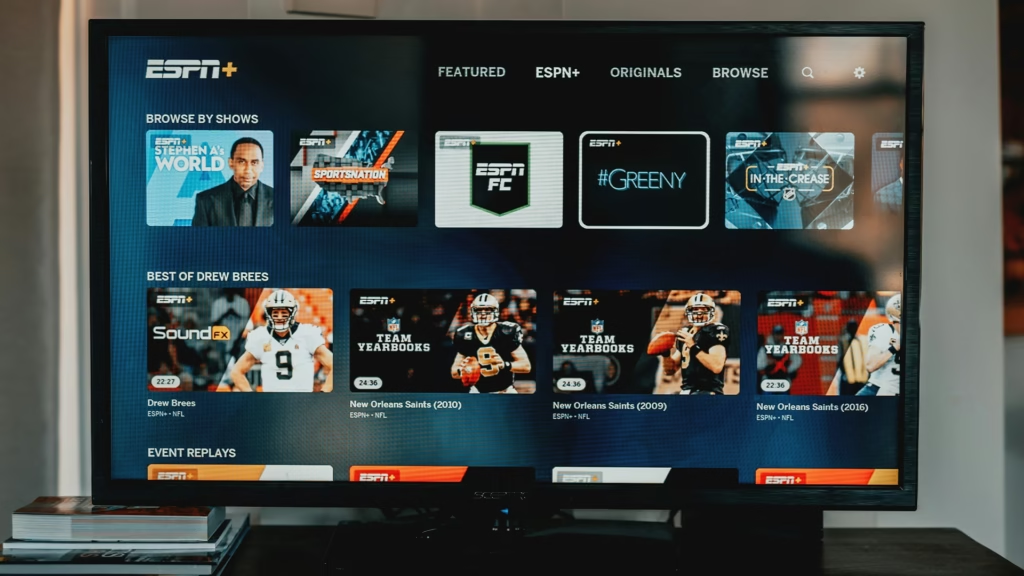
On August 21, 2025, ESPN launched its flagship streaming service, simply called “ESPN,” in a last-ditch effort to recapture subscribers fleeing cable. The $29.99 monthly price tag represented the network’s biggest gamble since acquiring Monday Night Football in 2006.
ESPN Flagship Streaming Service Details:
- Launch Date: August 21, 2025
- Monthly Price: $29.99 (Unlimited plan with all ESPN networks)
- Select Tier: $11.99 monthly (replaces ESPN+, limited content)
- Disney Bundle: $35.99/month (ESPN + Disney+ + Hulu with ads)
- Promotional Price: $29.99/month for 12 months (ESPN + Disney+ + Hulu bundle)
- Content Included: All ESPN linear networks, ESPN+, 47,000 live events annually
What ESPN Unlimited Streaming Includes:
- ESPN, ESPN2, ESPNU, ESPNews, ESPN Deportes
- SEC Network, ACC Network
- ESPN on ABC programming
- All ESPN+ exclusive content
- Enhanced fantasy sports integration
- Betting features and real-time statistics
- AI-personalized SportsCenter based on favorite teams
The Fox One Bundle Strategy
In a surprising move, ESPN partnered with Fox Corporation to offer a combined streaming bundle at $39.99 monthly starting October 2, 2025. The ESPN + Fox One package includes all Fox and ESPN sports content, effectively creating a streaming alternative to cable’s sports offerings at half the price of traditional pay-TV.
- ESPN Unlimited: $29.99/month
- Fox One: $19.99/month
- Combined Bundle: $39.99/month (saves $9.99)
Streaming Can’t Replace Cable Revenue
Analyst projections for ESPN’s direct-to-consumer service are sobering. LightShed analyst Rich Greenfield predicts just 2 million subscribers by end of 2025. Wolfe Research estimates 1.75 million in year one, ramping to 3 million by end of 2026. MoffettNathanson projects only $300 million in incremental first-year revenue.
Compare those projections to ESPN’s reality: the network currently generates $8.4 billion annually from 74 million cable subscribers at $9.50 monthly. If 2 million streaming subscribers pay $29.99 monthly, that’s just $720 million annually, barely offsetting the $798 million lost from 7 million cable subscriber defections in 2025 alone.
The Subscriber Math Problem:
- Cable subscribers paying $9.50/month: $114 million per million subscribers annually
- Streaming subscribers paying $29.99/month: $360 million per million subscribers annually
- ESPN needs: 2.6 streaming subscribers to replace every 1 million cable subscribers lost
If ESPN loses 7 million cable subscribers in 2025 ($798M revenue), it needs 18.2 million streaming subscribers at $29.99 monthly just to break even. Analysts project 2 million. The math doesn’t work.
Why ESPN Had No Choice But to Overpay
The Scarcity Economics of Live Sports
Strip away the criticism, and ESPN’s sports rights spending reveals an uncomfortable truth: the network didn’t overpay because executives made bad decisions. It overpaid because it had no alternative.
Only 272 NFL games exist per season. The NBA plays 1,230 regular season games. You can’t create more Super Bowls, more NBA Finals, more college football playoffs. Unlike movies or TV shows that can be produced endlessly, live sports have inherent scarcity.
When NBC, Fox, Amazon, and ESPN bid for NFL rights, they’re bidding for inventory that can’t be replicated. If ESPN doesn’t secure Monday Night Football, NBC takes it. If TNT can’t match Amazon’s NBA offer, the games move to Prime Video.
Four Reasons ESPN Keeps Paying Premium Prices:
1. Live Sports Are DVR-Proof Content
In 2025, 92% of Americans skip commercials on DVR-recorded programming. Netflix subscribers binge shows at their convenience. But Monday Night Football is watched live by 13.7 million people who sit through every commercial, halftime show, and injury timeout.
Advertisers pay premium rates for live sports because viewers actually watch the ads. A 30-second spot during Monday Night Football costs $800,000. During NBA Finals games, that price hits $1.2 million.
ESPN collected $2.4 billion in advertising revenue in 2024, nearly 30% from NFL and NBA broadcasts alone. Those games justify the rights fees because advertising rates more than triple during live sports compared to recorded entertainment.
2. Cable Leverage Depends on Must-Have Content
ESPN charges cable operators $9.50 per subscriber monthly, the highest carriage fee in the industry. CNN gets $2.50. TNT gets $2.15. Fox News gets $3.10. Why does ESPN command 3x the industry average? Because it has the NFL, NBA, and college football.
Cable operators know that subscribers cancel service when ESPN isn’t available. During carriage disputes, cable companies always cave because customers threaten to leave.
The 2023 Charter-Disney Carriage Dispute: In September 2023, Charter Communications (Spectrum) dropped all Disney channels including ESPN during a carriage fee dispute. Within 10 days, Charter caved and agreed to Disney’s terms, fearing millions of cancellations as NFL season started.
ESPN’s leverage in those negotiations comes entirely from sports rights. Without Monday Night Football and NBA games, Charter would have negotiated tougher terms.
3. Sports Are the Last Appointment Television
Americans no longer wait for Thursday at 8pm to watch a sitcom. They binge-watch on weekends. But Monday Night Football is watched Monday night. NBA Finals Game 7 is watched the night it airs.
This appointment viewing creates predictable audience delivery for advertisers and ensures ESPN remains relevant in cable packages. ESPN pays premium prices for sports rights because live sports are the only programming category that still generates mass simultaneous audiences.
4. The Alternative Is Irrelevance
Imagine ESPN without the NFL, NBA, or college football. What remains? SportsCenter highlights? Studio shows? Documentaries? Those don’t justify $9.50 monthly cable fees. They don’t generate $2.4 billion in annual advertising.
What Happened to Networks That Lost Major Sports Rights:
- NBC (Lost NFL 1998-2005): Ratings collapsed, lost sports credibility
- TNT (Lost NBA 2025): Projected to lose $1.4 billion annual value, facing crisis
- Fox (Lost Thursday Night Football 2023): Saved $660 million but lost viewership
When NBC lost NFL rights in 1998, the network’s sports division imploded. It took NBC until 2006 to reclaim Sunday Night Football at massive cost. ESPN learned that lesson: pay whatever necessary because losing rights to Amazon, NBC, or Apple would destroy the network’s core value.
The Structural Crisis ESPN Can’t Solve
Problem 1: The Per-Subscriber Revenue Cliff
When ESPN had 99 million cable subscribers in 2013, it generated $11.3 billion annually in subscriber fees. Today, with 74 million subscribers, that’s down to $8.4 billion. By 2026, Kagan projects 57.9 million subscribers, which would generate just $6.6 billion annually.
Meanwhile, ESPN’s sports rights costs are increasing:
- 2023: $5.1 billion in annual rights fees
- 2025: $6.2 billion (with new NBA deal)
- 2027: $6.8 billion projected
- 2030: $7.5 billion+ estimated
The Crossing Point: If ESPN’s subscriber base falls below 55 million while rights fees exceed $7 billion annually, the network can’t generate enough revenue to cover its programming costs even before accounting for production expenses, talent salaries, and infrastructure.
At current decline rates (7 million subscribers per year), ESPN hits 55 million subscribers in 2027. Its rights fees hit $7 billion that same year. That’s when the math breaks completely.
Problem 2: Streaming Creates Seasonal Volatility
ESPN needs roughly 2.6 streaming subscribers at $29.99 monthly to replace every cable subscriber paying $9.50 monthly. But cable subscribers don’t all watch ESPN. They pay for ESPN whether they watch SportsCenter or not, generating guaranteed revenue.
Streaming subscribers only pay when they actively want ESPN content. During NFL season (September-February), ESPN might attract millions. During summer baseball and off-season (March-August), many cancel.
Seasonal Streaming Volatility Problem:
- September-February (NFL/NBA season): High sign-ups
- March-June (playoff seasons): Moderate retention
- July-August (off-season): Massive cancellations
Analysts project 30-40% of ESPN streaming subscribers will cancel during off-seasons, creating revenue gaps that cable’s forced bundle never experienced.
Problem 3: Tech Giants Have Unlimited Budgets
Amazon generates $575 billion in annual revenue. Apple hits $383 billion. Netflix brings in $33 billion. ESPN, as part of Disney, operates within a $92 billion corporation.
When Amazon bids $1.8 billion annually for NBA Thursday night games, that’s 0.3% of its revenue. For ESPN, $2.6 billion for NBA rights is 31% of its subscriber revenue.
Amazon already took Thursday Night Football for $1 billion annually. Apple secured Friday Night Baseball for $85 million per year. NBC outbid everyone for Olympic rights at $7.75 billion through 2032. Each time a tech company buys major sports rights, ESPN loses leverage and audience.
The next major rights package up for renewal is Major League Baseball in 2028 ($1.5 billion current annual value). If Apple or Amazon bids $3 billion annually, ESPN can’t compete.
Problem 4: Young Viewers Aren’t Replacing Lost Subscribers
The most damaging long-term trend for ESPN is that younger demographics don’t consume sports through traditional television.
Nielsen Data Shows:
- Viewers 18-34: 67% watch sports primarily via streaming or social clips
- Viewers 35-49: 52% prefer streaming over cable
- Viewers 50+: 38% have adopted streaming
ESPN’s core cable subscriber base skews older. As that demographic ages out, replacement viewers aren’t signing up for $30 monthly streaming services. They’re watching YouTube highlights, TikTok clips, and Twitter videos for free.
The Free Content Problem:
- NBA highlights on YouTube: Free
- NFL highlights on Twitter: Free
- SportsCenter on ESPN app: $29.99 monthly
Why would a 22-year-old pay $30 monthly for ESPN when they can watch every major play on social media within minutes of it happening?
What Happens Next: Three Scenarios for ESPN’s Future
Scenario 1: The Managed Decline
ESPN accepts that traditional sports broadcasting is dying and focuses on maximizing revenue during the decline. The network maintains its current strategy: overpaying for marquee rights (NFL, NBA) while cutting costs elsewhere through layoffs, reduced original programming, and minimal innovation.
This Path Leads To:
- Continued subscriber losses: 50-55 million by 2028
- Streaming never exceeds 5-7 million subscribers
- Break-even operations by 2030
- Potential sale or spin-off by Disney (2032-2035)
Scenario 2: The Tech Acquisition
A major tech company (Apple, Amazon, Google) acquires ESPN from Disney for $20-30 billion, integrating the network into their broader streaming ecosystem.
This Path Leads To:
- Immediate financial relief for Disney
- ESPN operates with tech-company budgets allowing higher sports rights bids
- Integration with platforms having 200+ million existing users
- Transformation from cable network to streaming-first sports platform
In August 2025, when ESPN gave the NFL a 10% equity stake ($2.2-2.5 billion value) in exchange for NFL Network assets, analysts interpreted this as Disney potentially preparing ESPN for separation from the parent company.
Scenario 3: The Super-Bundle Solution
ESPN, Fox, and NBC create a joint sports streaming platform combining all major sports rights into a single $60-80 monthly subscription, effectively recreating the cable sports bundle in streaming form.
Combined Sports Rights Inventory:
- NFL: All games across ESPN (Monday), Fox (NFC Sunday), NBC (Sunday Night), CBS (AFC Sunday)
- NBA: Full coverage from ESPN, NBC, Amazon combined
- College Football: ESPN’s entire package + Fox’s Big Ten
- MLB, NHL, NASCAR, PGA Tour: Comprehensive coverage
This Path Leads To:
- Stable subscriber base (15-20 million paying $60-80 monthly)
- Revenue sufficient to cover combined rights fees
- Elimination of inter-network competition driving up rights costs
- Potential antitrust challenges from DOJ/FTC
The Bottom Line: Survival Business, Not Good Business
Did ESPN overpay for sports broadcasting rights? Yes. The network committed $2.7 billion annually for Monday Night Football games that draw 33% fewer viewers than NBC’s Sunday package. It pledged $2.6 billion per year for NBA games that average 1.6 million viewers on Wednesday nights.
By any traditional media economics analysis, ESPN overpaid dramatically. The revenue generated from those broadcasts doesn’t justify the rights fees. The advertising sales don’t cover the costs. The viewership doesn’t match the investment.
But here’s the paradox: ESPN had to overpay because not paying would have been fatal.
The Real Math of ESPN’s Strategy:
- Without NFL rights: Loss of $2.4 billion annual advertising revenue
- Without NBA rights: Loss of 15% viewership across all ESPN programming
- Without major sports: Cable operators reduce carriage fees from $9.50 to $4-5
- Without carriage leverage: Total subscriber revenue drops below $3 billion annually
ESPN chose to overpay for sports rights because the alternative, losing those rights to competitors, would have destroyed more value than overpaying preserves. It’s not good business. It’s survival business.
The network bet that cord-cutting would slow, that streaming would replace cable revenue, and that its monopoly on premium sports would justify ever-increasing costs. Through November 2025, all three bets are failing.
ESPN lost 7 million subscribers in 2025 alone. Its streaming service attracted just 2 million paid subscribers in its first three months. Tech companies continue outbidding traditional broadcasters for major sports packages.
The $113 Billion Question: ESPN has committed over $113 billion to sports rights through 2033. It’s losing subscribers at accelerating rates. Its streaming service can’t replace cable revenue. Tech giants have unlimited budgets.
What happens when an unstoppable decline meets immovable commitments? We’re about to find out. And the answer will reshape not just ESPN, but the entire economics of sports broadcasting.
Because if ESPN can’t make its $113 billion sports rights strategy work, nobody in traditional media can. And that means the future of sports broadcasting belongs to whoever has the deepest pockets and the least concern about short-term profitability.
Right now, that’s not ESPN. It’s Amazon, Apple, and Google. The Worldwide Leader in Sports is fighting for survival. And it’s losing.