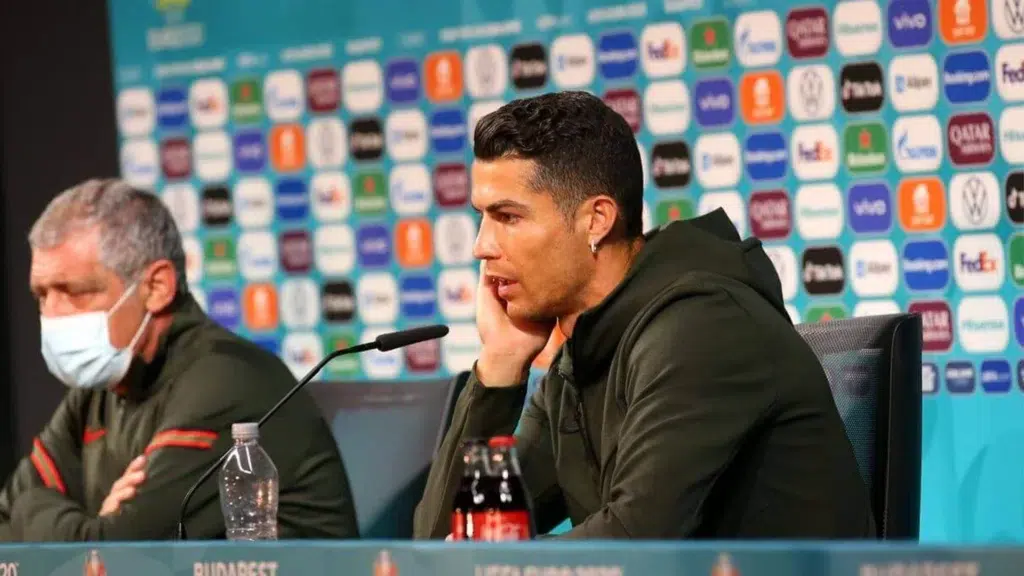
When Cristiano Ronaldo sat down for a Euro 2020 press conference in Budapest on June 14, 2021, he made a gesture that would dominate headlines for weeks. The Portuguese captain removed two Coca-Cola bottles placed in front of him, held up a water bottle, and said “Agua” (water in Portuguese) before rolling his eyes at the soft drink sponsor.
Within hours, media outlets worldwide reported that Coca-Cola’s market value had dropped $4 billion. The YouTube video accumulated 22 million views. Two more players imitated the gesture within days: Paul Pogba removed Heineken, Manuel Locatelli removed Coca-Cola. UEFA threatened team fines. Sponsors entered crisis mode.
The Incident Impact:
- Date: June 14, 2021 (Euro 2020, Portugal vs Hungary press conference)
- Video views: 22 million on YouTube
- Stock impact: Coca-Cola dropped 1.6% ($56.16 → $55.22), $4B market value loss
- Copycat incidents: Paul Pogba (Heineken), Manuel Locatelli (Coca-Cola), within 48 hours
- UEFA response: Threatened team fines, reminded federations of sponsor obligations
- Coca-Cola sponsorship: €30-50M for UEFA Euro 2020 placement rights
- Global reach: Ronaldo’s 300M+ Instagram followers amplified message
The reality? Financial analysts later revealed Coca-Cola’s stock had already declined before Ronaldo’s 9:45am press conference began, primarily due to ex-dividend date adjustments. But the perception mattered more than the truth. The incident fundamentally shifted the power dynamic between athletes and corporate sponsors.
The Gesture That Started Everything
What Actually Happened in Budapest
On June 14, 2021, Cristiano Ronaldo entered the press conference room at Puskás Aréna in Budapest ahead of Portugal’s Euro 2020 opening match against Hungary. Two glass bottles of Coca-Cola sat prominently on the table, positioned for maximum camera visibility as part of UEFA’s €30-50 million sponsorship agreement.
Ronaldo sat down, looked at the bottles, and immediately moved them aside out of camera frame. He then picked up a bottle of water, held it up to the assembled media, and said emphatically “Agua” (water in Portuguese). He rolled his eyes while glancing at where the Coca-Cola bottles had been. The entire sequence lasted less than 10 seconds. Within hours, it had been viewed millions of times globally.
Why Ronaldo Had the Platform
Cristiano Ronaldo wasn’t just any footballer removing sponsor products. At 36 years old in 2021, he had surpassed $1 billion in career earnings, owned 53 trademarks under the CR7 brand, and commanded 300 million Instagram followers. His influence transcended football into health, fitness, and lifestyle branding.
The gesture resonated because it aligned with Ronaldo’s well-documented health fanaticism. Unlike typical celebrity hypocrisy (critics quickly surfaced 2006 Coca-Cola ads featuring young Ronaldo), his modern image centered on extreme fitness discipline. The authenticity made the message powerful: if the world’s most famous athlete publicly rejected sugary sodas, what did that signal to millions of fans?
Ronaldo’s Platform Power:
- Career earnings: $1B+ (first footballer to reach this milestone)
- CR7 brand: 53 trademarks across products and services
- Social media: 300M+ Instagram followers (most-followed athlete)
- Health image: Strict diet, extreme fitness regimen, body fat percentage under 10%
- Endorsements: $100M annually from personal brand deals
- Tournament stakes: Fifth Euro appearance, chasing international trophy
The Immediate Viral Explosion
22 Million Views and Global Headlines
Within 24 hours of the press conference, the YouTube video of Ronaldo’s gesture had accumulated millions of views. Within weeks, it reached 22 million views, becoming one of the most-watched sports press conference moments in history. The clip spread across Twitter, Instagram, TikTok, and Facebook, generating memes, commentary, and debates about athlete activism.
Major media outlets worldwide ran the story as front-page news. CBS News, The Washington Post, NPR, Reuters, NBC News, and The Guardian all covered the incident. The narrative was irresistible: world’s most famous athlete publicly rejects major corporate sponsor during live global broadcast. The visual simplicity required no translation. Ronaldo’s contemptuous expression communicated everything.
Viral Metrics:
- YouTube views: 22M+ within weeks
- Media coverage: CBS, Washington Post, NPR, Reuters, NBC, Guardian
- Social platforms: Trending on Twitter, Instagram, TikTok, Facebook
- Meme generation: Thousands of user-generated content pieces
- Geographic reach: Coverage in Europe, Americas, Asia, Africa
- Tournament context: Euro 2020 maximum global audience post-pandemic
The $4 Billion Headline That Defined the Story
Media outlets from CBS News to The Washington Post ran headlines declaring “Cristiano Ronaldo snubbed Coca-Cola. Market value fell $4 billion.” The narrative was simple: celebrity gesture causes corporate collapse. Coca-Cola’s share price dropped 1.6% from $56.17 to $55.22 by the end of Ronaldo’s press conference, representing approximately $4 billion in market capitalization loss.
The story had everything: celebrity drama, corporate consequences, health advocacy, massive financial impact. It didn’t matter that the story was more complicated than headlines suggested. The perception became reality: one athlete’s 10-second gesture had cost a global corporation billions. That perception would fundamentally change athlete-sponsor dynamics forever.
The $4 Billion Myth That Became Reality
Media outlets from CBS News to The Washington Post ran headlines declaring “Cristiano Ronaldo snubbed Coca-Cola. Market value fell $4 billion.” The narrative was simple: celebrity gesture causes corporate collapse. The truth was more complicated. Financial analysts examining trading data revealed Coca-Cola’s stock price closed Friday June 11 at $56.16. When markets opened Monday June 14 at 9:30am, stock had dropped to $55.35 before Ronaldo’s 9:45am press conference began.
The decline was primarily driven by ex-dividend date adjustments. June 14 was the cutoff date for Coca-Cola’s upcoming dividend payment. Shareholders who owned stock before this date received dividends; new buyers after this date did not. Standard market mechanics dictate stock prices drop by approximately the dividend amount on ex-dividend dates. The expected drop was $0.42 per share representing $1.8 billion in total cash payments.
The Financial Reality:
- Stock close Friday June 11: $56.16
- Stock open Monday June 14 (9:30am): $55.35 (before press conference)
- Ronaldo removes bottles: 9:45am EST
- Stock movement 9:45am-close: Actually rose $55.27 → $55.55
- Ex-dividend date effect: Expected $0.42 drop ($1.8B)
- Actual total decline: $0.94 ($4B) including normal market adjustments
- Coca-Cola’s response: “Everyone is entitled to their drink preferences”
From 9:45am when Ronaldo removed bottles through the remainder of trading, Coca-Cola’s stock actually rose in absolute terms and relative to overall market. A revised headline could have read: “Cristiano Ronaldo snubbed Coca-Cola. Company’s market value then rose $1.2 billion.” But that wouldn’t have generated 22 million YouTube views.
The myth mattered more than the reality. Whether or not Ronaldo directly caused the stock drop, the global perception was that one athlete’s gesture had wiped billions off a corporate giant’s value. That perception changed how athletes, sponsors, and tournament organizers viewed power dynamics.
The Copycat Effect: When Athletes Follow Superstars
Paul Pogba and the Heineken Removal
Twenty-four hours after Ronaldo’s gesture, French midfielder Paul Pogba sat down for a Euro 2020 press conference following France’s 1-0 win against Germany. A bottle of Heineken 0.0 (non-alcoholic beer) sat prominently on the table. Pogba, a devout Muslim who doesn’t consume alcohol, discreetly removed the bottle from view before addressing media.
While Pogba’s gesture stemmed from religious conviction rather than health advocacy, the visual echoed Ronaldo’s rejection. Another superstar athlete, another sponsor product removed, another viral social media moment. Heineken had initially tweeted jokingly acknowledging Ronaldo’s preference for water, but deleted the tweet after Pogba’s incident created additional controversy.
Pogba’s Incident:
- Date: June 15, 2021 (one day after Ronaldo)
- Product: Heineken 0.0 (non-alcoholic beer, official UEFA sponsor)
- Motivation: Religious (practicing Muslim, alcohol forbidden)
- Pogba’s portfolio: 46 trademarks, $125M net worth
- Heineken response: Deleted previous joking tweet about Ronaldo
- UEFA clarification: “If for religious reasons, they don’t need bottle there”
Manuel Locatelli Completes the Trend
Two days after Ronaldo’s press conference, Italian midfielder Manuel Locatelli scored twice in Italy’s 3-0 victory against Switzerland. At his post-match press conference, Locatelli smiled broadly while moving two Coca-Cola bottles out of frame and replacing them with water. The gesture included an audible “acqua” (water in Italian), directly mimicking Ronaldo’s performance.
Locatelli’s copycat incident proved this wasn’t isolated athlete activism. It was a trend. Within 72 hours, three high-profile players across three different teams had publicly rejected sponsor products during official UEFA press conferences. Tournament organizers faced a crisis: their €30-50 million sponsor investments were being undermined by the very athletes generating tournament value.
The Trend Expands:
- Manuel Locatelli: Removed Coca-Cola, said “acqua” (Italy vs Switzerland)
- Ukraine’s Andriy Yarmolenko: Jokingly kept both Coke and Heineken, asked brands to contact him
- Belgium coach Roberto Martinez: Insisted team “loves” Coca-Cola (Belgium directly sponsored by Coke)
- Russia coach Stanislav Cherchesov: Drank Coca-Cola during press duties
- Scotland’s John McGinn: Jokingly asked “why no Coke?” at press conference
UEFA’s Response: Threatening Fines While Managing Superstars
The Sponsor Obligation Reminder
UEFA tournament director Martin Kallen issued warnings that teams could face fines for players removing sponsor products. The organization reminded participating federations of contractual obligations: “Partnerships are integral to the delivery of the tournament and to ensuring the development of football across Europe, including for youth and women.”
But UEFA faced an impossible dilemma. Fining Portugal risked losing Ronaldo for subsequent matches in the tournament’s “group of death.” The commercial value of Ronaldo playing (global viewership, merchandise sales, betting revenue) vastly exceeded any fine UEFA could impose. Moreover, asking a player worth $1 billion to pay fines of a few thousand euros was “truly laughable” according to sports marketing analysts.
UEFA’s Impossible Position:
- Warned: Teams could face fines for sponsor violations
- Reality: Couldn’t suspend Ronaldo without massive commercial losses
- Portugal’s group: “Group of death” featuring Germany, France (maximum viewership)
- Ronaldo’s value: Global viewership, merchandise, betting revenue exceeded any fine
- Compromise: Acknowledged religious exemptions (Pogba), didn’t pursue action
- Corporate sponsors: Paying €30-50M for rights being violated publicly
UEFA’s regulations required compliance with sponsor promises, but tournament officials acknowledged they “never fine players directly from UEFA side,” instead working through national federations who “could look if they will go further to the player.” This indirect enforcement mechanism provided plausible deniability while avoiding direct confrontation with superstar athletes.
The Athlete Power Shift
Sports marketing experts identified the incidents as evidence that power was shifting from sponsors to athletes. Simon Chadwick noted that “athletes are beginning to take control of space around themselves” and “feel confident enough to step up and speak out, knowing they represent fans and consumers too.”
The shift reflected broader changes in athlete activism and social media influence. Players increasingly viewed their personal brands as more valuable than tournament sponsor obligations. With combined Instagram followings in hundreds of millions, athletes controlled distribution channels sponsors couldn’t match. Why appease a beverage company when you could align with personal health brands generating long-term value?
Power Dynamic Shift:
- Traditional model: Athletes comply with tournament sponsor obligations
- New reality: Athletes prioritize personal brand values over sponsor contracts
- Social media factor: Direct-to-consumer distribution bypassing traditional media
- Post-career planning: Athletes aligning with brands for long-term partnerships
- Consumer authenticity: Fans reward genuine values over corporate obligations
- Sponsor vulnerability: €30-50M investments undermined by single gestures
How Brands and Consumers Reacted
Coca-Cola’s Muted Corporate Response
Coca-Cola issued a brief, corporate-friendly statement that revealed how unprepared the company was for the incident: “Players are offered water, alongside Coca-Cola and Coca-Cola Zero Sugar, on arrival at our press conferences. Everyone is entitled to their drink preferences.” The statement was diplomatic but did nothing to counter the narrative that Ronaldo’s rejection had damaged the brand.
The muted response suggested Coca-Cola had no crisis management playbook for this scenario. Should they defend their product? Ignore the incident? Embrace the controversy? The company chose passive acceptance, perhaps recognizing that any aggressive response would amplify attention and make them look defensive against the world’s most popular athlete.
Corporate Responses:
- Coca-Cola statement: “Everyone is entitled to their drink preferences”
- Heineken initial tweet: Joked about Ronaldo preferring water (later deleted after Pogba incident)
- UEFA response: Reminded teams of sponsor obligations, threatened fines
- Brand strategy: Coca-Cola maintained bottle placement despite ongoing incidents
- Public relations: No aggressive counter-campaign, passive acceptance approach
Consumer Behavior and Social Media Sentiment
Social media response split between praising Ronaldo for health advocacy and criticizing him for hypocrisy. Supporters pointed to his consistent fitness messaging and responsibility as role model to millions of young fans. Critics surfaced 2006 advertisements showing young Ronaldo endorsing Coca-Cola, plus KFC endorsements contradicting current health positioning.
The debate generated massive organic engagement for all parties involved. Coca-Cola received billions in media impressions (albeit negative context). Ronaldo’s gesture reinforced his health brand positioning. The incident demonstrated that controversy drives engagement more effectively than traditional advertising ever could.
Social Media Dynamics:
- Supporters: Praised health advocacy, role model responsibility
- Critics: Highlighted 2006 Coca-Cola ads, KFC endorsements showing hypocrisy
- Memes: Thousands generated comparing young Ronaldo ads to current gesture
- Engagement: Billions of impressions across all platforms
- Brand mentions: Coca-Cola received massive awareness (negative context)
- Influencer response: Fitness influencers amplified Ronaldo’s water message
The Lasting Impact on Athlete-Sponsor Relationships
What Brands Learned
The incidents forced sponsors and tournament organizers to reconsider product placement strategies. Coca-Cola maintained their bottle placement approach through the remainder of Euro 2020, but industry analysts questioned whether prominent product positioning was worth the risk. Some suggested returning to Euro 2016’s strategy of logo embedment on backdrops rather than physical products athletes could reject.
Brands recognized they needed risk management playbooks for values clashes. Coca-Cola and Heineken’s muted responses (Coca-Cola issued bland statement about drink preferences, Heineken deleted tweets) suggested they were caught off guard. Future sponsors couldn’t afford unpreparedness when prominent athletes rejected products during live global broadcasts.
Long-Term Consequences:
- Placement strategy: Question whether bottles on tables worth rejection risk
- Risk management: Brands need playbooks for athlete values clashes
- Authentic partnerships: Companies aligning strategically with athletes reap rewards
- Consumer expectations: Growing demand for authenticity over transactional endorsements
- Product placement evolution: Backdrop logos safer than physical products athletes handle
- Tournament obligations: Athletes increasingly refuse obligations conflicting with personal brands
The incidents highlighted growing tension between players and national association duties. These gestures wouldn’t have occurred at club press conferences where Coca-Cola or Heineken paid athletes directly. The snubs reflected discomfort with sponsors athletes hadn’t personally endorsed and didn’t financially benefit from promoting.
The Authenticity Economy
Marketing analysts noted that consumers increasingly sought authenticity in brand relationships. Athletes who genuinely used and believed in products created more value than transactional sponsorships. Ronaldo’s CR7 brand (53 trademarks), Pogba’s portfolio (46 trademarks), and their multi-million dollar endorsement deals reflected careful personal brand curation. Why risk that carefully built authenticity by appearing to endorse products contradicting their public image?
The shift created opportunities for brands that could align strategically with athlete values. Companies willing to build long-term partnerships around genuine shared values would reap rewards. But sponsors expecting athletes to uncritically promote whatever products tournament organizers placed in front of them had entered obsolete business model territory.
What Changed in Sports Sponsorship Forever
The End of Mandatory Product Placement
The Ronaldo incident forced sports organizations and sponsors to reconsider mandatory product placement strategies. Putting bottles directly in front of athletes who could publicly reject them created viral rejection moments worse than no placement at all. Some analysts suggested returning to Euro 2016’s approach: embed sponsor logos on backdrops where athletes couldn’t physically remove them.
Tournament organizers faced new reality: athletes with billion-dollar personal brands and hundreds of millions of social followers controlled more distribution power than any physical product placement. The value calculation had fundamentally changed. Was €30-50 million sponsorship worth the risk of global rejection and negative viral spread?
Industry Changes:
- Product placement risk: Physical bottles create rejection opportunities
- Backdrop strategy: Logo embedment safer than products athletes handle
- Athlete consultation: Some organizations now discuss placement with star players
- Sponsorship value: Questioned whether traditional placement worth rejection risk
- Power dynamics: Athletes control distribution through social platforms
- Contract revisions: Future deals include athlete cooperation clauses
The Authenticity Economy Takes Over
Sports marketing experts identified the shift toward authentic athlete-brand partnerships over transactional sponsorships. Athletes increasingly refused to promote products contradicting personal brand values, regardless of tournament obligations. Consumers rewarded authenticity, punishing brands that forced athletes into uncomfortable positions.
Companies that could align strategically with athlete values built long-term partnerships generating sustained value. Brands expecting athletes to uncritically promote whatever products tournament organizers placed in front of them had entered obsolete territory. The Ronaldo incident accelerated this transformation dramatically.
Future Sponsorship Model:
- Authentic partnerships: Brands aligning with athlete values win long-term
- Transactional deals: One-off tournament placements losing effectiveness
- Athlete activism: Growing willingness to reject brands publicly
- Social media leverage: Athletes control narrative through direct channels
- Consumer expectations: Fans reward authenticity, punish forced endorsements
- Long-term thinking: Post-career athlete partnerships more valuable than tournament placement
The Bottom Line
The Cristiano Ronaldo Coca-Cola press conference incident on June 14, 2021 generated 22 million YouTube views, sparked copycat gestures from Paul Pogba and Manuel Locatelli within 48 hours, and fundamentally shifted power dynamics between athletes and corporate sponsors despite the $4 billion stock drop narrative being largely mythical.
Why This Mattered:
- Athlete influence: 300M+ followers gave Ronaldo distribution power matching sponsors
- Copycat effect: Three players rejected sponsors within 72 hours creating trend
- UEFA’s dilemma: Couldn’t fine superstars without losing greater commercial value
- Power shift: Athletes prioritizing personal brands over tournament obligations
- Authenticity economy: Consumers rewarding genuine values over transactional endorsements
Financial analysis revealed Coca-Cola’s stock had declined before Ronaldo’s 9:45am gesture primarily due to ex-dividend date adjustments. Expected drop was $1.8 billion; actual decline reached $4 billion including normal market movements. But perception mattered more than reality. The global narrative became: one athlete gesture cost corporate giant $4 billion.
That perception changed everything. Within 72 hours, three high-profile players had publicly rejected sponsor products during official UEFA press conferences. Tournament sponsors paid €30-50 million for placement rights, but athletes with billion-dollar personal brands and hundreds of millions of social followers controlled more valuable distribution. UEFA threatened team fines but couldn’t enforce without losing commercial value from absent superstars.
The balance of power had shifted permanently. Coca-Cola maintained bottle placement through remaining Euro 2020 matches, but the damage was done. Two bottles removed, 22 million views generated, three copycat incidents sparked, and the entire sponsorship model questioned. That was the real cost of Ronaldo’s “Agua” moment.