When Dior signed Charlize Theron as the face of J’adore in 2004, nobody predicted it would become one of fashion’s longest-running partnerships. Twenty years, countless campaigns, and billions in revenue later, the South African actress didn’t just sell perfume. She created the template every luxury fragrance brand now follows.
The collaboration ended in 2024 when Rihanna took over, but the business model Theron built remains untouchable. While competitors cycled through celebrity faces every few years, Dior’s commitment to one muse transformed J’adore into more than a product. It became a cultural phenomenon that redefined how luxury brands approach celebrity partnerships.
This wasn’t about a famous face in a pretty ad. This was about building a 20-year empire where every campaign drove measurable market dominance, where gold-drenched imagery became synonymous with aspirational luxury, and where one actress’s association elevated a perfume into one of the world’s best-selling fragrances.
The partnership that redefined luxury fragrance marketing
Why Charlize Theron was the perfect J’adore muse
Dior didn’t choose Charlize Theron by accident in 2004. The brand needed someone who embodied contradictions: accessible yet untouchable, classic yet modern, elegant yet powerful. Theron, fresh off her Oscar win for Monster, represented transformation itself, the very essence J’adore wanted to bottle.
The timing mattered. J’adore launched in 1999 but needed a face that could carry it beyond the millennium’s first decade. Previous fragrance campaigns relied on fleeting celebrity appeal, but Dior recognized something different in Theron. Her beauty transcended trends, her acting credentials added gravitas, and her public persona aligned perfectly with luxury aspiration without alienating everyday consumers.
Key strategic advantages:
- Oscar-winning credibility: Academy Award legitimacy elevated J’adore beyond typical celebrity endorsements into artistic territory
- International appeal: South African heritage plus Hollywood success created global relatability across European, American, and emerging markets
- Longevity potential: Age 29 at signing allowed decades of partnership growth as both brand and actress matured together
- Visual consistency: Blonde, statuesque beauty provided instantly recognizable brand identity that competitors couldn’t replicate
The choice proved financially brilliant. Within years of Theron’s first campaign, J’adore climbed into the top tier of global fragrance sales, a position it has maintained for two decades.
How long-term brand ambassadorships create market dominance
Most luxury brands replace fragrance ambassadors every 3-5 years. Dior’s 20-year commitment to Theron represented a fundamental rejection of this model. The strategy worked because consistency builds equity that short-term partnerships can never achieve.
When consumers see the same face for two decades, they don’t just remember the product. They associate every achievement, every red carpet moment, every cultural milestone of that celebrity with the brand. Theron’s continued A-list status, her advocacy work, her aging with grace, all became part of J’adore’s narrative without Dior spending an extra dollar.
Business impact of long-term partnerships:
- Reduced onboarding costs: No need to rebuild brand associations every few years with new faces and new campaign strategies
- Compound brand equity: Each campaign builds on previous ones rather than starting from zero with consumer recognition
- Market share protection: Competitors can’t poach your ambassador or disrupt your brand identity through talent acquisition
- Consumer trust: Consistency signals confidence and stability, key factors in luxury purchasing decisions
- Cross-generational appeal: Mothers who bought J’adore in 2004 now share the brand with daughters who grew up seeing the same campaigns
The financial mathematics are straightforward. Short-term ambassadorships might generate initial buzz, but long-term partnerships create compounding returns that transform products into cultural institutions.
The gold standard: Visual branding that became iconic
Versailles, gold, and the creation of aspirational luxury
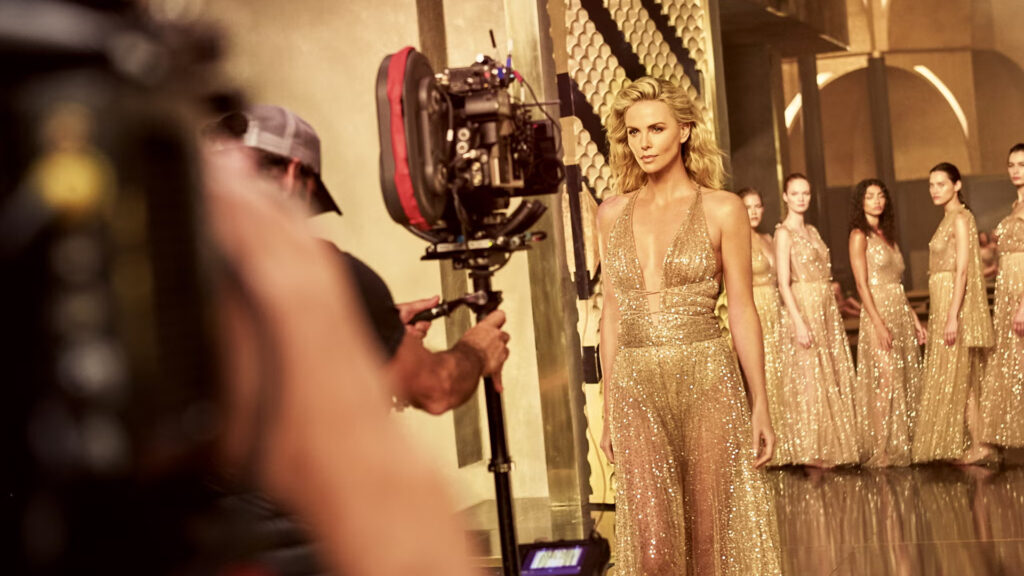
The 2011 campaign shot in the Hall of Mirrors at Versailles didn’t just look expensive. It rewrote the rules for how luxury brands could use location to convey value. Dior secured one of the world’s most iconic spaces and transformed Theron into modern royalty walking through French aristocratic history.
The gold color palette wasn’t arbitrary. Gold represents permanence, wealth, and timelessness, the exact attributes luxury perfume buyers seek. By drenching every frame in golden hues, from Theron’s dress to the lighting to the Versailles interiors, Dior created instant visual recognition. You could see a J’adore ad with the sound off and know exactly what you were watching.
Visual strategy components:
- Location prestige: Versailles association elevated J’adore into haute couture territory rather than mere cosmetics
- Color psychology: Gold triggers luxury associations across all cultures, making campaigns effective globally without adaptation
- Repetition effect: Using similar gold aesthetics across 20 years built subconscious brand recognition in consumers
- Architectural grandeur: Mirror-filled halls created infinite reflections of Theron and the product, multiplying brand exposure within single frames
Competitors tried to replicate the formula. Other brands shot in palaces, dressed actresses in gold, pursued similar aesthetics. But they lacked the consistency. Dior owned gold luxury because they committed to it for two decades, not two campaigns.
The walk: How movement became brand signature
Watch any J’adore commercial and you’ll notice Theron always walks. Not poses, not dances, but walks with purpose through opulent spaces. This wasn’t directorial preference. It was deliberate brand building.
The walk served multiple strategic purposes. It suggested confidence and control, attributes J’adore wanted to transfer to customers. It created narrative flow in 30-second spots where static beauty shots would bore viewers. Most importantly, it gave consumers something to remember and mimic, turning viewers into participants.
Movement marketing advantages:
- Memory retention: Physical actions stick in memory longer than static images, improving ad recall rates
- Aspiration triggering: Viewers imagine themselves walking with similar confidence, creating desire through identification
- Cinematic quality: Movement elevated commercials into short films, earning media coverage beyond paid advertising
- Global accessibility: Walking requires no cultural translation, working identically across all markets
The strategy worked so well that “the J’adore walk” became shorthand in advertising circles. Fashion students study the campaigns. Other brands openly attempt versions. But Theron’s walk through gold-lit corridors remains the original that competitors can only approximate.
Campaign evolution across two decades
From 2004 mystery to 2024 celebration
The first Theron campaigns played with mystery and sensuality. She appeared draped in gold, removing jewelry piece by piece, suggesting luxury as something to be revealed rather than displayed. These early ads positioned J’adore as a secret indulgence, something women chose for themselves rather than for others.
By the 2010s, as Theron’s status grew and feminist messaging entered mainstream marketing, the campaigns evolved. The 2011 Versailles spot showed her walking with purpose, not seducing the camera but commanding it. She wasn’t offering herself for viewing but inviting viewers into her world. This shift mirrored broader cultural changes while maintaining core brand identity.
Campaign evolution timeline:
- 2004-2008: Mystery and sensuality positioning, focus on product as intimate luxury choice
- 2009-2013: Power and confidence messaging, Versailles campaign establishing architectural grandeur
- 2014-2018: Celebration and joy themes, emphasizing J’adore as expression of self rather than attraction of others
- 2019-2024: Legacy and timelessness, positioning both Theron and fragrance as enduring cultural icons
The final campaigns with Theron acknowledged the partnership’s historic nature. L’Or de J’adore, launched in her last years as ambassador, literally meant “the gold of J’adore,” a meta-commentary on 20 years of golden campaigns. Dior wasn’t just selling perfume anymore. They were selling participation in fashion history.
How each campaign drove measurable sales impact
Dior doesn’t release granular sales data, but market analysis reveals clear patterns. Every major Theron campaign coincided with market share gains for J’adore in the luxury fragrance category. The Versailles campaign particularly drove international expansion, with notable sales increases in Asian markets where palace imagery resonates strongly.
The 2018 J’adore Absolu launch, supported by Theron campaigns, helped Dior capture younger demographics without alienating core customers. This demonstrated the partnership’s flexibility, its ability to introduce line extensions while maintaining brand coherence through Theron’s consistent presence.
Revenue indicators:
- Best-seller status: J’adore consistently ranks among top 5 best-selling luxury perfumes globally throughout the partnership
- Line extension success: Multiple J’adore variants launched during Theron era all achieved commercial viability
- Market share stability: Dior maintained luxury fragrance category leadership even as new competitors entered market
- Price premium maintenance: J’adore commanded higher price points than competitors despite being decades old
- Global expansion: Partnership enabled successful market penetration in Asia, Middle East, and South America
The financial success wasn’t just about the campaigns themselves. It was about how each campaign reinforced the previous one, building equity that compounded annually. This is the fundamental business case for long-term partnerships that short-term thinking never achieves.
The business model behind luxury fragrance partnerships
What Charlize Theron’s contract likely included
While exact terms remain confidential, industry standards and Theron’s status suggest a multi-million dollar annual contract with performance bonuses tied to sales targets. Top-tier fragrance ambassadorships typically include base compensation, usage rights across all media, appearance commitments, and equity components.
The length of the partnership suggests renewal negotiations every 3-5 years with increasing compensation as J’adore’s market position strengthened. By the end, Theron likely earned high eight figures annually, making her one of the highest-paid celebrity brand ambassadors globally.
Typical contract components:
- Annual base fee: Guaranteed compensation regardless of campaign usage or sales performance
- Usage rights: Separate fees for print, video, digital, and out-of-home advertising across global markets
- Appearance requirements: Red carpet obligations, store openings, Dior fashion show attendance
- Exclusivity clauses: Restrictions on competing fragrance partnerships and conflicting luxury brand relationships
- Performance bonuses: Additional compensation tied to sales thresholds or market share gains
The investment made economic sense. J’adore likely generates hundreds of millions in annual revenue. Even a 20 million annual ambassador fee represents a small percentage of revenue if that ambassador drives measurable sales increases.
Return on investment for Dior’s 20-year commitment
Calculating precise ROI requires proprietary sales data, but market position tells the story. J’adore entered a crowded luxury fragrance market in 1999. Twenty years of Theron campaigns later, it stands among the most recognizable and best-selling luxury perfumes globally.
Compare this to competitors who changed ambassadors frequently. They experienced temporary sales bumps with each new face but never built the lasting equity that drives purchase decisions across decades. Short-term thinking produces short-term results.
Long-term ROI factors:
- Brand equity accumulation: Two decades of consistent messaging created immeasurable goodwill impossible to achieve otherwise
- Reduced marketing costs: Later campaigns required less explanation and introduction because consumers already knew the brand story
- Premium pricing power: Strong brand identity justified higher prices, improving margins beyond volume growth
- Extension opportunities: Successfully launched multiple J’adore variants leveraging established brand equity
- Competitive moat: 20-year association made it nearly impossible for competitors to poach Theron or replicate the strategy
The partnership’s ROI wasn’t just financial. It positioned Dior as a brand that values loyalty, consistency, and long-term thinking. These are precisely the attributes luxury consumers seek in the brands they support.
Why Dior transitioned to Rihanna in 2024
Strategic reasons behind ending the Theron era
The transition to Rihanna wasn’t about Theron failing. It was about recognizing that even the most successful partnerships must evolve. After 20 years, J’adore risked becoming associated exclusively with Theron’s specific demographic, potentially limiting appeal to younger consumers entering the luxury market.
Rihanna represents strategic diversification. She brings different racial representation, different age demographics, different cultural capital from music rather than film. Most importantly, she brings Fenty Beauty credibility, proven ability to build and sell beauty products at scale.
Transition strategy components:
- Demographic expansion: Rihanna appeals to Gen Z and Millennial consumers who may not connect with Theron’s generation
- Cultural diversity: Black excellence representation expands J’adore’s cultural relevance and market accessibility
- Industry credibility: Fenty Beauty success provides fragrance expertise that pure acting celebrity lacks
- Digital native appeal: Rihanna’s social media fluency aligns with modern luxury marketing’s digital requirements
- Fresh narrative: New face enables campaign reinvention while maintaining core brand identity established over 20 years
Dior timed the transition carefully. They didn’t abruptly drop Theron but celebrated the partnership’s conclusion with L’Or de J’adore, honoring the legacy before moving forward. This approach maintained brand goodwill while signaling intentional evolution rather than desperation.
How the Rihanna partnership builds on Theron’s foundation
Rihanna’s first J’adore campaigns show clear strategic continuity. She walks through golden spaces, just as Theron did. The color palette remains unchanged. The confidence and power messaging continues. Dior learned from 20 years what works and what doesn’t.
The difference lies in execution details. Rihanna’s campaigns incorporate modern music, faster editing, stronger digital integration. She brings contemporary cultural references that Theron couldn’t. But the core brand identity remains intact because Theron spent two decades building foundations strong enough to support evolution.
Continuity elements:
- Gold aesthetic: Rihanna campaigns maintain the color palette Theron established as J’adore’s visual identity
- Power positioning: Confidence and self-determination messaging continues, adapted to contemporary feminist discourse
- Luxury locations: Similar use of architectural grandeur and prestigious settings
- Walking signature: Rihanna walks through spaces with purpose, maintaining the movement branding Theron created
This is the ultimate validation of long-term partnerships. They create brand equity so strong that even changing the face doesn’t disrupt the identity. Competitors who change ambassadors frequently never build this foundation. They start over every few years while Dior built once and now reaps compounding benefits.
The template every luxury brand now follows
What competitors learned from J’adore’s success
Every major luxury fragrance launch since 2011 has attempted some version of the J’adore formula. Celebrity ambassador, check. Opulent locations, check. Gold-toned aesthetics, check. Long-form cinematic commercials, check. But replication doesn’t equal success because most brands lack the patience for 20-year commitments.
Chanel’s partnership with Brad Pitt for Chanel No. 5 lasted barely a year before both parties moved on. Calvin Klein cycles through celebrity faces rapidly. Even successful partnerships like Johnny Depp with Sauvage don’t approach the duration and consistency that made J’adore iconic.
J’adore template elements:
- Long-term commitment: Multi-year contracts that allow brand associations to compound rather than reset
- Visual consistency: Recognizable aesthetic maintained across all campaigns and product variants
- Ambassador alignment: Celebrity whose personal brand genuinely reflects product positioning
- Cultural positioning: Aspirational luxury that feels accessible rather than exclusionary
- Storytelling focus: Campaigns that create narratives rather than simply displaying product
The lesson isn’t that every brand should sign 20-year deals. It’s that consistency matters more than novelty in building luxury brand equity. Brands that chase trends and change faces constantly may generate short-term buzz but never build the lasting value that drives premium pricing and customer loyalty across decades.
Why few brands will replicate the 20-year model
The challenge isn’t finding celebrities willing to commit. It’s finding brands willing to commit to celebrities. Twenty years means betting your entire brand identity on one person’s continued relevance, good behavior, and cultural capital. That’s a massive risk most marketing executives won’t take.
Dior got lucky with Theron. She aged gracefully, avoided scandals, maintained A-list status, and continued choosing prestigious projects that enhanced rather than diminished her luxury appeal. For every Charlize Theron, there are dozens of celebrities whose relevance faded, whose personal controversies damaged brand associations, or whose careers simply moved in directions incompatible with luxury positioning.
Barriers to long-term partnerships:
- Corporate risk aversion: Marketing executives prefer distributing risk across multiple shorter partnerships
- Career unpredictability: 20 years is long enough for celebrity relevance to completely shift
- Market evolution speed: Consumer preferences change faster than 20-year contracts allow adaptation
- Executive turnover: Different CMOs want their own ambassadors, not their predecessors’ choices
- Budget flexibility: Long contracts lock in spending that could be reallocated as market conditions change
The irony is that risk aversion prevents the very strategy that reduces risk. Long-term partnerships compound value, making brands more resilient to market fluctuations. But short-term thinking dominates marketing, so most brands will continue cycling through ambassadors while wondering why they can’t build the equity Dior created with J’adore.
The Bottom line
Charlize Theron’s 20-year partnership with Dior J’adore wasn’t just successful marketing. It was a masterclass in how long-term thinking creates compounding value that short-term strategies can never achieve. While competitors chased trends and cycled through celebrity faces, Dior built a brand identity so strong that even changing ambassadors couldn’t shake it.
The financial results speak clearly. J’adore maintained top-tier market position for two decades, commanded premium pricing, successfully launched multiple line extensions, and became one of the world’s most recognizable luxury fragrances. This didn’t happen through flashy innovation or constant reinvention. It happened through consistency, through committing to one face and one vision long enough for compound brand equity to work its magic.
Key success drivers:
- Strategic patience: 20-year commitment allowed brand associations to compound rather than reset every few years
- Visual consistency: Gold aesthetic became synonymous with J’adore, creating instant brand recognition across all markets
- Ambassador alignment: Theron’s personal brand genuinely reflected luxury, confidence, and timeless beauty J’adore wanted to convey
- Market timing: Partnership began as Theron reached peak cultural relevance and maintained through her continued A-list status
The Rihanna transition proves the strategy’s ultimate success. Dior can change the face while maintaining the identity because Theron spent 20 years building foundations strong enough to support evolution. This is the goal every luxury brand should pursue but few have the patience to achieve.
For marketers studying the case, the lesson is clear. Consistency beats novelty in building lasting brand value. Long-term partnerships compound equity that short-term thinking can never replicate. And sometimes the bravest strategy is simply committing to what works and letting time do the heavy lifting.