On November 22, 2025, Barcelona returned to their renovated Spotify Camp Nou after 900 days playing at the Olympic Stadium. They beat Athletic Bilbao 4-0 in front of 45,401 fans, with new goalkeeper Joan García keeping a clean sheet on his home debut. But the celebration couldn’t hide the brutal financial reality.
In January 2026, Barcelona’s total debt stands at €1.958 billion. Add the €1.5 billion Espai Barça stadium renovation, and economist Marc Ciria estimates combined debt at €3.5 billion. The club still owes €159 million to other clubs for unpaid transfer fees from signings made years ago.
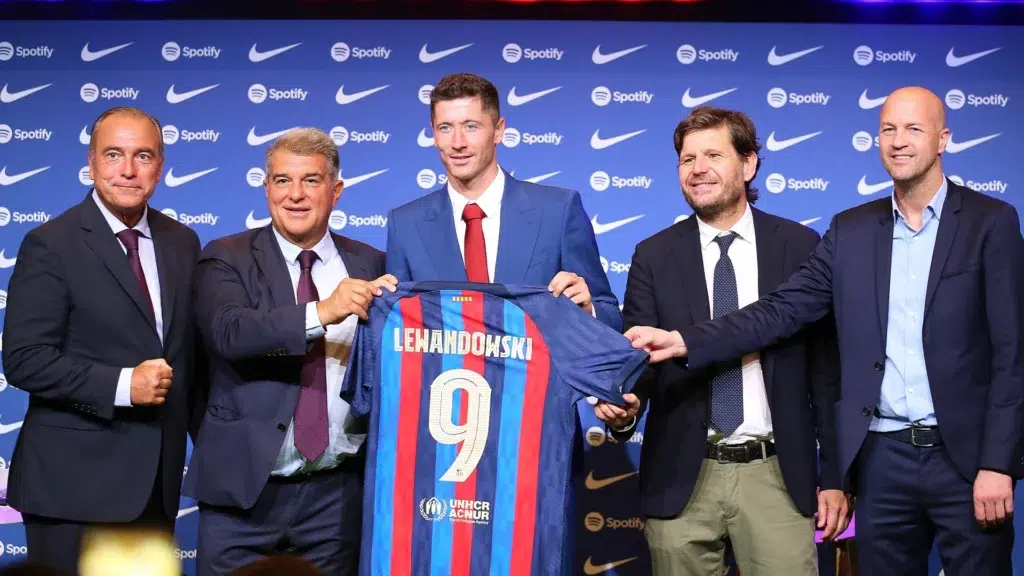
Yet Barcelona keeps spending. Summer 2025 brought Marcus Rashford on loan from Manchester United with a €30-35 million buy option and Joan García for €25 million from Espanyol. Add Dani Olmo for €55 million in 2024, and the 2022 trio of Lewandowski, Raphinha, and Koundé for €150 million, and you see a club that hasn’t stopped buying players.
Bayern Munich honorary president Uli Hoeness summarized it best in November 2025: “When you have 1.3 billion euros in debt, how are you supposed to function? In any normal country, a club run like that wouldn’t even be in the first division. It’s a miracle they’re still allowed to play.”
How is Barcelona still spending? The answer lies in the €555 million Messi contract that broke them, the €400 million wasted on three failed signings, controversial “financial levers” that mortgaged their future, and an €8.4 million referee scandal that could bring down the club.
Here’s the brutal truth about Barcelona’s spending despite owing billions.
The €555 Million Messi Contract That Broke Barcelona
The Biggest Contract in Sports History
In January 2021, Spanish newspaper El Mundo leaked Lionel Messi’s 2017 contract renewal, revealing the most expensive deal ever signed by an athlete in any sport.
The Messi Contract (2017-2021):
- Total value: €555,237,619 over four years
- Annual earnings: €138 million (including variables)
- Renewal fee: €115 million (paid just for signing)
- Loyalty bonus: €77.8 million (split into two payments)
- Fixed salary: €72 million annually
- Image rights: Included in total package
- Performance bonuses: €3.5 million for winning Champions League, bonuses for La Liga, Copa del Rey, FIFA Best
By the time the contract expired in June 2021, Messi had earned €511 million of the €555 million total (92%).
Per-Time Breakdown:
- Per day: €297,000 (after taxes)
- Per week: €2.08 million
- Per hour: €12,375
- Per minute: €206
Barcelona denied leaking the contract and threatened legal action against El Mundo, but they never disputed the numbers.
Why Barcelona Couldn’t Re-Sign Messi
In August 2021, Barcelona shocked the world by announcing Messi’s departure despite both sides wanting him to stay. La Liga’s financial fair play rules made it impossible.
The Financial Reality:
- Barcelona’s wage bill: Over 100% of total revenue (2020-21)
- La Liga spending limit: Negative €144 million (only club with negative cap)
- Messi’s new deal: Would have required 70% pay cut
- Even with pay cut: Still couldn’t register him under La Liga rules
Josep Maria Bartomeu, the president who signed Messi’s €555 million contract in 2017, resigned in October 2020 with Barcelona’s debt at €1.35 billion.
Messi left for free to PSG, and Barcelona received nothing after paying him €555 million over four years.
The €400 Million Trio: Barcelona’s Worst Signings Ever
Coutinho, Dembélé, Griezmann: €395 Million Spent, €90 Million Recovered
After Neymar’s €222 million departure to PSG in 2017, Barcelona went on a spending spree that would cripple the club financially.
Philippe Coutinho (Liverpool → Barcelona, January 2018):
- Transfer fee: €120 million + €40 million add-ons
- Total paid: €135-140 million (€15 million in add-ons met)
- Contract: 5.5 years
- Wages: Reportedly €12 million net annually
- Games played: 106 appearances
- Goals: 25 goals, 14 assists
- Outcome: Loaned to Bayern Munich (2019-20), sold to Aston Villa for €20 million (2022)
- Loss: €120+ million
Coutinho failed to replicate his Liverpool form. Barcelona’s record signing became their biggest flop.
Ousmane Dembélé (Borussia Dortmund → Barcelona, August 2017):
- Transfer fee: €105 million + €40 million add-ons
- Total paid: €148 million (€20 million in add-ons met, remaining €23 million paid in 2024)
- Contract: 5 years
- Games played: 185 appearances across 6 seasons
- Goals: 40 goals, 43 assists
- Injuries: Missed 116 matches due to injuries
- Outcome: Left for PSG for €50 million (2023)
- Loss: €98 million
Barcelona paid €5 million every time they qualified for Champions League during Dembélé’s tenure. The French winger spent more time injured than playing.
Antoine Griezmann (Atletico Madrid → Barcelona, July 2019):
- Transfer fee: €120 million (release clause)
- Contract: 5 years
- Wages: Reportedly €21 million gross annually
- Games played: 102 appearances across 2 seasons
- Goals: 35 goals, 17 assists
- Outcome: Loaned back to Atletico (2021-22, 2022-23), sold permanently for €21 million (2022)
- Loss: €99 million
Griezmann never fit Barcelona’s system. He returned to Atletico Madrid for €99 million less than Barcelona paid two years earlier.
The Damage:
- Total spent: €395 million
- Total recovered: €90 million (sales of all three)
- Net loss: €305 million
Barcelona spent nearly €400 million replacing Neymar with three players who collectively failed to match his impact.
The €1.9 Billion Debt: How Barcelona Got Here
From Financial Superpower to Bankruptcy
Barcelona Debt Timeline:
October 2020 (Bartomeu Era):
- Total debt: €1.35 billion
- Short-term liabilities: €730 million
- Wage bill: €671 million (103% of revenue)
- COVID-19 impact: €300 million revenue loss
January 2026 (Current Status):
- Total debt: €1.958 billion (not including Espai Barça)
- Espai Barça stadium debt: Additional €1.5 billion
- Combined total: €3.458 billion according to economist Marc Ciria
- Net worth: Negative €263 million
What Makes Up the Debt:
- Bank loans for operations
- Unpaid transfer fees: €159 million
- Stadium renovation: €1.5 billion project
- Player salaries owed
- Tax payments
- Delayed payments to suppliers
The Revenue Crisis
2024-25 Fiscal Year Results:
- Revenue: €994 million
- Expenses: €1.011 billion
- Net loss: €17 million (despite record revenues)
- Wage bill: €534 million (increased from €510 million)
Barcelona almost hit €1 billion in revenue but still lost money because expenses grew faster.
Why They’re Still Losing Money:
- UEFA fined Barcelona €15 million for Financial Fair Play violations
- Barça Produccions value collapsed from €408 million to €178 million
- Stadium renovation delays: no Camp Nou matchday revenue (playing at Olympic Stadium with half capacity)
- Lost matchday revenue: €108 million annually while at Olympic Stadium
The Camp Nou Situation
Barcelona has been playing at Olympic Stadium Montjuïc since May 2023 due to Camp Nou renovation.
Financial Impact (2023-2025):
- Lost matchday revenue: €108 million annually
- Capacity: 55,000 at Olympic Stadium vs 99,000 at Camp Nou
- VIP and hospitality: Severely reduced
- Total lost over 2 years: €216 million
Return to Spotify Camp Nou (November 2025):
- First match back: November 22, 2025 (Barcelona 4-0 Athletic Bilbao)
- Current capacity: 45,401 seats (not full 105,000)
- Phase 1C completion: End of 2025 (62,518 capacity)
- Full capacity: Target June 2027
- Total renovation cost: €1.5 billion
Until the stadium fully reopens, Barcelona operates at €50-70 million annual deficit from lost matchday income.
The Financial Levers: Selling Barcelona’s Future
How They Raised €927 Million in Summer 2022
To avoid bankruptcy and sign players, Joan Laporta activated what he called “financial levers” in 2022. In reality, Barcelona sold future revenue streams for immediate cash.
Lever 1: Sold 25% of TV Rights for 25 Years
- First sale (June 2022): 10% to Sixth Street for €207 million
- Second sale (July 2022): Additional 15% to Sixth Street for €400 million
- Total: €607 million for 25% of La Liga TV rights
- Duration: 25 years
- Annual loss: €40-52 million per year in TV revenue (forever)
- Buyback option: Available at “symbolic price” after 25 years
Barcelona sold 25% of their most valuable asset to pay current salaries and buy players.
Lever 2: Sold 49% of Barça Vision (formerly Barça Studios)
- Buyers: Socios.com (24.5%) and Orpheus Media (24.5%)
- Expected revenue: €200 million
- Actually received: Only €40 million by 2024
- Problem: Buyers failed to pay remaining €160 million on schedule
- Solution: “Resold” stakes to German company Libero and others
- Accounting trick: Barcelona counted €408 million (€200m sale + €208m “revaluation” of remaining 51%)
- Reality: Barça Produccions value collapsed to €178 million by 2024
Lever 3: Spotify Naming Rights
- Deal value: €280 million over 4 years
- Annual payment: €70 million
- What Spotify gets: Stadium naming rights (Spotify Camp Nou), front-of-shirt sponsorship (men’s and women’s teams), sleeve sponsorship
- Duration: 2022-2026 (with extension options)
For the first time in Barcelona’s 68-year history, they sold naming rights to their iconic stadium.
Total Raised from Levers:
- Claimed: €1.087 billion
- Actually received: €927 million (€607M TV + €40M Vision + €280M Spotify)
- Permanent cost: €40-52 million annual TV revenue lost forever
Barcelona’s Spending Spree Despite the Crisis
Summer 2022: €150 Million on Three Players
Despite Financial Crisis, Barcelona Bought:
Summer 2022 (€150 million):
- Robert Lewandowski: €45 million + €5 million add-ons (Bayern Munich)
- Raphinha: €58 million (Leeds United)
- Jules Koundé: €50 million (Sevilla)
Barcelona also signed Franck Kessié and Andreas Christensen on free transfers.
Still Owed to Clubs (January 2026):
- Leeds United: €41.9 million (Raphinha)
- Bayern Munich: €20 million (Lewandowski)
- Sevilla: €24.5 million (Koundé)
Three years later, Barcelona still owes €86.4 million combined for these three players.
Winter 2022: Ferran Torres
Ferran Torres (Manchester City, January 2022):
- Transfer fee: €55 million
- Still owed: €13.3 million (Manchester City)
2024-2025: The Spending Continues
Summer 2024:
- Dani Olmo: €55 million (RB Leipzig)
- Pau Víctor: €2.7 million (Girona, sold to Braga June 2025 for €12M)
Still Owed (January 2026):
- RB Leipzig: €18 million (Dani Olmo)
Summer 2025: Joan García and Marcus Rashford
Joan García (Espanyol, June 2025):
- Fee: €25 million (release clause)
- Contract: 6 years until 2031
- Previous salary at Espanyol: €300,000 annually
- New salary at Barcelona: €3 million annually (10x increase)
- Notable: La Liga’s best shot-stopper 2024-25 (146 saves)
Marcus Rashford (Manchester United, July 2025):
- Deal: Season-long loan with €30-35 million buy option
- Salary: €14 million gross (€7 million net, 15% pay cut)
- Jersey: Number 14
- Form (January 2026): 6 goals, 9 assists in 19 games
Total Unpaid Transfer Debt (January 2026):
- Leeds United: €41.9 million
- Sevilla: €24.5 million
- Bayern Munich: €20 million
- RB Leipzig: €18 million
- Manchester City: €13.3 million
- Others: €41.4 million
- Total: €159 million
Barcelona continues buying players on installment plans they cannot afford to pay.
The Negreira Scandal: €8.4 Million to Referees’ VP
Spain’s Biggest Football Corruption Case
In February 2023, Spanish prosecutors revealed Barcelona paid €8.4 million to José María Enríquez Negreira, the vice president of Spain’s refereeing committee, between 2001 and 2018.
The Payments:
- Total amount: €7.3-8.4 million over 17 years
- Recipients: Negreira’s companies (Dasnil 95 SL and Nilsad SCP)
- Period: 2001-2018 (entire time Negreira served as referee VP)
- Invoices: Over 600 invoices worth €6,000-7,000 each
- Official explanation: “External refereeing advisory services”
Who Paid During Their Terms:
- Joan Gaspart (2000-2003): €500,000
- Joan Laporta (2003-2010, first term): €1.5 million
- Sandro Rosell (2010-2014): €1.5 million
- Josep Maria Bartomeu (2014-2020): €5.5 million
- Joan Laporta (2021, second term): Brief payments before stopping
October 2025: Barcelona Officially Accused
Spanish courts formally charged Barcelona as a legal entity for “continuous corporate corruption in the form of fraud.”
Current Charges:
- Corporate corruption
- Fraud
- Breach of trust
- False business records
- Bribery charges dismissed: May 2024 court ruled Negreira not a “public official” under Spanish law
Missing Evidence:
In October 2025, courts ordered Barcelona to produce original Negreira contracts. Problem: Barcelona cannot find any contracts or written documentation justifying the €8.4 million payments.
Key Testimonies:
- Joan Laporta: Testified November 25, 2025
- Luis Enrique (former coach): Questioned about whether Negreira’s reports influenced tactics
- Ernesto Valverde (former coach): Also summoned
- Sandro Rosell: Testified September 18, 2025
- Josep Maria Bartomeu: Testified September 19, 2025
Negreira claimed he provided “technical reports on referees” and ensured Barcelona received “neutrality in arbitrages.” His son Javier admitted preparing referee analysis reports for monthly payments up to €6,000.
No physical evidence of these reports has been found.
Real Madrid’s Position:
Real Madrid, acting as private prosecutor, calls this “the biggest scandal in the history of football.” President Florentino Pérez demanded truth, suggesting “clubs were relegated” due to refereeing manipulation.
Potential Penalties:
- If convicted: Up to €5 million fine
- UEFA initially investigated but cleared Barcelona for Champions League participation (2023)
- La Liga has not sanctioned Barcelona pending court outcome
- Investigation ongoing, could extend into 2026
President Joan Laporta: “Barcelona has never bought referees. This is a witch hunt.”
The club maintains payments were for legitimate consulting services, though they cannot produce contracts or reports to prove it.
Why Barcelona Can Still Spend Money
The La Liga Loophole
Despite €1.9 billion debt, Barcelona can still buy players due to La Liga’s complex financial fair play system.
How La Liga FFP Works:
- Clubs must calculate: Revenue – Non-sporting expenses – Debt payments = Salary cap
- Barcelona can spend only this calculated amount on salaries and player amortization
- Amortization: Transfer fee divided by contract length
Barcelona’s Salary Cap Evolution:
- 2021-22: Negative €144 million (only negative cap in La Liga)
- 2022-23: €648 million (after financial levers)
- 2023-24: €204 million (levers depleted)
- 2024-25: €500 million
- 2025-26: €565 million projected
The financial levers temporarily boosted Barcelona’s salary cap, allowing signings like Lewandowski, Raphinha, and Koundé in 2022.
The Registration Tricks
Even with higher salary caps, Barcelona still struggles to register players.
Famous Registration Problems:
- Summer 2021: Couldn’t register Messi despite pay cut
- Summer 2022: Couldn’t register new signings until activating more levers
- Summer 2024: Couldn’t register Dani Olmo initially (eventually solved using Christensen injury exemption)
- 2024-25: Sergi Roberto contract extension delayed due to wage bill
How They Register Players:
- Wait until other players’ contracts expire (freeing salary space)
- Convince players to take pay cuts (Piqué, Busquets, Alba accepted reduced wages)
- Sell fringe players (youth products, unwanted squad members)
- Use “levers” to temporarily boost FFP calculations
- Loan out high earners (Coutinho to Bayern, Griezmann back to Atletico)
- Exploit injury exemptions (Christensen injury registered Olmo, ter Stegen injury for García)
The 2025-26 Budget: €1 Billion Revenue, Still Losing Money
Record Revenue, Record Expenses
According to October 2025 reports, Barcelona projects both revenue and expenses will exceed €1 billion for 2025-26 season.
Projected 2025-26:
- Revenue: €1.075 billion
- Expenses: €1.019 billion
- Wage bill: €565 million (includes Lamine Yamal renewal bonuses)
- Projected surplus: €56 million
Why Expenses Keep Rising:
- Player bonuses for winning La Liga 2024-25
- Contract renewals (Lamine Yamal’s new deal)
- Marcus Rashford salary: €14 million gross
- Joan García 10x salary increase: €3 million
- Stadium construction costs
- Debt servicing payments
Until Camp Nou reaches full 105,000 capacity in June 2027, Barcelona operates at €50-70 million annual deficit from lost matchday income.
Can Barcelona Survive This Debt?
Expert Opinions: “Unpayable”
Marc Ciria (Barcelona Economist):
In September 2024, Ciria declared Barcelona’s debt “unpayable.” He estimates total debt at €3.5 billion including stadium costs.
The Math:
- Annual debt service: €170-240 million
- Lost annual TV revenue from selling 25%: €40-52 million
- Lost matchday revenue until 2027: €50-70 million
- Current wage bill: €565 million
Barcelona must generate €1.075 billion in revenue just to break even in 2025-26.
Uli Hoeness (Bayern Munich Honorary President, November 2025):
“When you have 1.3 billion euros in debt, how are you supposed to function? I find it absurd and incomprehensible that they’re still playing in the top division. It’s a club model I would never respect. In any normal country, a club run like that wouldn’t even be in the first division. Honestly, it’s a miracle they’re still allowed to play in the first division.”
What Happens If They Can’t Pay?
Worst Case Scenario:
- Forced to sell remaining 51% of BLM merchandising (€150-200M)
- Sell additional TV rights (24% remaining available under member authorization)
- Player fire sales (Frenkie de Jong, Pedri, Gavi)
- Administration (Spanish equivalent of bankruptcy protection)
- Relegation if La Liga enforces strictest rules
Best Case Scenario:
- Camp Nou reopens June 2027 with full 105,000 capacity
- Matchday revenue jumps to €180-220 million annually
- Commercial deals increase (new Nike deal kicks in 2028)
- Wage bill decreases through natural attrition
- Stadium debt refinanced at lower interest rates
La Liga’s Position
Despite Barcelona’s debt, La Liga president Javier Tebas has not forced them into administration. Why?
La Liga’s Calculation:
- Barcelona brings massive TV value to Spanish football
- Forcing Barcelona’s collapse would hurt entire league
- Other clubs also benefit from Barcelona’s commercial appeal
- La Liga prefers Barcelona fix finances gradually rather than immediate sanctions
But this tolerance has limits. If debt continues rising, La Liga may have no choice.
The Bottom Line
Barcelona owes €1.958 billion in debt, plus €1.5 billion for stadium renovation, totaling nearly €3.5 billion according to economists. They still owe €159 million to clubs for transfers completed years ago.
How They Got Here:
- Paid Lionel Messi €555 million over four years (2017-2021), the largest contract in sports history
- Wasted €400 million on Philippe Coutinho (€135M), Ousmane Dembélé (€148M), and Antoine Griezmann (€120M), recovering only €90 million when selling them
- COVID-19 cost €300 million in revenue, pushing total debt to €1.35 billion by October 2020
- Wage bill reached 103% of revenue, making it impossible to re-sign Messi in 2021
- Lost €216 million playing at Olympic Stadium (2023-2025)
To Survive, Barcelona Sold Their Future:
- 25% of La Liga TV rights for 25 years (€607 million, costing €40-52M annually forever)
- 49% of Barça Vision/Studios (€40 million received of €200 million promised)
- Stadium naming rights to Spotify (€280 million over 4 years, first time in 68-year history)
These “financial levers” raised €927 million but cost Barcelona €40-52 million in annual TV revenue forever.
Meanwhile, Barcelona Faces:
- Negreira scandal: €8.4 million paid to referees’ VP (2001-2018), no documentation found, formally charged October 2025
- €17 million net loss in 2024-25 despite €994 million revenue
- €159 million unpaid transfer fees to Leeds, Bayern, Sevilla, others
- Playing at 43% Camp Nou capacity until June 2027, losing €50-70 million annually
Despite all this, Barcelona continues spending. They bought Lewandowski, Raphinha, and Koundé for €150 million in 2022 (still owe €86 million). They signed Dani Olmo for €55 million in 2024 (still owe €18 million). They brought in Joan García for €25 million and Marcus Rashford on loan in 2025.
Bayern Munich’s president calls Barcelona’s debt “absurd and incomprehensible,” saying they wouldn’t be in the first division in any normal country.
The brutal truth: Barcelona isn’t spending like a rich club. They’re spending like a desperate club that mortgaged its future to survive today. They sold 25% of TV rights for 25 years, can’t find the contracts justifying €8.4 million in referee payments, and still can’t pay Leeds United three years after signing Raphinha.
This isn’t financial management. It’s financial brinkmanship. And when the levers run out, Barcelona will have nothing left to sell.