When Bottega Veneta cast Jacob Elordi as the face of their Spring/Summer 2024 menswear campaign, the Italian luxury house wasn’t just booking a hot actor. They were making a calculated bet that quiet luxury, fashion’s most significant trend of the 2020s, needed a Gen Z male face who could translate stealth wealth aesthetics to audiences raised on streetwear and logos.
The timing was perfect. Elordi had just finished filming Priscilla, where he played Elvis Presley with a subtlety that matched Bottega’s design philosophy exactly. His 6’5″ frame photographed beautifully in Bottega’s tailored pieces. And most importantly, his 11 million Instagram followers represented exactly the younger luxury consumers Bottega Veneta needed to reach as the brand pursued €1.7 billion in annual revenue under Kering’s ownership.
The partnership represents quiet luxury’s smartest strategic move. While other heritage brands chase logo mania and hype collaborations, Bottega Veneta doubled down on understated elegance by casting an actor whose entire aesthetic screams expensive minimalism. Jacob Elordi doesn’t wear Bottega Veneta to scream wealth. He wears it because it’s the only luxury that matches his impossibly cool, effortlessly elevated personal style.
Why Bottega Veneta needed a Gen Z male ambassador
The quiet luxury problem nobody talks about
Bottega Veneta pioneered quiet luxury under creative director Daniel Lee from 2018-2021, achieving massive commercial success with his viral Jodie bag and Puddle boots. But when Lee departed and Matthieu Blazy took over in 2021, the brand faced a challenge: how do you sell stealth wealth to a generation raised on Supreme box logos and Balenciaga irony?
The numbers showed the problem clearly. Bottega Veneta generated €1.7 billion in revenue in 2024, strong performance but below Kering’s other mega-brands like Gucci and Saint Laurent. The brand appealed to wealthy older consumers who appreciated craftsmanship over branding, but struggled to convert Gen Z luxury buyers who still valued visible status symbols despite the quiet luxury trend’s media coverage.
Strategic challenges requiring younger ambassadors:
- Gen Z disconnect: Wealthy young consumers understood quiet luxury intellectually but still gravitated toward recognizable logos
- Male market gap: Bottega’s success skewed heavily female through bags and shoes, leaving menswear underrepresented
- Celebrity casting: Most quiet luxury ambassadors were established stars in their 40s-50s, not resonating with younger buyers
- Social media weakness: No-logo aesthetic made Bottega less Instagram-friendly than competitors with visible branding
- Cultural relevance: Needed younger faces to position quiet luxury as aspirational for next-generation consumers
Jacob Elordi solved all these problems simultaneously. At 27 years old, he represented Gen Z’s older edge with purchasing power and taste influence. His 11 million Instagram followers provided guaranteed campaign reach. His 6’5″ frame made him ideal for menswear. And his personal style already embodied quiet luxury before Bottega ever approached him.
How Euphoria and Saltburn made Jacob the perfect choice
Jacob Elordi’s casting wasn’t about his acting resume alone. It was about the specific characters he’d played and how they aligned with Bottega Veneta’s brand DNA. His role as Nate Jacobs in Euphoria showcased physical intensity and emotional complexity. His performance as Elvis in Priscilla demonstrated classical elegance and restrained power. Both qualities matched what Bottega wanted to communicate through menswear.
But the real alignment came through Saltburn, Emerald Fennell’s 2023 film about aristocratic British wealth and class obsession. Elordi played Felix Catton, the ultimate embodiment of inherited privilege worn so comfortably it becomes invisible. Felix doesn’t try to look rich. He simply is rich, and everything about him communicates that effortlessly. That’s exactly what quiet luxury sells.
Character roles aligning with Bottega’s aesthetic:
- Nate Jacobs (Euphoria): Physical presence, emotional intensity, commanding screen attention without excessive performance
- Elvis Presley (Priscilla): Classical elegance, restrained sensuality, capturing icon’s essence through subtle performance
- Felix Catton (Saltburn): Inherited wealth worn effortlessly, aristocratic ease, stealth wealth personified on screen
- Public persona: Off-screen style already embodied quiet luxury before any brand partnership existed
- Height advantage: 6’5″ frame ideal for showcasing tailored menswear and creating striking campaign imagery
The Spring/Summer 2024 campaign that launched the partnership
Minimal aesthetic, maximum impact
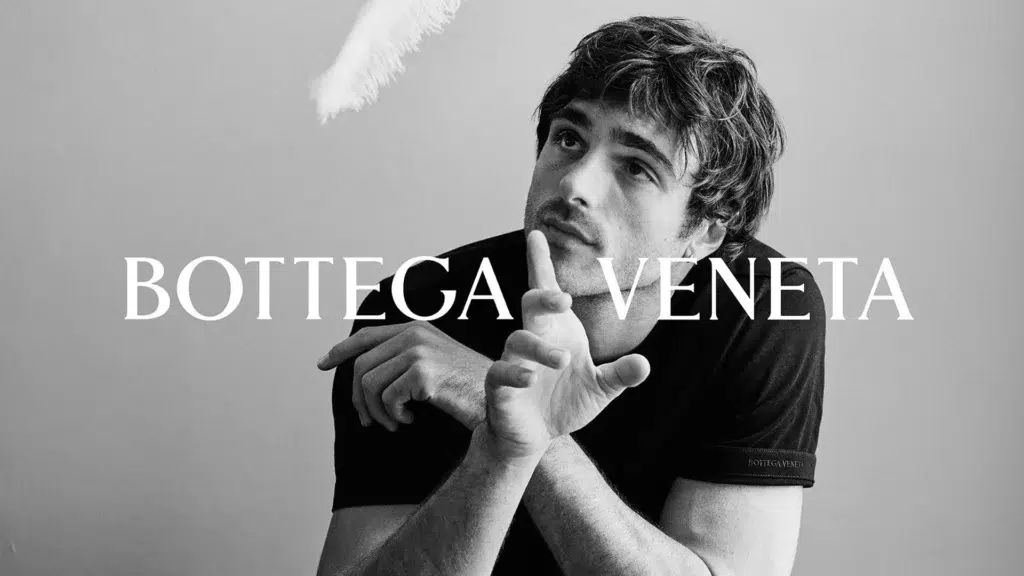
The Jacob Elordi Bottega Veneta Spring/Summer 2024 campaign, photographed by Tyrone Lebon, stripped fashion advertising down to essentials. Black and white photography. Minimal styling. Jacob in various Bottega pieces against stark backgrounds. No elaborate sets, no narrative gimmicks, no celebrity co-stars. Just product, model, and masterful photography creating images that felt more like fine art than commercial advertising.
This minimalism was entirely strategic. Bottega Veneta under Matthieu Blazy rejects the maximalist spectacle dominating luxury fashion. The brand doesn’t need elaborate productions because the clothes speak for themselves through cut, fabric, and craftsmanship. Jacob’s campaign images let viewers focus entirely on how beautifully Bottega’s tailoring drapes on a 6’5″ frame.
Campaign elements defining the aesthetic:
- Black and white photography: Timeless visual language avoiding trendy color palettes that date quickly
- Tyrone Lebon: Photographer known for capturing raw, unpolished beauty perfect for quiet luxury positioning
- Minimal styling: Clean, simple presentations letting garment quality and cut take complete focus
- Studio simplicity: Stark backgrounds eliminating distraction from clothing and Jacob’s physical presence
- Artistic framing: Images designed to feel like editorial art photography not commercial advertising
The campaign generated millions of impressions across Bottega’s social channels and fashion media coverage. Jacob’s personal Instagram posts about the campaign reached his 11 million followers, providing free amplification worth far more than paid advertising. The stark aesthetic also proved highly shareable, with fashion enthusiasts reposting campaign images as aspirational style references.
Why the campaign worked where others failed
Bottega Veneta had featured male celebrities before Jacob Elordi. A$AP Rocky appeared in campaigns. Various actors wore Bottega to red carpets. But none generated the sustained cultural conversation that Jacob’s partnership created. The difference lay in authentic alignment rather than transactional celebrity booking.
Jacob actually wears Bottega Veneta in his personal life, documented through paparazzi photos and red carpet appearances independent of campaign obligations. He chose Bottega for the Priscilla premiere, the Saltburn premiere, and various other high-profile events before and after the campaign launched. This genuine product enthusiasm made the partnership feel credible rather than purchased.
Success factors separating Jacob’s partnership from typical celebrity campaigns:
- Authentic wearing: Jacob photographed in Bottega pieces outside campaign work proving genuine product preference
- Style alignment: His personal aesthetic already matched Bottega’s quiet luxury before any commercial relationship
- Physical ideal: 6’5″ frame represented aspirational masculine proportions luxury menswear targets
- Age advantage: 27 years old positioned him as Gen Z’s older, more sophisticated edge not trying-too-hard youth
- Cultural timing: Partnership launched exactly when quiet luxury peaked as cultural conversation topic
Bottega Veneta’s €1.7 billion bet on stealth wealth
How quiet luxury became fashion’s biggest trend
Quiet luxury, also called stealth wealth, emerged as fashion’s defining trend of the 2020s in reaction against logo-heavy streetwear and conspicuous consumption. The aesthetic emphasizes exceptional quality, perfect tailoring, and subtle craftsmanship over visible branding. Bottega Veneta pioneered the movement, with their intrecciato woven leather becoming the ultimate status symbol for those who know.
The trend’s rise coincided with broader cultural shifts. Younger wealthy consumers increasingly valued discretion over display. Social media made obvious wealth markers feel tacky rather than aspirational. And economic uncertainty made flaunting luxury purchases seem tone-deaf. Bottega Veneta positioned itself perfectly to capture this moment, but needed ambassadors who could communicate the aesthetic to mass audiences.
Market dynamics driving quiet luxury’s dominance:
- €1.7 billion: Bottega Veneta’s 2024 annual revenue demonstrating quiet luxury’s commercial viability at scale
- Social media shift: Instagram culture moving from logo flexing to understated sophistication signaling taste over wealth
- Economic context: Recession fears and wealth inequality making conspicuous consumption culturally uncomfortable
- Quality focus: Gen Z luxury buyers researching craftsmanship and materials more than previous generations
- Celebrity adoption: Succession’s influence on fashion making quiet luxury aspirational for mainstream audiences
Succession, the HBO series ending in 2023, accelerated quiet luxury’s cultural penetration dramatically. The show’s costume design showcased ultra-wealthy characters wearing logo-free luxury, introducing mass audiences to brands like Loro Piana, Brunello Cucinelli, and Bottega Veneta. Jacob Elordi’s casting capitalized on this cultural moment by giving Bottega a face who could sustain the trend’s momentum.
Kering’s strategy and Bottega’s role
Bottega Veneta operates within Kering’s luxury portfolio alongside Gucci, Saint Laurent, Balenciaga, and others. The brand’s €1.7 billion annual revenue makes it significant but smaller than Gucci’s €9.9 billion. Kering positions Bottega as the portfolio’s ultra-luxury, craftsmanship-focused brand targeting sophisticated consumers willing to pay premiums for quality over recognition.
This positioning requires different marketing than Gucci or Balenciaga. Bottega can’t chase viral trends or hype collaborations without compromising its quiet luxury credibility. Celebrity partnerships must feel organic and sophisticated rather than transactional. Jacob Elordi’s genuine style alignment and understated public persona made him perfect for maintaining Bottega’s carefully constructed brand positioning.
Kering portfolio positioning showing Bottega’s strategic role:
- €1.6B Bottega revenue: Smaller than Gucci but profitable and growing, serving ultra-luxury segment
- Craftsmanship focus: Bottega positioned as portfolio’s quality and craftsmanship leader
- Premium pricing: Higher price points than Gucci or Saint Laurent justified by materials and construction
- No logo dependency: Only major luxury brand succeeding without visible branding or logo recognition
- Celebrity selectivity: Bottega casts far fewer ambassadors than competitors, making each partnership more impactful
The broader impact on men’s luxury fashion
How Jacob elevated Bottega’s menswear credibility
Before Jacob Elordi’s partnership, Bottega Veneta’s success skewed heavily toward women’s products. The viral Jodie bag, Puddle boots, and intrecciato accessories were predominantly purchased by female consumers. Menswear existed but lacked the cultural conversation and commercial performance of women’s categories. Jacob’s campaign addressed this imbalance by giving Bottega menswear a face that made it culturally relevant.
His 6’5″ frame showcased how Bottega’s tailoring worked on tall, athletic builds that many luxury brands struggle to dress convincingly. The Spring/Summer 2024 campaign featured suiting, knitwear, and casual pieces that demonstrated Bottega’s range beyond accessories. And Jacob’s personal adoption of the brand for red carpets created repeated organic exposure that traditional advertising couldn’t purchase.
Menswear category impact from Jacob’s partnership:
- Visibility increase: Menswear receiving cultural attention previously reserved for women’s bags and accessories
- Tall fit demonstration: 6’5″ frame showing how Bottega accommodates non-standard proportions elegantly
- Red carpet presence: Jacob wearing Bottega to Priscilla, Saltburn premieres created organic menswear exposure
- Young male demographic: 11M Instagram followers skewing younger male provided direct access to underserved segment
- Tailoring emphasis: Campaign focus on suiting and structure differentiated Bottega from streetwear-heavy competitors
Gen Z men and the quiet luxury conversion
The strategic brilliance of casting Jacob Elordi was converting Gen Z men from logo-dependent streetwear to appreciation for understated luxury. This demographic grew up wearing Supreme, Off-White, and Balenciaga with prominent branding. Quiet luxury represented a fundamental aesthetic shift that required cultural validation from someone they trusted and admired.
Jacob provided that validation. When a 27-year-old actor with 11 million followers chooses Bottega Veneta over logo-heavy alternatives, it signals to his audience that sophisticated taste matters more than visible wealth. The partnership essentially gave Gen Z men permission to embrace quiet luxury without feeling like they were aging into their father’s fashion choices.
Cultural conversion mechanics:
- Peer validation: Jacob’s age and cultural relevance made quiet luxury feel contemporary not conservative
- Aspiration shift: From wanting to look wealthy to wanting to look tasteful, quality-conscious, and sophisticated
- Red carpet education: Repeated Bottega appearances taught audiences to recognize quality without logos
- Social proof: 11M followers seeing Jacob choose Bottega created bandwagon effect among male followers
- Investment justification: Expensive Bottega pieces feel reasonable when positioned as sophisticated taste markers
What the partnership reveals about luxury’s future
Why authenticity beats transaction in modern endorsements
The Jacob Elordi Bottega Veneta partnership succeeds because it feels authentic rather than purchased. Jacob wore Bottega before the campaign. He continues wearing it to events without obvious campaign tie-ins. His personal aesthetic genuinely aligns with the brand’s quiet luxury positioning. This authenticity creates consumer trust that purely transactional celebrity endorsements cannot achieve.
Modern luxury consumers, especially younger ones, research extensively before purchases. They follow celebrities on social media and notice when endorsements feel forced or inconsistent with the celebrity’s usual style. Jacob’s genuine Bottega adoption across multiple years creates credibility that a single campaign booking never could. The partnership works because it documents existing preference rather than manufacturing false association.
Authenticity markers differentiating genuine partnerships:
- Pre-partnership wearing: Jacob photographed in Bottega before any commercial relationship announced
- Continued personal use: Wearing brand to non-campaign events without contractual obligation
- Style consistency: Bottega pieces fitting seamlessly into his established personal aesthetic
- Natural evolution: Partnership feeling like formalization of existing relationship not sudden pivot
- Credible endorsement: Audience believing Jacob actually prefers Bottega over cheaper or trendier alternatives
Quiet luxury’s sustainability beyond trend cycles
Some observers question whether quiet luxury represents a lasting shift or temporary trend. Jacob Elordi’s partnership with Bottega Veneta suggests the aesthetic has staying power beyond momentary fashion cycles. The partnership isn’t built on viral moments or hype that dissipates quickly. It’s built on craftsmanship, quality, and sophistication that transcends trend cycles.
Bottega’s €1.7 billion revenue and continued growth indicate quiet luxury serves genuine consumer demand rather than media-manufactured trend. Wealthy consumers genuinely prefer understated luxury that signals taste to those who know. Jacob’s younger audience discovering these values suggests quiet luxury will persist as they age and gain purchasing power. The aesthetic isn’t trend, it’s taste maturation.
Indicators suggesting quiet luxury’s permanence:
- Revenue stability: Bottega’s €1.6B annual revenue sustained across multiple years not single-season spike
- Craftsmanship value: Focus on quality appeals to consumers researching purchases more carefully than previous generations
- Economic reality: Discretion increasingly valued as wealth inequality makes conspicuous consumption uncomfortable
- Taste evolution: Gen Z aging into sophistication rather than remaining in logo-dependent streetwear indefinitely
- Celebrity adoption: A-list stars choosing quiet luxury for important events signals lasting cultural shift
The Bottom Line
Jacob Elordi’s partnership with Bottega Veneta represents quiet luxury’s most strategic celebrity collaboration, successfully translating stealth wealth aesthetics to Gen Z audiences while driving the brand’s €1.7 billion annual revenue. The partnership works because Jacob genuinely embodies the quiet luxury philosophy through his personal style, physical presence, and cultural positioning as Gen Z’s sophisticated edge.
Bottega Veneta’s choice of Jacob over more obvious celebrity options demonstrates the brand’s understanding of modern luxury marketing. Authenticity matters more than follower counts. Long-term credibility matters more than viral moments. And genuine style alignment matters more than transactional celebrity bookings. Jacob wears Bottega because it matches who he is, not because a contract requires it.
Key success factors defining the partnership’s impact:
- Authentic alignment: Jacob’s personal style genuinely matched Bottega before any commercial relationship existed
- Gen Z bridge: 27 years old and 11M followers provided access to younger luxury consumers Bottega needed
- Physical ideal: 6’5″ frame showcased menswear tailoring perfectly, elevating Bottega’s underperforming men’s category
- Cultural timing: Partnership launched as quiet luxury peaked, positioning Jacob as trend’s male Gen Z face
- Sustained commitment: Continued wearing beyond campaign obligations created credibility transactional endorsements lack
For luxury brands studying celebrity partnerships, the Jacob Elordi Bottega Veneta collaboration provides the blueprint. Find celebrities who already wear your products authentically. Choose faces that genuinely embody your brand aesthetic rather than chasing maximum follower counts. Build sustained relationships rather than one-off campaign bookings. And recognize that modern consumers, especially younger ones, value authentic preference over purchased endorsements.
As quiet luxury continues shaping fashion’s future, Jacob Elordi’s partnership with Bottega Veneta will stand as the moment Gen Z men discovered that sophisticated taste matters more than visible wealth. That’s the partnership’s real legacy: converting a generation from logo dependence to appreciation for craftsmanship, quality, and understated elegance.