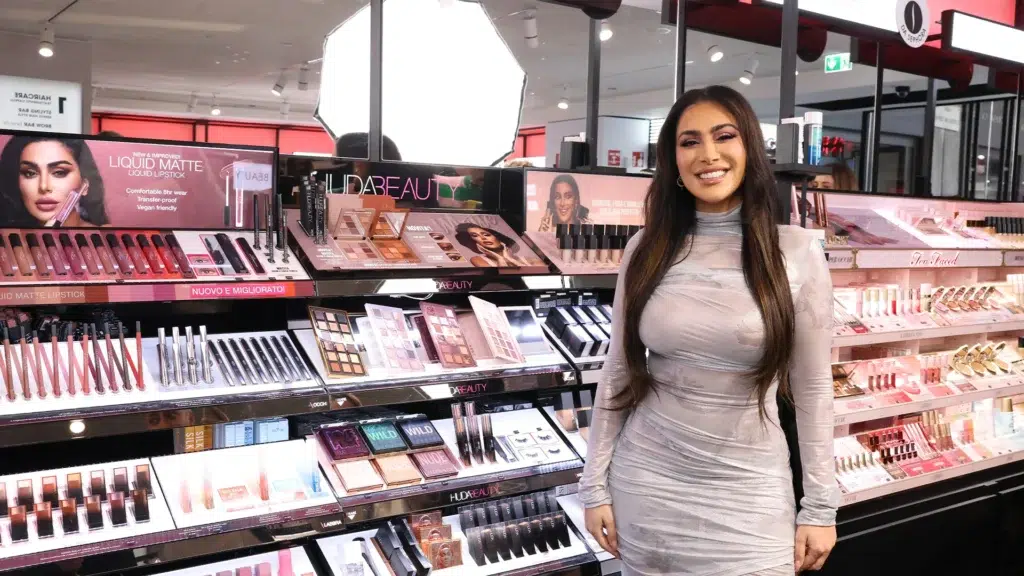
In April 2010, Huda Kattan launched a simple WordPress blog called “Huda Beauty” from Dubai. She had no investors, no business degree in beauty, and no grand plan beyond sharing makeup tutorials she learned working as a freelance makeup artist in Los Angeles. Fifteen years later, Huda Beauty stands valued at over $1 billion, has 57.1 million Instagram followers (more than double Kylie Cosmetics’ 24.7 million and seven times Rare Beauty’s 8 million), generates approximately $75 million in annual revenue from cosmetics alone, and in June 2025, Huda Kattan became one of the few beauty founders in history to buy back full ownership from a private equity firm.
The numbers tell part of the story. Huda Kattan’s personal net worth stands at $550 million as of December 2025. Her brand outsells established names at Sephora globally. The Kayali fragrance division she co-founded with sister Mona Kattan was sold to General Atlantic and Mona in February 2025 for an undisclosed sum that enabled Huda to buy back the stake TSG Consumer Partners held since 2017, returning Huda Beauty to complete founder control.
The Huda Beauty Numbers:
- Personal net worth (2025): $550 million (Reality Tea, Celebrity Net Worth)
- Brand valuation (2017): $1.2 billion when TSG invested
- Annual revenue (2024): $75 million from cosmetics (Wikipedia)
- Instagram followers: 57.1 million (versus Rare Beauty 8M, Kylie Cosmetics 24.7M)
- Launch: 2010 blog, 2013 first product (false eyelashes via Sephora Dubai)
- TSG investment: December 2017 minority stake at $1.2B valuation
- KAYALI sale: February 2025 to Mona Kattan and General Atlantic
- TSG buyback: June 2025, full founder ownership restored
- Product count: 140+ SKUs across makeup, skincare (Wishful, Glowish)
- Biggest award: Hottest beauty brand Q1 2025 (Cosmetify, beat Fenty Beauty, Nyx, Dior)
This is not another celebrity beauty brand built on licensing deals and manufactured hype. This is the story of how an Iraqi-American makeup artist from Oklahoma built one of the most valuable independent beauty companies in the world through authentic content, strategic timing, and refusing to sell when everyone told her to.
How Huda Beauty Started: The Blog That Became a Billion-Dollar Business
From Finance Degree to False Eyelashes
Huda Kattan was born October 2, 1983 in Oklahoma City, Oklahoma to Iraqi parents. She grew up in Cookeville, Tennessee and later moved to Dartmouth, Massachusetts. Unlike most beauty founders, Huda actually studied finance at the University of Michigan-Dearborn, graduating with a degree that seemed destined for corporate banking or investment management.
Instead, in 2006, she followed her father to Dubai when he accepted a teaching position. After two years working in finance and hating every moment, Huda made a radical decision: she would train as a makeup artist in Los Angeles and build a career doing what she loved instead of what paid well.
The Early Years:
- 2006: Moved to Dubai with family when father accepted teaching role
- 2008-2009: Returned to Los Angeles to study makeup artistry
- Celebrity clients: Eva Longoria, Nicole Richie among early high-profile work
- Revlon employment: Worked as makeup artist for Revlon after returning to Dubai
- Side hustle: Freelance makeup artist building portfolio and skills
The Blog That Started Everything
On April 2010, Huda launched a WordPress blog called “Huda Beauty” offering makeup tutorials and beauty tips. The blog wasn’t revolutionary. Hundreds of beauty bloggers existed by 2010. But Huda brought something different: genuine technical skill from professional training, Middle Eastern beauty perspectives rarely seen in Western-dominated beauty media, and an authentic, conversational voice that didn’t talk down to readers.
Within months, the blog attracted thousands of daily visitors. By 2012, it became one of the most-viewed beauty blogs globally according to Forbes, eventually reaching one million unique monthly visitors by 2018 (Similar Web data).
Blog to Business Evolution:
- April 2010: Launched Huda Beauty WordPress blog with makeup tutorials
- 2011: Blog traffic exploded, became top beauty content destination
- Instagram launch: Started sharing makeup looks on Instagram, follower count grew exponentially
- 2013 decision: Use blog audience and social media following to launch actual products
- Funding: $10,000 personal savings + $6,000 borrowed from sister Alya Kattan
The First Product: False Eyelashes and the Kardashian Effect
Why Lashes?
In 2013, Huda made her first product decision: false eyelashes. Not lipstick, not eyeshadow, not foundation. Eyelashes. The reasoning was strategic. False lashes were consumable (customers buy repeatedly), had high margins, required less complex manufacturing than color cosmetics, and addressed a specific need Huda identified from years applying makeup professionally: most false lashes looked fake or felt uncomfortable.
Working with manufacturers, Huda developed a collection of false eyelashes designed to look natural while adding drama. They launched exclusively through Sephora Middle East in Dubai in 2011, then expanded to Sephora United States in 2015.
The Launch Strategy:
- First product: Collection of false eyelashes
- Launch partner: Sephora Middle East (Dubai, 2011), then Sephora US (2015)
- Price point: Accessible premium, $20-25 per pair
- Unique selling point: Natural-looking drama, comfortable wear
- Kardashian boost: Kourtney, Khloe, Kim Kardashian began wearing Huda Beauty lashes, providing massive publicity
The Kardashian connection wasn’t paid endorsement. It was organic. The sisters genuinely wore the lashes, posted about them on social media, and the Huda Beauty Instagram account exploded. By 2017, Huda’s personal Instagram reached 20+ million followers, making her the top beauty influencer on Instagram’s 2017 Influencer Rich List, reportedly earning up to $18,000 per sponsored post.
Expanding Beyond Lashes
After proving the business model with lashes, Huda expanded into liquid lipsticks (2016), eyeshadow palettes (2017), and eventually a full color cosmetics range. Each launch followed the same pattern: Huda tested products herself, shared the development process on social media, built anticipation, then sold through Sephora and HudaBeauty.com.
Product Expansion Timeline:
- 2011-2015: False eyelashes establishing brand foundation
- 2016: Liquid lipsticks and lip liners entering color cosmetics
- 2017: Eyeshadow palettes, Desert Dusk and Rose Gold collections became bestsellers
- 2018: Foundation launch with 30+ shades (criticized for copying Fenty Beauty’s 40-shade Pro Filt’r)
- 2018: Kayali fragrance line launched, co-founded by sister Mona Kattan
- 2020: Wishful skincare arm launched with Yo Glow Enzyme Scrub
- 2021: Glowish skincare line added
The $1.2 Billion Valuation: TSG Investment and What It Meant
Why TSG Wanted Huda Beauty
In December 2017, TSG Consumer Partners, a California-based private equity firm with previous investments in Smashbox and IT Cosmetics, acquired a minority stake in Huda Beauty at a $1.2 billion valuation. The deal made Huda one of the richest self-made women in the beauty industry and validated her DIY approach to building a global brand.
TSG’s investment thesis was straightforward: Huda Beauty had genuine revenue (approaching $300 million annually by 2018), massive organic social media reach (26+ million Instagram followers at time of deal, now 57.1 million), proven product-market fit across Sephora globally, and authentic founder involvement that couldn’t be replicated by established competitors.
The TSG Deal:
- Investment date: December 2017
- Stake acquired: Minority stake (exact percentage not disclosed)
- Valuation: $1.2 billion total company value
- Investor: TSG Consumer Partners (previously invested in Smashbox, IT Cosmetics)
- Use of funds: Global expansion, manufacturing scale, additional hiring
- Founders retained: Majority control remained with Huda, Mona, and Alya Kattan
Life Under Private Equity: 2018-2025
The TSG partnership brought professional infrastructure. In 2020, Huda stepped down as CEO and appointed industry veteran Nathalie Kristo from Clinique to scale the business. By 2021, Huda and her husband Christopher Gonçalo took back co-CEO roles. In February 2024, Huda publicly announced she was returning as sole CEO and launching a brand refresh.
But the TSG years also brought pressure to grow revenue beyond the core cosmetics line. Kayali fragrance (2018) succeeded. Wishful skincare (2020) and Glowish skincare (2021) struggled, failing to replicate the magic of Huda’s makeup products.
TSG Era Performance:
- 2018 projected revenue: On track for $300 million
- 2020: Huda stepped down as CEO, appointed Nathalie Kristo
- 2021: Huda and Christopher Gonçalo became co-CEOs
- 2024 February: Huda returned as sole CEO, announced brand refresh
- 2024 revenue: $75 million from cosmetics alone (Wikipedia, September 2024)
The $75 million revenue figure for 2024 is significantly lower than the $300 million projections from 2018, suggesting the brand faced challenges during the TSG partnership years, possibly from competition with Rare Beauty, Fenty Beauty, Rhode, and other celebrity brands that launched 2017-2022.
The 2025 Buyback: Regaining Full Control
The KAYALI Sale That Funded Everything
On February 17, 2025, Huda Beauty announced it was selling the Kayali fragrance division to co-founder Mona Kattan and General Atlantic, a global private equity firm. Kayali, launched in 2018, had become a successful standalone fragrance brand with 6+ million social media followers and strong global distribution.
The sale served dual purposes: it allowed Mona to fully own and control the fragrance brand she built, while providing Huda Beauty with the capital to buy back TSG Consumer Partners’ minority stake held since 2017.
The KAYALI Transaction:
- Announcement: February 17, 2025
- Buyer: Mona Kattan (co-founder) and General Atlantic (private equity)
- Terms: Undisclosed valuation, subject to regulatory approval
- Post-sale structure: Kayali operates independently with Mona as CEO
- Strategic impact: Proceeds used to buy back TSG stake in Huda Beauty
- Advisors: Goldman Sachs (Huda Beauty), Raymond James (General Atlantic), Skadden Arps (Mona Kattan)
Full Founder Ownership Restored
In June 2025, three months after the Kayali sale closed, Huda Kattan announced that Huda Beauty had fully redeemed the ownership interest TSG Consumer Partners held since December 2017. The brand returned to complete founder control, making Huda one of the few beauty entrepreneurs in history to buy back a stake from institutional investors.
“We are always told, as founders, that we have to do things a certain way,” Huda told WWD in June 2025. “You have to go institutionally in a certain route. It’s all about money, but when you’re a founder just starting out, you start with a vision. We were told we couldn’t do a brand from Dubai. We were told you have to sell your brand and you can’t buy your equity back from TSG.”
The Buyback Achievement:
- Completion: June 2025
- Full ownership: Returned to Huda, Mona (no longer involved post-Kayali sale), Alya Kattan
- TSG exit: Private equity fully bought out after 7.5 years
- Rare achievement: One of few established beauty brands to return to full founder control
- Industry significance: Demonstrates sustainable indie beauty model without permanent PE ownership
Huda Beauty vs. The Competition: Where It Stands in 2025
Instagram Followers as Market Position Proxy
In beauty, Instagram followers correlate directly with brand awareness and sales potential. As of December 2025, Huda Beauty’s 57.1 million Instagram followers dwarf most competitors, including celebrity beauty brands launched with far more initial capital and hype.
Instagram Follower Comparison (December 2025):
- Huda Beauty: 57.1 million followers
- Kylie Cosmetics: 24.7 million followers (less than half Huda’s reach)
- Fenty Beauty: Data not available but estimated 10-15 million
- Rare Beauty: 8 million followers (seven times smaller than Huda)
- Rhode (Hailey Bieber): Data not available but estimated 3-5 million
- Pleasing (Harry Styles): 8.4 million followers
Hottest Beauty Brand Q1 2025
According to Cosmetify data analyzing social media following, engagement, and Google search volumes, Huda Beauty ranked as the hottest beauty brand in Q1 2025, beating Fenty Beauty, Nyx Professional Makeup, and Dior Beauty. This ranking demonstrated sustained consumer interest despite revenue declines from 2018 peaks.
Why Huda Beauty Maintains Relevance:
- Founder authenticity: Huda personally tests products, appears in campaigns, maintains genuine involvement unlike passive celebrity endorsements
- Middle Eastern perspective: Brings unique beauty aesthetics and techniques rarely seen in Western-dominated beauty market
- Product quality: Maintains high ratings across Sephora, Ulta, and independent review sites
- Social media mastery: 15 years of consistent, genuine content beats paid influencer campaigns at most competitors
- Dubai base: Operating from Dubai rather than LA or NYC provides cost advantages and unique positioning
The Controversies: What Complicated the Story
The 2022 FDA Lawsuit
In 2022, the US Food and Drug Administration flagged Huda Beauty’s Neon Obsessions palette for using prohibited substances around the eye area. A class-action lawsuit filed by consumers claimed the palette concealed prohibited ingredients by hiding warning labels stating “not intended for the eye area.” A California federal judge approved a $1.93 million settlement plus $1.2 million in legal fees for plaintiffs.
The lawsuit damaged the brand’s reputation for quality and regulatory compliance, particularly among US consumers who expected FDA-approved formulations from premium beauty brands.
The August 2025 TikTok Controversy
In August 2025, Huda faced severe backlash after posting a TikTok video that TikTok removed for violating community guidelines. The video allegedly accused Israel of causing World Wars I and II, the September 11 attacks, and Hamas’ October 7, 2023 attacks. Public criticism followed immediately, with Sephora publicly stating it was “reviewing” its relationship with Huda Beauty.
The controversy sparked boycott calls and raised questions about whether retailers would continue stocking the brand. As of December 2025, Huda Beauty remains available at Sephora globally, though the brand’s reputation took a hit in Western markets.
Additional Controversies:
- 2018 vaginal lightening blog post: Widely criticized as unprofessional and dangerous
- 2017 Fenty Beauty copying accusations: Foundation launch criticized for appearing to copy Fenty’s 40-shade Pro Filt’r campaign imagery
- January 2026: Faced backlash during 2025-2026 Iranian protests for Instagram post critics characterized as supportive of Islamic Republic state narrative
The Bottom Line: What Makes Huda Beauty Different
Huda Kattan’s journey from a 2010 WordPress blog to a $1 billion beauty brand, regaining full ownership in 2025 after buying back private equity, represents one of the most successful indie beauty stories of the social media era. Unlike Kylie Cosmetics (sold to Coty), Rare Beauty (exploring sale), or Rhode (sold to e.l.f. Beauty for $1 billion), Huda Beauty proved a founder-controlled beauty brand can scale to nine figures, survive private equity partnership, and return to independence.
Why Huda Beauty Succeeded Where Others Failed:
- Authentic expertise: Huda trained professionally as makeup artist, worked with celebrities, and brought genuine technical skill versus celebrity licensing deals
- Content-first approach: 15 years of consistent beauty tutorials, product reviews, and behind-the-scenes content built trust impossible to manufacture through paid advertising
- Strategic product launches: Started with false lashes (proven need, high margins, repeat purchase) before expanding to full color cosmetics
- Sephora partnership: Global Sephora distribution from day one provided legitimacy and scale indie brands typically lack
- Middle Eastern positioning: Operating from Dubai and representing Arab beauty perspectives differentiated Huda from LA/NYC-based competitors
- Founder commitment: Huda never treated the brand as side project, maintaining active involvement even during TSG partnership
The buyback of TSG’s stake in June 2025 demonstrated something rare in beauty: a founder willing to sacrifice short-term liquidity to maintain long-term control and vision. Where George Clooney sold Casamigos for $1 billion, Kylie Jenner sold majority of Kylie Cosmetics for $600 million, and Hailey Bieber sold Rhode for $1 billion, Huda chose independence over exit.
Key Success Factors:
- Social media leverage: 57.1 million Instagram followers provide free marketing worth hundreds of millions annually
- Product consistency: Maintains 4+ star ratings across Sephora, demonstrating genuine quality versus hype-driven launches
- Strategic exits: KAYALI sale funded TSG buyback, proving savvy capital management
- Founder authenticity: Huda personally appears in campaigns, tests products, maintains genuine brand connection
- Global distribution: Available in Sephora globally, Cult Beauty, and direct-to-consumer via HudaBeauty.com
- Influencer credibility: Named one of Time’s 25 Most Influential People Online, recognized as top beauty influencer by Forbes
Lessons from Huda’s Journey:
- Content builds brands: The 2010 blog created audience that became customers, proving content marketing before it was mainstream strategy
- Quality compounds: 15 years of consistent product quality beats short-term viral launches
- Private equity isn’t forever: The TSG buyback proves founders can regain control if they structure deals properly
- Authenticity scales: Huda’s genuine involvement differentiates the brand in era of passive celebrity licensing
- Patience pays: Building to $1B valuation over 13 years (2013-2025) beats rushing to exit in year 3-5
Current Reality December 2025:
- Ownership: Full founder control after June 2025 TSG buyback
- Revenue: $75 million from cosmetics (2024), projected growth under independent ownership
- Valuation: Estimated $1 billion+ based on 2017 TSG deal and subsequent growth
- Distribution: Sephora globally, Cult Beauty, HudaBeauty.com
- Product count: 140+ SKUs across makeup, Wishful skincare, Glowish skincare
- Net worth: Huda Kattan personal net worth $550 million (December 2025)
Whether Huda Beauty reaches the $2-3 billion valuations of Rare Beauty or maintains its current trajectory depends on how successfully Huda executes the brand refresh launched in February 2024. The Q1 2025 ranking as hottest beauty brand (beating Fenty, Nyx, Dior) suggests consumer appetite remains strong. The Instagram follower lead over Kylie Cosmetics and Rare Beauty provides ongoing marketing advantage. The full founder control allows agility larger corporate-owned brands lack.
For Huda Kattan at 42, the $550 million net worth and full control of a billion-dollar brand represent validation of every decision critics questioned: training as makeup artist instead of staying in finance, moving to Dubai instead of Los Angeles, starting with a blog instead of launching products immediately, refusing acquisition offers from global conglomerates, and buying back equity instead of cashing out.
Huda Beauty isn’t the biggest beauty brand. It isn’t the fastest-growing. But it might be the most authentic celebrity beauty brand ever built, and in June 2025, it became one of the few to escape private equity and return to complete founder ownership. That makes it genuinely rare.