In 1969, Italian jewelry designer Aldo Cipullo lay awake at 3am, tormented by a failed relationship. His heart was broken and the only thing remaining from the romance were memories. That sleepless night produced a design sketch that would become one of the most recognizable pieces of jewelry in the world and transform Cartier into a jewelry powerhouse.
The Cartier Love bracelet launched in 1970 at $250 for a gold-plated version. Today, the solid 18-karat gold bracelet starts at $7,350 and goes up to $62,000 for diamond pavé versions. The Love collection, which has expanded to include rings, necklaces, earrings, and watches, accounts for approximately one-third of Cartier’s annual revenue. Parent company Richemont reported €14.2 billion in jewelry sales for 2024, with Cartier as the dominant driver.
The bracelet’s genius was not in its materials or craftsmanship. It was in transforming love into a physical lock that could only be fastened with help from another person, using a tiny screwdriver that came with each purchase. This made the Love bracelet the first piece of permanent jewelry, a category that did not exist before Cipullo invented it.
This is how one heartbroken designer turned hardware store inspiration into luxury’s most profitable product strategy, creating a collection that has outsold every competitor for 55 consecutive years.
Why Tiffany Rejected the Design That Made Cartier Billions
Aldo Cipullo designed the Love bracelet while working at Tiffany & Co. in 1969. He presented the concept to Tiffany management: a rigid gold bangle featuring visible screws that locked around the wrist and required a special screwdriver to remove. The design was radical, drawing inspiration from medieval chastity belts and industrial hardware rather than traditional fine jewelry aesthetics that dominated the era.
Tiffany passed on the design. The concept felt too unconventional, too hardware-focused, and too far from the romantic diamond jewelry that defined Tiffany’s brand identity. Management could not see how industrial screws translated to luxury or why customers would want jewelry they could not put on themselves.
Cipullo left Tiffany when his contract expired and took the design to Cartier New York. Michael Thomas, president of Cartier’s independent New York branch, immediately recognized the bracelet’s massive potential to appeal to a new generation with entirely new values and attitudes about love, commitment, and luxury. Thomas understood that the 1970s counterculture created opportunity for jewelry that felt modern, unisex, and permanent rather than precious and feminine.
Why Tiffany missed billion-dollar opportunity:
- Too unconventional: Hardware aesthetic conflicted with traditional jewelry design language
- Gender ambiguity: Unisex design did not fit feminine-focused luxury jewelry market
- Functionality concerns: Customers expecting easy-on jewelry would reject lock mechanism
- Commitment symbolism: Permanent jewelry felt too serious for casual luxury purchases
- Industrial inspiration: Screws and bolts seemed inappropriate for fine jewelry
- Limited imagination: Could not envision hardware translating to luxury status
Cartier launched the Love bracelet in 1970 and immediately gifted pieces to high-profile celebrity couples including Elizabeth Taylor and Richard Burton, and Ali McGraw and Steve McQueen. The celebrity endorsements, combined with the bracelet’s revolutionary concept of jewelry as commitment symbol rather than ornamentation, created instant demand that has never subsided.
Aldo Cipullo: The Designer Who Made Jewelry Modern
Cipullo was born in Naples in 1935 but grew up in Rome, the eldest of five children. His father ran a costume jewelry business and sent young Aldo out after school with bags of jewelry to sell, teaching him salesmanship from childhood. Artistically talented and movie-star handsome, Cipullo was obsessed with American culture, earning the nickname “Aldo Americano” for his blue jeans and Stetson hat.
He arrived in New York in 1959 at age 24, studied at the School of Visual Arts, and worked as bench jeweler at David Webb before joining Tiffany in 1967. His design philosophy centered on taking everyday objects and transforming them into luxury through simplicity and meaning. Bolts, screws, nails, and wrenches became his signature motifs, elevating industrial hardware to fine jewelry status.
Cipullo’s design philosophy:
- Industrial inspiration: Hardware stores provided design vocabulary other jewelers ignored
- Modernist minimalism: Clean lines and functional forms replacing ornate traditional jewelry
- Emotional narrative: Pieces told stories about love, commitment, freedom, and identity
- Unisex appeal: Designing for both men and women equally rather than gender-specific
- Permanent wearability: Jewelry meant to stay on body rather than saved for special occasions
- American boldness: Reflecting 1970s New York cultural confidence and freedom
How the Screw-Lock Mechanism Created Permanent Jewelry Category
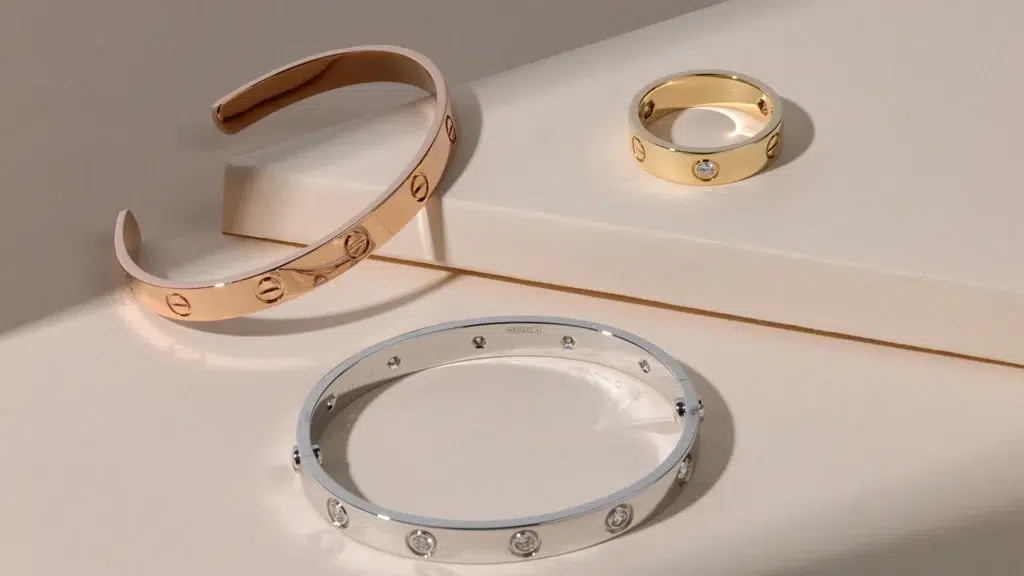
The Cartier Love bracelet consists of two curved gold halves that fit around the wrist and connect via a proprietary screw system. Four small screws, two functional and two decorative, dot the exterior surface creating the bracelet’s signature aesthetic. The functional screws require a tiny screwdriver, included with purchase, to fasten and remove the bracelet.
This mechanism made the Love bracelet fundamentally different from every bracelet that preceded it. Traditional bracelets featured hinges, clasps, or elastic allowing wearers to put them on independently. The Love bracelet deliberately required help from another person, transforming jewelry from personal accessory into relationship ritual. The act of locking the bracelet onto your partner’s wrist became ceremonial, a physical manifestation of commitment that traditional jewelry could not match.
The permanence created powerful psychological dynamics. Once locked on, wearers left the bracelet on continuously, showering, sleeping, and living with it. This constant presence made the Love bracelet more intimate than rings or necklaces removed nightly. It became part of the body, a permanent reminder of commitment that traditional removable jewelry could not provide.
Why permanent jewelry revolutionized the category:
- Requires partnership: Cannot put on alone, forcing relationship interaction
- Continuous wear: Designed to stay on indefinitely unlike special occasion jewelry
- Commitment symbol: Physical lock representing emotional bond permanence
- Ritual creation: Locking ceremony adding meaning beyond material value
- Visible marker: Screws instantly recognizable signaling relationship status
- Intimacy level: Constant body presence creating stronger emotional attachment
The permanent jewelry concept Cipullo invented has spawned entire industry. Jewelers now offer welded chains, permanent bracelets, and lock-fastened pieces all tracing lineage directly to the 1969 Love bracelet innovation. But none have matched Cartier’s execution or cultural penetration because none carried the narrative power of love locked permanently.
The $250 Launch Price That Became $62,000
Cipullo’s original 1970 Love bracelets were gold-plated rather than solid gold, priced at accessible $250 to reach younger customers who valued the concept over precious materials. This democratic pricing reflected both Cipullo’s design philosophy and Thomas’ marketing strategy targeting a generation that rejected their parents’ conspicuous luxury but still desired meaningful status symbols.
Cartier quickly transitioned to solid 18-karat gold as demand exploded and the Love bracelet established luxury credentials. Prices increased systematically over five decades as Cartier moved the collection firmly upmarket, transforming from accessible luxury into premium jewelry commanding prices rivaling traditional diamond pieces.
Current Love bracelet pricing (2025):
- Classic yellow gold: $7,350 for solid 18k gold bangle
- Small model: $5,800 for thinner 3.6mm width version
- Diamond version: $10,300 with four diamonds embedded in screws
- 10-diamond version: $14,600 with additional stone settings
- Full pavé: $62,000 with diamonds covering entire surface
- Custom configurations: Pricing varies by stone quality and metal choice
The 2,380% price increase from $250 (1970) to $62,000 (2025) for top versions exceeds inflation dramatically, reflecting Cartier’s systematic repositioning from accessible to ultra-luxury. The classic solid gold bracelet at $7,350 represents 29x increase from original $250, still substantial but more moderate reflecting Cartier’s need to maintain entry-level accessibility while pushing high-end boundaries.
Expanding Love Beyond Bracelets Into Total Product Ecosystem
Cartier introduced the Love ring in 1978, eight years after the bracelet launched, extending the screw motif into additional product category. The rings featured the same visible screws and minimalist aesthetic, offering customers who wanted Love symbolism in traditional engagement or wedding ring format. This expansion proved strategically brilliant, allowing Cartier to capture committed couples at multiple price points and wear occasions.
The 1979 introduction of diamond-studded Love bracelets added premium tier above the solid gold version, enabling Cartier to capture customers willing to spend significantly more for enhanced luxury. White gold followed in 1993, rose gold in 2002, and mini Love bracelets in 2016, systematically covering all metal preferences and wrist sizes. By 2025, the Love collection included rings, bracelets, necklaces, pendants, earrings, cufflinks, and watches unified by the screw motif.
This product proliferation transformed Love from single item into comprehensive jewelry wardrobe. Customers could stack multiple Love bracelets in different metals, match Love rings to bracelets, layer Love necklaces, and coordinate Love earrings creating total look. Cartier actively encouraged this mixing through marketing campaigns showing models wearing multiple pieces simultaneously.
Love collection product expansion:
- Bracelets: Classic, small, cuff, diamond variations across three metal colors
- Rings: Narrow, wide, multi-row, pavé diamond versions
- Necklaces: Pendants, chains, statement pieces featuring screw motif
- Earrings: Studs, hoops, drops in coordinating designs
- Watches: Love-branded timepieces incorporating signature aesthetic
- Cufflinks: Men’s accessories extending collection beyond jewelry
The collection expansion strategy worked because every piece reinforced the core Love narrative while offering entry at different price points. A customer priced out of the $7,350 bracelet could enter the collection via $1,600 ring or $800 pendant, eventually upgrading to higher-value pieces as income increased. This tiering captured customers across income spectrum while maintaining cohesive brand story.
Celebrity Endorsement Strategy That Built Cult Status
Cartier’s celebrity strategy differed fundamentally from paid endorsement deals that luxury brands typically deployed. Rather than contracting ambassadors, Cartier strategically gifted Love bracelets to influential celebrity couples in the 1970s, letting organic adoption and paparazzi documentation create desire. Elizabeth Taylor and Richard Burton famously wore matching Love bracelets, as did Ali MacGraw and Steve McQueen, creating association between Hollywood’s most glamorous relationships and Cartier’s permanent jewelry.
The strategy worked because it felt authentic rather than commercial. These couples genuinely wore the bracelets continuously, photographed in them repeatedly across years, demonstrating the permanent wearability concept rather than treating them as paid endorsement props worn once for campaigns. The visible screws made Love bracelets instantly recognizable in paparazzi shots, providing continuous free publicity as celebrities lived their lives.
Celebrity adoption driving Love bracelet cultural status:
- Elizabeth Taylor & Richard Burton: Original 1970s power couple establishing luxury credentials
- Ali MacGraw & Steve McQueen: Bohemian cool translating Love to counterculture acceptance
- Angelina Jolie: Contemporary celebrity adoption maintaining relevance across generations
- Jennifer Aniston: Accessible celebrity appeal broadening demographic reach
- Victoria Beckham: Fashion credibility validating Love as style statement
- Meghan Markle: Royal endorsement elevating prestige positioning
Modern celebrity adoption continues organically without Cartier paying endorsement fees, proving the product’s cultural staying power. When Meghan Markle wore her Cartier Love bracelet to royal events, it generated hundreds of millions in publicity value. Cartier benefits from continuous celebrity visibility without the expense and authenticity concerns that paid partnerships create.
The 33% Revenue Contribution Making Love Cartier’s Most Valuable Asset
The Love collection accounts for approximately one-third of Cartier’s total annual revenue according to industry analysis, making it the single most commercially successful jewelry collection in luxury history. For context, Cartier is Richemont’s largest brand within a jewelry division generating €14.2 billion in 2024. If Love represents 33% of Cartier revenue, the collection generates several billion dollars annually from a design created 55 years ago.
This revenue concentration creates both strength and vulnerability. Love’s profitability funds Cartier’s entire high jewelry operations, boutique expansions, and new collection development. But heavy dependence on single product family means Cartier faces existential risk if Love ever loses cultural relevance or competitive positioning weakens.
Cartier has managed this risk by continuously refreshing the collection through new product introductions, metal variations, diamond configurations, and limited editions while never changing the core design that customers recognize instantly. The 1970 bracelet looks nearly identical to 2025 versions, preserving heritage while allowing customization through stacking, mixing metals, and choosing diamond densities.
Why Love collection dominates Cartier financially:
- Consistent demand: 55 consecutive years without significant sales decline
- Premium pricing: $7,350-$62,000 per bracelet generates extraordinary margins
- Repeat purchases: Stack culture driving multiple bracelet sales per customer
- Product family: Rings, necklaces, earrings multiplying customer lifetime value
- Gift market: Commitment symbolism making Love preferred romantic gift
- Resale strength: Strong secondary market validating purchase as investment
The collection’s enduring success validates permanent jewelry as legitimate luxury category and demonstrates that emotional narrative can sustain product relevance across generations when execution remains disciplined. Love succeeds not because of materials or craftsmanship superiority but because the story of locked commitment resonates universally across cultures and time.
Trademark Protection and Copycat Legal Battles
Cartier filed trademark protection for “Love Bracelet” in 1974, specifically protecting the spelling with a line through the “O” and “E” (styled as L⊝VE). This trademark prevents competitors from using identical branding, though it does not protect the screw motif design itself which other jewelers have copied extensively.
Throughout the 1990s and 2000s, Cartier pursued aggressive litigation against Manhattan and Puerto Rico jewelry stores selling counterfeit Love bracelets. The lawsuits established precedent that Cartier would defend its intellectual property relentlessly, creating legal risk for competitors attempting direct copies. In 2019, a Singapore court dismissed Cartier’s attempt to trademark the word “love” in jewelry, demonstrating limits of trademark protection even for brands with established associations.
Cartier intellectual property protection:
- Trademark: “Love Bracelet” with specific L⊝VE styling protected since 1974
- Design patents: Specific screw configurations and bracelet proportions
- Litigation history: Multiple successful lawsuits against counterfeiters
- Enforcement priority: Active monitoring and legal action against copies
- Authentication: Official Cartier stamps and certificates verifying authenticity
- Screwdriver inclusion: Original tool included with purchase as authenticity marker
Despite legal protections, the Love bracelet remains one of the most counterfeited jewelry pieces globally. The simple design makes replication relatively easy, and strong demand creates profitable black market. Cartier combats this through authentication services, original screwdriver inclusion, and certificates of authenticity, but copies persist across online marketplaces.
The Bottom Line
Cartier Love bracelet strategy proved that jewelry could sell emotion more profitably than gems. From $250 launch price to $62,000 pavé versions, from single bracelet to comprehensive product family generating billions annually, Love transformed Cartier from respected jeweler into cultural phenomenon defining permanent jewelry category.
The 55-year run demonstrates that timeless design paired with powerful narrative sustains luxury relevance across generations when executed with discipline. Cartier never fundamentally changed the Love bracelet design Cipullo created in 1969, resisting trends and fashion cycles that might have diluted the purity that makes the piece recognizable instantly.
What made Cartier Love bracelet strategy succeed:
- Emotional narrative: Love as physical lock resonating universally across cultures
- Permanent jewelry: Creating new category through screw-lock mechanism requiring partner
- Celebrity adoption: Organic endorsements by power couples creating authentic desire
- Product proliferation: Expanding from bracelets into rings, necklaces, earrings
- Revenue concentration: 33% of Cartier revenue from single collection
- Premium pricing: $7,350-$62,000 per piece generating extraordinary margins
- Stack culture: Multiple bracelet ownership driving repeat purchases
- Timeless design: 55 years without fundamental changes preserving recognition
The challenge ahead involves maintaining Love’s cultural relevance as younger consumers prioritize experiences over possessions and question traditional symbols of commitment. Lab-grown diamond disruption and changing relationship norms could weaken the permanent commitment narrative that makes Love meaningful. Competitors have successfully copied the screw aesthetic without Cartier’s heritage, creating price pressure.
But Love’s staying power through five decades suggests the collection possesses resilience that temporary trends cannot diminish. The bracelet works because the story works, and human need for commitment symbols appears timeless regardless of cultural shifts. Cartier bet everything on love as product strategy, and 55 years later, that bet continues paying billions annually.