In 2016, when Trent Limited (Tata Group’s retail arm) launched Zudio with a single store in Bangalore, India’s fashion retail was polarized. Premium brands like Zara and H&M targeted affluent metros at ₹2,000-5,000 price points. Unorganized retailers sold cheap clothing with inconsistent quality. The massive middle existed unserved, customers wanting branded quality at prices near unorganized retail.
Zudio saw the gap and built India’s fastest-growing fashion chain by targeting it relentlessly. They offered jeans at ₹299, shirts at ₹199, and dresses at ₹399, prices matching unorganized markets but with organized retail quality and shopping experience. The value proposition was simple: branded fashion without premium pricing.
Seven years later, Zudio retail strategy has created 500+ stores across 250+ cities, ₹4,000+ crore annual revenue, and growth rates exceeding 100% annually. The chain expanded faster than any fashion retailer in Indian history, opening 150-200 stores per year while maintaining profitability that premium competitors struggle to achieve.
This is the story of how Tata’s retail arm cracked India’s budget fashion market through supply chain efficiency, tier-2/3 city focus, and ultra-low pricing model that industry experts said was impossible. It’s proof that in India’s price-sensitive markets, accessible pricing beats aspirational branding when execution delivers consistent quality.
Why India’s Budget Fashion Market Was Massive But Unserved
India’s apparel market splits into stark segments. The top 10-15% shops at Zara, H&M, Marks & Spencer paying ₹2,000-8,000 per garment. The bottom 50-60% buys from street markets and unorganized retailers at ₹200-500 prices. The middle 30-35%, India’s emerging middle class, was stuck between expensive branded options and unreliable cheap alternatives.
This middle segment represents 300+ million consumers with increasing incomes wanting better quality than street markets but unable or unwilling to pay premium brand prices. They wanted organized retail’s consistency, return policies, and shopping experience without 3-5x price premiums.
Existing players failed serving this segment for structural reasons:
- Premium brands: Business models required high margins, couldn’t operate profitably at ₹300-500 prices
- Mid-tier brands: Pantaloons, Lifestyle positioned at ₹800-1,500 range, too expensive for mass market
- Unorganized retail: Inconsistent quality, no returns, poor shopping experience despite low prices
- E-commerce: Myntra, Flipkart Fashion offered variety but shipping costs and trust issues limited adoption
- Local brands: Regional players lacked scale for supply chain efficiencies enabling rock-bottom pricing
- International fast fashion: Lacked India-specific operations for sub-₹500 price points profitably
The market opportunity was enormous but required different retail playbook. Success needed Walmart-style operational efficiency combined with understanding of Indian consumer price sensitivity and preference for touch-and-feel shopping over online purchasing.
The Price-Quality Gap Creating Opportunity
Consumer frustration with existing options:
- Unorganized retail quality: Fabric pilling after 2-3 washes, stitching coming apart, colors fading rapidly
- Premium brand pricing: ₹2,500 jeans unaffordable for families with ₹40,000-60,000 monthly incomes
- Limited size availability: Unorganized retailers stocked limited sizes forcing compromises
- No exchange policies: Street market purchases were final with no recourse for defects
- Inconsistent shopping: Quality varied dramatically even within same unorganized retailer
- Aspirational frustration: Wanting branded experience but excluded by pricing
How Zudio Retail Strategy Cracked Ultra-Low Pricing Profitably
Zudio’s breakthrough was achieving organized retail quality at unorganized retail prices through supply chain innovations and operational efficiencies that competitors couldn’t or wouldn’t replicate. The model required rethinking every retail cost element.
Tata Group backing provided advantages impossible for startups or smaller players. Access to capital enabled building supply chain infrastructure before revenue justified it. Manufacturing relationships through Tata Textiles provided sourcing leverage. Real estate negotiation power from Tata’s corporate reputation lowered rental costs.
Supply Chain Efficiency Enabling Low Prices
Manufacturing and sourcing strategies:
- Direct factory partnerships: Eliminated wholesaler and distributor margins adding 30-40% costs
- Bulk ordering: Massive volume commitments (100,000+ units per style) reduced per-unit costs 25-35%
- Limited SKUs: Focused inventory on 2,000-3,000 fast-moving styles versus competitors’ 10,000+ SKUs
- In-house design: Simple, trendy designs avoiding licensing fees premium brands pay
- Fabric optimization: Standard fabrics ordered in bulk rather than premium materials
- Minimal customization: Limited color and style variations reducing manufacturing complexity
- Tata Textiles leverage: Access to Tata’s textile manufacturing relationships providing cost advantages
- Payment terms: Tata backing enabled favorable supplier payment terms improving cash flow
Store operations reducing costs:
- Large format efficiency: 6,000-12,000 sq ft stores reducing per-sq-ft rental and staffing costs
- Self-service model: Minimal staff assistance lowering labor costs versus full-service retail
- Basic interiors: Functional but minimal store design avoiding expensive fixtures and lighting
- Central billing: Single checkout area rather than multiple counters reducing staffing needs
- Limited services: No alterations, gift wrapping, or value-added services requiring staff time
- Tier-2/3 locations: Lower rental costs than metro prime locations
- Standardized layouts: Identical store formats reducing design and setup costs
Marketing savings reinvested in pricing:
- Zero traditional advertising: No TV, print, or celebrity endorsements
- Word-of-mouth focus: Relying on customer satisfaction driving recommendations
- Social media organic: User-generated content instead of paid campaigns
- Location visibility: Large stores in high-traffic areas providing free billboard effect
- Price as marketing: Ultra-low pricing itself became compelling marketing message
The Large-Format Store Model in Tier-2 and Tier-3 Cities
While premium brands focused on metro malls, Zudio retail strategy targeted tier-2 and tier-3 cities with large standalone stores. Cities like Indore, Nagpur, Jaipur, Lucknow became expansion priorities versus expensive Delhi and Mumbai markets.
The tier-2/3 focus made strategic and economic sense. These cities had growing middle classes wanting organized retail but limited branded fashion options. Real estate was 40-60% cheaper than metros. Competition was primarily unorganized retailers rather than international brands.
Tier-2/3 city advantages:
- Lower competition: Few organized fashion retailers creating first-mover opportunities
- Rental arbitrage: Prime locations at ₹40-80 per sq ft versus ₹200-400 in metro malls
- Underserved demand: Growing incomes with limited quality shopping options
- Brand loyalty: Being first organized retailer created strong customer relationships
- Market education: Teaching customers about organized retail benefits
- Expansion speed: Easier real estate negotiations and faster store openings
- Local employment: Creating jobs in smaller cities building community goodwill
- Supply chain efficiency: Hub-and-spoke distribution from metros to tier-2/3 stores
The large format (6,000-12,000 sq ft) enabled displaying extensive inventory creating perception of variety that smaller stores couldn’t match. Customers could browse 2,000+ styles in categories from western wear to ethnic wear to kids’ clothing in single visit.
Store Layout Maximizing Sales Per Square Foot
Strategic store design elements:
- Central location: High-traffic areas ensuring visibility and walk-in customers
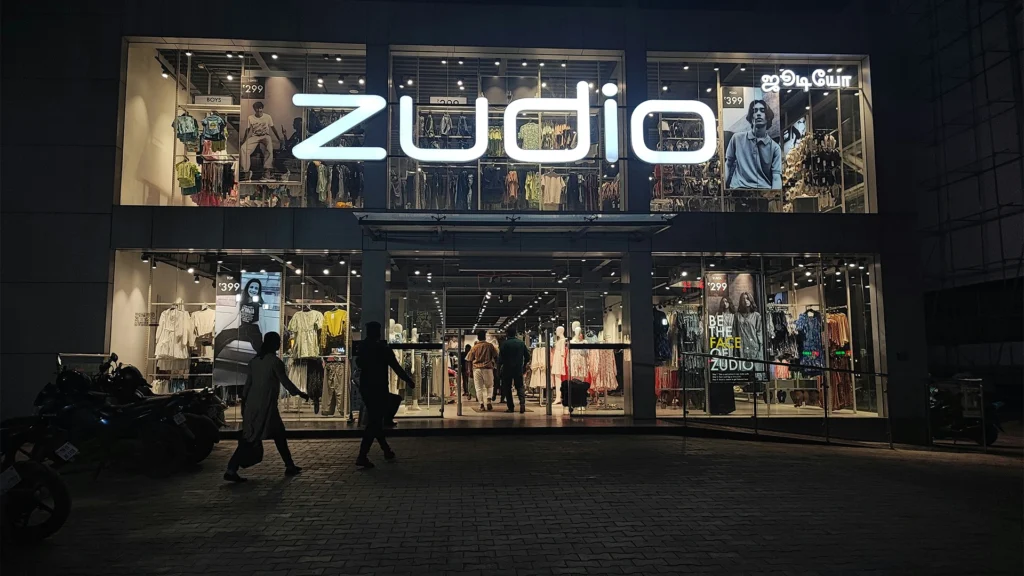
- Glass frontage: Full visibility from street attracting curious passersby
- Category zoning: Clear sections for men’s, women’s, kids’ enabling quick navigation
- Display density: Maximizing products per square foot without cluttered appearance
- Try-before-buy: Ample trial rooms encouraging purchase decisions
- Impulse sections: Strategic placement of accessories and add-ons near billing
- Stock visibility: Backend inventory visible suggesting extensive selection
- Standardized fixtures: Consistent display systems across all stores
The ₹299 Jeans Model: How Pricing Drives Volume
Zudio’s signature product, ₹299 jeans, exemplifies the entire strategy. At that price point, jeans become impulse purchase rather than considered decision. Customers buy 3-4 pairs instead of one. The volume compensates for razor-thin per-unit margins.
The pricing psychology works because ₹299 crosses critical affordability threshold for mass market. A customer earning ₹30,000 monthly can justify ₹299 jeans easily. The same customer thinks twice about ₹1,500 jeans from Levi’s or ₹2,500 from Zara.
Volume-driven profitability mechanics:
- Gross margins: 30-35% versus premium retail’s 60-70%, compensated by volume
- Inventory turns: 8-10 turns annually versus industry average 4-6 turns
- Transaction frequency: Customers visit 4-6 times yearly versus 1-2 for premium brands
- Basket size: ₹1,500-2,500 average purchase (5-8 items) versus ₹3,000-5,000 single-item premium purchases
- Impulse buying: Low prices enabling unplanned purchases
- Gift purchases: Affordable pricing making Zudio popular for budget gifts
- Family shopping: Parents buying for entire family in single visit
- Seasonal refreshes: Low prices enabling wardrobe updates every season
The model required scale to work. Fixed costs (rent, utilities, staff) stayed constant whether selling 100 or 1,000 units daily. Zudio’s volume model meant stores sold 500-1,500+ units daily, spreading fixed costs across massive transaction volumes.
Product Mix Strategy Balancing Margin and Volume
Category-specific pricing and margins:
- Basic t-shirts: ₹199-299 at 25-30% margins driving volume
- Jeans and trousers: ₹299-599 at 30-35% margins, highest volume category
- Shirts: ₹299-799 at 35-40% margins balancing volume and profitability
- Dresses: ₹399-999 at 40-45% margins, higher fashion quotient
- Ethnic wear: ₹399-1,299 at 40-50% margins serving Indian occasion wear
- Kids’ clothing: ₹149-499 at 30-35% margins, high turnover due to growth
- Accessories: ₹99-299 at 50-60% margins, impulse add-ons
- Footwear: ₹299-999 at 35-45% margins expanding category presence
Why Zudio Avoided Malls and Built Standalone Stores
Unlike premium brands anchoring in Westside or Phoenix malls, Zudio retail strategy focused on standalone high-street locations. This decision reduced costs dramatically while maintaining or increasing customer traffic.
Mall economics didn’t support Zudio’s low-price model. Malls charged ₹150-250 per sq ft monthly rent plus revenue sharing (typically 8-15% of sales). For ₹299 jeans business, these costs made profitability impossible. Standalone locations in tier-2/3 high streets cost ₹40-100 per sq ft with no revenue sharing.
Standalone versus mall advantages:
- Rental savings: 50-70% lower costs than mall locations
- No revenue share: Keeping 100% of sales versus 85-92% after mall commissions
- Flexible hours: Operating beyond mall timings capturing evening shoppers
- Parking control: Dedicated parking in many locations improving convenience
- Brand visibility: Standalone stores with large signage creating billboard effect
- Location choice: Selecting specific high-traffic areas rather than mall-dependent
- Expansion speed: Faster buildouts than mall approval processes
- Customer demographics: Attracting neighborhood shoppers not just mall visitors
The standalone strategy also enabled rapid expansion. Opening 150-200 stores annually in malls would require coordinating with multiple mall operators across cities. Standalone locations meant dealing directly with property owners, faster negotiations, and quicker launches.
Real Estate Strategy Creating Competitive Moat
Tata Group’s real estate advantages:
- Corporate credibility: Landlords preferring stable Tata tenants over smaller retailers
- Payment reliability: Tata backing ensuring rent payments even during slow periods
- Lease negotiations: Long-term commitments (9-15 years) enabling better terms
- Location scouting: Dedicated teams identifying high-traffic, low-cost areas
- Build-to-suit: Some landlords constructing Zudio-specific spaces for long leases
- Regional clustering: Opening multiple stores in nearby cities leveraging distribution
- Anchor tenant benefits: In mixed-use developments, becoming retail anchor
How Tata Backing Enabled Aggressive Growth Without Profitability Pressure
Zudio’s parent company Trent Limited, backed by Tata Group, provided patient capital that independent retailers or venture-funded startups couldn’t access. This enabled prioritizing market share and customer acquisition over immediate profitability.
From 2016-2020, Zudio operated at losses or break-even while building brand awareness and supply chain scale. The strategy required deep pockets tolerating negative cash flow for 3-4 years until volumes justified the model. Most retailers couldn’t or wouldn’t accept this timeline.
Tata backing strategic advantages:
- Capital access: ₹500-800 crore annual investments funding rapid expansion
- Supplier confidence: Tata name ensuring vendor partnerships despite payment terms
- Real estate deals: Landlords accepting below-market rents from creditworthy tenant
- Talent attraction: Hiring experienced retail professionals with Tata brand credibility
- Patient timelines: 5-7 year expansion horizon versus VC-funded 2-3 year exits
- Cross-company synergies: Leveraging Tata Textiles, Tata Realty, Tata Capital
- Risk tolerance: Absorbing store-level failures while scaling successful formats
- Technology investments: Building inventory management and supply chain systems upfront
The Tata association also provided brand credibility that startup fashion retailers lacked. Customers trusted Zudio quality partly because Tata backing suggested reliability and accountability absent in unknown brands.
Trent’s Multi-Brand Portfolio Strategy
Zudio within Trent’s brand portfolio:
- Westside: Mid-premium positioning at ₹800-3,000 targeting urban affluent
- Zudio: Ultra-value positioning at ₹199-999 targeting mass market
- Utsa: Ethnic wear brand positioning at ₹1,500-5,000 premium segment
- Samoh: Contemporary Indian wear at ₹3,000-10,000 luxury positioning
- Misbu: Plus-size fashion filling underserved category
- Star Bazaar: Hypermarket format complementing fashion retail
This portfolio enabled Trent capturing customers across income levels and occasions. A Westside customer might shop Zudio for casual wear. A Zudio customer aspiring to Westside creates upgrade pathway within Trent portfolio.
The No-Frills Retail Experience Customers Accept for Prices
Zudio retail strategy eliminated services that premium brands considered essential. No personal stylists, no alteration services, no gift wrapping, no home delivery initially. The bet was that ₹299 jeans justified self-service shopping.
Customers accepted trade-offs because pricing made them worthwhile. Spending ₹1,500 across 5 items versus ₹3,000 for 2 items at premium brands compensated for lack of white-glove service.
Services intentionally excluded:
- Personal shopping: Customers browse independently versus assisted sales
- Alterations: No in-store tailoring requiring staff and equipment
- Gift services: No wrapping or packaging beyond basic bags
- Loyalty programs: No points cards or membership tiers initially
- Home delivery: Walk-out purchases only, no last-mile logistics costs
- Advanced reservations: No hold-and-pay-later services
- Exclusive previews: No VIP events or early access programs
- Customer lounges: No seating areas or refreshments
The minimalist approach extended to store interiors. Basic lighting, simple fixtures, concrete floors in some locations. Functional but far from premium retail aesthetics. Yet stores remained clean, organized, and spacious enough for comfortable browsing.
Where Zudio Didn’t Compromise
Quality maintained despite low prices:
- Fabric standards: Minimum thread counts and colorfastness requirements
- Stitching quality: Double-stitched seams and reinforced stress points
- Sizing consistency: Standardized measurements across production batches
- Color accuracy: Dye quality preventing excessive fading after washes
- Trial facilities: Adequate trial rooms with proper mirrors and lighting
- Return policies: 7-day exchange for defects matching organized retail standards
- Store cleanliness: Daily maintenance ensuring pleasant shopping environment
- Staff politeness: Trained personnel even if not providing extensive assistance
Competition Response and Market Impact
Zudio’s explosive growth forced responses from multiple retail segments. Premium brands initially ignored Zudio as different market segment. But as Zudio stores opened in metros and started capturing mid-tier customers, competitive pressure increased.
Competitor responses to Zudio threat:
- Reliance Trends: Lowered prices on basic categories matching Zudio
- V-Mart: Expanded fashion offerings beyond traditional value retail
- Max Fashion: Increased store openings in tier-2/3 cities
- Brand Factory: Enhanced discounting to compete on value perception
- Pantaloons: Introduced lower-priced sub-brands
- Myntra, Flipkart: Increased fashion discounting online
- Unorganized retail: Some upgraded store formats and quality
- Premium brands: Mostly unaffected, different target customers
The impact went beyond competitor responses. Zudio retail strategy demonstrated that Indian mass market would adopt organized retail for fashion if pricing matched affordability levels. This validated massive opportunity that other Tata companies and competitors now pursue aggressively.
Market Expansion Creating Rising Tide
Zudio effect on Indian fashion retail:
- Market formalization: Moving customers from unorganized to organized retail
- Price consciousness: Demonstrating viability of ultra-low-price organized fashion
- Tier-2/3 growth: Proving smaller cities supported large-format fashion stores
- Supply chain innovation: Forcing industry to optimize for lower prices
- Employment creation: Direct hiring 15,000+ staff plus indirect manufacturing jobs
- Real estate activity: Increasing demand for retail spaces in smaller cities
- Consumer confidence: Building trust in organized retail among budget-conscious shoppers
The Bottom Line
Zudio retail strategy built India’s fastest-growing fashion chain by solving massive market inefficiency. The 300+ million middle-class consumers wanted organized retail quality without premium pricing. Zudio delivered through supply chain efficiency, tier-2/3 focus, and Tata-backed patient capital.
The ₹299 jeans symbolizes the entire playbook: accessible pricing driving volumes that compensate for thin margins. Large stores displaying thousands of SKUs create shopping experience matching premium retailers. Standalone locations in smaller cities reduce costs while serving underserved demand.
What made Zudio retail strategy successful:
- Ultra-low pricing: ₹199-999 range matching unorganized retail while delivering organized quality
- Supply chain efficiency: Direct sourcing, bulk ordering, limited SKUs reducing per-unit costs
- Volume focus: High inventory turns and transaction frequency offsetting thin margins
- Tier-2/3 expansion: Targeting cities with lower costs and less competition
- Large-format stores: 6,000-12,000 sq ft displaying extensive variety
- Standalone locations: Avoiding mall rent and revenue sharing
- Tata backing: Patient capital and credibility enabling aggressive expansion
- No-frills service: Eliminating costs not essential to value proposition
- Mass market positioning: Serving 300+ million underserved middle-class consumers
The challenges ahead involve maintaining quality as scale increases, managing inventory across 500+ stores efficiently, and defending market share as competitors copy the model. Premium brands may launch value sub-brands. Amazon and Flipkart may intensify fashion discounting. Unorganized retailers may formalize operations.
But Zudio’s first-mover advantage in tier-2/3 cities, Tata-backed supply chain, and proven profitability at scale create moats that competitors need years to replicate. The brand became synonymous with affordable fashion in target markets, similar to how Walmart owns value retail in US consumer mindshare.
For Indian retail, Zudio proved that bottom-of-pyramid and mass-market segments deserve same retail sophistication as premium customers. The model works when companies prioritize operational efficiency over brand aspirations, serve underserved markets versus over-competed metros, and maintain patience building infrastructure before demanding returns.
The question isn’t whether Zudio’s model works, the 500+ profitable stores and 100%+ annual growth prove it does. The question is how far Zudio can scale before market saturation, whether they can maintain quality at 1,000+ stores, and if the model translates to categories beyond basic fashion. Those answers will determine if Zudio becomes India’s Uniqlo or Primark, or remains regional value chain that grew fast but plateaued.