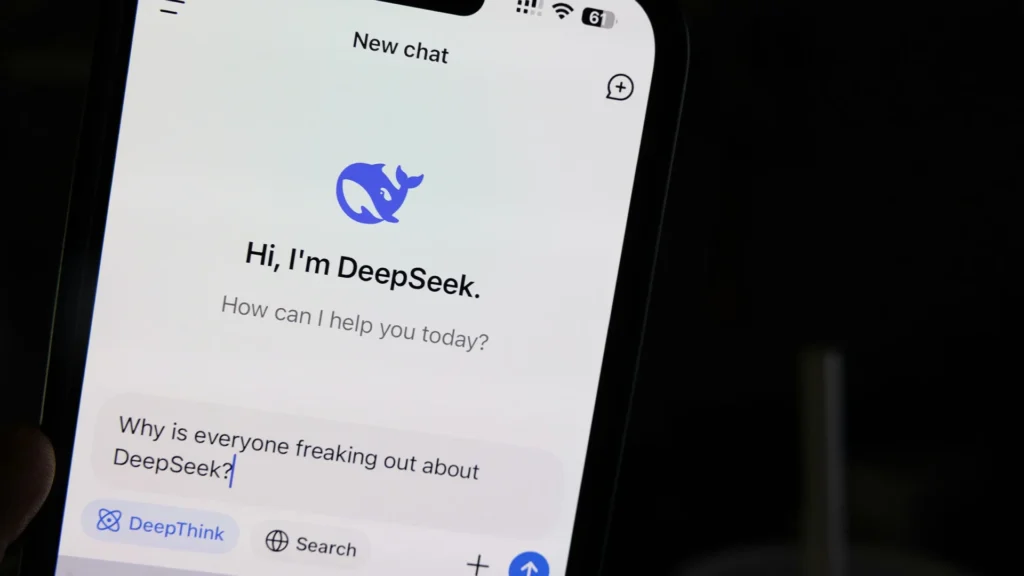
When DeepSeek’s AI assistant topped Apple’s App Store as the most downloaded free app in late January 2025, dethroning ChatGPT from its seemingly permanent throne, the global tech industry experienced what analysts called an “AI earthquake.” This wasn’t just another ChatGPT competitor launching with venture capital hype, this was a Chinese startup claiming it trained a GPT-4-level model for approximately $5.6 million (including the base model), compared to OpenAI’s estimated $100 million+ for GPT-4 and Google’s $191 million for Gemini Ultra.
The immediate market reaction was catastrophic:
- Nvidia lost $589 billion in market cap on January 27, 2025 (largest single-day loss in US stock market history)
- Broadcom and other chip stocks plummeted
- Combined tech sector losses exceeded $800 billion
- Nasdaq dropped 3.1%, S&P 500 fell 1.5%
- Investors questioned whether multi-billion dollar AI infrastructure buildout was necessary or wasteful
The DeepSeek R1 release on January 20, 2025, proved that a relatively unknown Chinese company founded in 2023 by Liang Wenfeng could match or exceed the performance of models from OpenAI, Google, and Anthropic while spending a fraction of their training budgets. The announcement challenged the fundamental assumption underlying the entire AI boom: that building frontier AI models required spending billions on cutting-edge hardware and massive computing clusters.
The Real Cost Breakdown Beyond the $6 Million Headline
What the Training Cost Actually Includes
The “$6 million” figure that dominated headlines requires significant context to understand accurately. DeepSeek’s training costs actually consist of two separate components that media reports often conflated.
The actual cost structure:
- Base model (DeepSeek-V3): Approximately $5.6 million over 55 days
- Hardware used: 2,048 Nvidia H800 GPUs
- Reinforcement learning phase (R1): Additional $294,000
- Total disclosed training cost: ~$5.9 million
- Calculation basis: $2 per hour per GPU rental rates
- Source: 2.79 million GPU hours disclosed in Nature journal papers
However, as semiconductor research firm SemiAnalysis revealed in late January 2025, these training cost figures exclude substantial additional expenses that DeepSeek incurred.
The hidden costs not included:
- Hardware acquisition: $51 million for 2,048-GPU cluster alone at market prices
- Total hardware expenditure: “Well higher than $500 million” over company’s operating history
- Infrastructure expenses: Data center facilities, networking equipment, cooling systems
- Power consumption: Massive electricity costs for large-scale training
- Research team: Approximately 200 researchers and engineers over years
- Failed experiments: Ablation studies, testing different approaches
- Data acquisition: Cleaning and preparing training data
- Iterative development: All work preceding “official” training run
As DeepSeek’s own technical paper acknowledges, the disclosed costs “exclude the costs associated with prior research and ablation experiments on architectures, algorithms, or data.”
The Comparison to Western AI Labs
When properly contextualized, DeepSeek’s total investment becomes more comparable to Western AI companies than initial reports suggested, though still significantly lower.
Training cost comparisons:
- DeepSeek R1: $5.9 million (disclosed), $500 million+ (total estimated)
- OpenAI GPT-4: $100 million+ (training only)
- Google Gemini Ultra: $191 million (training only)
- Anthropic Claude 3.5 Sonnet: “Tens of millions” (training only)
Total company spending context:
- OpenAI raised billions from Microsoft for total operations
- Anthropic raised billions from Amazon and Google
- Google/Microsoft operate massive existing infrastructure
- DeepSeek’s “hundreds of millions” still dramatically lower than billions
The fundamental difference is that DeepSeek achieved frontier-model performance with dramatically constrained resources compared to what industry leaders considered necessary. While DeepSeek’s total spending may reach hundreds of millions when fully accounted, Western labs were operating on the assumption that training cutting-edge models required billions in infrastructure and compute. DeepSeek proved this assumption wrong, triggering the market panic that erased $800 billion in AI-related stock value in a single day.
The democratization implications:
- Barriers to entry drop dramatically if models cost single-digit millions
- Smaller companies can potentially compete with tech giants
- Academic institutions gain access to frontier AI development
- Well-funded startups can challenge established players
- AI development shifts from oligopoly to competitive landscape
The Technical Innovations that Enabled Cost Efficiency
Mixture of Experts Architecture
DeepSeek’s dramatic cost reduction stems from specific architectural and training innovations rather than simply using cheaper hardware. The Mixture-of-Experts (MoE) architecture represents the foundation of DeepSeek’s efficiency gains.
MoE architecture advantages:
- Total parameters: 671 billion in the model
- Active per query: Only 37 billion activate for any given query
- Computational reduction: Over 90% less compute vs dense models like GPT-4
- Result: Large-model performance at small-model compute costs
- Deployment benefit: Dramatically lower operational costs
The Multi-Head Latent Attention system deployed in DeepSeek-V3 reduces Key-Value cache usage by 93.3%, dramatically lowering memory requirements during inference. This innovation directly translates to reduced operational costs, as serving models to users often exceeds training costs over the model’s lifetime.
Key technical components:
- 8-bit training framework: FP8 precision instead of standard 32-bit floating point
- Memory usage reduction: Approximately 75% less bandwidth required
- Storage benefits: Can train larger models on same hardware
- Quality maintenance: Careful implementation maintained accuracy despite lower precision
- Years of research: Knowledge accumulated through extensive experimentation
Reinforcement Learning Optimizations
DeepSeek’s training methodology emphasized reinforcement learning optimizations that reduced compute requirements compared to traditional supervised fine-tuning approaches.
Group Relative Policy Optimization technique:
- Eliminates critic model typically required for RL
- Critic model normally: Doubles compute costs (second model same size)
- DeepSeek’s approach: Estimates baselines from group scores instead
- Result: Cut RL training costs approximately 50%
- Quality: Maintained training effectiveness
Synthetic data generation strategy:
- Required “considerable compute” according to SemiAnalysis
- More efficient than massive web-scraping operations
- Algorithmically generated high-quality training data
- Reduced data acquisition costs
- Eliminated potential copyright issues
- Controlled data quality more precisely
The synthetic data approach only became feasible recently as models reached sufficient capability to generate training data for successor models, representing a fundamental shift in how AI training pipelines operate.
Performance Benchmarks Matching GPT-4 Where it Matters
Mathematical and Coding Dominance
DeepSeek R1’s performance on academic benchmarks demonstrates that cost-efficient training didn’t compromise model capabilities. The mathematics and coding performance represents DeepSeek’s most dramatic advantages.
MMLU (Massive Multitask Language Understanding):
- DeepSeek R1: 90.8% accuracy
- GPT-4: 87.2% accuracy
- Significance: Tests broad academic knowledge across dozens of subjects
- Implication: Can handle diverse real-world queries effectively
Mathematics performance (almost 10x improvement):
- AIME 2024: DeepSeek 79.8% vs GPT-4’s 9.3%
- MATH-500: DeepSeek 97.3% vs GPT-4’s 74.6%
- Interpretation: Fundamental superiority in structured logical reasoning
- Extension: Applies beyond mathematics to step-by-step problem-solving
Coding benchmarks:
- Codeforces: DeepSeek 2,029 vs GPT-4’s 759 (elite territory among human programmers)
- HumanEval: DeepSeek 82-83% vs GPT-4’s 80-81% pass rates
- LiveCodeBench: DeepSeek 41% on practical coding challenges
- Consistency: Slight but consistent advantages in code generation accuracy
Where ChatGPT Maintains Advantages
Despite DeepSeek’s impressive benchmark performance, ChatGPT retains significant advantages in areas beyond pure reasoning tasks.
ChatGPT’s continuing strengths:
- Multimodal capabilities: Image understanding, generation (DALL-E), voice interactions
- Conversational quality: Extensive fine-tuning on human preference data
- Natural language fluency: Better flow in open-ended discussions
- User experience: More “natural” feeling in general conversation
- Ecosystem integration: Google Workspace, Microsoft Office, thousands of APIs
DeepSeek’s limitations:
- Core R1 model remains text-only (separate vision-language model exists)
- Optimizes for technical accuracy over conversational flow
- Limited third-party integrations
- Less natural in casual conversation
- Strong with precise technical problems, weaker in open-ended discussions
Enterprise considerations:
- Tooling and integration represent substantial value beyond benchmarks
- Many organizations continue choosing ChatGPT despite cost disadvantages
- Ecosystem lock-in creates switching costs
- Technical performance alone doesn’t determine business value
The Geopolitical and Security Implications
Data Security Concerns
DeepSeek’s rapid rise triggered immediate security concerns from Western governments. The concerns stem from data collection practices and infrastructure location.
Government responses:
- US Navy: Banned DeepSeek usage in late January 2025
- White House: Initiated investigations into security implications
- Reasoning: Data security risks, Chinese server location
- Data collection: Mirrors ChatGPT’s scope but stores on servers in China
- Legal framework: Potentially subject to Chinese government access under national security laws
The major security flaw:
- Researchers discovered DeepSeek exposed 1 million+ user records to open internet
- Exposed data: API tokens, chat histories, personal identifiers
- Keystroke patterns: Potentially sensitive behavioral data
- API token risk: Compromised tokens enable unauthorized account access
- Cybersecurity concerns: Could be incompetence or designed data collection feature
The incident highlighted that rapid development sometimes prioritizes functionality over security, a pattern that has plagued Chinese tech companies internationally.
US Export Control Failure
The US export restrictions on advanced chips to China, implemented three times between 2022-2024, were specifically designed to prevent Chinese AI companies from developing frontier models. DeepSeek’s success demonstrated these restrictions failed to achieve their intended effect.
Export control timeline:
- 2022-2024: Three rounds of chip export restrictions to China
- H800 chips: Deliberately downgraded version of H100s for compliance
- Specification limits: Lower interconnect bandwidth than H100
- Theory: Should limit effectiveness for large-scale AI training
- Reality: DeepSeek overcame limitations through algorithmic innovation
Strategic implications:
- Chinese AI companies can match Western capabilities with restricted hardware
- Export controls may force innovation rather than prevent development
- Technology restrictions less effective than policymakers assumed
- Companies innovate around constraints, potentially creating advantages
- Historical pattern: Necessity drives innovation in constrained environments
The $800 Billion Question
DeepSeek’s emergence forced a strategic reckoning in Western capitals and corporate boardrooms. The market’s violent reaction reflected fundamental uncertainty about AI investment assumptions.
The January 27, 2025 market carnage:
- Nvidia: Lost $589 billion (largest single-day loss in US history, 17% drop)
- Broadcom: Massive losses
- Combined tech sector: $800 billion+ erased
- Nasdaq: Dropped 3.1%
- S&P 500: Fell 1.5%
- Billionaire losses: Planet’s 500 wealthiest lost $108 billion combined
The strategic questions raised:
- $500 billion “Stargate” project suddenly seemed potentially wasteful
- Hundreds of billions in planned AI infrastructure questioned
- Can Chinese companies match capabilities with fraction of investment?
- Does US technological superiority depend on outspending or innovation?
- Are multi-billion dollar data centers necessary or inefficient?
Nvidia CEO Jensen Huang’s response:
- Called DeepSeek “an excellent AI advancement”
- Emphasized it’s “a perfect example of Test Time Scaling”
- Noted inference still requires “significant numbers of NVIDIA GPUs”
- Maintained demand for high-performance chips won’t collapse
Marc Andreessen’s assessment:
- Called DeepSeek “one of the most amazing and impressive breakthroughs I’ve ever seen”
- Described it as “a profound gift to the world”
- Acknowledged significance of cost-efficient AI development
The Bottom Line
DeepSeek’s challenge to ChatGPT with dramatically lower training costs represents far more than a temporary market disruption or clever engineering achievement. The emergence of a frontier-level AI model trained for approximately $6 million in direct costs fundamentally questions the assumptions underlying the entire AI investment boom.
The achievement that shook tech:
- $5.9 million disclosed training cost vs $100 million+ for Western competitors
- Comparable performance to models costing billions to develop
- Proved algorithmic innovation matters as much as raw computing power
- First Chinese AI to earn US tech industry recognition
- Matched or exceeded GPT-4 in technical reasoning
The technical innovations:
- Mixture-of-Experts activating only 37 billion of 671 billion parameters per query
- Multi-Head Latent Attention reducing KV cache by 93.3%
- Group Relative Policy Optimization eliminating critic models in RL
- 8-bit training framework cutting memory usage 75%
- Synthetic data generation reducing acquisition costs
The performance benchmarks:
- 90.8% on MMLU (vs GPT-4’s 87.2%)
- 79.8% on AIME 2024 mathematics (vs GPT-4’s 9.3%)
- 97.3% on MATH-500 (vs GPT-4’s 74.6%)
- 2,029 Codeforces score (vs GPT-4’s 759)
- Fundamental superiority in structured reasoning
The market reaction:
- $800 billion in AI infrastructure valuations erased in single day
- Largest single-day market cap loss in US history (Nvidia’s $589 billion)
- Fundamental uncertainty about whether massive capital investments necessary
- Questions whether multi-billion spending represents inefficiency vs requirements
- Forced strategic reckoning about AI development assumptions
The geopolitical fallout:
- Western export controls on advanced chips failed to prevent Chinese AI development
- DeepSeek succeeded using restricted H800 chips through innovation
- Technology restrictions may drive innovation rather than suppress capability
- China demonstrated ability to develop frontier AI with constrained resources
- US technological superiority less assured than comfortable assumptions suggested
The democratization reality:
- Algorithmic innovation can substitute for nearly unlimited capital
- Barriers to frontier AI development reduced beyond handful of tech giants
- Smaller companies, academics, startups gain access to competitive capabilities
- AI development shifts from oligopoly toward competitive landscape
- Innovation matters more than whoever builds bigger data centers
The skepticism and questions:
- SemiAnalysis estimates total costs “well higher than $500 million”
- $5.9 million excludes R&D, infrastructure, failed experiments
- Full accounting shows hundreds of millions in total investment
- Still dramatically lower than billions Western labs considered necessary
- Proves efficiency advantages real even if headline cost misleading
The future implications:
- Western AI labs rushing to replicate DeepSeek’s innovations
- Training costs could drop another 5x by end of year
- Both DeepSeek and competitors benefit from efficiency advances
- Question shifts from “can it be done” to “who innovates fastest”
- Multi-billion infrastructure spending may represent over-engineering
For companies attempting to build AI capabilities, the DeepSeek case study reveals that algorithmic innovation and clever engineering can substitute for nearly unlimited capital, democratizing access to frontier AI development beyond the handful of tech giants who can write billion-dollar checks. The $500 billion Stargate project announced by Microsoft, OpenAI, and Oracle just before DeepSeek’s emergence now faces scrutiny about whether such massive spending remains necessary or represents legacy thinking about AI development requirements.
DeepSeek didn’t just build a cheaper ChatGPT competitor, it challenged the entire economic and strategic assumptions underlying the AI race, forcing a fundamental reassessment of what’s required to compete at the frontier of artificial intelligence development.