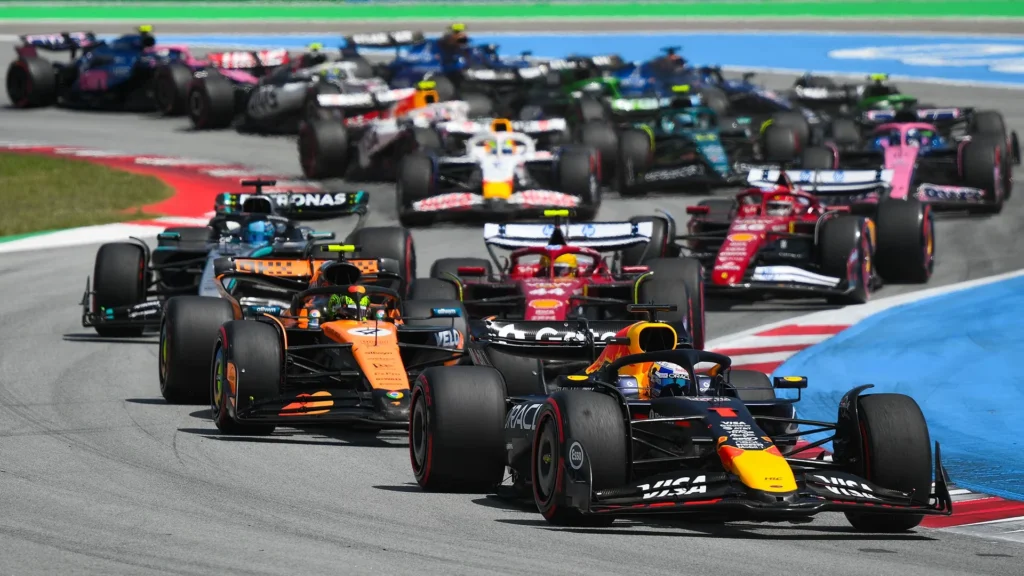
Formula 1 teams are now worth a combined $23 billion, with every single team valued above $1 billion for the first time in history. Ferrari tops the list at $4.78 billion, followed by Mercedes at $3.94 billion and Red Bull at $3.5 billion.
But here’s the paradox: despite record valuations and revenue hitting $3.8 billion collectively in 2024, most F1 teams lose money year after year.
Williams Racing has posted losses for five consecutive years, totaling £211 million ($285.4 million) since 2020. Alpine, Aston Martin, and Racing Bulls all operate in the red. Even Red Bull Racing, winners of the 2022 and 2023 Constructors’ Championships, posted just £1.68 million profit in 2024 on £314.4 million turnover, a margin of 0.5%.
Only one team consistently prints money: Mercedes-Benz Grand Prix, which has turned profit every year for over a decade. Here’s why F1 team valuations hit $23 billion while most teams bleed cash, and why losing money is often the strategy.
The $135 Million Budget Cap That Changed Everything
From Unlimited Spending to Controlled Costs
In 2021, F1 introduced a budget cap of $145 million per team, excluding driver salaries, marketing, legal costs, and certain other expenses. The goal: level the playing field and make the sport financially sustainable.
The budget cap evolved significantly:
- 2024: $135 million nominal (approximately $165 million with inflation adjustments)
- 2025: Similar to 2024 with inflation adjustments
- 2026: $215 million (+30.3% increase announced December 2024)
Before the cap, top teams spent $400-500 million annually. Mercedes, Ferrari, and Red Bull could outspend midfield teams 3-to-1, creating an unbridgeable performance gap. The cap was supposed to make teams profitable by forcing spending discipline. Instead, it revealed a deeper truth: F1 teams aren’t built to make money. They’re built to win races, and winning costs more than the sport pays back.
2024 Cost Cap Compliance: Nearly Perfect Record
The FIA completed its 2024 review in October 2025. Nine teams were fully compliant, Aston Martin had a minor procedural breach (missing signature, no overspending), and all five power unit manufacturers complied.
This marks the third consecutive year of full compliance after Red Bull’s 2021 overspend violation (£1.864M over cap, $7M fine, 10% aerodynamic testing reduction). The budget cap didn’t eliminate losses. It just changed where teams spend money and how they structure costs.
How F1 Teams Actually Generate Revenue
Prize Money and Sponsorships Drive Team Income
F1 teams generate revenue from three sources: prize money from Liberty Media, sponsorship deals, and parent company support for factory teams. The gap between top and bottom earners exceeds $100 million annually despite attempts at balance.
Liberty Media distributes prize money based on previous year’s Constructors’ Championship results, with bonuses for heritage teams. The 2024 distribution shows massive inequality:
- McLaren (2024 Champions): $161 million
- Ferrari: $151 million (includes $60M+ heritage bonus for competing since 1950)
- Red Bull Racing: $140 million
- Mercedes: ~$130 million
- Mid-tier teams: $100-120 million each
- Williams: $79 million
- Sauber (Kick F1): $69 million
The gap between first and last place is nearly $100 million annually.
Sponsorships account for 40-60% of team revenue with massive variation:
- Oracle x Red Bull: $100 million annually
- Petronas x Mercedes: $600+ million multi-year deal
- Mastercard x McLaren: £74 million annually (starting 2026)
- Dell, Goldman Sachs, Google x McLaren: Major partnerships driving revenue growth
Even smaller teams secure 15-25 sponsors each, with deals ranging from $1 million to $50+ million annually. Top teams command premium rates while backmarkers struggle to justify high fees when they rarely appear on television.
Total Team Revenues Show 4-to-1 Gap
Based on published financials:
- McLaren: £530.3 million ($710 million) – includes IndyCar and Formula E
- Mercedes: $680 million (F1 only)
- Ferrari: ~$620 million
- Red Bull Racing: ~$400 million
- Alpine: ~$350 million
- Aston Martin: ~$300 million
- Williams: $158 million (smallest among independent constructors)
The revenue gap between top and bottom exceeds 4-to-1 even with prize money redistribution. This explains why some teams afford multi-million dollar driver contracts while others settle for pay drivers.
Why Mercedes Is The Only Consistent Financial Winner
The Factory Team Advantage
Mercedes-Benz Grand Prix 2024 performance: $680 million revenue, operating profit undisclosed but consistently profitable for 10+ years. Mercedes treats F1 as a high-performance marketing laboratory. Every innovation tested in F1 feeds directly into Mercedes-AMG road car development.
The team doesn’t just sell sponsorships and collect prize money. It generates intellectual property worth hundreds of millions, validates cutting-edge technology, and provides marketing value far exceeding financial statements.
Mercedes’ structural advantages explain their profitability:
- Parent company absorbs power unit development costs (excluded from budget cap, worth $50-100M annually)
- Technology transfer to road cars creates unquantified value
- Premium brand positioning justifies higher sponsorship rates
- Consistent performance attracts and retains top sponsors
Compare this to independent teams like Williams or McLaren, which fund operations purely from F1 revenue. When Mercedes spends $100 million developing a new hybrid power unit, that cost gets amortized across millions of road cars. When Williams spends $10 million on aerodynamic development, that’s pure racing expense with no secondary revenue stream.
Mercedes can lose $50 million on paper in racing operations and still deliver massive value to Daimler AG through technology transfer and brand equity enhancement. The F1 team functions as marketing department, R&D lab, and prestige generator simultaneously.
McLaren’s Remarkable Turnaround: From Loss to £54.2M Profit
Championship Success Drives Profitability
McLaren Racing 2024 results published October 2025:
- Total Revenue: £530.3 million ($710 million)
- Pre-tax Profit: £37.5 million
- Total Profit: £54.2 million ($73.3 million)
- 2023 Profit: £12.9 million
McLaren’s profit surge came from winning the 2024 Constructors’ Championship for the first time since 1998, securing a deferred tax credit of £16.6 million from prior losses, and landing premium partnerships including Mastercard’s £74M annual deal starting 2026.
CEO Zak Brown’s compensation reflected championship success: £37.3 million ($50.4 million) in 2024, up nearly £11 million from 2023. McLaren proves F1 teams can be profitable, but only through winning championships and converting success into premium sponsorships.
Gulf Ownership Values Team at $2.65 Billion
On September 2, 2025, Bahrain’s Mumtalakat sovereign wealth fund partnered with Abu Dhabi’s CYVN Holdings to buy out MSP Sports Capital and other minority shareholders. McLaren Racing is now fully Gulf-owned with strategic capital backing future growth.
The deal valued McLaren at approximately $2.65 billion despite generating just £54.2 million profit annually, proving F1 team valuations reward winning teams with exponential premiums far exceeding traditional earnings multiples.
Williams Racing: Five Years of Continuous Losses
Revenue Growth Doesn’t Stop the Bleeding
Williams Racing 2020-2024 performance:
- 2024 Revenue: £179.8 million ($243.2 million), up £50M+ from 2023
- 2024 Loss: £49.9 million ($67.5 million) after tax
- Total Losses 2020-2024: £211 million ($285.4 million)
- Administrative Expenses 2024: £176.2 million ($238.3 million)
Williams posted five consecutive years of losses despite 38% revenue growth in 2024. This is F1’s fundamental paradox: revenue can grow dramatically while losses continue because costs grow faster than income.
The cost structure problem involves several factors:
- Heavy infrastructure investment in facilities, wind tunnel, simulation technology
- Performance struggles (finished last in 2023, recovered to 9th in 2024)
- Lower prize money ($79M vs McLaren’s $161M)
- Administrative expenses nearly matching revenue growth
- Competitive pressure as every team invests in 2026 regulation changes
Williams’ strategy accepts short-term losses for medium-term competitiveness. The problem is every other team pursues the same strategy, so Williams stays trapped at the bottom despite heavy investment.
Survival Through Capital Injections
Williams survives through several financial lifelines:
- Fresh capital injections from shareholders: £183 million over 2022-2024
- Debt-free balance sheet (unlike Alpine or McLaren)
- Historic brand value attracting investors
- Budget cap preventing competitors from outspending by 3x
Investors believe F1 team valuations will continue rising 30-50% annually. Williams lost $285 million over five years but is valued at $1.24 billion. That math works only if investors expect to sell for $2+ billion in the future.
Alpine: Celebrity Investors Betting on Turnaround
$218 Million From U.S. Celebrity Consortium
Alpine Racing raised £125 million in 2023 from U.S. investors led by RedBird Capital, Otro Capital, and Maximum Effort. Notable celebrity investors include:
- Ryan Reynolds (actor, entrepreneur, Maximum Effort founder)
- Rory McIlroy (professional golfer)
- Patrick Mahomes (NFL quarterback, Kansas City Chiefs)
- Travis Kelce (NFL tight end, Kansas City Chiefs)
- Anthony Joshua (professional boxer, heavyweight champion)
- Alexander Zverev (professional tennis player)
- Rob McElhenney (actor, It’s Always Sunny in Philadelphia creator)
- Michael B. Jordan (actor, Creed star)
The investor group paid $218 million (€200M) for 24% of Alpine, valuing the team at approximately $900 million despite ongoing losses. Today Alpine is valued at $1.5 billion, a 67% increase in just over a year.
Alpine used £100 million to clear shareholder loans from Renault Group, buying financial independence. The remaining £25 million went to infrastructure upgrades and performance development.
Investors chose Alpine despite losses for clear reasons:
- Budget cap creates path to profitability by preventing unlimited spending
- F1 team valuations surging 44% year-over-year regardless of financial performance
- Prize money guaranteed ($69M minimum for last place)
- Commercial rights agreement ensures revenue stability through 2030+
- Celebrity investors bring significant marketing value
Alpine’s business model accepts short-term losses while building capabilities, then either sells at massive valuation gain or achieves profitability through championship contention. Celebrity investors expect 3-5x returns when they exit in 2028-2030.
Aston Martin: $2 Billion Valuation With Annual Losses
Lawrence Stroll’s 20x Return in Six Years
Aston Martin F1 valuation (2024): $2.07 billion despite posting $27 million losses in 2023. The team continues operating in the red while Stroll’s consortium pours hundreds of millions into infrastructure.
Fall 2024 brought two institutional investors:
- HPS Investment Partners: Private credit firm specializing in growth capital
- Accel: Silicon Valley venture capital (early Facebook investor)
Stroll’s consortium acquired Racing Point in 2018 when valued under $100 million. Today it’s worth $2+ billion, representing a 20x+ return in six years despite continuous losses. Stroll achieved this through F1’s overall valuation expansion and strategic positioning as a premium brand.
Infrastructure Investment for 2026 Dominance
Aston Martin accepts annual losses for long-term gains:
- Building new headquarters and wind tunnel facilities
- Leveraging Fernando Alonso’s global appeal to attract sponsors
- Absorbing losses through Stroll family capital injections
- Securing Honda power units from 2026 to become factory team
- Targeting top-3 team status by 2026 regulation changes
Stroll measures success in F1 team valuations appreciation, not quarterly profits. His $100 million investment became $2 billion in six years, a 2,000% return. Even at $30-50 million annual losses, valuation gains dwarf operational losses.
Aston Martin is building a new factory and wind tunnel complex exceeding $300 million cost, with 2025 completion targeted. This doesn’t count toward budget cap but must be funded through losses or shareholder capital.
F1 Team Valuations Hit $23 Billion: Every Team Worth $1B+
The Billion-Dollar Entry Fee
F1 team valuations 2024 (Sportico):
- Ferrari: $4.78 billion
- Mercedes: $3.94 billion
- Red Bull Racing: $3.5 billion
- McLaren: $2.65 billion
- Aston Martin: $2.07 billion
- Alpine: $1.5 billion
- Williams: $1.24 billion
- RB (Racing Bulls): $1.22 billion
- Sauber (Kick F1): $1.2 billion
- Haas: $1.02 billion
Combined total: $23.01 billion. Every team surpassed $1 billion valuation for the first time, joining NFL (2015), NBA (2018), MLB (2019), and NHL (2024) as billion-dollar minimum entry leagues.
The budget cap didn’t create profitability. It created competitive balance, which made teams worth billions to investors betting on future profits that may never materialize.
Four Reasons F1 Team Valuations Skyrocketed
Budget Cap Created Competitive Balance
Before 2021, Mercedes and Ferrari spent $450 million annually while Williams spent $125 million. Smaller teams had zero championship chances.
The cap compressed spending to $135-165 million range, creating real changes:
- McLaren went from last in early 2023 to champions by end 2024
- Seven different race winners emerged in 2024
- Title hopes exist for everyone, not just the big three
- Mid-tier teams can now compete with proper execution
Investors see realistic championship paths, making teams valuable competitive assets rather than hopeless money pits. This explains why Alpine attracted $218 million and Williams raised £183 million despite five consecutive loss years.
Guaranteed Revenue Streams Eliminate Downside Risk
The 2020 Concorde Agreement ensures stability:
- Prize money distribution even for last place ($69 million minimum)
- Long-term commercial rights through 2030+
- Predictable revenue regardless of on-track performance
Unlike other sports where terrible teams get relegated, F1 teams have guaranteed income floors providing downside protection. Even if Williams finishes last for a decade, they’ll collect $69 million annually from Liberty Media plus sponsorships.
This creates a valuation floor around $800 million to $1 billion because the revenue stream alone justifies that price. Even worst-case scenarios generate $100+ million annual revenue.
Netflix Effect and Global Growth
“Drive to Survive” transformed F1 from European niche sport to global phenomenon starting 2019:
- 750 million viewers annually
- 41% female audience (highest in motorsports)
- U.S. market explosion (Miami, Las Vegas, Austin grands prix)
- Mainstream appeal competing with NFL and NBA for casual fans
F1 generated $3.4 billion total revenue in 2024, up from $3.2 billion in 2023 and $1.8 billion in 2019. The sport added three U.S. races in three years, each generating $100-400 million in local economic impact.
The Netflix series brought F1 to audiences who never watched motorsport, creating new sponsorship categories and revenue streams targeting millennials and Gen Z viewers.
Private Equity Sees Profit Potential
Recent private equity deals show massive confidence:
- RedBird Capital and Otro Capital: 24% of Alpine for $218 million (2023)
- Arctos Partners: Stake in Aston Martin (2024)
- HPS Investment Partners plus Accel: Additional Aston Martin capital (2024)
- Mumtalakat plus CYVN: McLaren buyout at $2.65 billion valuation (2025)
These firms see 5-10 year paths to profits through revenue growth from calendar expansion (24 races in 2024 vs 17 in 2020), sponsorship increases as F1’s popularity surges, cost control via budget cap, and potential sales to auto manufacturers or billionaires at higher valuations.
Private equity bets F1 team valuations will rise 30-50% annually for 5-7 years. They don’t need teams to become profitable if valuations keep doubling every 3-4 years. A firm buying 24% of Alpine for $218 million at $900 million valuation can sell that stake for $600-800 million at $3 billion valuation in 2028, tripling money without Alpine ever profiting.
The Brutal Math: Why Most Teams Can’t Make Money
Midfield Team Economics
A typical midfield team like Alpine or Aston Martin faces tough economics:
Revenue Sources:
- Prize money: $110 million (midfield finishing position)
- Sponsorships: $80-100 million (10-20 partners at various levels)
- Total Revenue: $190-210 million
Costs Inside Budget Cap ($135M limit):
- Car development: $50 million
- Personnel (capped employees): $40 million
- Race operations: $20 million
- Facilities and equipment: $15 million
- Parts and materials: $10 million
Costs Outside Budget Cap (excluded categories):
- Driver salaries: $20-40 million
- Top executive salaries: $5-10 million
- Marketing and hospitality: $20-30 million
- Legal, finance, HR: $10-15 million
- Heritage programs: $5-10 million
- Capital expenditures (facilities): $20-100+ million
The Financial Reality:
- Total Annual Costs: $250-350 million
- Total Revenue: $190-210 million
- Annual Loss: $60-140 million
Even with budget cap restricting core racing spending, teams spend 25-50% more than revenue through excluded categories and infrastructure investment. The budget cap covers only 50-60% of actual spending.
Why Billionaires and Manufacturers Keep Funding Losses
Auto Manufacturers: R&D and Marketing Value
Mercedes, Ferrari, Renault (Alpine), and Honda (2026 return) use F1 for multiple purposes:
- Hybrid powertrain testing laboratories
- Aerodynamics research facilities
- Materials science development platforms
- Premium brand halo effects
Mercedes-AMG road cars benefit directly from F1 technology. When Mercedes develops a new MGU-K for F1, that technology gets adapted for AMG road cars, justifying F1’s entire budget through technology transfer.
Ferrari validates technologies appearing in $300,000+ supercars. The F1 team loses money operationally but generates technology worth hundreds of millions in road car applications.
Billionaires: Passion Projects and Prestige
Lawrence Stroll (Aston Martin) and Gene Haas (Haas F1) own F1 teams for several reasons:
- Global visibility and prestige
- Access to exclusive events and elite motorsport community
- Personal passion fulfillment
- Potential massive valuation gains (20x returns possible)
Stroll bought Racing Point for under $100 million in 2018. It’s now worth $2+ billion in 2024, a 2,000% return in six years despite annual operating losses. For billionaires, F1 team valuations appreciation matters far more than quarterly profits.
Red Bull: Marketing ROI That Sells Energy Drinks
Red Bull GmbH treats F1 as marketing spend, measuring success through:
- Brand exposure (millions of TV viewers per race, 24 races annually)
- “Gives You Wings” association with speed and performance
- Young demographic engagement (18-34 year olds, primary energy drink consumers)
- Global market penetration (F1 races in 20+ countries across 5 continents)
Red Bull operates two teams (Red Bull Racing plus Racing Bulls) with combined budgets exceeding $400 million annually. Both lose money on paper. Red Bull doesn’t care because F1 sells energy drinks better than TV commercials.
Red Bull Racing’s six world championships (2010-2013, 2022-2023) generated billions in brand value. Operating losses are rounding errors compared to global energy drink sales exceeding $10 billion annually.
Private Equity: Betting on Valuation Growth
Firms like RedBird Capital, Arctos Partners, and Mumtalakat invest based on key beliefs:
- Budget cap will force profitability by 2027-2028
- F1’s global growth continues driving revenue
- Team valuations keep rising 30-50% annually
- Exit opportunities at 3-5x returns within 7-10 years
These investors don’t expect annual dividends. They expect to buy Alpine at $900 million and sell at $2.5-3 billion in 5-7 years, tripling investment. Current losses are irrelevant if F1 team valuations keep appreciating faster than losses accumulate.
The private equity thesis relies on F1’s structural scarcity: only 10 teams allowed on the grid, creating permanent supply constraint. If demand for ownership continues rising while supply stays fixed, valuations must keep appreciating regardless of profitability.
The Bottom Line: F1’s Backward Economics
F1 teams are worth $23 billion combined in 2024, yet most lose money year after year:
- Mercedes alone prints money consistently
- McLaren achieved profitability through winning (£54.2 million profit)
- Williams, Alpine, Aston Martin, and Racing Bulls bleed cash despite budget caps
The paradox exists because F1 teams aren’t designed to be profitable businesses in traditional sense.
F1 teams serve as marketing vehicles for auto manufacturers like Mercedes and Ferrari, who test technology for road cars. They’re prestige projects for billionaires like Stroll, who turned $100M into $2B in 6 years. They function as brand amplification for energy drink companies like Red Bull, selling billions through F1 success. They operate as technology laboratories with racing attached, developing hybrid systems, aerodynamics, and materials science. They represent appreciating assets for private equity, with valuations rising 30-50% annually regardless of profits.
The budget cap didn’t create profitability across the grid. It created competitive balance, which made teams worth billions to investors betting on future profits that may never materialize but don’t need to if valuations keep rising.
Williams lost $285 million over 5 years. Investors still value the team at $1.24 billion.
That’s the economics of Formula 1: where losing money is the business model, and the business model is worth billions anyway.