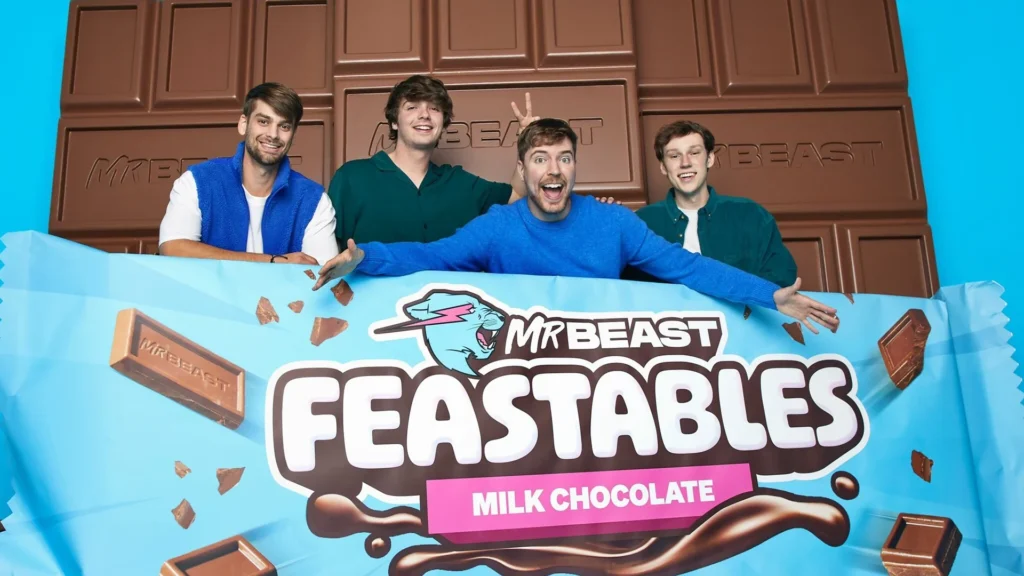
When MrBeast’s Feastables chocolate bars hit Walmart shelves in January 2022, the launch represented more than celebrity product placement. It tested whether YouTube’s biggest creator, with 372 million subscribers as of October 2025, could translate digital influence into physical retail dominance. Three years later, Bloomberg’s March 2025 report delivered the answer: Feastables generated $250 million in sales and $20 million profit in 2024.
This outearned MrBeast’s YouTube channel for the first time. While his media operations including YouTube and Amazon’s Beast Games produced similar revenue but lost $80 million, Feastables delivered profitable growth. The financial trajectory demonstrated sustainability beyond launch hype. Feastables grew from $33 million in 2022 to $96 million in 2023, then $250 million in 2024.
Financial Performance:
- 2022 sales: $33M (first full year)
- 2023 sales: $96M (191% growth year-over-year)
- 2024 sales: $250M ($20M profit, first time outearning YouTube)
- 2025 projection: $520M per Beast Industries investor documents
- 2026 target: Triple 2024 revenue through beverage/wellness expansion
- Distribution: 30,000 retail locations (Walmart, Target, 7-Eleven)
The strategy succeeded because MrBeast competed on narrative, not taste or price. Each chocolate bar became vessel for potential YouTube appearance through golden ticket campaigns. Fans didn’t just buy chocolate, they bought lottery tickets for viral fame. This transformed commodity purchase into interactive experience, driving store rushes Walmart rarely witnessed for confectionery.
By October 2025, Feastables occupied 30,000 retail locations including Walmart, Target, and 7-Eleven across US, Canada, and Mexico. Beast Industries projects $520 million in 2025, dwarfing projected $288 million from YouTube. The company targets tripling revenue by 2026 through beverages and wellness products. MrBeast’s competitive advantage? Zero advertising spend translates to profit margins twice industry average.
The Walmart Strategy: Why Physical Retail Mattered More Than D2C
Choosing Mass Market Over Exclusive Launch
MrBeast’s decision launching through Walmart rather than direct-to-consumer contradicted creator wisdom. Most YouTuber products debut through personal websites maximizing margins. Yet Feastables prioritized immediate physical presence despite lower per-unit margins. The strategy reflected understanding of chocolate psychology.
Unlike energy drinks purchased individually, chocolate bars sell through impulse buying and routine grocery trips. Consumers browse Walmart candy aisles without brand loyalty, making shelf visibility critical. Feastables needed physical proximity to Hershey’s and Reese’s, not isolated e-commerce requiring shipping costs incompatible with chocolate cravings.
Retail Expansion Timeline:
- January 2022: Feastables launches with initial Walmart distribution
- 2022 sales: $33 million first full year
- 2023 expansion: Target, 7-Eleven, regional grocers added
- 2023 sales: $96 million (191% growth year-over-year)
- 2024 distribution: 30,000 retail locations nationwide
- 2024 sales: $250 million with $20M profit
- Geographic reach: US, Canada, Mexico, expanding Europe/Asia
- 2029 target: $4.78 billion (per investor deck)
Walmart’s scale provided infrastructure impossible to replicate independently. Rather than building fulfillment centers and negotiating supplier contracts, Feastables leveraged Walmart’s existing distribution network reaching every American ZIP code. The partnership also provided credibility. Shelf space at Walmart validated Feastables as legitimate brand rather than temporary YouTube merchandise.
The choice demonstrated strategic thinking beyond typical creator product launches. While direct-to-consumer maximizes margins, mass retail maximizes volume and accessibility. MrBeast chose scale over margin, betting that chocolate’s impulse-purchase nature required physical presence at point of natural consumer flow.
The Golden Ticket Phenomenon That Drove Store Rushes
MrBeast weaponized Walmart distribution through golden ticket campaigns generating artificial scarcity. Videos showing fans searching stores for special bars containing prizes or YouTube appearances transformed grocery shopping into treasure hunt. The “Find the MrBeast Factory” contest offered $1 million prize, creating massive sales while generating content views monetizing campaign through advertising.
This closed-loop marketing proved impossible for traditional brands. Hershey’s couldn’t offer YouTube appearances because Hershey’s didn’t control media platform generating hundreds of millions monthly views. MrBeast’s vertical integration from content to commerce created synergy where chocolate sales funded video production and videos drove chocolate sales.
Golden Ticket Strategy:
- Videos showing fans searching stores for special prize bars
- YouTube appearances as prizes (impossible for traditional brands to offer)
- “Find the MrBeast Factory” contest with $1M prize
- Store rushes generated content views monetized through advertising
- Closed-loop marketing: chocolate funds videos, videos drive chocolate sales
- Artificial scarcity transformed commodity purchase into treasure hunt
Golden tickets also generated earned media through fan-created content. YouTube, TikTok, and Instagram flooded with videos showing people searching Walmart shelves and unboxing Feastables bars. This user-generated content reached audiences beyond MrBeast’s 372 million subscribers. Each fan video functioned as authentic testimonial more persuasive than corporate marketing.
The strategy converted passive consumers into active participants. Rather than pushing advertising onto reluctant audiences, MrBeast created game where fans voluntarily promoted product while competing for prizes. This participatory framework generated exponentially more engagement than traditional advertising campaigns costing millions.

🍫 Feastables MrBeast Cookies & Creme Chocolate Bar – King Size Fairtrade Cocoa (10-Pack, 2.1 oz)
🛒 Shop Now on AmazonThe $250 Million 2024: How Chocolate Outearned YouTube
Breaking Down Beast Industries Revenue Split
Beast Industries’ 2024 financial performance revealed fundamental shift in creator monetization. According to investor documents obtained by Bloomberg March 2025, the company generated approximately $500 million total revenue split between media ($246 million) and Feastables ($250 million). Yet profitability told different story: Feastables contributed $20 million profit while media lost nearly $80 million.
The media loss was strategic investment, not failure. MrBeast’s YouTube videos cost $2-4 million each, with some challenges exceeding $5 million. Beast Games became Amazon Prime’s biggest reality show, drawing 50 million viewers within 25 days despite MrBeast personally covering production overspend. These investments maintained audience growth fueling Feastables sales through free marketing.
2024-2025 Financial Breakdown:
- 2024 total revenue: ~$473-500 million
- 2024 Feastables: $250M sales, $20M profit
- 2024 media: $246M revenue, $80M loss (strategic reinvestment)
- 2025 projected total: $899 million
- 2025 Feastables projection: $520 million
- 2025 YouTube projection: $288 million
- 2025 other businesses: $105M (Lunchly, Viewstats software)
- Company valuation: $5 billion (after $300M Series C led by Alpha Wave)
The profit margin differential explained Feastables’ strategic importance. While YouTube generated revenue through advertising split with platform, Feastables captured full retail markup. With production costs controlled and marketing expenses zero (MrBeast’s channel served as free advertising), profit margins reached twice industry average.
Traditional chocolate brands spending 10-15% revenue on advertising couldn’t compete against creator leveraging existing audience without incremental marketing costs. This economic advantage stemmed directly from MrBeast’s ownership of attention rather than renting it through advertising channels.
Why Traditional Brands Couldn’t Replicate Model
Hershey’s, Mars, and Nestlé possessed distribution advantages, manufacturing expertise, and century-long brand equity. Yet none could replicate Feastables’ growth because none controlled media platform generating hundreds of millions monthly impressions. When Hershey’s launched new product, company paid influencers or bought television advertising.
When MrBeast launched Feastables, he integrated product into videos organically while maintaining creative control and capturing advertising revenue. The economics created insurmountable competitive advantage. If Hershey’s spent $50 million annually reaching 500 million impressions, cost per impression was $0.10. MrBeast’s channel generated similar impressions monthly at zero marginal cost.
Competitive Advantages Over Traditional Brands:
- Zero marketing expenses versus 10-15% revenue for traditional brands
- 372 million subscribers function as permanent free marketing platform
- Customer acquisition cost approaches zero versus $5-20 for traditional brands
- Profit margins twice industry average due to eliminated advertising spend
- Content fans actively seek versus advertising that interrupts consumption
- Audience relationship quality: fans want MrBeast to succeed
Audience relationship quality also differentiated approaches. Traditional advertising interrupts content consumers want, creating resistance. MrBeast’s product integration appeared within content fans actively sought, creating positive association. Fans wanted MrBeast to succeed, so buying Feastables felt like supporting favorite creator rather than enriching faceless corporation.
This emotional connection transformed transactional purchase into participatory support. Traditional brands compete on taste, price, and convenience. MrBeast competed on narrative and belonging, creating loyalty traditional chocolate brands couldn’t replicate through advertising spend alone.
The 2025 Expansion: From Chocolate Bars to Beverage Empire
The Lunchly Launch and Cross-Brand Synergy
September 16, 2024, MrBeast partnered with Logan Paul and KSI launching Lunchly, grab-and-go lunch kits positioning as “better-for-you” Lunchables rival. Each box bundled Prime drink and Feastables bar, creating cross-brand synergy. Kits rolled immediately into Walmart, Target, and Kroger with first-quarter sell-through reaching seven-figure units and day-one stock-outs.
The partnership demonstrated creator collaboration amplifying individual reach. Combined subscriber bases created promotional firepower traditional brands couldn’t match. Single Instagram post reached hundreds of millions organically, generating awareness Kraft Heinz required millions in advertising spend. The collaboration validated multi-creator partnerships as legitimate CPG strategy.
Lunchly Launch Details:
- September 16, 2024 launch with Logan Paul and KSI
- Positioned as “better-for-you” Lunchables rival
- Bundled Prime drink and Feastables bar (cross-brand synergy)
- Immediate rollout: Walmart, Target, Kroger
- First-quarter sell-through: Seven-figure units
- Day-one stock-outs demonstrated demand
- Combined subscriber bases amplified promotional firepower
However, Lunchly faced immediate scrutiny. Nutrition advocates criticized sodium gaps in on-pack comparisons. TikTokers posted mold-spotting videos racking up 8 million views. Unlike Feastables’ smooth launch, Lunchly exposed risks of moving too fast without traditional CPG rigor. The controversy demonstrated that creator influence accelerates both success and failure.
The Beast Industries Vision: $4.78 Billion by 2029
Beast Industries investor documents reveal ambitious diversification beyond chocolate. Company projects revenue growing from $899 million in 2025 to $1.6 billion in 2026 and $4.78 billion by 2029 through five areas: software (Viewstats), consumer packaged goods (Feastables, Lunchly), health and wellness, media (YouTube, streaming), and video games.
The 2029 projection assumes Feastables triples by 2026 then continues aggressive growth through beverage launches, wellness products, and international expansion. Documents show company eyeing European and Asian markets where MrBeast’s YouTube presence already established brand awareness without marketing investment.
Growth Projections:
- 2026 projection: $1.6 billion total revenue
- 2029 target: $4.78 billion total company revenue
- Expansion categories: Beverages, wellness products, video games
- International markets: Europe and Asia expansion
- Total funding raised: $450+ million over four years
- Valuation: $5 billion following Series C
- MrBeast philosophy: Aggressive reinvestment, claims less than $1M personal bank account
Beast Industries’ $5 billion valuation following $300 million Series C led by Alpha Wave validated investor confidence. Total funding exceeded $450 million over four years. Yet MrBeast maintains aggressive reinvestment philosophy, claiming less than $1 million in personal bank account despite billion-dollar net worth. This approach prioritizes growth over personal wealth extraction.
The diversification strategy reduces dependence on any single revenue stream. If YouTube algorithm changes devastate ad revenue, Feastables continues generating profit. If chocolate market saturates, beverages and wellness products provide growth. This portfolio approach mirrors traditional conglomerates but leverages creator marketing advantages across all categories.

🥜 Feastables MrBeast Peanut Butter Cups – Milk Chocolate & Creamy Filling (24-Count, 2-Pack)
🛒 Shop Now on AmazonThe Creator-to-CPG Blueprint: Lessons From Feastables Success
Why 372 Million Subscribers Beats $50 Million Ad Budget
Feastables validated fundamental shift in brand building economics. Traditional CPG brands spend decades and billions building awareness through advertising. Feastables launched with instant recognition among hundreds of millions because MrBeast already owned attention. Customer acquisition cost differential manifests financially.
Traditional brands pay $5-20 acquiring each customer through advertising channels. Feastables’ customer acquisition approaches zero because MrBeast’s existing audience discovers product through content they already consume. When video featuring Feastables generates 100 million views, cost of reaching viewers was already accounted for in video production budget serving dual purpose: entertainment monetized through advertising and product marketing generating retail sales.
Economic Model Advantages:
- Traditional brands: $5-20 customer acquisition cost through advertising
- Feastables: Near-zero customer acquisition cost through existing audience
- Traditional brands: 10-15% revenue spent on advertising
- Feastables: 0% advertising spend, margins twice industry average
- Video production serves dual purpose: entertainment revenue + product marketing
- 372 million subscribers provide permanent free marketing platform
This economic model explains margin advantages. Without advertising expenses consuming 10-15% revenue, creators capture additional profit while matching traditional brand pricing. Feastables’ profit margins reaching twice industry average stem directly from zero marketing spend. The structural advantage compounds over time as subscriber base grows organically through content quality.
The Operational Challenges Traditional Brands Handle Better
Despite marketing advantages, Feastables faced operational challenges traditional CPG brands navigate routinely. Initial production in Peru faced tariff pressures forcing manufacturing relocation consideration. Quality control issues emerged as scale increased. Distribution complexity grew across 30,000 locations requiring sophisticated logistics.
These hurdles explain why celebrity products typically fail. Marketing generates initial demand, but sustained success requires supply chain expertise and quality assurance systems celebrities rarely possess. MrBeast’s advantage stemmed from recognizing limitations early, partnering with experienced CPG operators rather than attempting in-house operations.
Success Factors:
- Hybrid approach: Creator marketing + professional operations
- MrBeast owns majority stake ensuring aligned incentives
- Operations delegated to professionals understanding CPG complexity
- Genuine product quality beyond celebrity association
- Ethical sourcing supports long-term customer loyalty
- Walmart partnership provided distribution infrastructure
- Professional partnerships compensated for creator skill gaps
The hybrid approach combining creator marketing with professional operations represents optimal structure. Pure celebrity licensing fails because celebrities lack incentive optimizing operations. Fully celebrity-run businesses fail because celebrities lack operational expertise. Feastables’ success stems from MrBeast owning majority stake ensuring aligned incentives while delegating operations to professionals.
The Bottom Line
MrBeast Feastables generated $250 million sales and $20 million profit in 2024, outearning his YouTube channel for first time since January 2022 launch. Walmart became primary distribution partner alongside Target and 7-Eleven, with Feastables now available in 30,000 retail locations across US, Canada, and Mexico. Beast Industries projects $520 million Feastables sales in 2025, triple revenue by 2026, and $4.78 billion total company revenue by 2029.
Why This Strategy Worked:
- Leveraged attention ownership traditional brands couldn’t replicate
- Zero advertising spend created profit margins twice industry average
- Golden ticket campaigns transformed chocolate into lottery tickets for viral fame
- Walmart distribution provided infrastructure and credibility
- Vertical integration: content funds product, product funds content
- 372 million subscribers function as permanent free marketing platform
The strategy succeeded because MrBeast leveraged attention ownership traditional chocolate brands couldn’t replicate. While Hershey’s and Mars spend 10-15% revenue on advertising, Feastables reached hundreds of millions monthly at zero marginal cost through content fans actively sought. Walmart launch demonstrated physical retail distribution amplified rather than competed with digital influence.
Golden ticket campaigns created participatory framework where fans voluntarily promoted product while competing for prizes. Store rushes, user-generated unboxing videos, and earned media generated through fan enthusiasm amplified reach exponentially beyond paid advertising. The closed-loop economics where chocolate sales fund video production and videos drive chocolate sales created sustainable competitive advantage.
Key Lessons for Creators:
- Owned attention beats rented attention through advertising
- Physical retail distribution amplifies rather than competes with digital influence
- Vertical integration creates synergy where each business line amplifies others
- Professional operational partnerships compensate for creator skill gaps
- Genuine product quality required beyond celebrity association
- Participatory campaigns (golden tickets) generate exponential engagement
- Hybrid approach: Creator marketing + professional operations
For creators studying Feastables success, lessons transcend chocolate industry. Vertical integration from content to commerce creates synergy where each business line amplifies others. Aggressive reinvestment in content quality maintains audience growth fueling product sales. Professional operational partnerships compensate for creator skill gaps. Most critically, sustainable creator businesses require genuine product quality beyond celebrity association, with Feastables’ ethical sourcing supporting long-term customer loyalty transcending initial curiosity purchases.