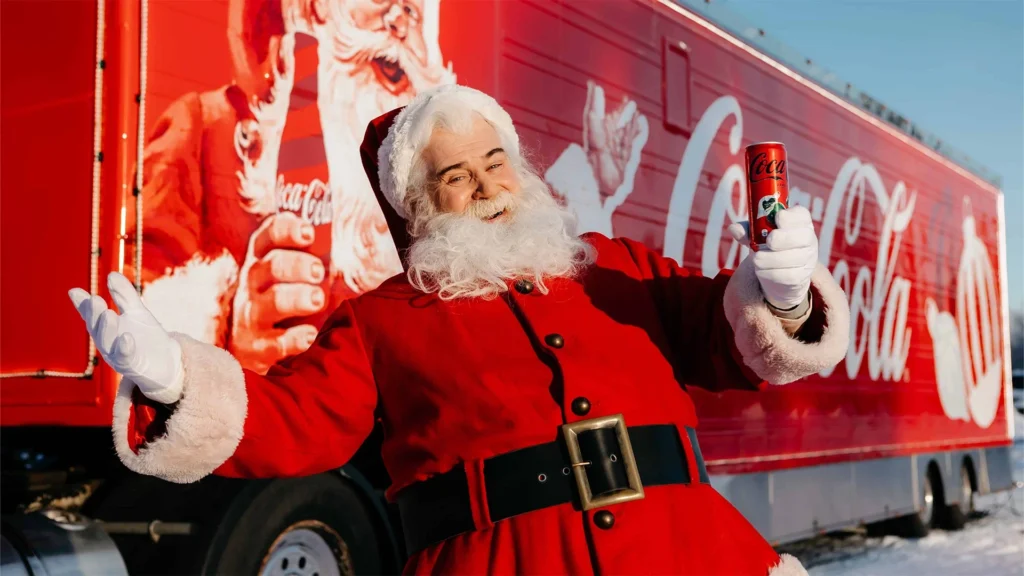
Every December, a simple phrase signals Christmas has arrived. Not “Merry Christmas.” Not “Happy Holidays.” Just four words sung over glowing red trucks. “Holidays are coming, holidays are coming.” For millions worldwide, Coca-Cola Christmas ads mark the season’s official start more reliably than calendar dates or retail decorations.
2025 Campaign Performance:
- 38,752 social media messages generated
- 735,000+ engagements (more than double runner-up John Lewis)
- 61% positive sentiment despite AI controversy
- Most talked-about Christmas campaign per Sprout Social analysis
The 2025 campaign launched November 3 with AI-generated “Holidays Are Coming” refresh, generating conversation volume proving Coca-Cola Christmas remains cultural moment transcending typical advertising. This dominance didn’t happen accidentally. Coca-Cola Christmas strategy began 1931 when the company commissioned Michigan-born illustrator Haddon Sundblom to create Santa Claus advertisements that would change Christmas forever.
Before Sundblom, Santa appeared as everything from tall gaunt man to spooky-looking elf, with no consistent appearance across cultures. Sundblom drew inspiration from Clement Clark Moore’s 1822 poem “A Visit From St. Nicholas,” creating warm, friendly, pleasantly plump Santa with rosy cheeks and twinkling eyes. That first image titled “My Hat’s Off” debuted The Saturday Evening Post December 1931. For next 33 years until 1964, Sundblom painted every Coca-Cola Christmas Santa, cementing association between brand and holiday figure that endures 94 years later.
The 1931 Campaign That Changed Christmas Forever
Before Coca-Cola, Santa Had No Standard Appearance
Prior to 1930s, Santa Claus existed as collection of contradictory folklore figures rather than single character. Civil War cartoonist Thomas Nast drew Santa for Harper’s Weekly in 1862 as small elflike figure wearing bishop’s robe and Norse huntsman’s animal skin, supporting the Union. Over decades, various cultures contributed different Santa elements.
Santa’s Scattered Origins:
- Reindeer and sleigh from Scandinavia
- Pipe and chimney from Holland
- Saint Nicholas traditions from Europe
- Father Christmas mythology from Britain
- By 1920s appeared tall, thin, strict, gaunt, cheerful, serious
- Wore green, tan, blue, or red with no consistent personality
The Coca-Cola Company began Christmas advertising in 1920s with shopping-related magazine ads featuring strict-looking Santa similar to Thomas Nast’s interpretations. In 1930, artist Fred Mizen painted department store Santa drinking Coca-Cola in crowd at Famous Barr Co. in St. Louis, featuring world’s largest soda fountain. The ad appeared The Saturday Evening Post December 1930. While successful, neither campaign created lasting Santa image.
Archie Lee, D’Arcy Advertising Agency executive working with Coca-Cola, wanted campaigns showing wholesome Santa who was both realistic and symbolic, showing Santa himself rather than man dressed as Santa. Coca-Cola commissioned Haddon Sundblom in 1931 to develop advertising images using Santa Claus. Sundblom studied Clement Clark Moore’s 1822 poem “A Visit From St. Nicholas,” which described Santa as dressed in fur from head to foot with clothes tarnished with ashes and soot, looking like peddler opening pack.
Sundblom’s Creative Process:
- Studied Moore’s 1822 poem for Santa’s description
- Initially used friend Lou Prentiss as model
- Later even used himself as model
- Created Santa radiating warmth like favorite grandfather
- Made character who loved children and enjoyed life
Sundblom’s Santa succeeded where others failed because of specific artistic choices making character approachable rather than authoritarian. Previous Santas appeared stern, judgmental, or mystical. Sundblom’s Santa looked genuinely joyful, catching children climbing chimneys, playing with toys before delivering them, taking breaks to read children’s letters while enjoying Coke. The poses suggested Santa as real person with personality, quirks, and genuine affection for children rather than distant mythological figure dispensing rewards and punishments.
Coca-Cola Christmas Santa Evolution (1931-1964)
Key Milestones:
- 1931: “My Hat’s Off” debuts The Saturday Evening Post and Collier’s December issues
- 1931-1964: Sundblom created all Coca-Cola Christmas Santa advertisements (33 consecutive years)
- 1936: Santa without jacket showing rolled-up sleeves during Great Depression
- 1942: Introduction of Sprite Boy character (elf appearing alongside Santa)
- 1964: Sundblom’s final Santa version
- Campaign distribution: Magazines, store displays, billboards, posters, calendars, plush dolls
The Coca-Cola Christmas red color proved strategically critical. While red Santa suits existed before 1931, no previous campaign consistently used specific shade of joyful bright red matching Coca-Cola brand color. By consistently portraying Santa in Coca-Cola red year after year across magazines, billboards, store displays, and calendars, the brand created inseparable association in public consciousness between Santa’s red and Coca-Cola’s red.
Over decades, this color consistency made red-suited Santa dominant image worldwide, with Coca-Cola’s specific shade becoming synonymous with Christmas itself. The timing of Great Depression amplified campaign success. Sundblom’s 1931 Santa debuted during economic hardship when Americans desperately needed hope and joy. The warm, cheerful Santa drinking Coca-Cola represented simple moment of pleasure and reminder of happy times.
During era before television, before color motion pictures became common, before widespread color newspaper use, Coca-Cola Christmas magazine advertisements, billboards, and point-of-sale store displays became many Americans’ primary exposure to modern Santa image. The campaign provided consistent, comforting visual during decade of economic uncertainty.
The 1995 Innovation That Created Modern Coca-Cola Christmas
How Glowing Trucks Became Holiday Tradition
While Sundblom’s Santa created foundation, the Coca-Cola Christmas truck campaign transformed brand into official Christmas herald. In 1995, Coca-Cola premiered holiday ad with Industrial Light and Magic, George Lucas’s special effects company responsible for Star Wars, Raiders of the Lost Ark, and Forrest Gump.
The 60-second spot featured Coca-Cola delivery truck covered in holiday lights and Santa Claus images traveling worldwide, lighting up towns and families as caravan passed through. The illuminated vehicles immediately became symbols of holiday happiness. The campaign’s jingle became instant classic. “Holidays are coming, holidays are coming” repeated over orchestral warmth with drums and chimes created melody millions now associate with Christmas arrival.
Why the Jingle Works:
- Repeated over orchestral warmth with drums and chimes
- Created melody millions associate with Christmas arrival
- Plays prominently in every iteration since 1995
- Reinforces nostalgia as key emotional anchor
- For many viewers, hearing jingle means Christmas officially started
By late 1990s, Coca-Cola brought trucks from advertisements into physical reality. Actual trucks decked out in lights and Santa images appeared in 65 U.S. cities and multiple Eastern European locations, creating experiential marketing events where families could photograph glowing vehicles and meet Santa. The physical tours transformed television advertising into real-world experiences, proving effectiveness of experiential marketing during festive season.
Coca-Cola Christmas Truck Campaign Evolution
Timeline:
- 1995: Original “Holidays Are Coming” ad debuts with Industrial Light and Magic
- Late 1990s: Physical trucks tour 65 U.S. cities plus Eastern European locations
- 2000s-2010s: Expansion to UK, becoming British Christmas tradition
- 2020: Pause due to COVID-19 pandemic
- 2021-2024: Return with enhanced experiences, Santa photos, donation drives
- 2025: 28th consecutive year (excluding 2020 pause)
The 2025 Coca-Cola Christmas Holiday Caravan visiting Los Angeles December 3-7 represents modern evolution of 30-year tradition. The experience built around small but charming moments: snapping postcard-worthy photo with Santa on brand-new throne, picking up complimentary holiday bag and tag from Coca-Cola Gifting Box, grabbing warm drink at Costa Coffee cart pouring limited-edition holiday cups designed for Instagram sharing.
Philanthropic elements woven into 2025 tour demonstrate brand values alignment. Coca-Cola partnered with No Kid Hungry, inviting guests to give back through interactive donation stations highlighting exactly how many meals each contribution funds. Scanning QR code triggers donation and sends thank-you email packed with celebrity chef recipes, rewarding generosity with practical value.
2025 Los Angeles Tour Stops:
- December 3: Rosemead at Panda Express parking lot
- December 4: Inglewood (El Super and Smart & Final)
- December 5: Torrance Walmart and Terranea Resort evening session
- December 6: Long Beach Ralphs and Buena Park Albertsons
- December 7: Seven-hour run inside Six Flags Magic Mountain
The Los Angeles route kicked off December 3 in Rosemead at Panda Express parking lot from midday into afternoon. December 7 culminated with seven-hour run inside Six Flags Magic Mountain, positioning Santa against roller coasters to merge holiday magic with theme park entertainment.
The Controversial 2025 AI Campaign That Still Dominated
Why Coca-Cola Doubled Down on Artificial Intelligence
Coca-Cola launched “Refresh Your Holidays” campaign Monday, November 3, 2025, featuring “refreshed and optimized version” of “Holidays Are Coming” developed with generative artificial intelligence. The 60-second ad begins with Santa Claus popping top off Coca-Cola bottle before following delivery trucks that power lights and capture attention of anthropomorphic animals including polar bears, penguins, puppies, and rabbits as they drive by.
The decision to use AI for second consecutive year sparked immediate backlash. Tech outlet The Verge dubbed ad “eyesore.” Social media users blasted it as “AI slop,” with one X post viewed over 20,000 times stating: “2025 ai slop cheap coca cola commercial, you will never be 1990s festively warm and comforting coca cola Christmas commercial.”
AI Campaign Criticism:
- The Verge called it “eyesore”
- Social media users blasted as “AI slop”
- Featured differently shaped Coke lorry in every frame (typical AI error)
- Nostalgia for 1993’s classic ad dominated comparisons
- Critics noted lack of “design, character, story, personality, warmth and heart”
Despite controversy, Coca-Cola defended strategy. Press release stated: “Last year we set global milestone with world’s first entirely GenAI-created film on broadcast media, a bold leap that broke new ground. This year’s campaign is another proof point in our journey of emerging technology to rethink how we create and scale content.”
Pratik Thakar, Coca-Cola’s global VP and head of generative AI, explained to The Hollywood Reporter that AI enables geo-specific media buys with localized elements. “Viewers in Boston will see Coca-Cola Christmas trucks passing by ‘Welcome to Boston’ billboard. Another superpower of AI is that we can create personalized and programmatic content like this at scale.”
The Strategic Reasoning Behind AI Persistence
Coca-Cola’s commitment to AI despite backlash reflects long-term strategy rather than short-term reaction. Mostafa ElDessouky, Coca-Cola’s senior director of global creative strategy, explained to Marketing Dive: “Without trying and pushing limits, we’re not going to add more to brand. Maybe we land on something that people love so much it becomes our own Labubu. You might land on something like that, and then it becomes asset of yours, just like we landed on Santa Claus and truck.”
Campaign Development Partners:
- WPP Open X (led by VML, supported by EssenceMediacom, Ogilvy, Burson)
- Silverside AI
- Secret Level
- Leonardo.ai
- Mimic
- OpenAI
- Accenture
- Microsoft
Coca-Cola’s marketing transformation centers on connecting deeply with consumers through digital engagement, personalized experiences, and cultural relevance, according to CEO James Quincey during Q3 2025 earnings call. Q3 saw net revenue grow 5% to $12.5 billion despite challenging macroeconomic climate. Quincey’s statement suggests AI campaigns represent investment in future capabilities rather than cost-cutting measure.
Research revealed multiple cohorts connect with Coca-Cola Christmas but have different needs and demands requiring different creative approaches. AI enables Coca-Cola to weave these variations into campaigns running across North America, Latin America, and Asia South-Pacific markets simultaneously. The technology allows global reach with local personalization previously impossible at scale.
Why 94 Years Later, Coca-Cola Still Owns Christmas
The Consistency that Creates Cultural Ownership
Coca-Cola Christmas dominance stems from 94-year commitment to consistent visual language. The red color never wavers. Santa imagery remains constant. Truck lights maintain same glowing quality. “Holidays Are Coming” jingle stays recognizable. While campaigns modernize with AI technology and social media integration, core elements remain unchanged since 1931.
This consistency created cultural shorthand where seeing specific shade of red with white trim immediately triggers Christmas associations, even without Coca-Cola logo visible. The brand’s Christmas assets, from trucks to Santa Claus to polar bears (introduced 1993), remain central to marketing strategy.
Owned Cultural Properties:
- Specific shade of Coca-Cola red synonymous with Christmas
- Sundblom’s Santa Claus visual standard
- “Holidays Are Coming” jingle
- Glowing red trucks
- Polar bears (introduced 1993)
These elements function as owned cultural properties that competitors cannot replicate without seeming derivative. When other brands attempt Christmas campaigns featuring Santa or red trucks, audiences immediately compare to Coca-Cola originals. The 94-year head start creates insurmountable competitive advantage, as Coca-Cola Christmas became definitional example against which all other holiday campaigns measured.
Value congruence between Santa Claus and Coca-Cola brand strengthened over decades. Both represent happiness, generosity, and connection. Santa brings joy to children worldwide. Coca-Cola positions as beverage bringing people together for refreshing pause. By consistently showing Santa as joyful, kind, and warm-hearted, Coca-Cola didn’t just use Santa as spokesperson. The brand made Santa carrier of its identity.
The Numbers Proving Continued Dominance
Coca-Cola operates in over 200 countries with 96% global brand awareness and 64% usage rate according to Statista. This massive reach ensures Coca-Cola Christmas campaigns penetrate markets worldwide, from Americas to Europe, Asia to Africa. The brand adapted marketing to different cultures while maintaining consistent red-and-white logo everywhere.
Global Reach Metrics:
- 200+ countries operations
- 96% global brand awareness
- 64% usage rate
- Christmas campaign runs globally with geo-specific variations
- Universal message delivered through culturally relevant lenses
The 2025 campaign’s 735,000+ engagements and 38,752 social messages demonstrate continued cultural relevance despite AI controversy. Generating twice the engagement of runner-up John Lewis proves Coca-Cola Christmas remains conversation-starting force even when reception splits between appreciation and criticism.
Digital innovation complements physical experiences. The 2025 campaign included first-of-its-kind AI-powered Santa conversation experience letting consumers have real-time chat with Santa in 45+ languages to generate customized snow globe shareable on social media. Accessible by scanning on-pack QR codes or visiting CreateRealMagic.com, the experience brought 1931 Sundblom Santa from static images to dynamic interaction.
The Bottom Line
Coca-Cola Christmas dominance represents 94-year marketing masterclass in consistency, cultural appropriation, and brand-character symbiosis. The campaign launched 1931 when Haddon Sundblom created warm, friendly Santa Claus that transformed varied folklore figure into globally recognized icon. For 33 consecutive years until 1964, Sundblom painted every Coca-Cola Christmas Santa, establishing association between red-suited character and red-branded beverage that endures through 2025.
What Made It Work:
- 94-year commitment to consistent visual language (red color, Santa, trucks, jingle)
- Cultural ownership through owned properties competitors cannot replicate
- Value congruence between Santa Claus and Coca-Cola brand (happiness, generosity, connection)
- Physical truck experiences amplifying digital campaigns since 1995
- Technological innovation enhancing rather than replacing historical assets
The 1995 “Holidays Are Coming” truck campaign created second pillar of Coca-Cola Christmas strategy. Industrial Light and Magic produced glowing red trucks that immediately became symbols of holiday happiness. The 2025 Holiday Caravan marked 28th consecutive year, visiting Los Angeles December 3-7 with Costa Coffee warm drinks and No Kid Hungry charitable donations, proving 30-year tradition maintains relevance through modern enhancements.
The controversial November 3, 2025 AI-generated campaign generated 38,752 social media messages and 735,000+ engagements, more than double runner-up John Lewis despite 61% positive sentiment amid backlash. Yet conversation volume proves Coca-Cola Christmas remains dominant cultural moment. The brand’s willingness to push technological limits while maintaining core visual elements demonstrates commitment to evolution without abandoning 94-year heritage.
Key Lessons for Brands:
- Long-term consistency creates cultural ownership
- Visual language standardization across decades builds instant recognition
- Character-brand symbiosis makes spokespersons carriers of brand identity
- Physical experiences amplify digital campaigns
- Patience and persistence win cultural dominance impossible through short-term tactics
Coca-Cola Christmas succeeds because brand didn’t just advertise during holidays. The company quietly took over Christmas through consistent 94-year strategy making Santa Claus inseparable from Coca-Cola, creating glowing truck tradition signaling season’s arrival, and maintaining visual language transcending generations. With 96% global brand awareness across 200+ countries and ability to generate twice competitor engagement despite controversy, Coca-Cola Christmas demonstrates how single brand can dominate cultural holiday through relentless consistency and strategic innovation.