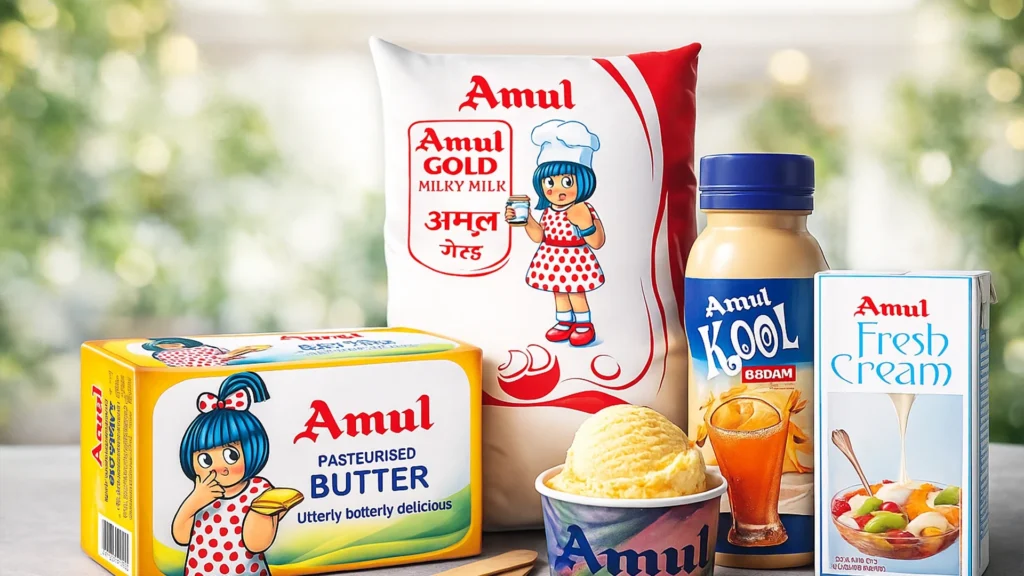
In 1946, dairy farmers in Anand, Gujarat faced brutal exploitation. Middlemen purchased milk at rock-bottom prices from farmers but sold it to Polson Dairy in Mumbai at huge markups, keeping most profits while farmers struggled. When farmers demanded fair prices, the British-era monopoly refused. Frustrated farmers approached Sardar Vallabhbhai Patel, who suggested forming their own cooperative. On December 14, 1946, Tribhuvandas Patel founded what would become Amul, challenging the idea that poor farmers couldn’t organize successful businesses competing against powerful corporations.
By 2024, Amul generates ₹72,000 crore annual revenue, making it India’s largest food brand and 8th largest dairy company globally. The cooperative model now serves 3.6 million milk producers across 18,600 village societies, processing 35 million liters daily. Amul controls 40% of India’s organized dairy market and 65% of Gujarat’s packaged milk segment. Most remarkably, farmers receive 80% of the consumer spending on milk versus just 35-40% typical in Western markets, proving that farmer-owned businesses can deliver superior returns while building dominant market positions.
The Three-Tier Cooperative Structure
Understanding Amul’s success requires examining its unique organizational architecture. Unlike traditional corporations with shareholders at top and workers at bottom, Amul’s cooperative model inverts the power structure, placing farmers at the apex controlling decision-making while professional managers handle operations. This democratic ownership combined with corporate efficiency creates hybrid model delivering benefits of both systems while avoiding their weaknesses.
The base tier consists of village dairy cooperative societies where approximately 200 milk producers, predominantly women, organize locally. These societies collect milk twice daily from member farmers, test quality and fat content, and make immediate electronic payments based on quantity and quality. The village cooperatives elect representatives to district unions, maintaining democratic control while pooling resources for bargaining power that individual farmers lack. This village-level organization transforms isolated subsistence farmers into organized suppliers with collective strength.
The three-tier cooperative structure:
- Village tier: 18,600 dairy cooperative societies with ~200 producers each
- Predominantly women members organizing locally
- Milk collected twice daily with quality and fat content testing
- Immediate electronic payments based on quantity and quality
- District tier: 18 district milk unions coordinating regional societies
- Unions procure milk, transport to plants, manufacture products
- Provide veterinary care, cattle feed, technical assistance
- Apex tier: GCMMF (Gujarat Cooperative Milk Marketing Federation)
- Manages marketing and distribution under Amul brand
- 87 branches nationwide
- Coordinates 15,000 dealers and 1 million retailers
- Exports to 50+ countries
The Power of Democratic Ownership
The cooperative model functions because farmers control governance through elected representatives at each tier. Village societies elect leaders to district unions, district unions elect state federation boards, ensuring power flows upward from producers rather than downward from distant shareholders. This democratic structure means management serves farmer interests rather than maximizing returns for external investors. When cooperatives succeed, benefits accrue directly to farmer-owners through higher milk prices and patronage dividends rather than enriching disconnected stockholders.
Dr. Verghese Kurien and the White Revolution
While Tribhuvandas Patel founded Amul, Dr. Verghese Kurien transformed it into national movement. Hired in 1949 as general manager despite wanting to leave India for better opportunities abroad, Kurien initially resented being assigned to Anand. However, Patel’s vision and the farmers’ determination convinced him to stay. Kurien brought technical expertise, marketing acumen, and organizational genius that scaled village cooperative into dairy powerhouse that sparked India’s White Revolution.
Kurien’s first breakthrough came through technical innovation. In partnership with H.M. Dalaya, they developed process for making skim milk powder and condensed milk from buffalo milk rather than cow milk. This mattered enormously because India had far more buffaloes than cows, but existing technology only processed cow milk. By enabling buffalo milk processing, Kurien unlocked India’s massive milk production potential previously wasted due to lack of preservation and transport infrastructure.
The White Revolution impact:
- Official name: Operation Flood (started 1970)
- Prime Minister Lal Bahadur Shastri established NDDB in 1964
- Dr. Kurien as chairman spreading cooperatives nationwide
- India transformed from milk-deficient to world’s largest producer by 1998
- Milk production: 22 million tons (1970) to 187 million tons (current)
- “Anand Pattern” replicated across multiple states
- Karnataka (Nandini), Maharashtra (Mahanand), Rajasthan (Saras)
- Benefits 80-100 million farming families nationwide
The White Revolution, officially called Operation Flood, replicated Amul’s cooperative model across India starting in 1970. Prime Minister Lal Bahadur Shastri, impressed by Amul’s success during his 1964 visit, established the National Dairy Development Board with Kurien as chairman to spread cooperatives nationwide. Operation Flood created dairy cooperatives in multiple states, established milk processing infrastructure, and organized marketing networks. The program transformed India from milk-deficient nation importing dairy products into world’s largest milk producer.
Delivering 80% to Farmers: The Economics of Fairness
Amul’s most powerful competitive advantage is returning 80% of consumer spending directly to farmers compared to 35-40% typical in Western private dairy companies. This isn’t charity but smart economics. By eliminating middlemen and minimizing corporate overhead, Amul passes savings to producers, creating loyalty and ensuring consistent milk supply that competitors struggle matching. Farmers producing for Amul know they receive fair prices determined by quality rather than arbitrary middleman negotiations, building trust that sustains cooperative through market fluctuations.
Why 80% farmer payout works:
- Farmers receive 80% of consumer spending (vs. 35-40% in Western markets)
- Eliminates middlemen and reduces profit extraction layers
- Traditional chains: farmers, collectors, transporters, processors, distributors, retailers
- Amul collapses layers through farmer-owned infrastructure
- GCMMF operates as cooperative service vs. profit-maximizing entity
- Electronic transfers based on objective quality testing
- Samples tested for fat content, solids-not-fat, quality parameters
- Standardized formulas visible to all farmers
- Transactions viewable through mobile apps
- Transparency prevents corruption in agricultural supply chains
The high farmer payout works because the cooperative model reduces profit extraction at multiple levels. Traditional dairy supply chains involve farmers, collectors, transporters, processors, distributors, and retailers, each taking margins. Amul’s integrated cooperative structure collapses these layers, with farmers directly owning collection and processing infrastructure. The only external player is GCMMF handling marketing and distribution, operated as cooperative service rather than profit-maximizing entity.
The Quality Incentive System
Paying for quality rather than just quantity creates powerful incentives for farmers to maintain healthy cattle and hygienic milk production. Farmers producing higher fat-content milk or cleaner samples receive premium prices, directly linking better practices to higher incomes. This quality-based pricing eliminates the race-to-bottom dynamics in commodity agriculture where farmers only compete on price, often by cutting corners on inputs or hygiene. Amul’s system makes quality profitable, aligning farmer incentives with consumer interests and brand reputation.
Professional Management Within Democratic Control
Amul’s genius lies in balancing democratic farmer control with professional corporate management. The cooperative structure could create bureaucratic inefficiency if managed by committees making operational decisions. Amul avoids this by maintaining clear separation: farmers control governance and strategic direction through elected boards, while hired professional managers handle day-to-day operations, manufacturing, marketing, and distribution. This hybrid approach captures cooperative benefits like farmer loyalty while avoiding inefficiency that pure committee management might create.
The management structure:
- Clear separation: governance vs. operations
- Farmers control governance and strategic direction through elected boards
- Professional managers handle operations, manufacturing, marketing, distribution
- GCMMF hires from top business schools with competitive compensation
- Managers serve farmer-owners vs. shareholders
- Measured by farmer milk prices and product quality vs. just profit margins
- Managing Director Rupinder Singh Sodhi: 40-year career at Amul
- Leadership consistency prevents strategic whiplash
- Institutional knowledge from decades of experience
- Stability builds trust with farmers
GCMMF hires managers from top business schools and provides competitive compensation attracting talent that could work for multinationals. These professionals bring corporate discipline, modern management techniques, and market expertise to operations. However, unlike corporate managers serving shareholders, Amul’s management serves farmer-owners, measured by farmer milk prices and product quality rather than just profit margins. This different accountability structure shapes decision-making toward long-term sustainability and stakeholder welfare over short-term profit extraction.
Innovation Within Cooperative Framework
Amul continuously innovates despite cooperative structure that could resist change. The company fully computerized village societies for transparent record-keeping, implemented digital payment systems processing ₹150 crore daily, developed mobile apps where farmers track transactions and access veterinary services, and launches 30-40 new products annually responding to changing consumer preferences. These innovations prove that cooperatives can be as dynamic as corporations when leadership balances tradition with adaptation.
Building India’s Most Beloved Brand
Beyond operational excellence, Amul built emotional connections through consistent branding and clever marketing. The Amul Girl, created in 1966 by art director Eustace Fernandes and copywriter Sylvester daCunha, became India’s longest-running advertising campaign. The cartoon character with pigtails appears on billboards commenting on current events through witty puns and wordplay, creating topical humor that keeps brand culturally relevant across generations. The campaign costs minimal amounts compared to celebrity endorsements but generates enormous recall and affection.
The Amul brand strategy:
- Amul Girl campaign: longest-running advertising in India (since 1966)
- Created by Eustace Fernandes and Sylvester daCunha
- Topical humor commenting on current events through puns
- Minimal cost vs. celebrity endorsements
- “Utterly Butterly Delicious” tagline for butter
- Consistent red and white packaging for decades
- Product recipes unchanged since 1960s
- Umbrella branding across 50+ products
- Milk, butter, cheese, ice cream, chocolates, infant formula
- Brand extension leveraging reputation across categories
- 30-40 new products launched annually
The “Utterly Butterly Delicious” tagline for Amul butter, along with consistent packaging using red and white colors, created instant brand recognition. Amul maintained product quality and recipes unchanged for decades, with today’s butter tasting identical to 1960s versions. This consistency builds trust that products won’t suddenly change or decline in quality, unlike brands that reformulate to cut costs after achieving market leadership.
The Value-for-Money Positioning
Amul positioned itself as high-quality products at fair prices rather than premium luxury or cheap commodity. The brand occupies the sweet spot where middle-class consumers find affordable products meeting quality expectations without feeling they’re compromising. This value positioning resonates powerfully in price-sensitive Indian markets where discretionary income is limited but consumers still want quality. Amul delivers both through cooperative efficiency that minimizes overhead rather than maximizing margins, creating win-win for consumers and farmer-owners.
Challenges and Competition
Despite success, Amul faces significant challenges. Multinationals like Nestlé, Unilever, and Danone are increasing India presence, competing aggressively in value-added products like yogurt, flavored milk, and cheese where margins are higher than commodity milk. These companies have deep pockets for marketing, product development, and distribution that cooperatives struggle matching. Modern retail chains like Walmart and D-Mart are consolidating distribution, potentially squeezing Amul’s margins and undermining the vast network of small retailers and distributors that the cooperative depends upon.
Current challenges facing Amul:
- Multinational competition: Nestlé, Unilever, Danone increasing India presence
- Aggressive competition in high-margin value-added products
- Yogurt, flavored milk, cheese offering better margins than commodity milk
- Deep multinational pockets for marketing and distribution
- Modern retail consolidation: Walmart, D-Mart squeezing margins
- Rural migration threatening long-term milk procurement
- Young people seeking urban jobs vs. dairy farming
- Agricultural work viewed as difficult and unrewarding
- Political risks from farmer vote banks in Gujarat
- Democratic structure vulnerable to political interference
- Maintaining operational independence critical
The rural migration challenge threatens long-term procurement. India’s large young rural population increasingly seeks urban jobs rather than dairy farming, viewing agriculture as difficult and unrewarding. Maintaining milk supply growth requires keeping young people in villages, but rural economic opportunities remain limited. Amul addresses this through improving farmer incomes, modernizing dairy practices, and providing support services making farming more profitable and less labor-intensive.
Global Expansion and Diversification
Amul is expanding internationally, exporting to 50+ countries, and aiming for ₹1 lakh crore revenue by 2025-26. The company is exploring plant-based products, direct-to-consumer channels, and even personal care items leveraging brand equity. This diversification creates growth opportunities but risks spreading resources too thin or diluting core dairy focus that built Amul’s success. Balancing innovation with consistency in original mission of empowering dairy farmers through quality products requires careful strategic management as the cooperative scales globally.
Expansion and diversification plans:
- Current exports: 50+ countries
- Revenue target: ₹1 lakh crore by 2025-26
- Exploring plant-based products
- Direct-to-consumer channels
- Personal care items leveraging brand equity
- Risk of spreading resources too thin
- Potential dilution of core dairy focus
- Balancing innovation with farmer empowerment mission
The Bottom Line
Amul built ₹72,000 crore dairy empire by proving that farmer-owned businesses can dominate industries when combining democratic ownership with professional management. The cooperative model serving 3.6 million farmers through 18,600 village societies delivers 80% of consumer spending to producers versus 35-40% in Western markets, demonstrating that inclusive economics generates competitive advantages through supplier loyalty and operational efficiency that middleman-dependent models cannot match.
The achievement metrics:
- Annual revenue: ₹72,000 crore
- India’s largest food brand
- 8th largest dairy company globally
- 3.6 million milk producers served
- 18,600 village cooperative societies
- 35 million liters processed daily
- 40% of India’s organized dairy market
- 65% of Gujarat’s packaged milk segment
- Farmers receive 80% of consumer spending
The cooperative model pillars:
- Three-tier structure: village societies, district unions, apex federation
- Democratic ownership: farmers control governance through elected boards
- Professional management: hired experts handle operations
- 80% farmer payout vs. 35-40% in Western markets
- Quality-based pricing incentivizing better practices
- Electronic payments with transparent testing
- ₹150 crore daily digital payment processing
- 30-40 new products launched annually
Key lessons from Amul’s success:
- Stakeholder capitalism works when properly structured
- Serving farmers, consumers, employees vs. just shareholders
- Democracy and professional management coexist through governance-operations separation
- Elected boards set direction while managers execute
- Consistency builds trust marketing cannot buy
- Unchanged recipes and reliable quality for 78 years
- Inclusive business models create societal impact beyond company success
- White Revolution transformed India into world’s largest milk producer
- Benefits 80-100 million farming families nationwide
What differentiated Amul:
- Inverted power structure: farmers at apex vs. shareholders at top
- Eliminating middlemen returning profits to producers
- Kurien’s technical innovation: buffalo milk processing technology
- Anand Pattern replicated across India through Operation Flood
- Amul Girl campaign: longest-running advertising since 1966
- Value-for-money positioning: high quality at fair prices
- Umbrella branding across 50+ product categories
- Purpose-driven mission genuinely improving stakeholder lives
Amul’s success reveals fundamental truths about cooperative economics and inclusive business models. The company demonstrated that eliminating middlemen and returning profits to producers creates sustainable competitive advantages, that democratic ownership structures can compete with multinational corporations when executed with professional management, that empowering suppliers builds loyalty and quality that transaction-based relationships cannot match, and that serving both farmers and consumers generates growth that pure profit-maximization strategies miss.
The success extended beyond Amul to spark India’s White Revolution, replicating the cooperative model nationwide and transforming India from milk-deficient to world’s largest producer. This multiplicative impact proves that successful cooperatives don’t just build businesses but transform entire industries and economies, improving millions of lives while generating sustainable profits.
For entrepreneurs and policymakers, Amul demonstrates that inclusive capitalism works when stakeholder interests align and governance separates from operations. The cooperative structure that seemed destined for inefficiency instead built India’s most beloved brand and largest food company by serving farmers and consumers rather than maximizing shareholder returns. This different approach to business created something corporations could not: genuine loyalty from suppliers and customers who feel the company serves their interests, not just extracts value from them. When businesses truly belong to the people they serve, they build competitive advantages that capital alone cannot purchase.