
Imagine walking into a car dealership. You’ll see sports cars, family SUVs, pickup trucks, and electric vehicles. All are vehicles, but they serve completely different purposes. You wouldn’t buy a Ferrari if you need to haul construction materials, right?
Stocks work the same way.
Apple stock behaves very differently from Coca-Cola stock. Tesla stock has nothing in common with AT&T stock. They’re all stocks, but they serve different investment goals and carry different levels of risk.
Understanding the different types of stocks helps you build the right portfolio for YOUR goals. Let’s break down what you need to know.
Growth Stocks: The Fast Movers
Growth stocks are companies that are expanding rapidly. They’re reinvesting all their profits back into the business to grow even bigger. Think of them as the ambitious startups and tech companies that want to take over the world.
Real Examples (October 2025):
Tesla – Started making electric cars, now building batteries, solar panels, and developing robots. Every dollar of profit goes back into research and expansion. Stock price around $445, but five years ago it was under $50 (split-adjusted).
Nvidia – Makes computer chips for AI and gaming. As AI exploded, Nvidia’s stock went from $150 in 2022 to over $400 in 2025. Massive growth driven by AI demand.
Netflix – Streaming service that keeps spending billions on new shows and expanding to new countries. Stock at $1,160 in October 2025.
Characteristics:
- High revenue growth (20%+ per year)
- Usually don’t pay dividends (they need that money to grow)
- Stock prices can swing wildly
- Higher risk, higher potential reward
- Often in tech, biotech, or emerging industries
The Trade-off:
Growth stocks are like planting a seed. It might become a massive tree… or it might not grow at all. You’re betting on the future. If the company succeeds, you make big returns. If it fails, you could lose a lot.
Who should buy growth stocks?
- Younger investors (time to recover from volatility)
- Higher risk tolerance
- Long-term horizon (5+ years)
- Want capital appreciation, not income
Value Stocks: The Bargain Hunters’ Choice
Value stocks are established companies that the market has overlooked or undervalued. They’re profitable, stable businesses trading below their “true” worth. Think of them as buying a quality used car at a great price instead of paying premium for the newest model.
Real Examples (October 2025):
Ford Motor Company – Making solid profits, pays dividends, but stock trades at lower valuations because people are excited about Tesla. Stock around $12, P/E ratio of 6 (meaning it’s cheap relative to earnings).
AT&T – Massive telecom company with millions of customers. Steady profits, pays good dividends, but stock doesn’t move much. It’s “boring” but reliable.
Bank of America – One of the largest banks in the U.S. Profitable, pays dividends, but banks aren’t as exciting as tech companies so it trades at lower multiples.
Characteristics:
- Lower P/E ratios (price seems “cheap”)
- Established businesses with track records
- Often pay dividends
- Less volatile than growth stocks
- Found in traditional industries (banking, utilities, manufacturing)
- Stock price grows slowly but steadily
The Trade-off:
Value stocks are like buying a solid, reliable Honda Civic. It won’t turn heads, but it’ll get you where you need to go reliably. You won’t get rich quickly, but you’re less likely to lose your shirt either.
Who should buy value stocks?
- Conservative investors
- People nearing retirement
- Want steady, predictable returns
- Lower risk tolerance
- Looking for dividends plus some growth
Growth vs Value: The Real Difference
Let me show you with actual performance:
2020-2021 (Bull Market):
- Growth stocks (Tesla, Nvidia): Up 100-300%
- Value stocks (Banks, Energy): Up 20-40%
- Growth wins big in good times
2022 (Market Correction):
- Growth stocks: Down 40-60%
- Value stocks: Down 10-20%
- Value holds up better in bad times
The Pattern:
Growth stocks are like riding a roller coaster, thrilling highs, scary drops. Value stocks are like driving on a highway, steady, predictable, less exciting.
Most smart investors own BOTH.
When you’re young, maybe 70% growth and 30% value.
As you age, flip it to 30% growth and 70% value.
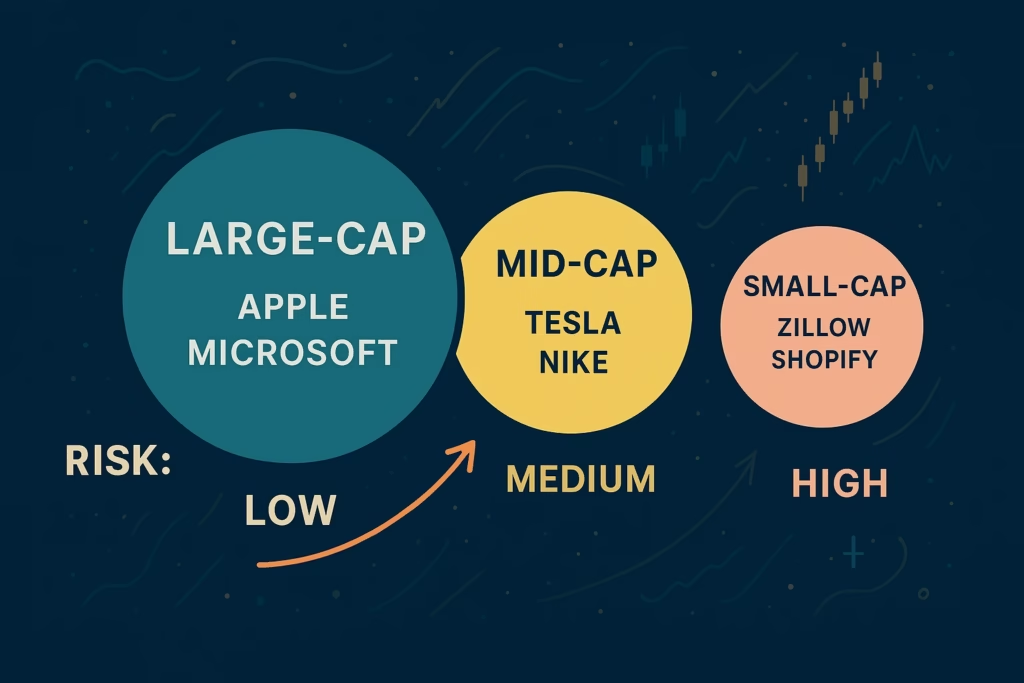
Size Matters: Large-Cap, Mid-Cap, Small-Cap
“Cap” means market capitalization, the total value of the company. This tells you how big a company is.
Large-Cap Stocks (Over $10 Billion)
These are the giants. Household names everyone knows.
Examples:
- Apple ($3.8 trillion market cap) – World’s most valuable company
- Microsoft ($3.1 trillion)
- Amazon ($2.1 trillion)
- Coca-Cola ($270 billion)
- McDonald’s ($210 billion)
What you get:
- Very stable (they’re too big to disappear overnight)
- Lower growth potential (already huge, hard to double in size)
- Survive economic downturns better
- Usually pay dividends
- Highly liquid (easy to buy/sell)
The reality: Apple growing from $3.8 trillion to $7.6 trillion is harder than a small company growing from $500 million to $1 billion. Big companies grow slower.
Who should buy large-cap?
- Beginners (safest place to start)
- Conservative investors
- Core of most portfolios
- Want lower risk
Mid-Cap Stocks ($2 Billion – $10 Billion)
The middle ground. Established but still growing.
Examples:
- Rivian ($12 billion) – Electric vehicle maker
- Robinhood ($8 billion) – Trading app
- Spotify ($75 billion) – Music streaming
- DoorDash ($70 billion) – Food delivery
What you get:
- More growth potential than large-caps
- More stable than small-caps
- Sweet spot of growth + stability
- Might start paying dividends
Who should buy mid-cap?
- Moderate risk tolerance
- Want balance of growth and stability
- 10-30% of a diversified portfolio
Small-Cap Stocks (Under $2 Billion)
The small guys trying to make it big.
Examples:
- Smaller regional banks
- New biotech companies
- Emerging tech startups
- Local restaurant chains expanding
(Specific names change rapidly as companies grow or fail)
What you get:
- Huge growth potential (can double or triple quickly)
- Huge risk (can also go to zero)
- Very volatile (price swings of 10-20% in a day)
- Usually no dividends
- Less liquid (harder to buy/sell large amounts)
The reality: For every small-cap that becomes the next Amazon, hundreds fail. But if you pick a winner early, the returns can be life-changing.
Who should buy small-cap?
- Experienced investors
- High risk tolerance
- Money you can afford to lose
- Small portion of portfolio (5-10% max)
Dividend Stocks: The Income Generators
Dividend stocks are companies that share their profits directly with shareholders through regular cash payments. Instead of reinvesting everything back into growth, they send you money every quarter.
Real Examples (October 2025):
Coca-Cola
- Pays $1.84 per share annually
- Stock price: ~$63
- Dividend yield: 2.9%
- Has increased dividends for 61 consecutive years!
AT&T
- Pays $1.11 per share annually
- Stock price: ~$22
- Dividend yield: 5%
- Reliable income for retirees
Johnson & Johnson
- Pays $4.76 per share annually
- Stock price: ~$159
- Dividend yield: 3%
- Dividend aristocrat (raised dividends 60+ years)
How It Works:
You buy 100 shares of Coca-Cola at $63 each = $6,300 investment
Each year, Coca-Cola pays $1.84 per share in dividends: 100 shares × $1.84 = $184 per year in passive income
You didn’t have to work for it. You just owned the stock.
The Math Over Time:
If you reinvest those dividends (buy more shares with the dividend money), your wealth compounds:
- Year 1: $6,300 investment, $184 dividend
- Year 5: $7,200 value, $210 dividend
- Year 10: $9,500 value, $275 dividend
- Year 20: $16,800 value, $490 dividend
Characteristics:
- Mature, established companies
- Stable businesses (utilities, consumer goods, telecom)
- Lower growth but steady income
- Less volatile
- Popular with retirees
Dividend Yield Formula: Annual Dividend ÷ Stock Price = Dividend Yield
Warning: If a dividend yield is over 8%, be suspicious. It might be unsustainable (the company might cut it later) or the stock price dropped for a reason.
Who should buy dividend stocks?
- Income-focused investors
- Retirees needing cash flow
- Conservative investors
- Want passive income
- 30-50% of portfolio for older investors
Blue-Chip Stocks: The Elite
Blue-chip stocks are the elite companies, the most established, most respected, most reliable stocks in the market. The name comes from poker, where blue chips are the most valuable.
Characteristics:
- Household names
- Decades of profitability
- Pay dividends consistently
- Survive recessions
- Leaders in their industries
- Large market caps
Examples:
- Microsoft – Tech giant, cloud computing leader
- Visa – Dominates payment processing
- Procter & Gamble – Makes Tide, Gillette, Pampers (brands you use every day)
- Walmart – Largest retailer in the world
- JPMorgan Chase – Largest U.S. bank
Why They’re Special:
During the 2008 financial crisis, many companies went bankrupt. Blue-chip companies survived. During COVID in 2020, many businesses closed forever. Blue-chips survived and thrived.
They’re not the most exciting investments, but they’re the backbone of strong portfolios.
Who should buy blue-chips?
- Everyone (should be core of most portfolios)
- Especially beginners
- 40-60% of most investment portfolios
- Want reliability over excitement
Sectors: Industry Groups
Stocks are also categorized by which industry they’re in. This matters because different sectors perform differently at different times.
11 Major Sectors
1. Technology (Apple, Microsoft, Google)
- High growth, high risk
- Drives innovation
- Does well during economic expansion
2. Healthcare (Pfizer, Johnson & Johnson, UnitedHealth)
- Defensive (people need medicine in good times and bad)
- Aging population = growing demand
- Relatively stable
3. Financials (JPMorgan, Bank of America, Visa)
- Banks, insurance, payments
- Tied to interest rates and economy
- Does well when economy grows
4. Consumer Discretionary (Amazon, Tesla, Nike, Starbucks)
- Things people WANT but don’t need
- Does well in strong economy
- Struggles in recessions
5. Consumer Staples (Coca-Cola, Walmart, Procter & Gamble)
- Things people NEED (food, household products)
- Defensive, stable even in recessions
- Lower growth but reliable
6. Energy (Exxon, Chevron)
- Oil and gas companies
- Tied to oil prices
- Cyclical (up and down with commodity prices)
7. Utilities (Electric, water, gas companies)
- Most defensive sector
- Everyone needs electricity
- Boring but stable, pays good dividends
8. Real Estate (REITs – Real Estate Investment Trusts)
- Own and rent properties
- Required to pay 90% of profits as dividends
- Tied to interest rates
9. Materials (Mining, chemicals, forestry)
- Raw materials for manufacturing
- Cyclical with economy
10. Industrials (Boeing, Caterpillar, FedEx)
- Manufacturing, aerospace, logistics
- Tied to economic growth
11. Communication Services (AT&T, Verizon, Meta/Facebook)
- Telecom and social media
- Mix of growth (social media) and stability (telecom)
Why Sectors Matter
2020-2021: Tech stocks soared (everyone working from home). Energy stocks crashed (nobody traveling).
2022: Energy stocks soared (oil prices jumped). Tech stocks crashed (interest rates rose).
Smart investors diversify across sectors. Don’t put everything in tech just because it’s exciting.
How to Choose: Matching Stocks to Your Goals
Let’s get practical. Which types should YOU buy?
Scenario 1: You’re 25, Just Started Working
Your goal: Grow wealth for retirement in 40 years
Your portfolio:
- 60% Growth stocks (Tesla, Nvidia, emerging tech)
- 30% Large-cap blue-chips (Apple, Microsoft)
- 10% International or small-cap for diversification
Why? You have time. You can handle volatility. Growth stocks historically return more over long periods.
Scenario 2: You’re 40, Established Career
Your goal: Balance growth with some stability
Your portfolio:
- 30% Growth stocks
- 40% Large-cap value/blue-chip (Microsoft, J&J, Coca-Cola)
- 20% Dividend stocks (steady income)
- 10% Bonds or international
Why? Still growth-focused but adding stability. Starting to build income sources.
Scenario 3: You’re 60, Planning Retirement in 5 Years
Your goal: Protect wealth, generate income
Your portfolio:
- 10% Growth stocks (small exposure for potential)
- 40% Blue-chip dividend stocks (Coca-Cola, AT&T, J&J)
- 30% Bonds
- 20% Cash equivalents
Why? Can’t afford big losses now. Need income. Stability over growth.
Scenario 4: You’re 30, Want Passive Income
Your goal: Build dividend income stream
Your portfolio:
- 50% High-quality dividend stocks (Coca-Cola, J&J, Procter & Gamble)
- 30% Dividend growth stocks (companies increasing dividends yearly)
- 20% Growth stocks (some capital appreciation)
Why? Focused on income now, but still young enough for some growth.
Common Mistakes to Avoid
Mistake 1
“This stock is $10, so I’ll buy 100 shares. That one is $500, too expensive!”
Price per share means nothing. A $10 stock isn’t “cheaper” than a $500 stock. Look at the company’s total value (market cap) and fundamentals.
Right approach: Look at whether the company is undervalued or overvalued based on earnings, growth, and industry position.
Mistake 2
“I’ll only buy growth stocks because they go up the most!”
When growth stocks fall (and they will), you’ll lose sleep. Diversification across types reduces risk.
Right approach: Mix growth with value and dividend stocks. Balance risk and reward.
Mistake 3
“I heard about this small biotech company. I’m putting everything into it!”
Small-cap stocks are risky. Most fail. Never bet everything on one stock, especially a small one.
Right approach: Small-caps should be 5-10% of your portfolio at most. Diversify even within small-caps.
Mistake 4
“Dividend stocks are boring. I want excitement!”
Boring makes money. Dividend stocks plus reinvestment is how many millionaires were made.
Right approach: Excitement is for entertainment. Investing should be “boring but profitable.”
Mistake 5
“I need to own every type of stock!”
Owning 1 stock from each category doesn’t mean you’re diversified.
Right approach: Own enough stocks within each type you choose. 20-30 quality stocks across sectors is better than 1 of each type.
Building Your Portfolio: A Simple Framework
Here’s a simple starting point for most beginners:
Foundation (40%) – Blue-chip large-caps
- Microsoft, Apple, Johnson & Johnson, Coca-Cola
- The stable core that weathers any storm
Growth Engine (30%) – Growth stocks
- Tesla, Nvidia, or growth sectors you believe in
- The part that accelerates your wealth
Income Layer (20%) – Dividend stocks
- AT&T, Procter & Gamble, Verizon
- Creates passive income
Opportunity Zone (10%) – Mid-cap or small-cap
- Higher risk, higher potential
- The “moonshot” portion
As you age: Shift more to foundation and income, less to growth and opportunity.
As you learn: Adjust based on what works for your risk tolerance and goals.
Why This Matters to You
Understanding stock types changes how you invest:
Before understanding: “I’ll buy whatever stock is going up today. My coworker made money on it!”
After understanding: “I’m 28, so I’ll focus on growth stocks for long-term wealth. I’ll add some blue-chip stocks for stability and maybe 10% in dividend stocks. Small-caps are too risky for me right now. I’ll build a balanced portfolio that matches my age and goals.”
This mindset shift is crucial. You’re no longer randomly picking stocks. You’re strategically building a portfolio that serves your specific situation.
Let’s Recap
Not all stocks are created equal. Understanding the different types helps you build the right portfolio.
- Growth stocks = High risk, high reward. Companies expanding rapidly. No dividends. Best for young investors
- Value stocks = Lower risk, steady returns. Undervalued established companies. Often pay dividends. Good for conservative investors
- Large-cap = Safest, most stable. Big established companies. Lower growth. Core of most portfolios
- Mid-cap = Balance of growth and stability. Emerging leaders. Moderate risk
- Small-cap = Highest risk, highest potential. Small companies growing fast. Can double or go to zero
- Dividend stocks = Provide passive income. Mature companies sharing profits. Popular with retirees
- Blue-chip stocks = Elite companies. Survive downturns. Backbone of strong portfolios
- Sectors = Industry groups. Diversify across sectors to reduce risk
- Match stocks to YOUR goals = Age, risk tolerance, and timeline determine what you should buy
What’s Next?
Now that you understand the different types of stocks, you’re ready to learn:
- How to analyze if a specific stock is worth buying
- Key metrics to evaluate stocks (P/E ratio, earnings, etc.)
- How to read financial statements
- Building a diversified portfolio
- When to buy and when to sell
Understanding stock types is like knowing what tools are in your toolbox. The next step is learning how to use them.
Remember: This is educational content only. All investing involves risk. Diversify your investments and never invest money you can’t afford to lose. Past performance doesn’t guarantee future results.